Germany Briefing
German national news, political and economic analysis, and expat life guides.
EN+KR
www.aec-berlin.euBlog
Insights and information about European market entry
Korea Briefing
Main Focus: Geopolitics, business & finance, K-Pop & K-culture trends in South Korea.
DE+EN
aec-berlin.eu/korea-briefing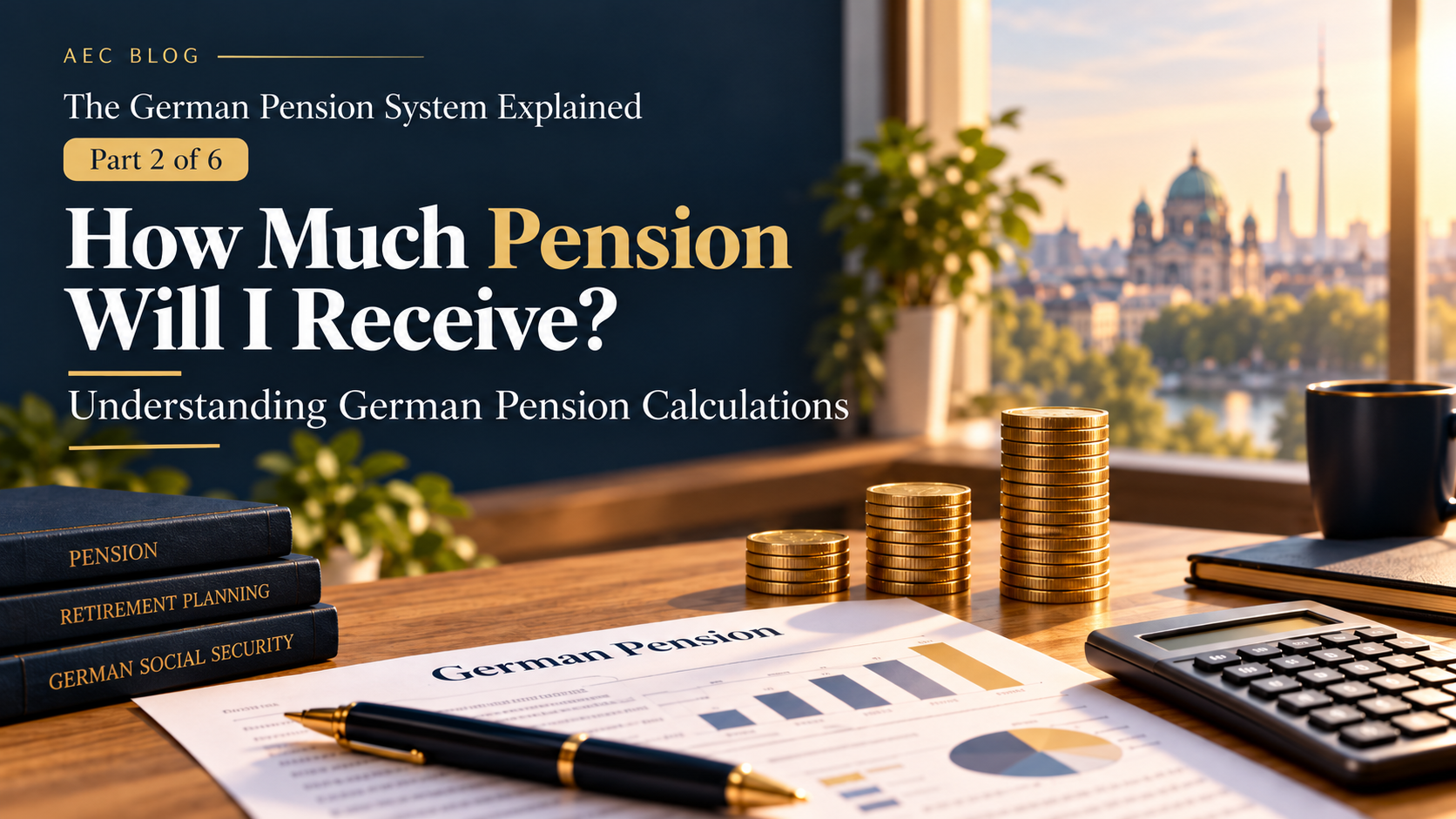
The German Pension System Explained - Part 2
Part 2 of 6: How Much Pension Will I Receive? In Part 1 of our series, we explained how Germany's statutory pension system works. Now we address a question that concerns almost every employee: How much pension will I receive after working in Germany for 20, 30 or 40 years? Your future pension is not simply the total amount of contributions you have paid. It depends primarily on your insured earnings, the pension points you accumulate and the age at which you start receiving your pension. Using the official pension figures for 2026, we explain how the calculation works.
October 18, 2026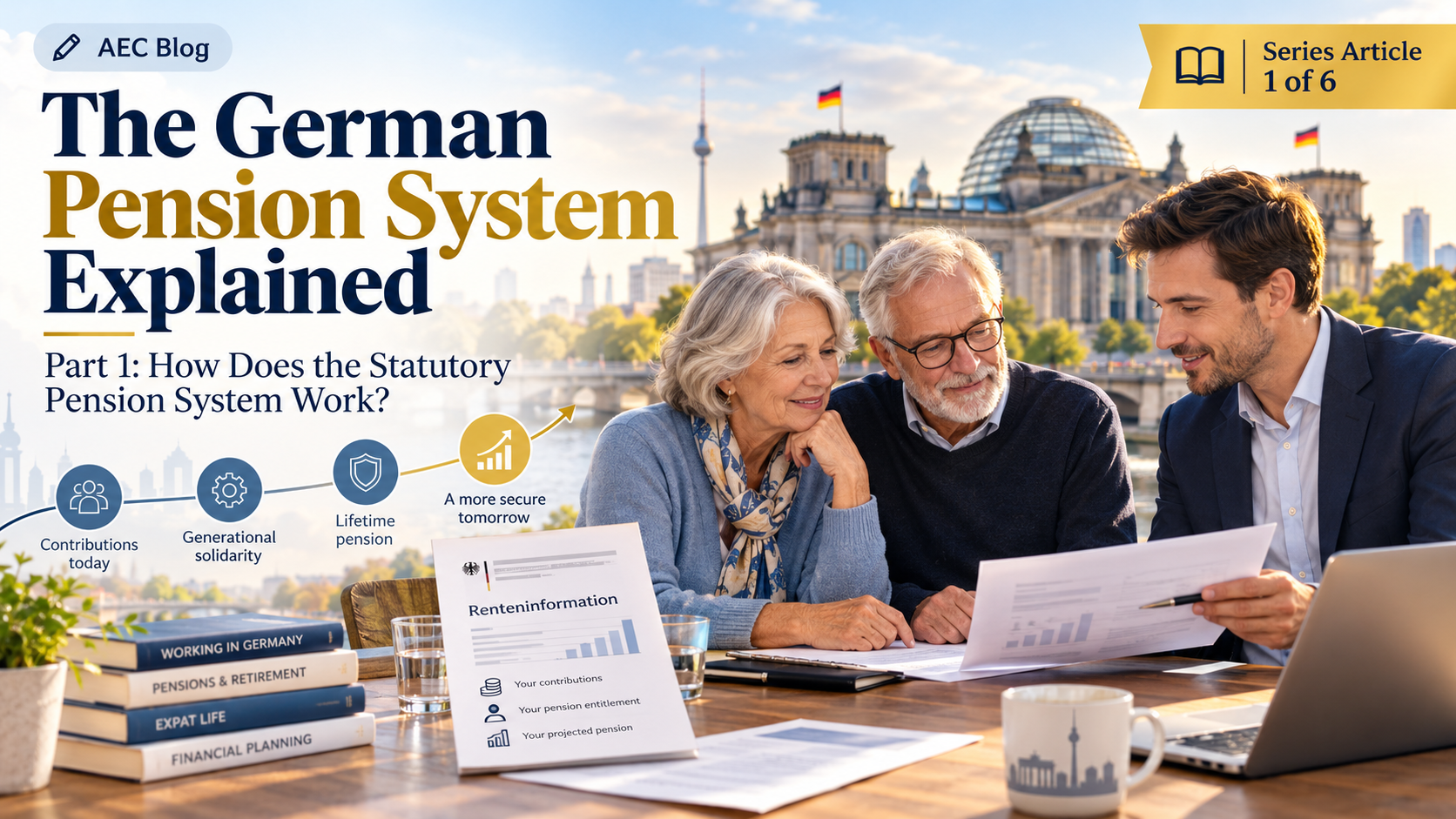
The German Pension System Explained - Part 1 of 6
Part 1: How Does the Statutory Pension System Work? For many people, the German pension system can initially be difficult to understand. Employees see a pension insurance deduction on their payslip every month, which can easily create the impression that this money is being saved specifically for their own future retirement. However, this is not how the German pension system works. Germany’s statutory pension insurance is primarily based on a pay-as-you-go system. The contributions paid today by employees and employers are largely used to finance the pensions of today’s retirees. This does not mean that your own contributions are lost. Your insurance periods and the amount of your insured income create individual pension entitlements that will later be used to calculate your pension.
October 17, 2026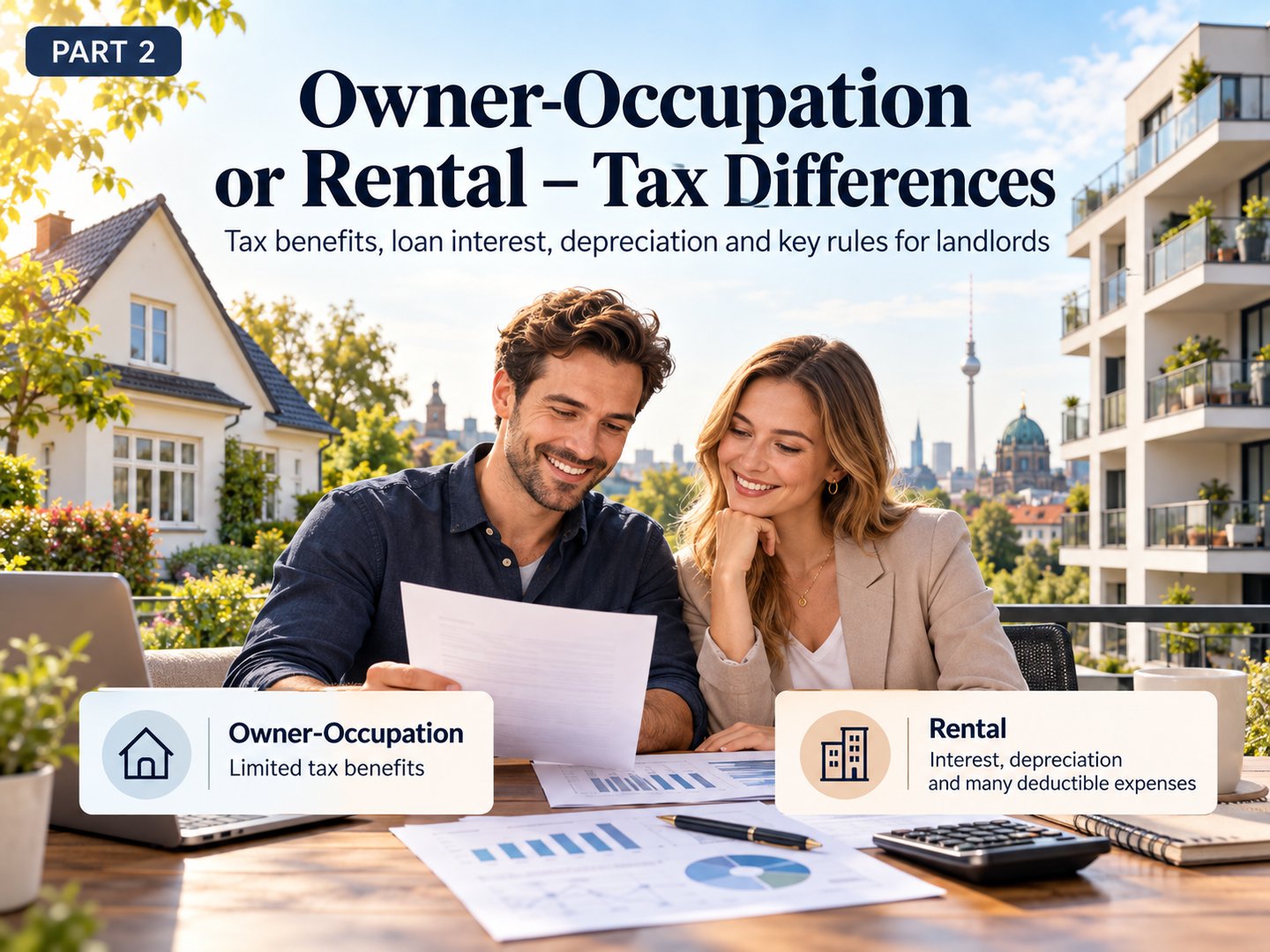
Article 2 - Owner-Occupation or Rental – Tax Differences
The tax treatment of a property depends substantially on how it is used. A property occupied by its owner is treated very differently from a property purchased for rental purposes. This distinction affects financing costs, depreciation, renovation expenses and many other items.
September 28, 2026
Article 1 - Property Purchased – What Costs Come Next?
Once the financing has been approved and the notarized purchase agreement has been signed, many buyers assume that the most important financial steps have been completed. In reality, a number of additional costs and payments still follow. These may include the real estate agent’s commission, real estate transfer tax, notary and land registry fees, financing-related costs, renovation expenses and the first ongoing costs of the property. It is therefore important not only to calculate the purchase price, but also to understand when the individual costs arise.
September 28, 2026
Buying Property in Berlin: What Additional Costs Should Buyers Expect?
In the previous article, we looked at the question of when real estate financing can actually be considered secure. But even if the bank is generally prepared to finance the purchase, another important question arises: How much of the buyer’s own money is actually required? This is because the purchase price is not the only cost involved in acquiring property. Additional acquisition costs can easily amount to several tens of thousands of euros. Let us use the following example: Purchase price of the property: €500,000 Bank financing: €450,000 Difference to the purchase price: €50,000 At first glance, one might therefore assume that the buyer only needs €50,000 in equity. That would be too simplistic.
September 20, 2026
Real Estate Financing: When Is the Financing Really Secure?
Buying a property is one of the biggest financial decisions most people will make in their lifetime. This is why an important question arises for both buyers and sellers: When can the financing of a property purchase be considered truly secure? An initial financing confirmation from a bank is helpful, but it does not necessarily mean that the financing has been finally approved. Before making a binding credit decision, the bank will generally examine both the financial situation of the buyer and the property itself. The more complete the documentation, the more efficiently and reliably the bank can assess the financing.
September 20, 2026
Inheriting a Company in Germany
German Inheritance Tax on GmbH Shares, Family Businesses and Business Succession Anyone who inherits a house, a securities portfolio or other private assets in Germany will usually have to consider German inheritance tax relatively quickly. The situation can be very different when a business is inherited. German tax law is designed, in principle, to avoid a situation in which a functioning company has to be sold or broken up simply because the next generation cannot finance the inheritance tax. For this reason, substantial tax relief is available for qualifying business assets. Under certain conditions, 85% or even 100% of qualifying business assets may be exempt from German inheritance tax. However, this does not mean that every inherited company automatically remains tax-free.
September 15, 2026
Buying a Home in Germany with Money from Abroad: When Can Gift Tax Become an Issue?
For many foreigners living in Germany, buying a house or apartment means transferring a substantial amount of money from abroad to Germany. This may be personal savings accumulated before moving to Germany, proceeds from assets sold abroad, or financial support from parents or other family members. From a German tax perspective, however, there is a very important difference: Are you transferring your own money – or are you receiving somebody else’s money?
August 30, 2026
10 Common Tax Mistakes Foreign Business Owners Make in Germany – and How to Avoid Them
Running a business in Germany can be challenging, especially if you are not familiar with the German tax system. Many foreign business owners already have business experience. The difficulty is often not running the business itself, but understanding German tax terminology, administrative procedures, deadlines and documentation requirements. And these mistakes are certainly not limited to foreign entrepreneurs. German business owners can make them as well. However, language barriers and an unfamiliar tax system can make certain issues easier to overlook. The good news is that many problems can be prevented through good bookkeeping, proper documentation and a basic understanding of the German tax system. This article explains ten common mistakes from a practical bookkeeping perspective – and what business owners can do to avoid them.
August 25, 2026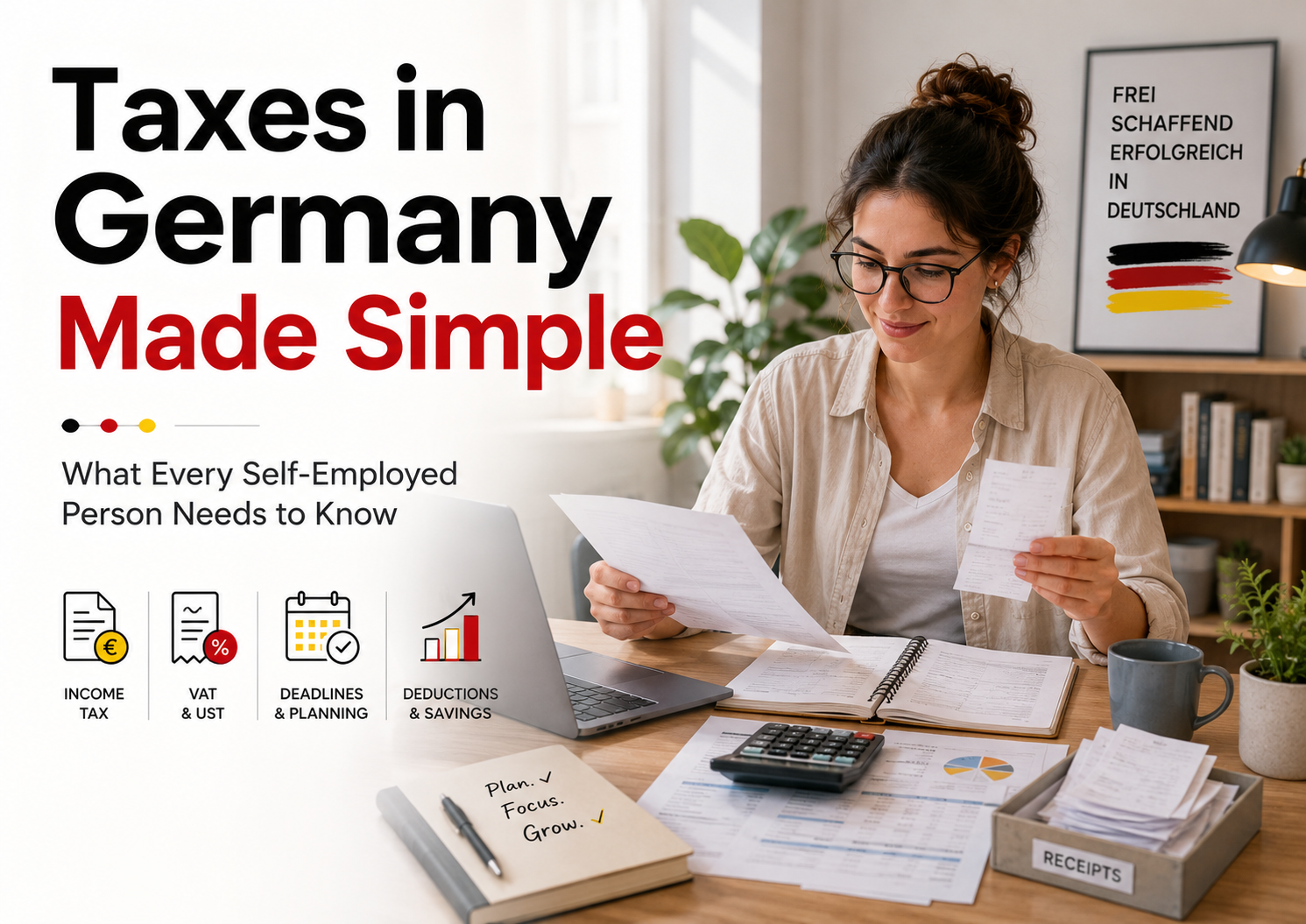
Taxes in Germany Made Simple: What Every Self-Employed Person Needs to Know
If you are self-employed or own a business in Germany, you will quickly come across many new terms: VAT, income tax, trade tax, advance tax payments, tax assessments and business expenses. For people who have had little experience with the German tax system, this can initially seem complicated. This article is therefore not intended to replace individual tax advice. Instead, it explains the most important basics in simple and practical language. It is particularly aimed at foreign self-employed people and business owners who want to better understand how the German tax system works.
August 24, 2026
Permanent Settlement Permit and Stays Abroad
What Actually Happens When You Exceed the 6-Month Limit A Permanent Settlement Permit (Niederlassungserlaubnis) grants its holders a permanent right of residence in Germany. However, the German Residence Act (Aufenthaltsgesetz – AufenthG) sets clear deadlines regarding how long you may remain outside of Germany. If the statutory re-entry deadline of 6 months is exceeded without prior approval from the authorities, severe legal consequences often follow upon returning to Germany or during subsequent appointments with government agencies.
August 16, 2026
New Tax Proposals: Mandatory Cash Registers, Digital Tax Notices and Greater Tax Scrutiny
The German government and the Federal Ministry of Finance introduced several tax and digitalisation proposals during the summer of 2026. Many of these measures are still going through the legislative process and may therefore be amended. Nevertheless, the proposals already indicate what self-employed people, companies, employees and families in Germany may face in the future. The following overview reflects the planning status as of 12 August 2026. Some of the measures described are not yet applicable law.
August 12, 2026
The Right Structure Must Be in Place Before the Property Purchase - German Real Estate Investment Series 10
Why ownership, financing, taxation, exit planning and insurance should be decided before the notary appointment International investors often begin with the property. They identify an office building, logistics facility, hotel or development site, negotiate the price and then consider which company should become the purchaser. For a substantial German real estate investment, this order can be risky. The investor should first determine who will own the property, how the acquisition will be financed, where liabilities will be located, how profits will be distributed and how the investment may eventually be sold. Once the purchase agreement has been notarised and the property has been transferred, correcting an unsuitable structure can become expensive or, in some cases, commercially impractical. The final article in this series therefore begins with a simple principle: The property may be the investment—but the structure determines how that investment will function.
July 27, 2026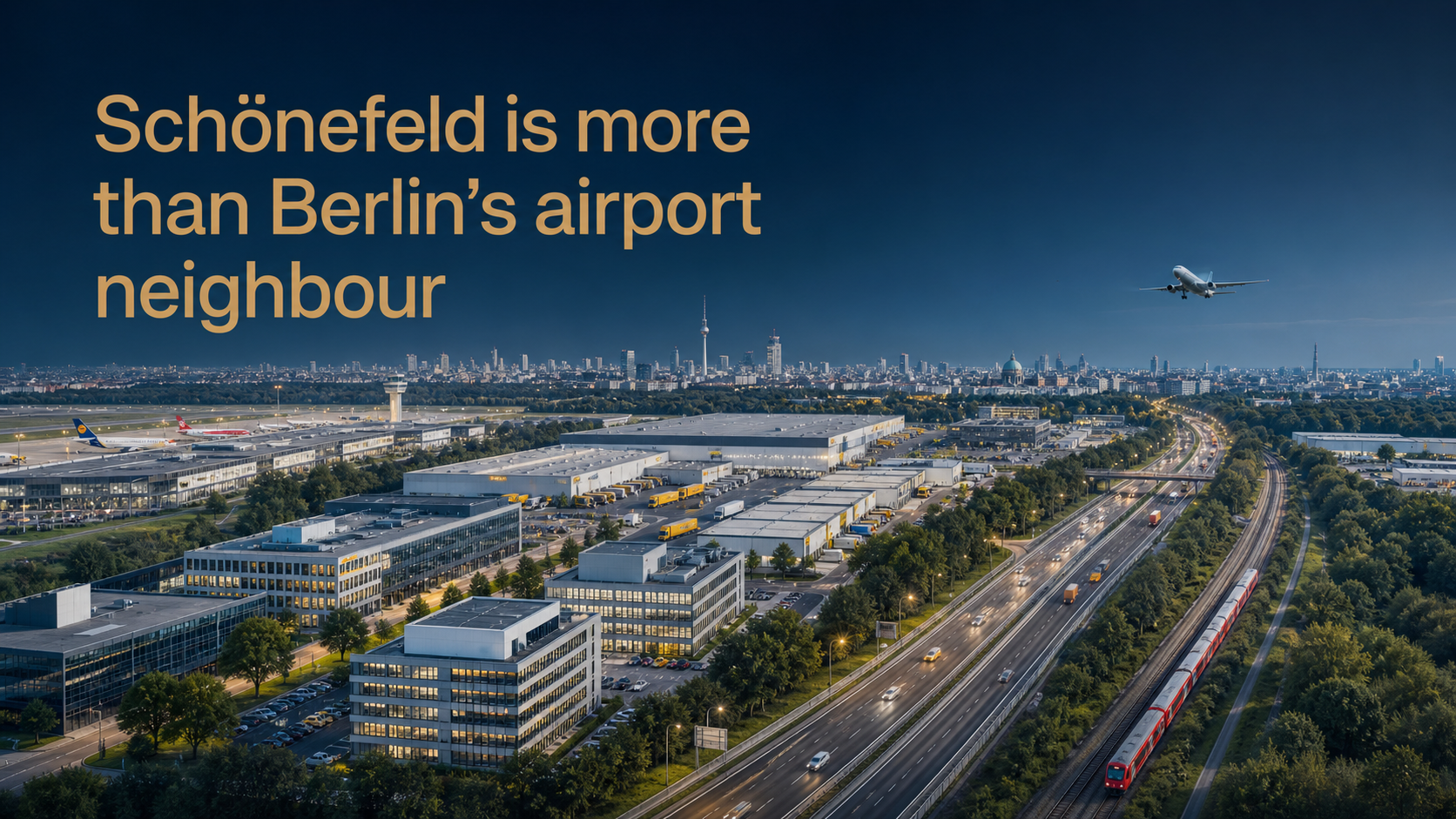
Schönefeld as a Business Location for International Real Estate Investors - German Real Estate Investment Series 09
Trade tax, the BER airport region and the limits of a purely tax-driven registered office Schönefeld is usually associated with Berlin Brandenburg Airport. For international real estate investors, however, the municipality may also be interesting as a location for holding companies, property companies and operating businesses. Its appeal is based on two factors: its position directly next to Berlin and its comparatively low trade tax multiplier. Nevertheless, establishing a company in Schönefeld solely to obtain a lower tax rate can create problems if the company has no genuine business presence there. The decisive question is therefore not simply: Where should the company be registered? It is: Where will the company actually be managed and conduct its activities?
July 27, 2026
Berlin and Brandenburg as a Real Estate Investment Region - German Real Estate Investment Series 08
Demand, infrastructure, micro-locations and long-term development potential Berlin and Brandenburg form one interconnected metropolitan region, but their real estate markets are far from uniform. Berlin offers the economic strength, international profile and density of a major European capital. The surrounding parts of Brandenburg provide additional land, commercial development areas, logistics locations and expanding residential communities. For international investors, this combination can create attractive opportunities. However, success depends less on the general reputation of Berlin and more on selecting the right property, use concept and micro-location.
July 27, 2026
Asset Deal or Share Deal? - German Real Estate Investment Series 07
Buying German Real Estate Directly or Through a Company When acquiring commercial property in Germany, international investors may encounter two fundamentally different transaction structures: the asset deal and the share deal. In an asset deal, the investor purchases the property itself. In a share deal, the investor acquires shares in the company that owns the property. Both structures can be suitable. However, they differ significantly in terms of ownership transfer, liability, financing, due diligence and real estate transfer tax. The appropriate structure should therefore be determined before negotiations become binding.
July 26, 2026
The German Real Estate Holding Company - German Real Estate Investment Series 06
How a Holding GmbH and separate property companies can help international investors manage multiple German real estate investments This article provides general information for international investors. The appropriate corporate, financing and tax structure depends on the properties, investors, financing arrangements and intended exit strategy. When does a real estate holding structure make sense? An international investor planning to acquire only one German property may not need a complete holding structure. In such a case, a single German property company can sometimes be sufficient.
July 26, 2026
Discretion in German Real Estate Investments - German Real Estate Investment Series 05
Trust arrangements, silent partnerships and corporate structures—without unlawfully concealing beneficial owners This article provides general information for international investors. Legal, tax and transparency consequences depend on the individual ownership and control structure.
July 25, 2026
The German Asset-Managing Real Estate GmbH - German Real Estate Investment Series 04
Corporate taxation, the extended trade tax reduction and activities that may jeopardise it For an international investor building a German commercial property portfolio, the asset-managing real estate GmbH can be an important investment vehicle. It is commonly referred to in German as a vermögensverwaltende Immobilien-GmbH or VV-GmbH. However, it is not a separate legal form. It is an ordinary German limited liability company whose activities are structured around holding, leasing and managing its own real estate. Its main tax attraction is the potential application of the extended trade tax reduction. If all statutory conditions are satisfied, qualifying income from the management and use of the company’s own real estate can be removed from the trade tax base. The company remains subject to corporate income tax and the solidarity surcharge. This advantage comes with strict conditions. An apparently minor additional activity can affect the company’s eligibility and create an unexpected trade tax burden.
July 24, 2026
Investing Personally or Through a Foreign Company? - German Real Estate Investment Series 03
A financially strong international entrepreneur planning a substantial German commercial property portfolio can either own the German Real Estate Holding GmbH personally or through an existing foreign company. The foreign investor may own 100 per cent of the German holding. German law does not generally require a local shareholder. However, if a German partner contributes valuable market knowledge, management, business relationships or capital, the investor may voluntarily grant that partner a minority interest—for example, 10 to 20 per cent. This percentage is only an example. A partner working on the entire portfolio may participate in the holding, while a partner responsible for one project may be better placed in the relevant project company.
July 23, 2026
Can Foreigners Buy Property in Germany? - German Real Estate Investment Series 02
Market access, the notary, the land register, proof of funds, anti-money-laundering checks and sanctions Germany is generally open to international property investors. Foreign individuals and foreign companies can normally acquire apartments, houses, commercial buildings and development sites without German citizenship or permanent residence. This distinguishes Germany from countries that impose special quotas, residency requirements or general approval procedures on foreign property buyers. Nevertheless, access to the market does not mean that every transaction is easy. International investors must pass identity, beneficial-ownership, source-of-funds and sanctions checks. They must also understand the role of the German notary, the land register and the banking system.
July 22, 2026
Germany as a Real Estate Market for International Investors - German Real Estate Investment Series 01
Why the Market Remains Relevant Despite Economic Uncertainty Germany is going through a period of economic and political uncertainty. Higher financing costs, rising construction expenses, regulatory requirements and weaker economic growth have also affected its real estate market. Some domestic investors are reducing their portfolios, postponing projects or exploring opportunities outside Germany. International investors, however, do not necessarily have to interpret this development as a reason to avoid the German market. When domestic market participants become more cautious, new entry opportunities may emerge. This does not mean that every German property is inexpensive or that the market has reached its final bottom. It means that sellers, developers and financing banks must once again pay closer attention to pricing, cash flow, equity and transaction structures. For internationally diversified and long-term investors, German real estate may therefore remain a relevant component of a broader investment strategy.
July 22, 2026
Which Comes First: The Residence Permit or Health Insurance?
How a Canadian entrepreneur and his family became trapped between German immigration rules and private health insurance The people and company in this article are fictional. The story combines situations that international entrepreneurs may encounter when relocating to Germany. Insurance premiums, admission requirements and immigration decisions always depend on the individual case.
July 15, 2026
The Second Barrier to Health Insurance in Germany
A credit card debt from 2014, a SCHUFA record and two children still waiting for coverage This is the continuation of Emma Collins’s story. Emma moved from Canada to Germany with her two school-age children after accepting a position with the German subsidiary of a Canadian company. Her husband, Daniel Brooks, remained in Canada to continue managing the family’s business interests. Emma became a member of Germany’s statutory health insurance system. However, her children were refused free family insurance because Daniel was not a member of a German statutory health insurance fund and earned more than Emma while continuing to work in Canada. An attempt to enrol the children as voluntary members of the German public system was also unsuccessful. Emma therefore applied for private health insurance for both children. She believed that this would finally resolve the problem. Instead, the family encountered a second and entirely unexpected barrier.
July 15, 2026
When Children Cannot Join a Parent’s German Public Health Insurance
A hidden risk for international families moving to Germany Many international families do not move to Germany together at the same time. One parent may take up employment in Germany while the other continues working in the family’s home country. The children may move with the parent coming to Germany, especially when education, an international school or a new professional opportunity is involved. This arrangement can work well for the family. However, it can create an unexpected problem under German health insurance law. The following fictional example illustrates why the children’s health insurance should be clarified before applying for visas and travelling to Germany.
July 15, 2026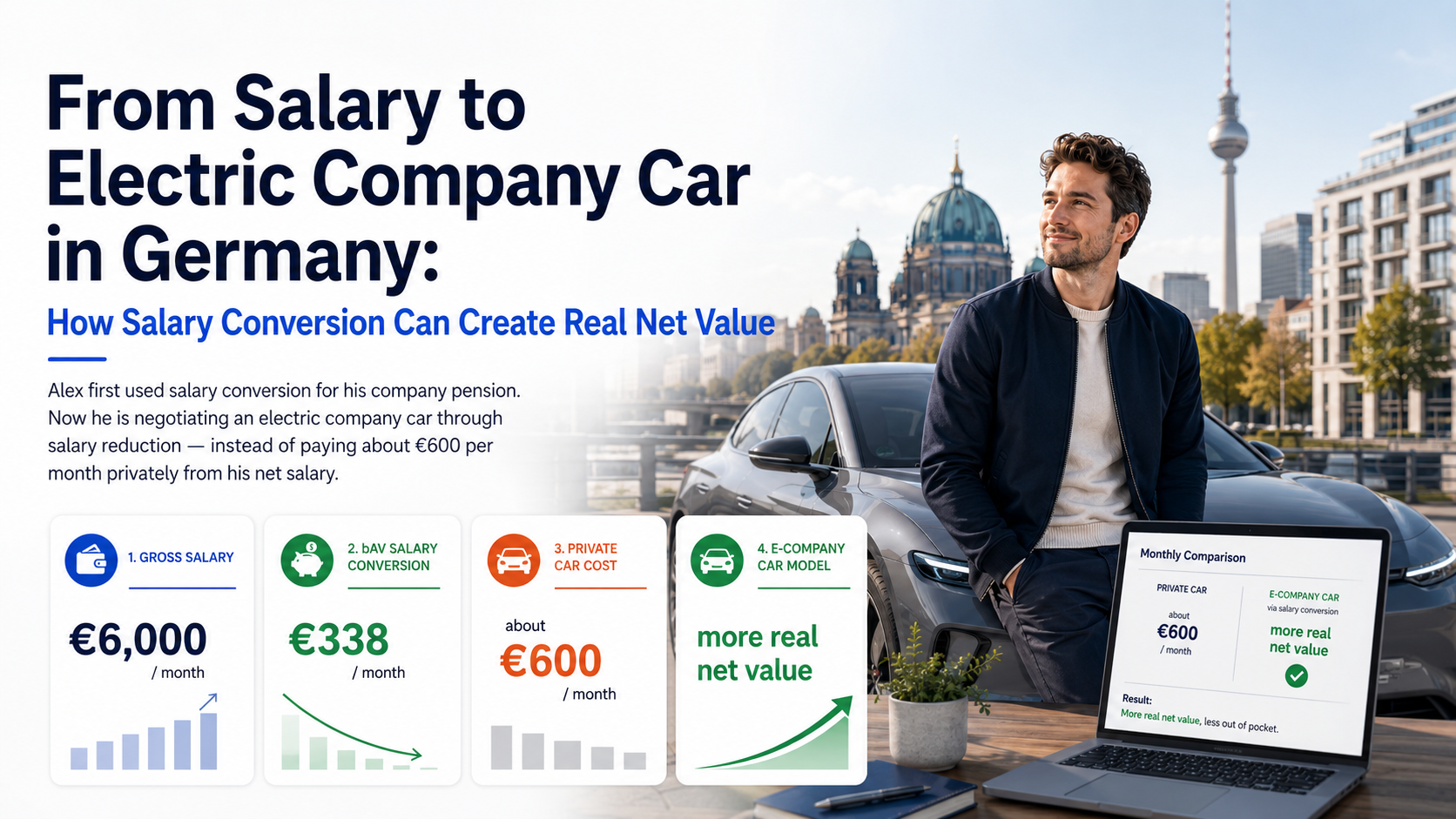
From Salary to Electric Company Car – How Salary Conversion Can Create Real Net Value
Alex is 30 years old, lives in Berlin, and works as an IT engineer for a German GmbH. As a regular employee, his salary is subject to normal German payroll tax and social security contributions. Alex earns a monthly gross salary of €6,000. He is single, has no children, is covered by statutory health insurance, and is in tax class 1. In the first step, Alex already used a classic form of salary conversion in Germany: he converts €338 per month of his gross salary into a company pension scheme, known as betriebliche Altersvorsorge or bAV.
June 4, 2026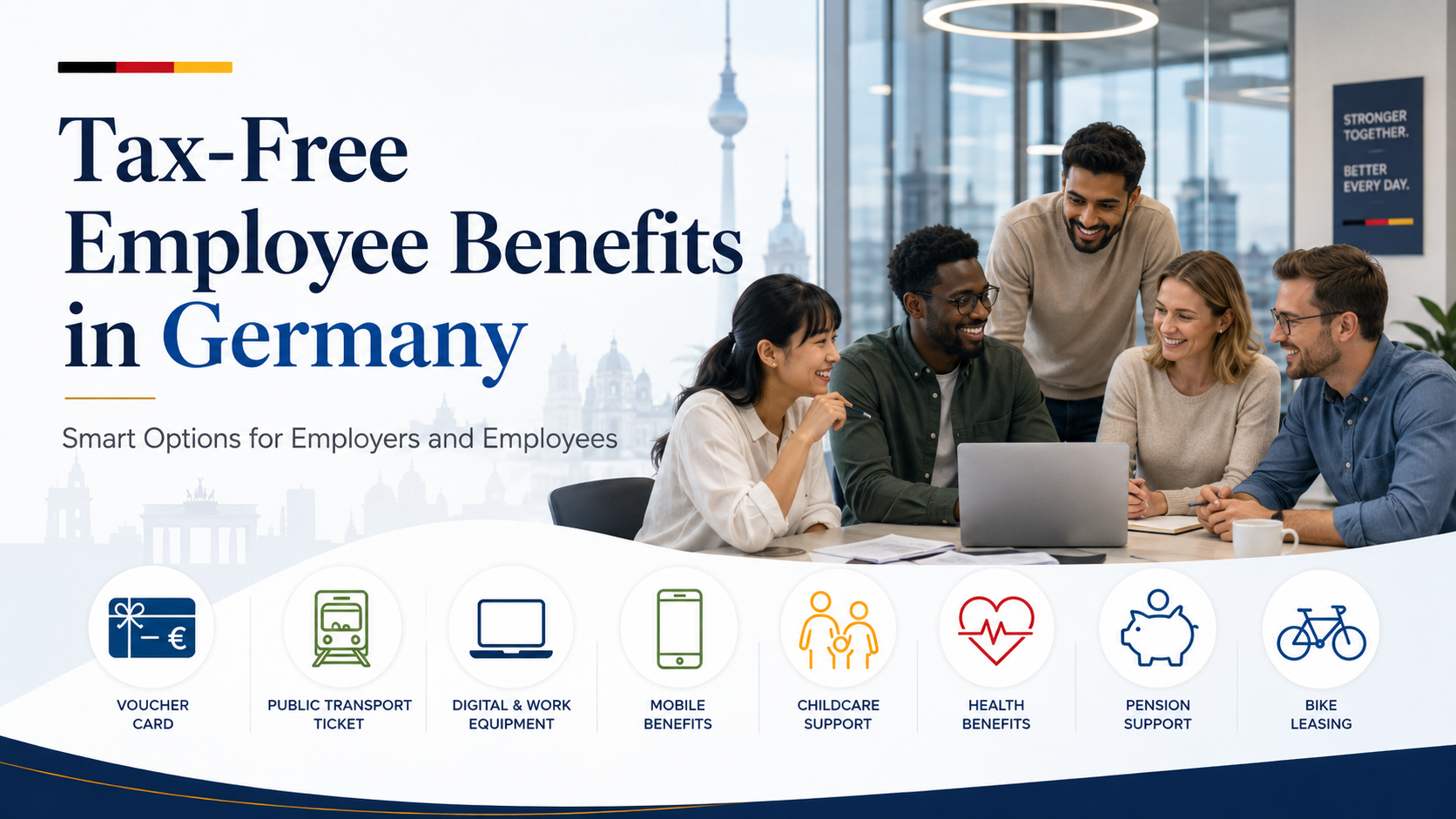
Tax-Free Employee Benefits in Germany: How Employers Can Offer More Net Value
Many companies in Germany want to reward their employees better, but a normal salary increase is often expensive. The employer pays additional payroll costs, while the employee may lose a significant part of the increase through wage tax and social security contributions. This is why tax-free employee benefits are so interesting in Germany. Used correctly, they allow employers to offer real additional value without simply increasing gross salary.
May 28, 2026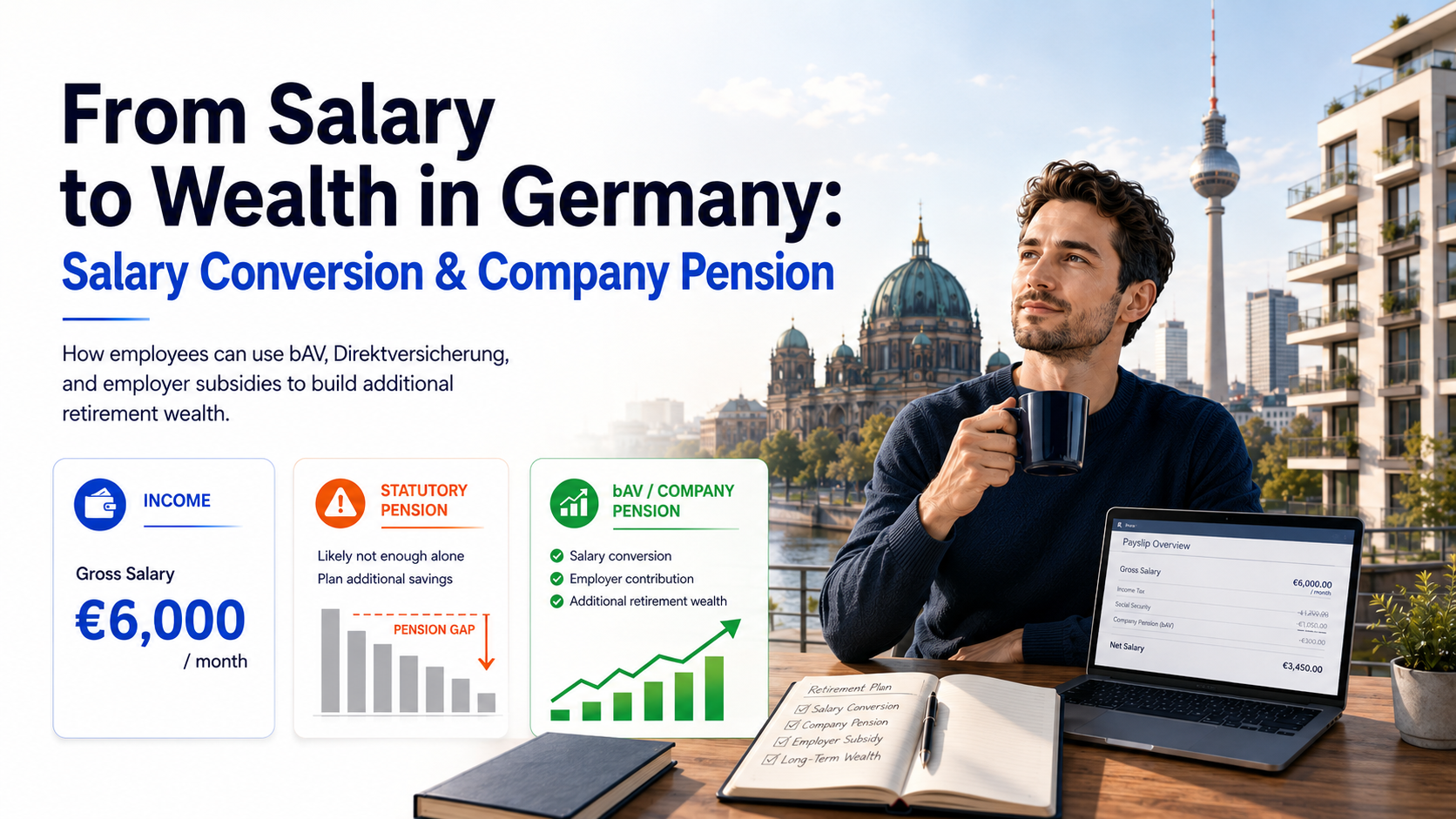
From Salary to Wealth in Germany: Salary Conversion and Company Pension
How employees can use bAV, Direktversicherung, and employer subsidies to build additional retirement wealth Alex is 30 years old, single, and works as an IT engineer in Germany. He earns €6,000 gross per month, or €72,000 gross per year. He has a good job, a stable salary, and strong career prospects. But he also understands one important truth: A salary is not the same as wealth. A salary pays monthly bills. Wealth is built when part of that income is systematically converted into assets.
May 23, 2026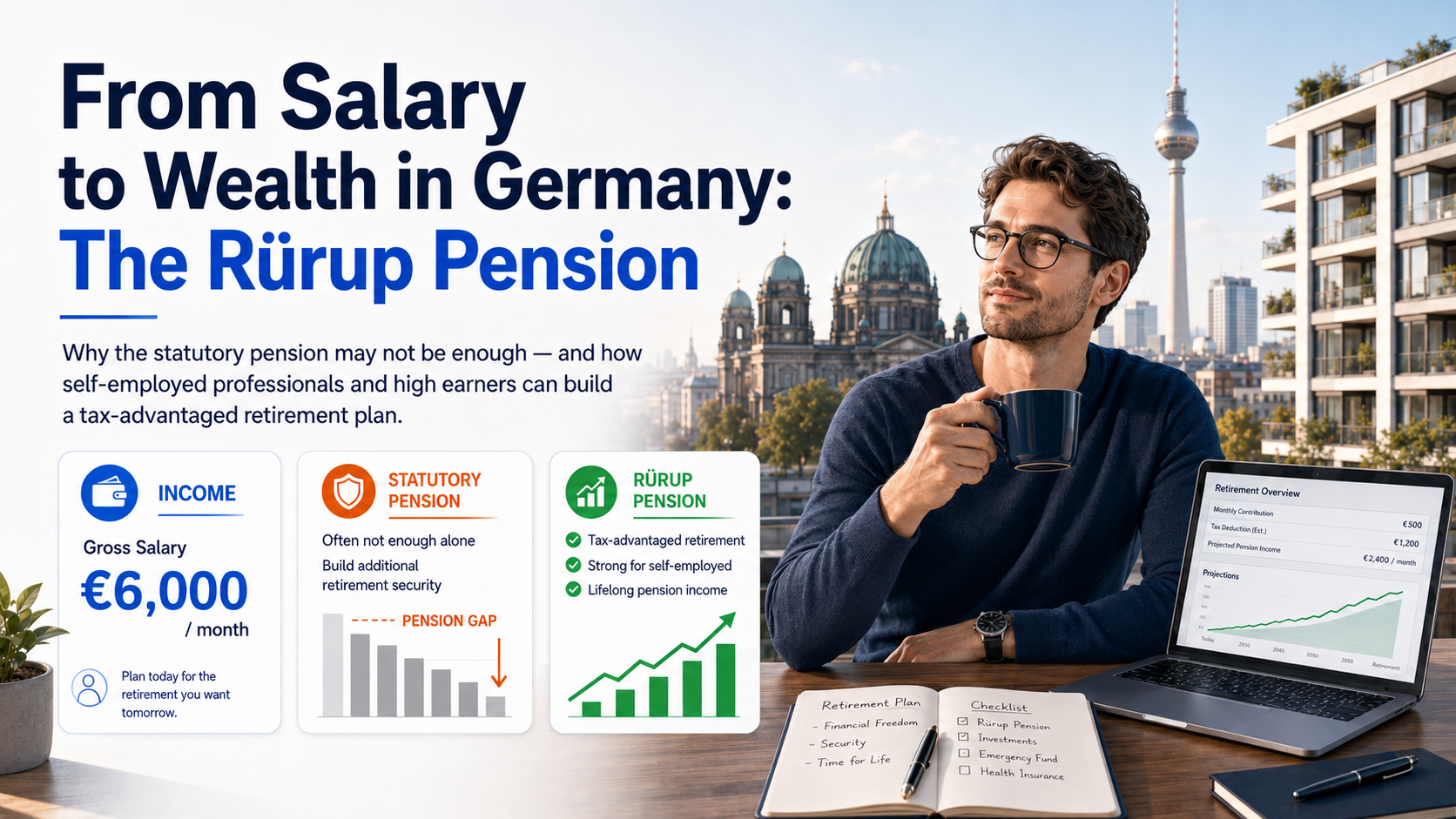
From Salary to Wealth in Germany: The Rürup Pension
Why the statutory pension may not be enough — and how self-employed professionals and high earners can build a tax-advantaged retirement plan Alex is 30 years old, single, and works as an IT engineer in Germany. He earns a gross salary of €6,000 per month, or €72,000 per year. At first glance, this looks like a strong income. And it is. But Alex quickly realizes that earning a good salary in Germany does not automatically mean building wealth.
May 23, 2026
Germany’s EU Blue Card Guide
One of the Most Realistic Pathways for Highly Skilled Professionals to Live and Work in Europe Europe is currently facing a significant shortage of skilled professionals. In particular, sectors such as IT, engineering, semiconductors, healthcare, logistics, research, and industrial technology are actively searching for qualified international talent. To address this challenge, the European Union introduced the EU Blue Card, a residence and work permit designed for highly qualified professionals from non-EU countries. The EU Blue Card was first introduced at the EU level in 2009. Its purpose is to make it easier for skilled professionals from third countries to work, live, and potentially settle long-term in Europe.
May 16, 2026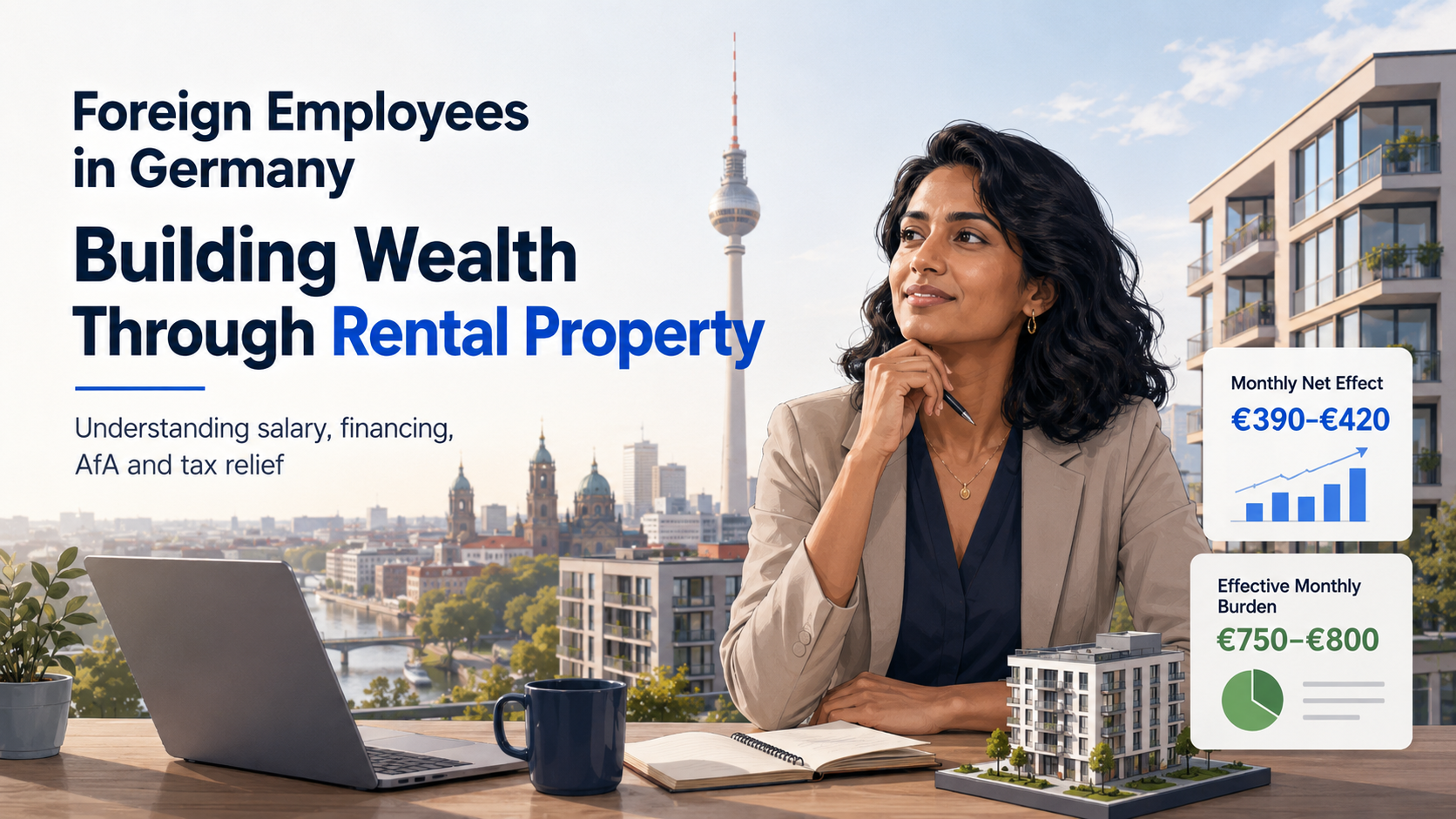
Why a Good Salary in Germany Does Not Automatically Build Wealth
Many foreign professionals in Germany know the feeling. You have a good job. You earn a solid salary. You work hard. You pay your bills on time. And still, at the end of the month, you ask yourself: “I earn quite well — so why am I not really building wealth?”
May 12, 2026
International Private Schools in Germany: A Guide for International Families and Expat Employees
For many international families moving to Germany, education is one of the most important planning issues. This is especially true if children do not yet speak German, if the family will stay only for a few years, or if the child may later move to another country for school or university. In such cases, an international school or bilingual private school can be a practical alternative to the German public school system.
May 9, 2026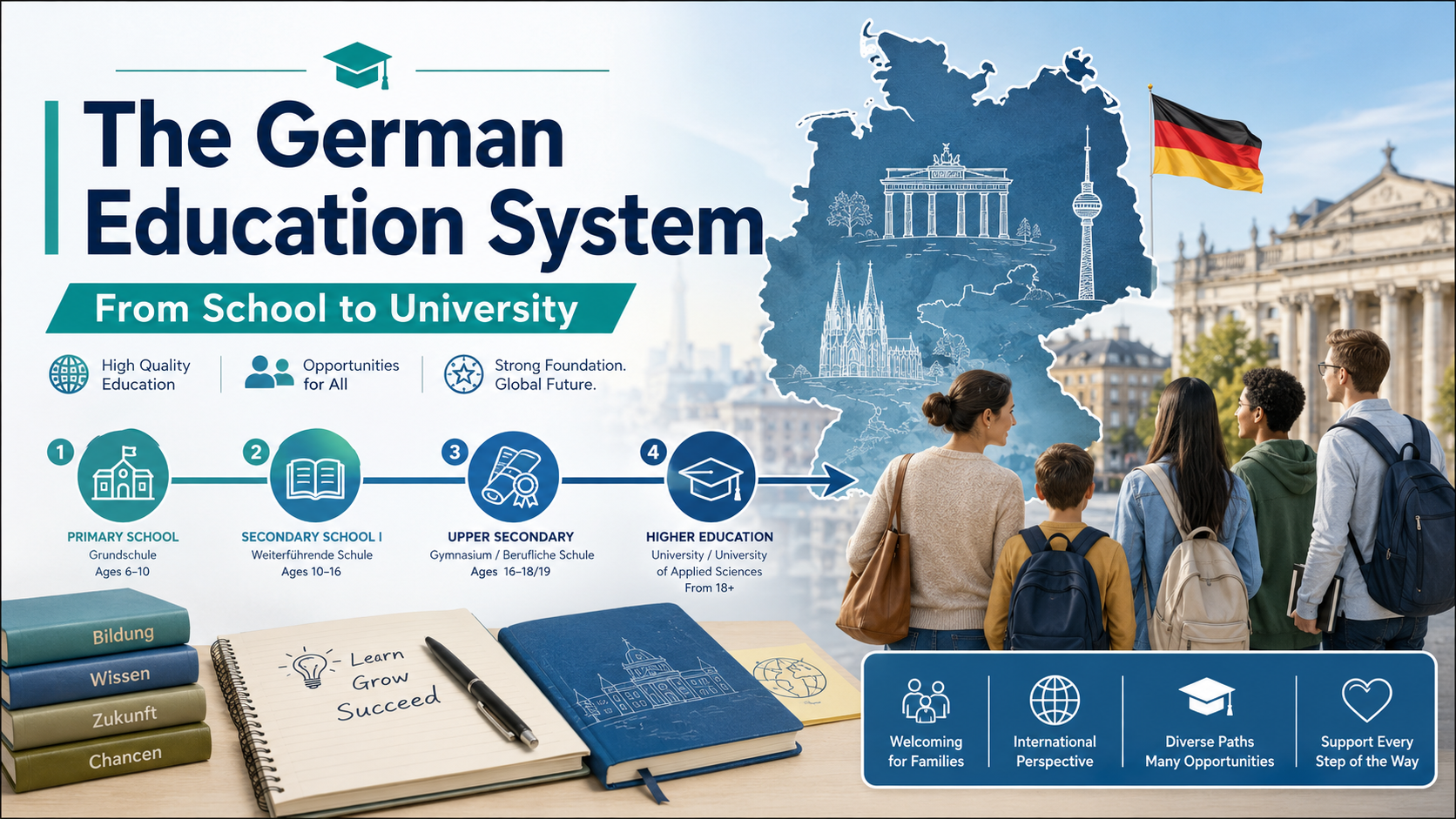
Understanding the German Education System: A Guide for International Families
For many international families, Germany is attractive because education is often much more affordable than in countries such as the United States, the United Kingdom, or many parts of Asia. Public schools are generally free, and public universities usually charge only modest semester fees instead of high tuition. But Germany should not be understood simply as a “low-cost education country.” The German education system is different in its structure, culture, and expectations. It gives students more freedom — but also expects more independence
May 7, 2026
Investing in a German GmbH
A Practical Guide for International Investors Germany is one of the most attractive business and investment locations in Europe. International investors are increasingly looking at German companies, especially in sectors such as: • Real estate • Hotels and hospitality • Restaurants and food service • Logistics and trade • IT and startups • Manufacturing • Recruitment and staffing services • Cross-border European business platforms Germany offers: • a stable legal system, • strong banking infrastructure, • high business credibility, • and direct access to the European Union market. However, investing in a German company — especially a GmbH — differs significantly from investment structures commonly used in other countries. Understanding these differences is essential before entering the German market.
May 6, 2026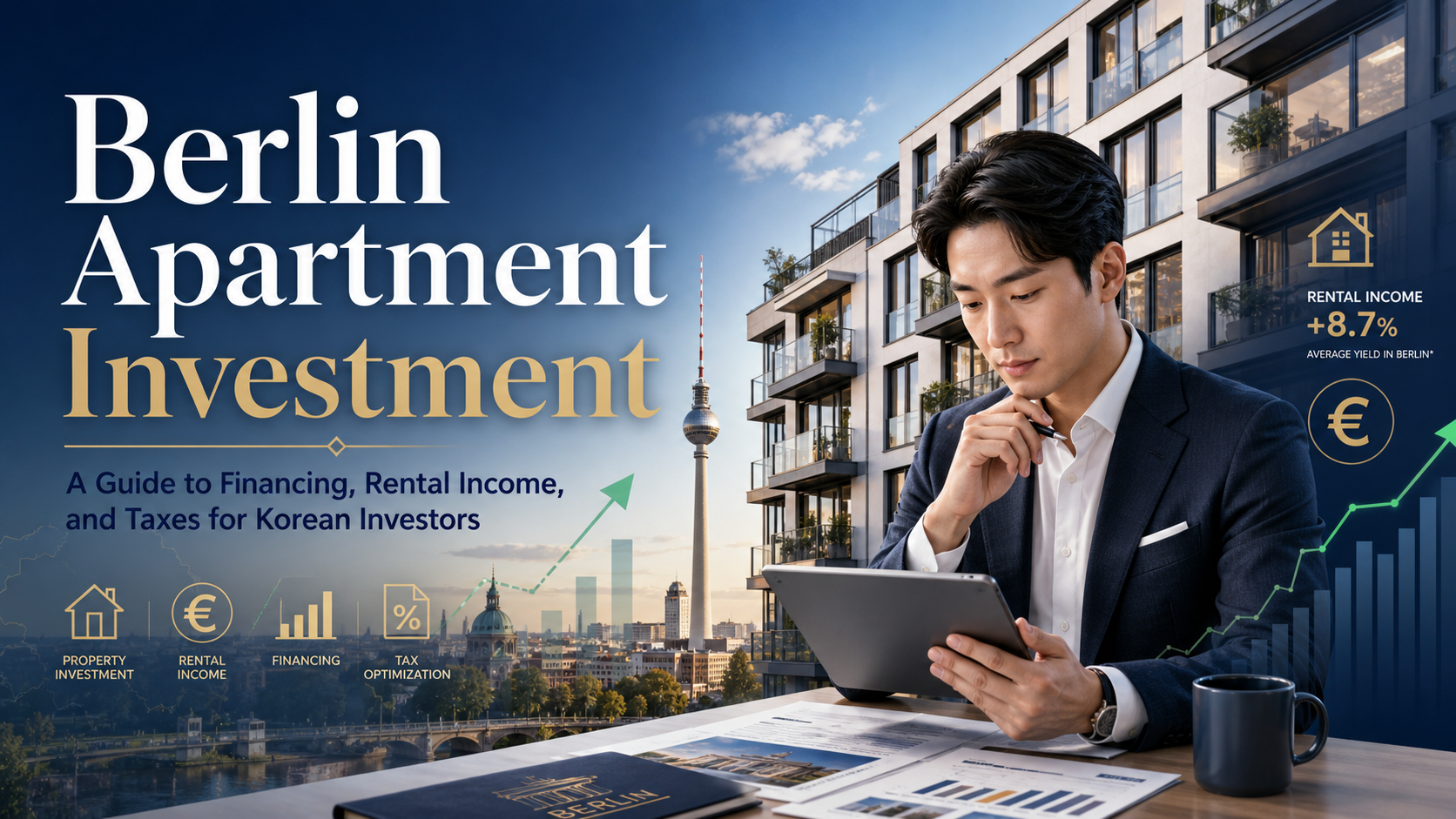
Buying an Apartment in Berlin as a Rental Investment: Financing, Rental Income, Depreciation and Taxes
Rental property investment in Germany: it is not just about rent Many international investors look at German property and ask a simple question: If the rent covers the loan interest, is it a good investment? That is a good starting point, but it is not enough. In Germany, a rental property investment should be assessed through several layers: financing, rental income, non-recoverable costs, depreciation, tax effects, repair risks and the exit strategy.
May 3, 2026
Buying an Owner-Occupied Apartment in Berlin: What International Families Should Know
For international buyers, the main challenge is usually not whether they are legally allowed to buy property in Germany. Foreign buyers can generally purchase real estate in Germany. The more important question is whether a bank is willing to finance the purchase, and under what conditions. Many international families living in Berlin eventually face the same question: Should we continue renting, or should we buy our own apartment? For a family of four, this question is especially important. Larger rental apartments in Berlin can be expensive, difficult to find, and uncertain in the long term. A suitable owner-occupied apartment can provide stability: children can stay in the same area, the family has more security, and part of the monthly housing cost goes into building equity instead of simply paying rent.
May 3, 2026
The Mandarin Duck of Neuer See
Berlin’s Quiet Answer to New York’s “Hot Duck” On May 1st, Berlin’s spring already felt like summer. The sky was clear, the trees of the Tiergarten were full of fresh green leaves, and people seemed to be drawn outdoors as if they had been waiting for this light for months. Parks, lakes and cafés were suddenly full of life. That day, following the recommendation of a German friend who was visiting Berlin, I went together with that friend to Café am Neuen See, near the Spanish Embassy in the Tiergarten. The café is located by Neuer See, a small lake whose name simply means “New Lake.” Although it is called a café, international readers may understand it better as a kind of Berlin freestyle beer garden.
May 2, 2026
Do foreign companies in Germany really just need a tax advisor for everything?
Many international companies entering the German market start with a simple assumption: “As long as we have a German tax advisor, everything related to accounting and taxes is taken care of.” To a certain extent, this is true.
April 30, 2026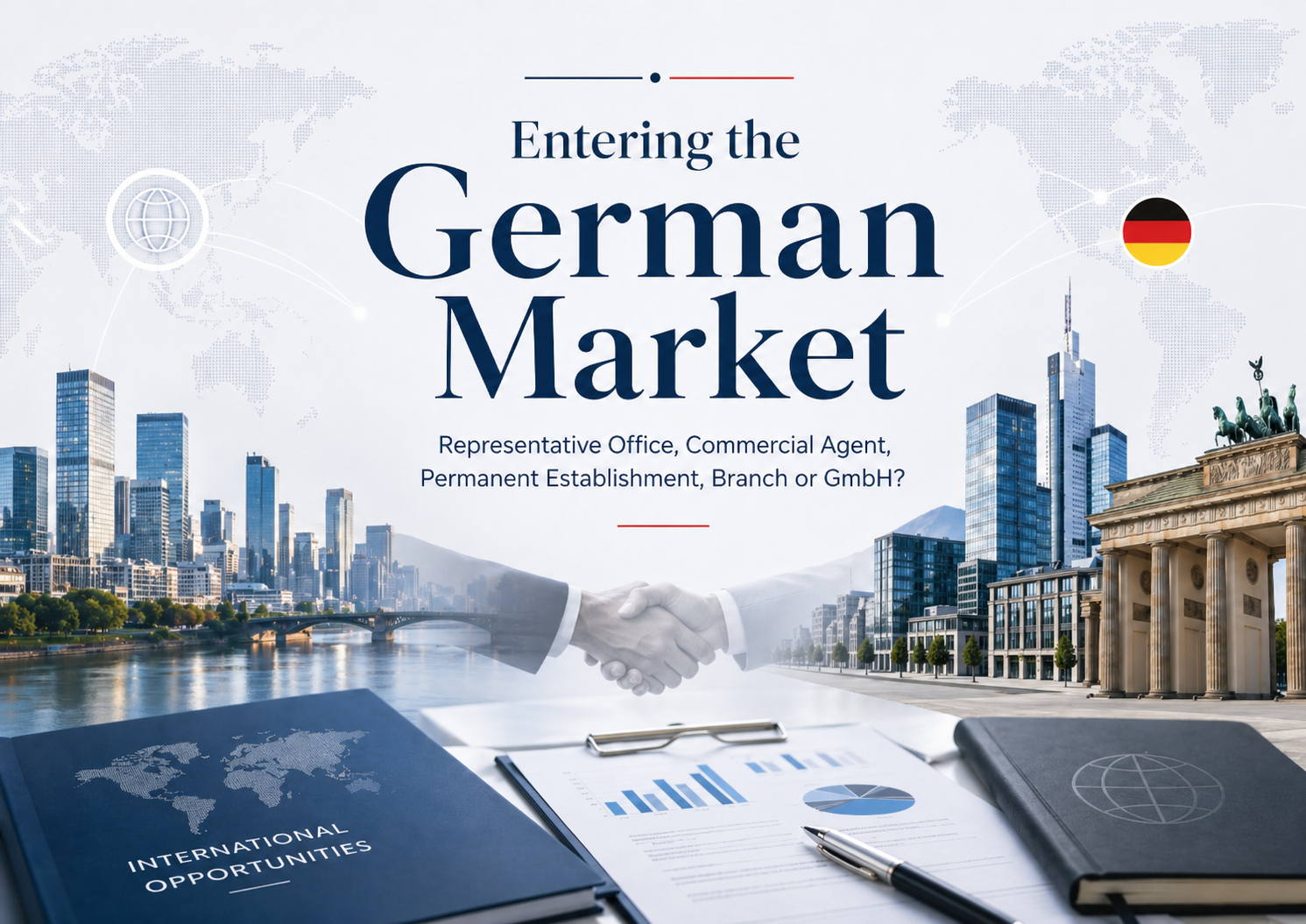
Entering the German Market: Representative Office, Commercial Agent, Permanent Establishment, Branch or GmbH?
Which structure is suitable for foreign companies starting business activities in Germany? Germany is an attractive market for many foreign companies. It is not only one of Europe’s largest economies, but also a strategic gateway to the European Union. For many business owners, Germany offers access to customers, suppliers, technology partners, logistics networks and long-term expansion opportunities within Europe. However, many foreign companies do not want to establish a full German subsidiary from the beginning. In many cases, the first step is to test the market: Are there potential customers? Is there demand for the product or service? Can local sales channels be developed? Is it worth building a permanent structure in Germany? In practice, the term “representative office” is often used for this first phase. The term is internationally understandable, but in Germany it does not describe a separate legal form. What matters is not the name, but the actual activity carried out in Germany. For foreign companies entering the German market, the following practical stages can be distinguished: 1. Pure representation / market research without own establishment in Germany 2. External commercial agent or representation partner in Germany 3. Dependent establishment / dependent branch 4. Independent branch of the foreign parent company 5. German GmbH as an economically dependent subsidiary 6. German GmbH as a more independently operating subsidiary
April 29, 2026
Dental Supplementary Insurance in Germany: Why International Residents Should Consider It
Many international residents in Germany assume that once they are covered by statutory health insurance — the German gesetzliche Krankenversicherung, or GKV — most medical and dental costs are covered. For general medical treatment, that is often true. But dental care is one of the areas where statutory health insurance can leave patients with significant out-of-pocket costs. This is especially relevant for people who plan to stay in Germany long term, including employees, students, freelancers, business owners, and families. While the German healthcare system is very strong overall, statutory coverage for dental treatment is limited when it comes to high-quality dental prosthetics such as crowns, bridges, inlays, dentures, and especially implants.
April 27, 2026
Buying Real Estate as a Foreigner: How Germany and Switzerland Differ
Germany and Switzerland are two European countries often compared by international property buyers. Both countries are known for economic stability, legal reliability, strong infrastructure, and attractive living conditions. However, the legal conditions for foreign buyers are very different.
April 26, 2026
Germany’s 1% Rule for Company Cars: Why a Cheap Used Luxury Car Can Become a Tax Trap
Many entrepreneurs and self-employed people in Germany use a company car. At first, this sounds simple: the company buys or leases the vehicle, pays for insurance, repairs, fuel or electricity, and the car is used for business appointments. However, things become more complicated when the company car is also used privately. In that case, the German tax office treats the private use of the car as a personal benefit. In German tax language, this is called a geldwerter Vorteil, which means a “benefit in kind” or a non-cash benefit. This benefit is taxable.
April 24, 2026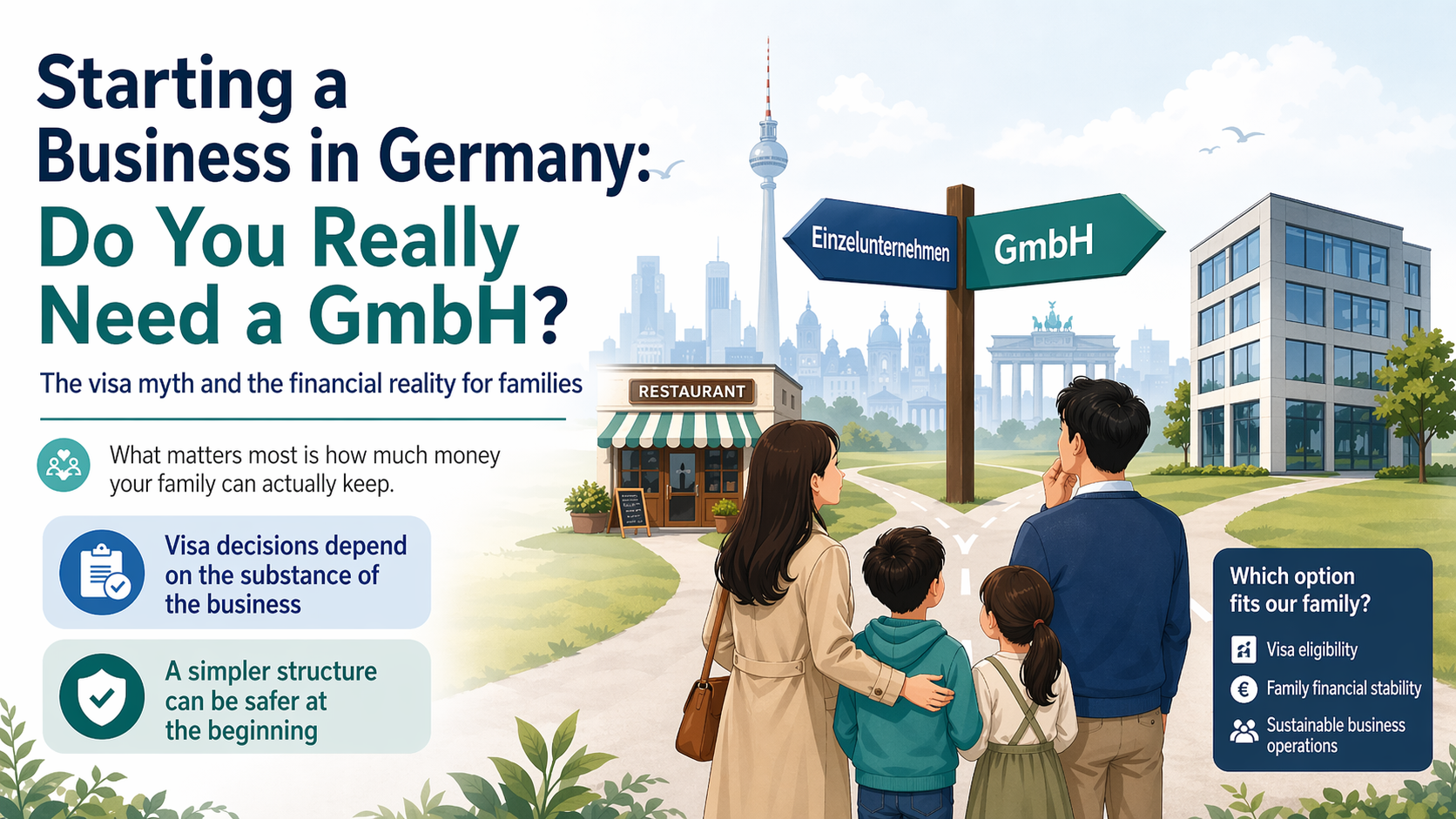
Starting a Business in Germany: Do You Really Need a GmbH?
A practical note for immigrant families planning a new life in Germany Many families who move to Germany and want to become self-employed think about setting up a GmbH right away. The idea often sounds logical: • “A GmbH must be better for getting or keeping a visa.” • “A GmbH looks more professional.” • “A proper business in Germany should start as a GmbH.” This is exactly where many families make an expensive mistake. I am not writing this as a tax adviser or lawyer. I am writing this as someone who understands the practical side of German company structures, taxation, and everyday business reality fairly well, and who wants to help immigrant families avoid unnecessary financial pressure at the very beginning.
April 23, 2026
Start in Germany – We support you from before company formation to long after relocation
Entering Europe is not just about setting up a company. Visa matters, relocation, housing, insurance, registration procedures, business operations, accounting, real estate, and school research should all be planned together from the very beginning.
April 22, 2026
Moving to Germany: What You Should Prepare Before You Arrive
Moving to Germany does not begin on the day you arrive. Visa matters, relocation, housing, administrative steps, and long-term planning should ideally be clarified in advance to save time, reduce costs, and avoid unnecessary mistakes.
April 22, 2026
A Simple Guide to German Income Tax
For foreigners living in Germany or planning to move to Germany If you are an international resident in Germany — or you are planning to move here — one of the first confusing topics you will face is German income tax. Many people ask questions like: Do I automatically pay tax if I register an address in Germany? Is the “183-day rule” the most important rule? Does it matter if I am single, married, divorced, or a single parent? What happens if I have children? What if I am an employee, self-employed, or both? Can I have a mini-job in addition to my main job? German tax law can feel complicated at first, especially for foreigners. But the good news is: once you understand the basic structure, it becomes much easier. This article gives you a simple overview in plain English.
April 22, 2026
Residence Titles and Visa Pathways for Germany
Germany’s immigration system is easiest to understand when it is divided into three layers: short stays, entry for longer stays, and longer-term residence titles after arrival. In legal terms, Germany recognizes several main residence titles, especially the visa, temporary residence permit, EU Blue Card, settlement permit, and EU long-term residence permit.
April 22, 2026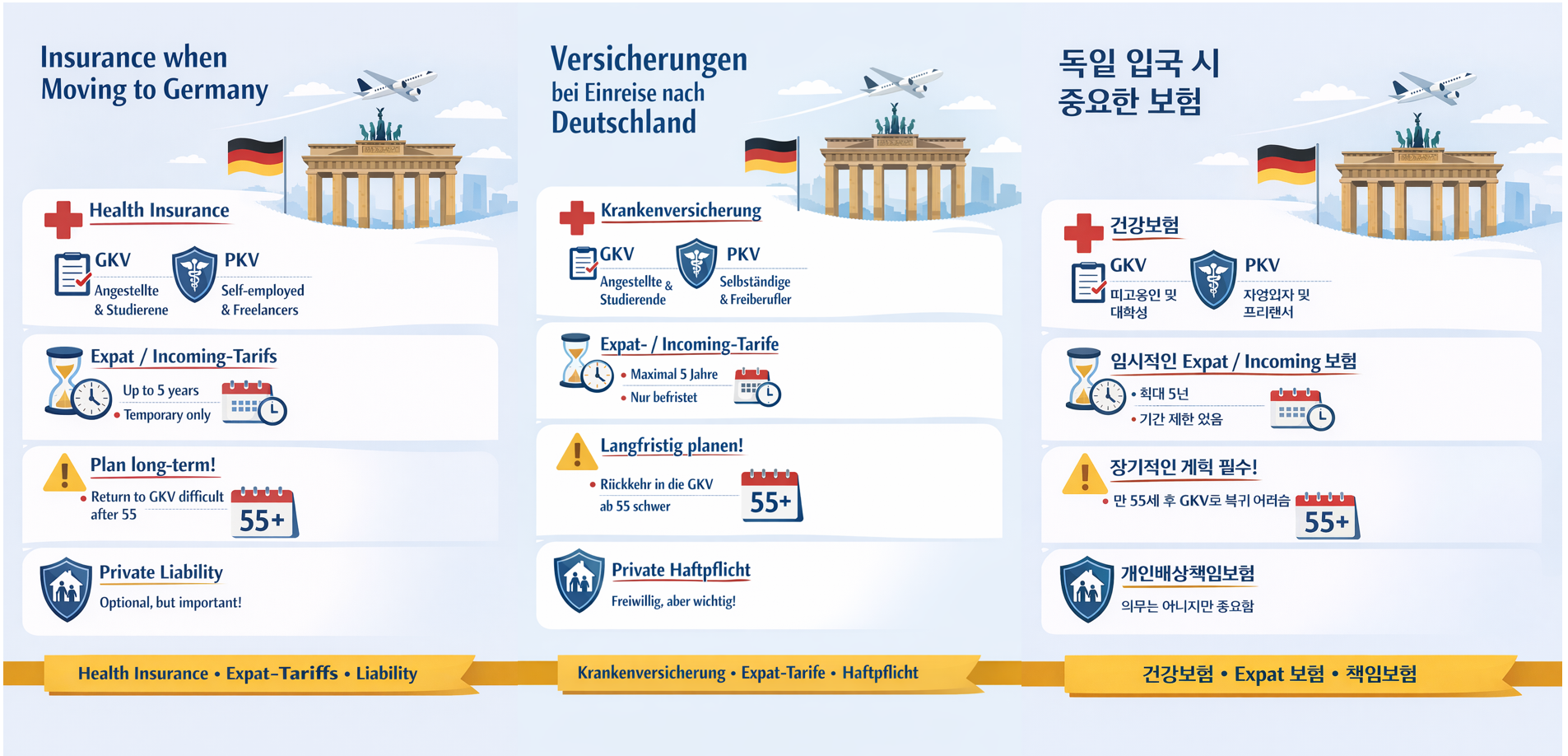
Which insurance policies are important for people coming to Germany?
Anyone coming to Germany should address the topic of insurance at an early stage. The most important one is clearly health insurance. In Germany, insurance coverage is generally mandatory. Health insurance also includes long-term care insurance: in the statutory health insurance system, it is included automatically, while privately insured persons must additionally take out private compulsory long-term care insurance.
April 22, 2026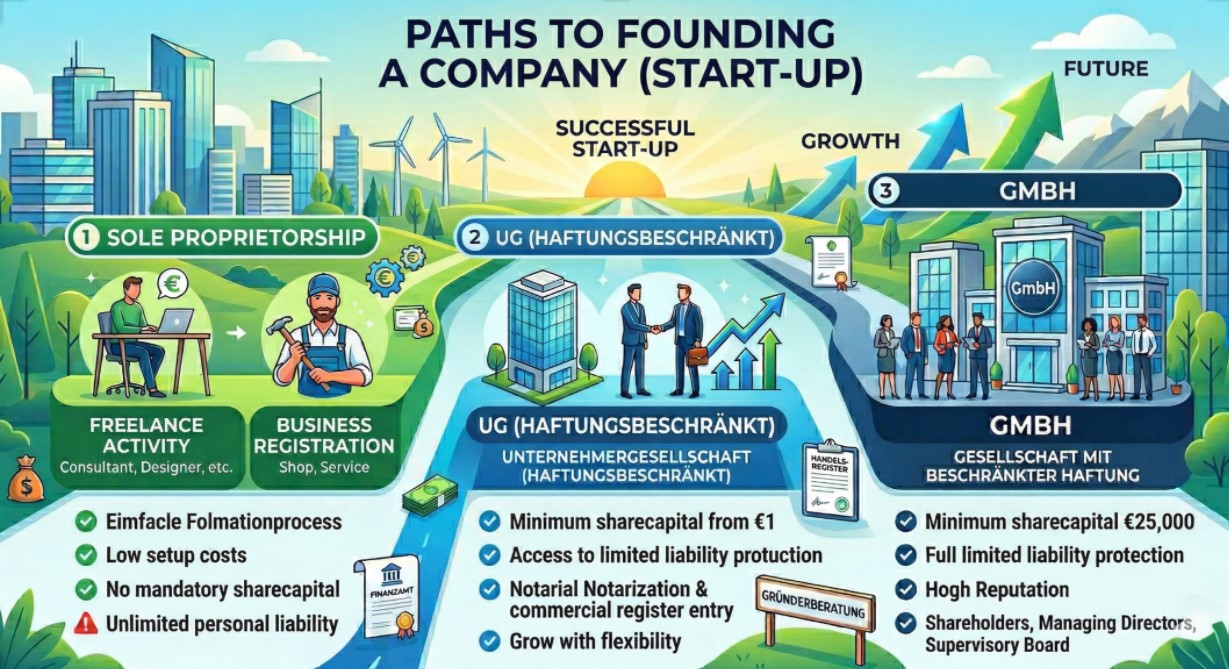
Starting a Business in Germany: Sole Proprietorship or Company?
The right business structure for foreign founders Starting a business in Germany is an exciting step — but one of the first important decisions is choosing the right legal structure. For most foreign founders, the two most common options are a sole proprietorship or a company, usually a UG (limited liability entrepreneurial company) or a GmbH (limited liability company). Both options can work well, but they are designed for different situations. A sole proprietorship is often the easiest and most affordable way to get started. A UG or GmbH, on the other hand, can be the better choice if you want limited liability, plan to start with partners, or need a more formal company structure. The right decision depends on your budget, your business model, your long-term plans, and in some cases also your residence permit situation.
April 22, 2026