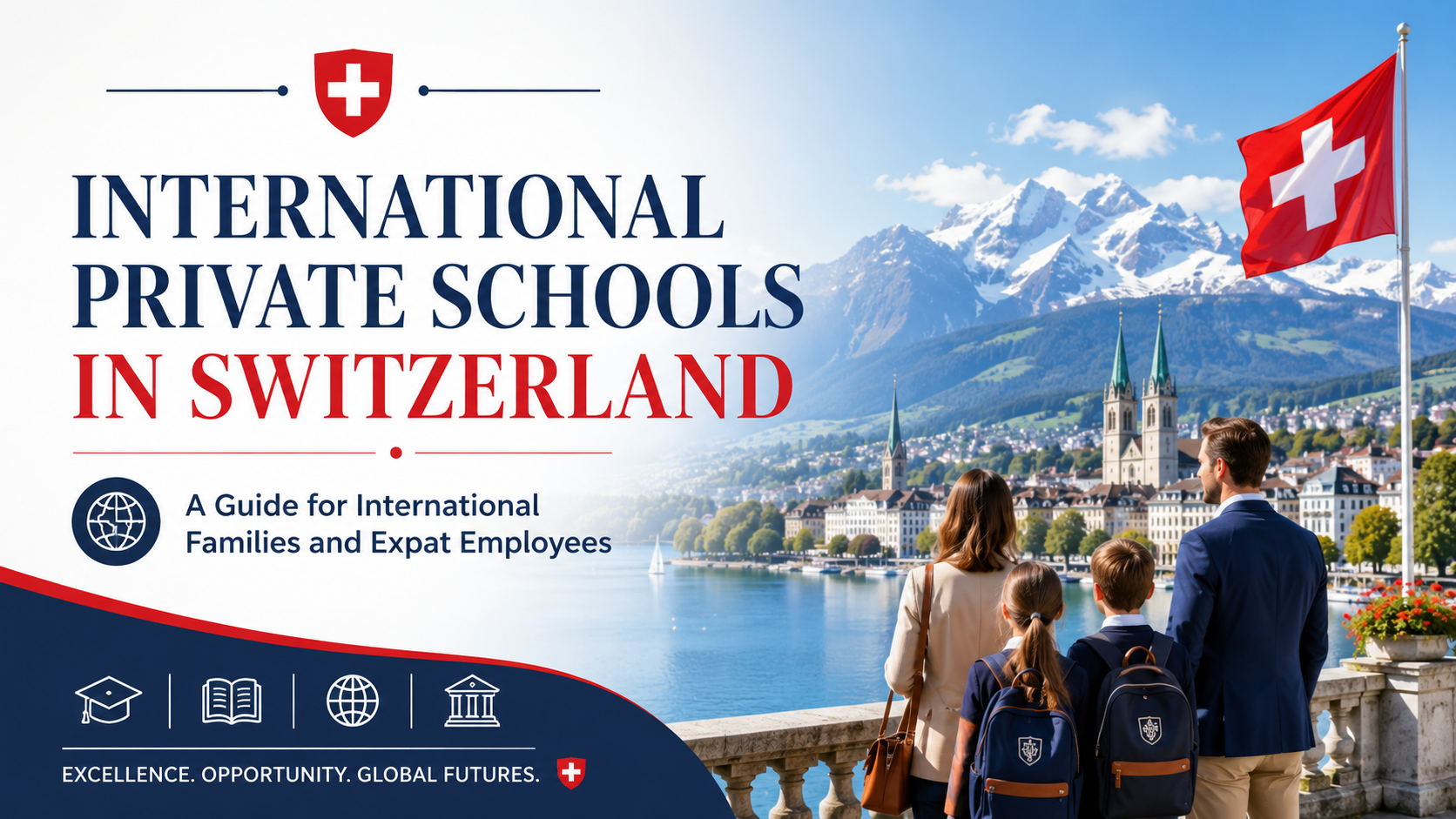
For many international families moving to Germany, education is one of the most important planning issues. This is especially true if children do not yet speak German, if the family will stay only for a few years, or if the child may later move to another country for school or university.
In such cases, an international school or bilingual private school can be a practical alternative to the German public school system.
Germany’s international school market differs strongly by city. Berlin offers the widest range of options and price levels. Frankfurt and Munich are classic premium expat markets. Düsseldorf is shaped by the Japanese community, international companies, and the Rhine-Ruhr region. Hamburg has a smaller but stable and family-friendly school market.
What Is an International School?
The term “international school” can mean different things. Families should first understand what kind of school they are actually considering.
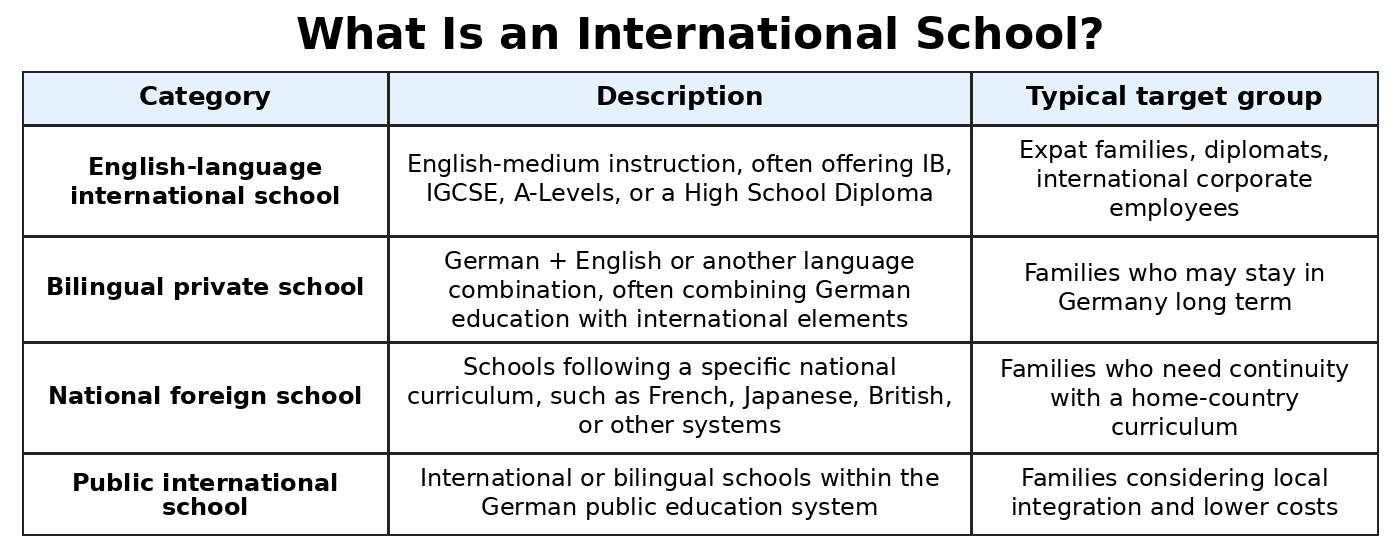
This distinction is important because fees vary greatly. Some bilingual schools may cost only a few thousand euros per year, while established IB schools in major cities can cost €25,000 to more than €30,000 per year.
Size of the International School Market in Major German Cities
The number of international schools depends on how the term is defined. Some databases count only English-medium schools, while others also include bilingual schools and national foreign schools.
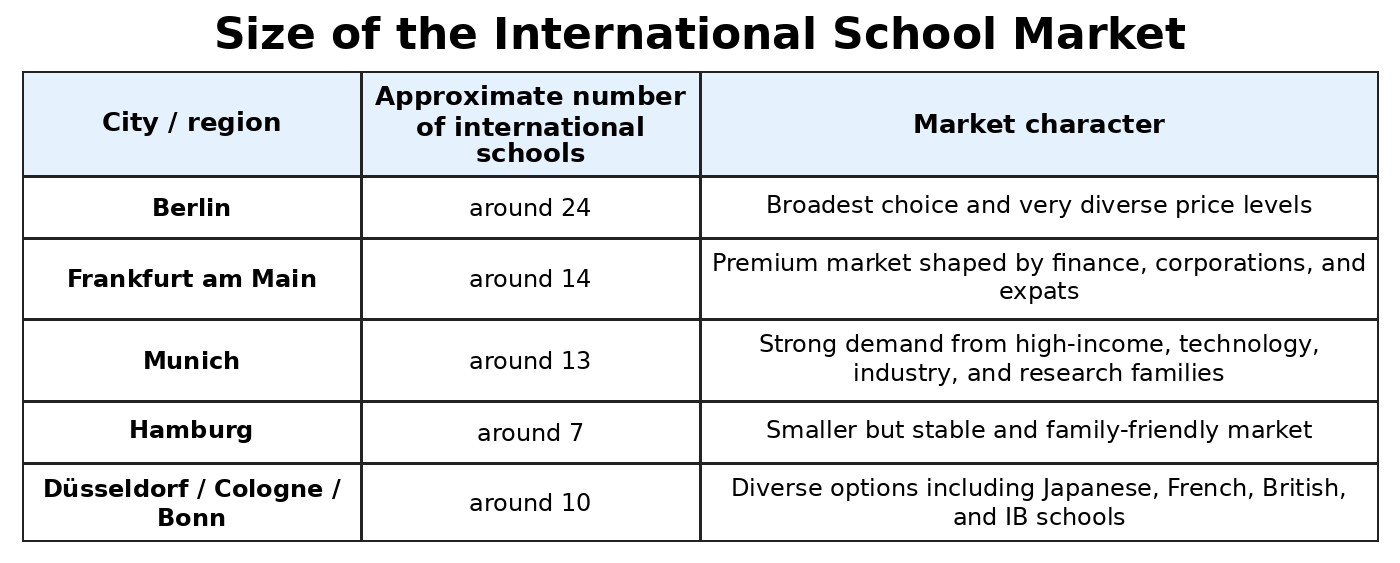
In simple terms: Berlin offers the widest range, Frankfurt and Munich are the most premium corporate-expat markets, Düsseldorf is highly international and diverse, and Hamburg is smaller but practical and family-oriented.
Why International Families Consider International Schools in Germany
Families do not choose international schools only because they are “good schools.” In many cases, the decision is driven by language, mobility, and the family’s expected length of stay.
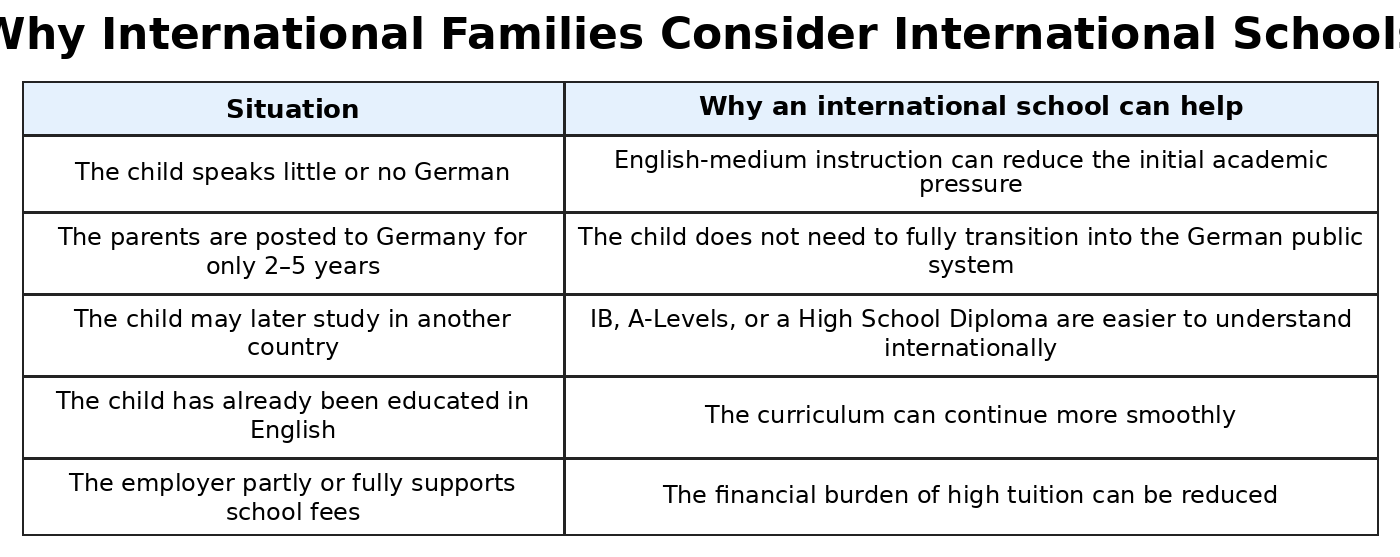
However, if the family plans to stay in Germany long term and the child may later study at a German university, an English-only international school is not always the best solution. In that case, German language development, Abitur options, and possible transition into the German education system should also be considered.
Berlin: The Widest Range of Options
Berlin has one of the most diverse international school markets in Germany. Families can find English-language international schools, bilingual schools, national foreign schools, and even public international schools. Areas such as Steglitz-Zehlendorf, Dahlem, Charlottenburg, Mitte, and Kleinmachnow are especially relevant for international families.
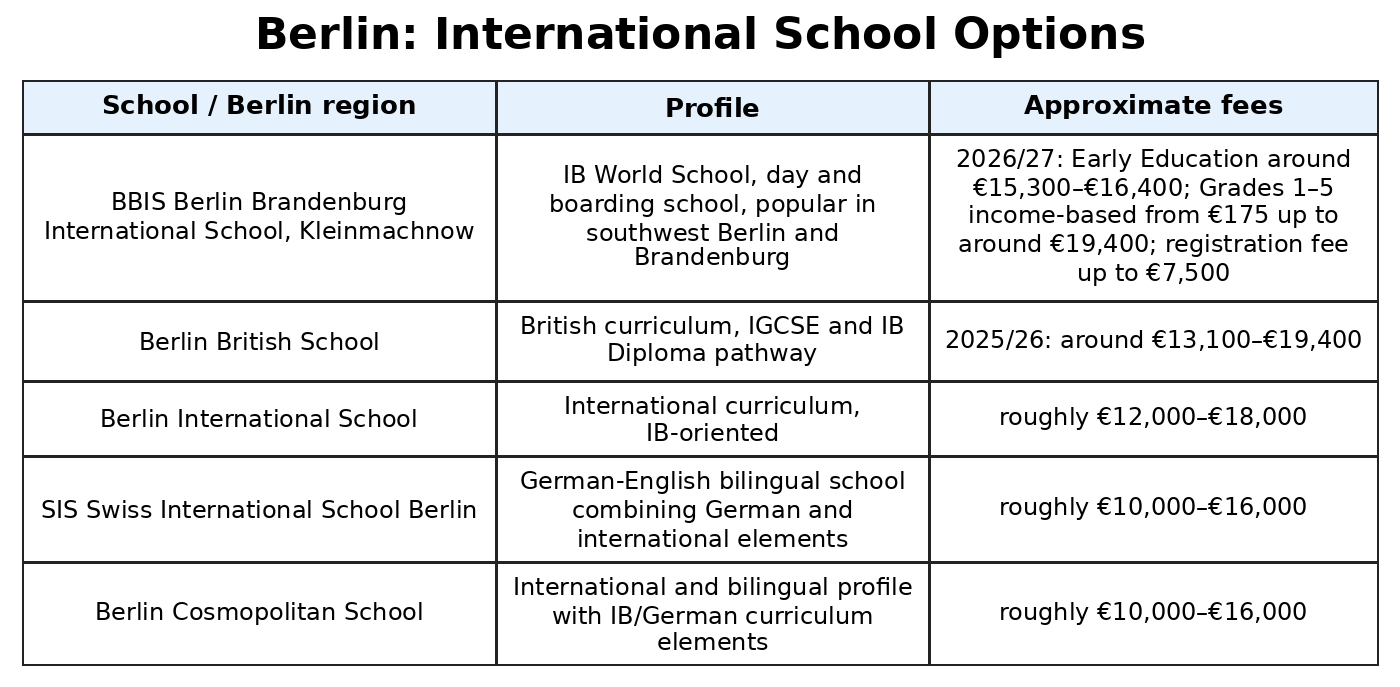
Berlin’s advantage is its variety. There are premium international schools, but also income-based and bilingual models. There are also public international schools such as John F. Kennedy School and Nelson Mandela School, although they are highly competitive and should be considered separately from private international schools.
Hamburg: Smaller, Stable, and Practical
Hamburg has fewer international schools than Berlin, Frankfurt, or Munich. However, it is a stable, family-friendly city, and some bilingual options can be much more affordable than classic premium IB schools.
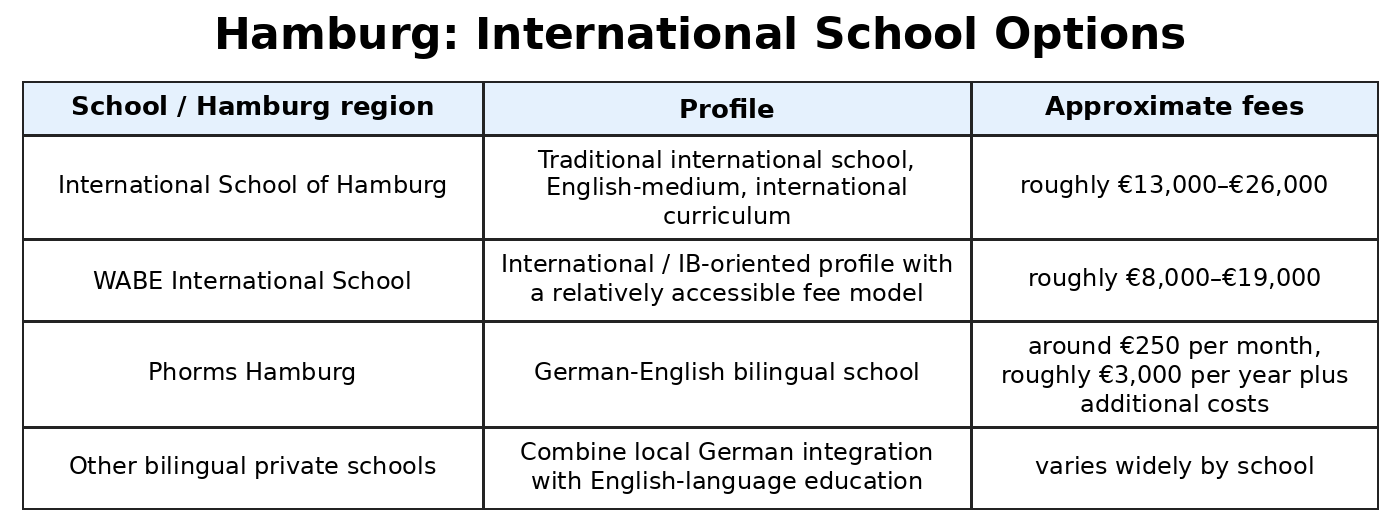
Hamburg is not the largest premium expat school market, but it can be attractive for families who want a calmer city and a more practical school choice.
Düsseldorf / Rhine-Ruhr: International, Japanese, French, British, and IB Options
Düsseldorf is an important city for international families. It has a strong Japanese community, many international companies, and access to the larger Rhine-Ruhr region. Families can choose between English-language IB schools, British schools, French schools, and Japanese schools.
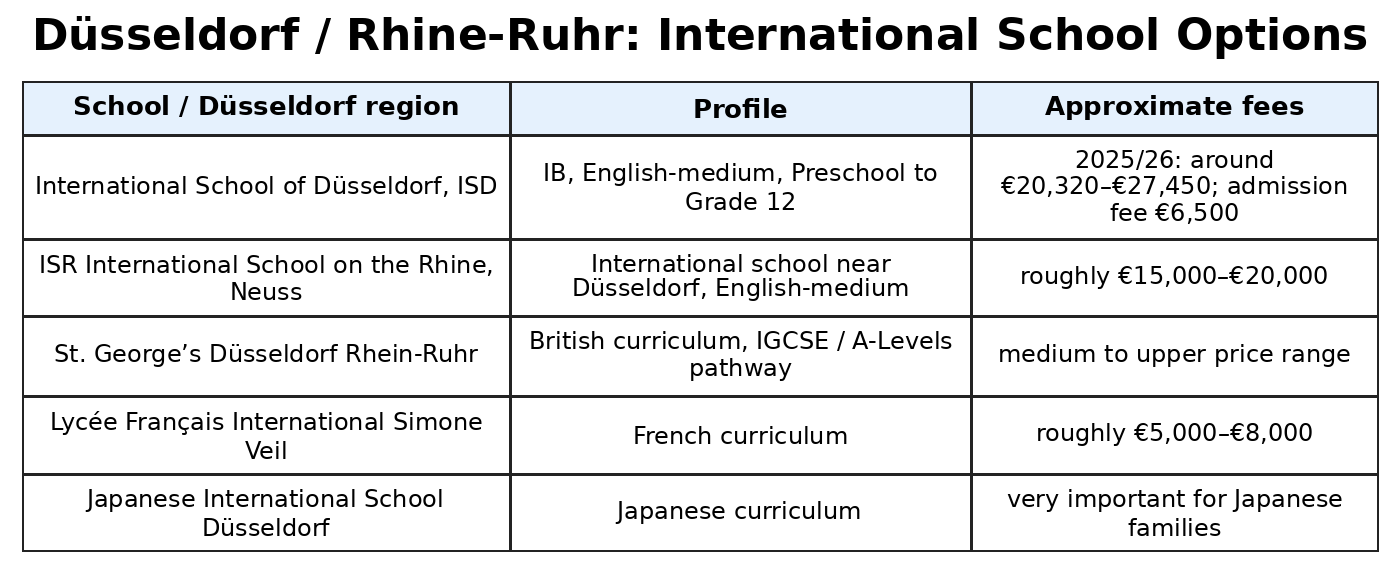
Düsseldorf is not simply an English-speaking international school market. Its strength is diversity: Japanese, French, British, IB, and other international options exist side by side. For mobile corporate families, the next destination and language strategy may be just as important as the current school choice.
Frankfurt am Main: A Premium Corporate and Finance Expat Market
Frankfurt is one of Germany’s most typical expat school markets. Banks, consulting firms, international corporations, the airport, and the wider Rhine-Main economy create strong demand for international education. As a result, school fees are often high.
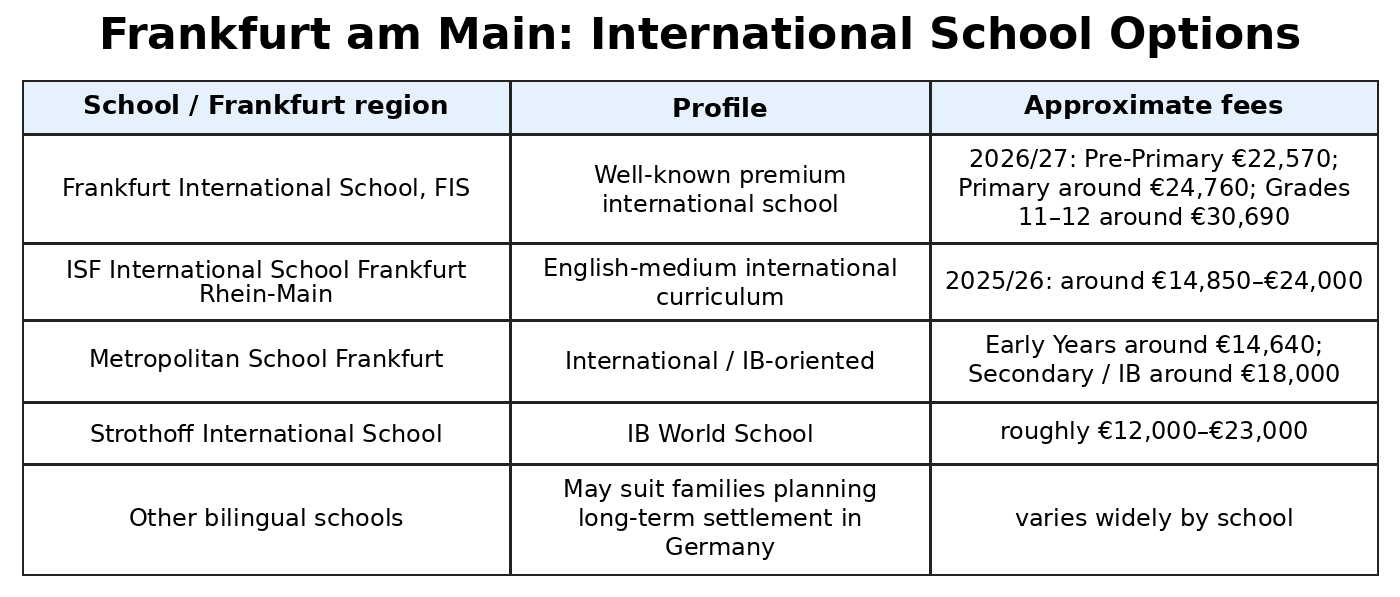
Frankfurt schools often have strong international experience, university counselling, and expat-family support. But families should calculate total costs carefully, including tuition, housing, transport, and additional school fees.
Munich: High Quality, High Cost
Munich is one of Germany’s strongest economic regions, with technology, automotive, engineering, research institutions, and global companies. It also has high living costs. International schools in and around Munich are generally well regarded, but the total financial burden can be high.
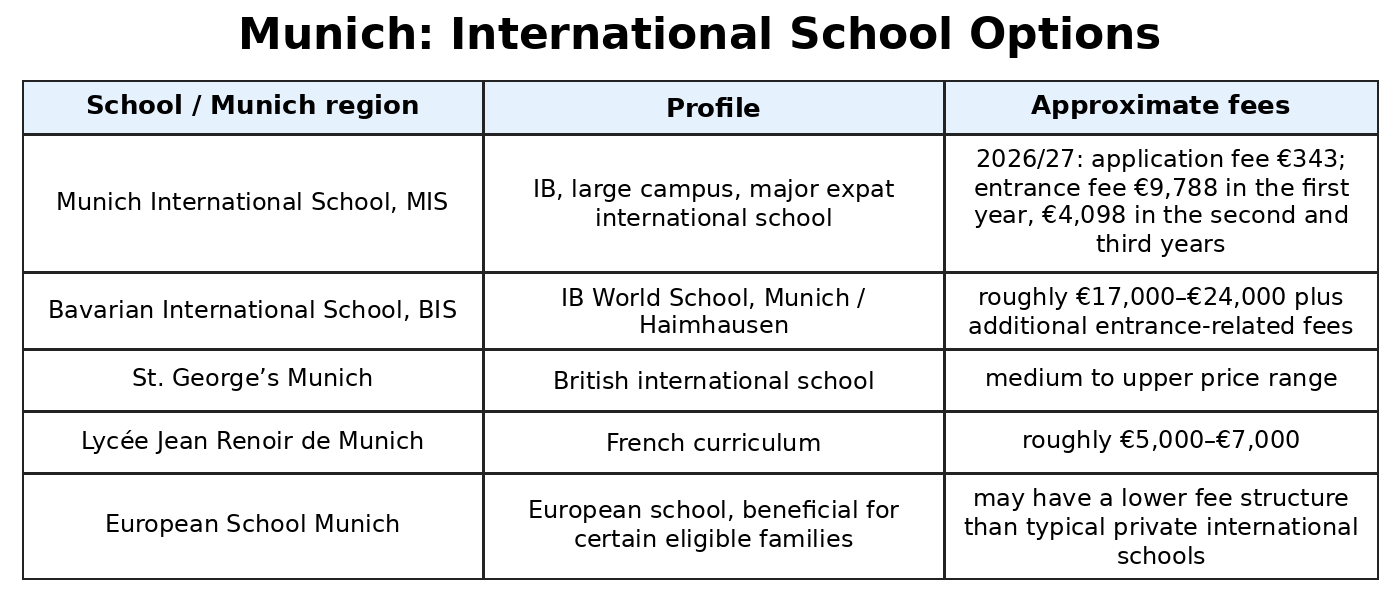
Munich offers excellent education options, but families should not look only at school quality. They must also consider housing, commuting, and overall cost of living.
Fee Comparison by City
International school fees change every year and usually increase in higher grades. IB Diploma, A-Levels, and Grades 11–12 are often more expensive than lower grades.
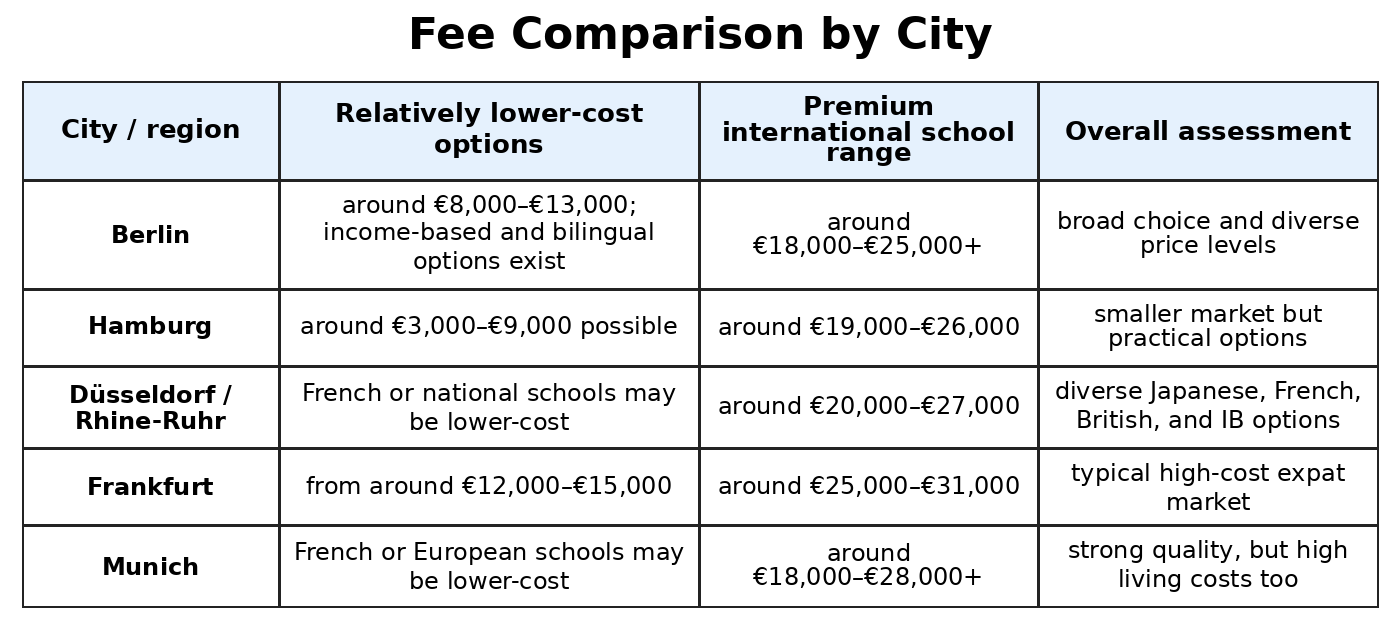
Overall, international schools in Germany may look cheaper than schools in London, Zurich, or Geneva, but they are still expensive compared with German public schools.
Price Is Not the Only Quality Factor
The most common mistake is assuming that the most expensive school is automatically the best school. The right school depends on the family’s goals.
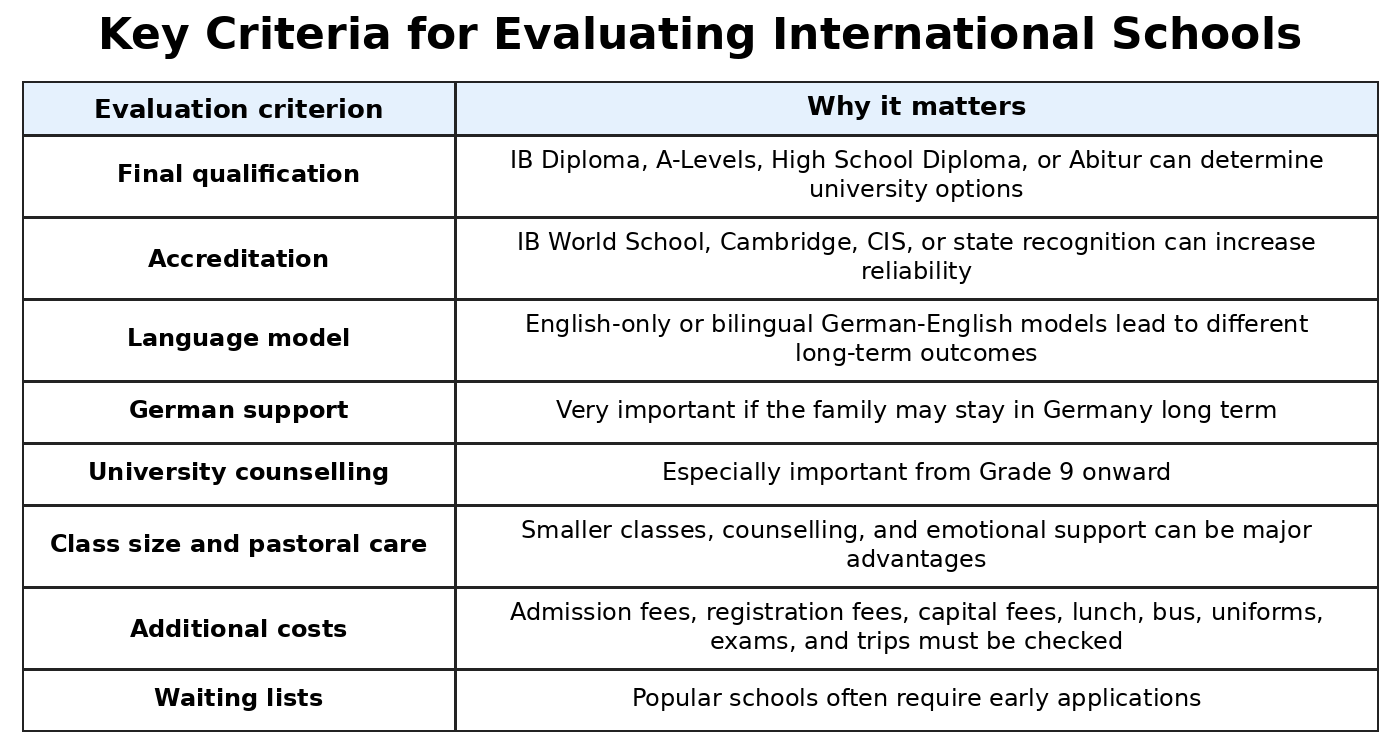
For international families, emotional adjustment is just as important as academic achievement. English-language instruction may reduce the initial barrier, but school life still requires social adaptation, cultural flexibility, presentations, discussions, and independent learning.
Which Families Fit International Schools Well?
International schools are not necessary for every family. But they can be very suitable in certain situations.
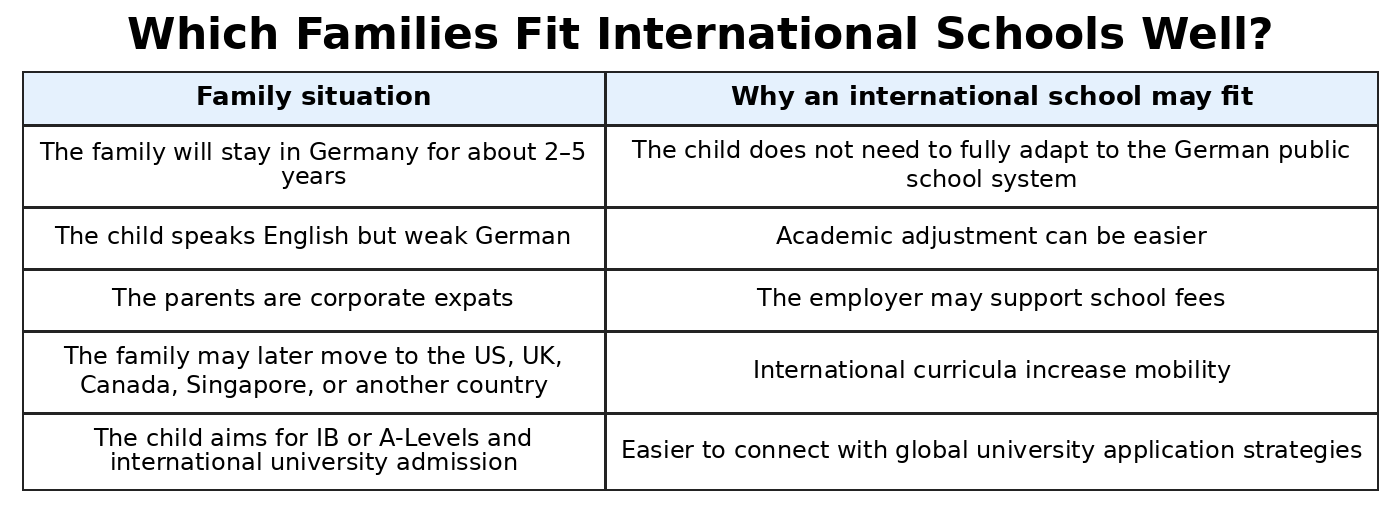
On the other hand, if the family plans long-term settlement in Germany and the child may study at a German university, a bilingual school or German public school may be more suitable in the long run.
Key Questions for Corporate Expat Families
Corporate expat families often have different needs from immigrant families. Their stay may be limited, the employer’s school-fee policy matters, and the child may later return to the home country or move to another international education system.
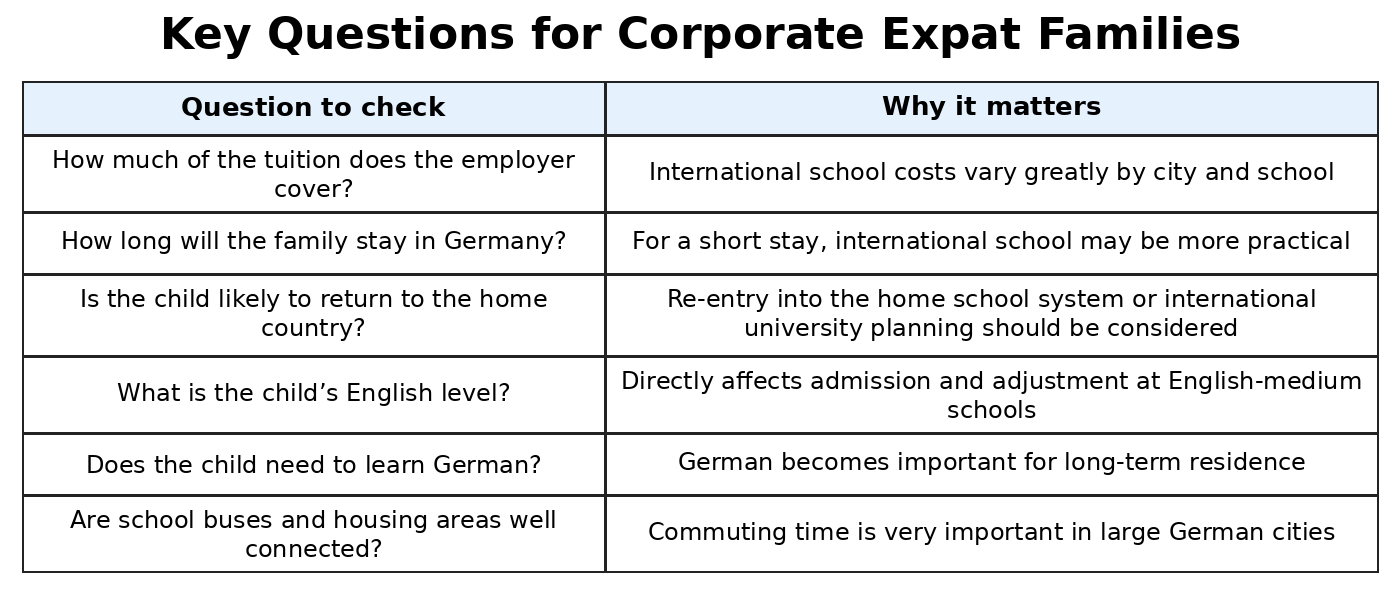
For expat families, school choice and housing choice should not be separated. In Berlin, areas such as Steglitz-Zehlendorf, Dahlem, Charlottenburg, and Kleinmachnow are often considered because of school access and family living conditions. In Frankfurt, families may also look at Oberursel, Kronberg, and Bad Homburg. In Munich, school location and housing affordability must be evaluated together.
Short City-by-City Conclusion
Berlin offers the broadest range of choices. It has international schools, bilingual schools, and public international options, with very diverse fee levels. It is attractive for families who want flexibility and a wider price spectrum.
Hamburg is smaller but stable and family-friendly. Some bilingual options may be relatively affordable.
Düsseldorf is strong because of its Japanese, French, British, and IB school options. It is especially relevant for international corporate families in the Rhine-Ruhr region.
Frankfurt is a premium corporate expat market. Schools are internationally experienced, but fees are high.
Munich offers strong school quality and an attractive economic environment, but both tuition and living costs are high.
The international private school market in Germany cannot be explained as one single market. Each city has a different character, and each school has its own curriculum, fee structure, and admissions strategy.
The most important question is:
Should the child become internationally mobile, or should the child settle long term into the German education system?
International schools can be expensive, but for mobile expat families they may provide continuity, stability, and easier access to international university pathways. For long-term Germany-oriented families, bilingual schools or public schools may be more strategic.
International schools in Germany are not simply “expensive private schools.” For some families, they are a strategic choice that reduces language pressure, protects curriculum continuity, and keeps international university options open.
But they are not the right answer for every family. Berlin, Hamburg, Düsseldorf, Frankfurt, and Munich all have different international school markets. Families should compare not only tuition, but also language model, expected length of stay, university goals, employer support, housing, and commuting.
Choosing an international school is not only a school decision. It is part of the family’s overall Germany strategy.
Free Consultation
Have questions about entering the German market? Request a free consultation.
Request Free Consultation