What International Entrepreneurs Should Know
Switzerland has long been one of Europe’s most attractive business locations for international founders, investors, and growing companies. Its strong legal system, political stability, excellent infrastructure, international reputation, and business-friendly cantons such as Zurich and Zug make it especially appealing for cross-border entrepreneurs.
At the same time, setting up a company in Switzerland is not only a matter of choosing a legal form. For foreign founders, it is equally important to understand the relationship between company law, residency requirements, and immigration rules. This is where Switzerland often differs from other European jurisdictions.
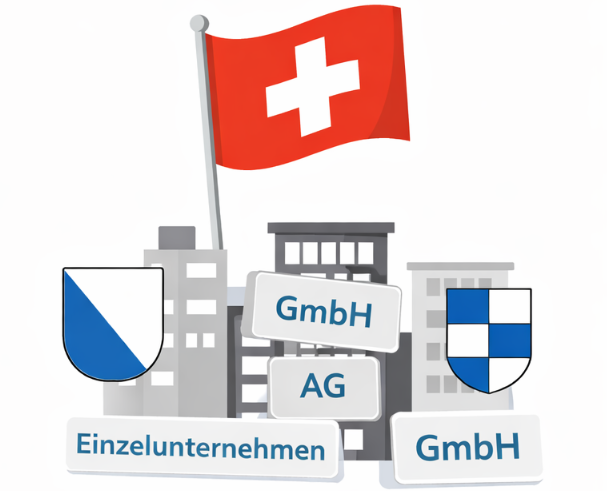
The most common legal forms: GmbH and AG
For international founders, the two most relevant legal forms in Switzerland are usually:
GmbH (Swiss limited liability company)
AG (Swiss corporation / stock corporation)
A GmbH is often the preferred option for small and medium-sized businesses. It requires a minimum share capital of CHF 20,000, which must be fully paid in at the time of incorporation.
An AG is often chosen for larger projects, investor structures, or businesses that want a more corporate setup. It requires a minimum share capital of CHF 100,000, of which at least CHF 50,000 must generally be paid in upon formation.
Both legal forms come into existence only after registration in the Swiss Commercial Register.
Can a foreigner own 100% of a Swiss company?
Yes. A foreign individual or foreign company can generally own 100% of the shares in a Swiss GmbH or AG. From an ownership perspective, Swiss law is relatively open.
However, ownership is only one part of the picture.
The more important practical question is: Who is allowed to represent the company in Switzerland?
The key Swiss requirement: a Swiss-resident representative
This is one of the most important points for foreign founders.
A Swiss GmbH or AG must be able to be represented by at least one person who has residence in Switzerland and who has the appropriate authority to act on behalf of the company.
For a GmbH, this may be a managing director or a director.
For an AG, this may be a board member or a director, provided the person has the required authority.
In practical terms, this means:
A foreign founder may own the company entirely.
But the company still needs a real Swiss-resident legal representative.
This is often the decisive difference between Switzerland and other countries.
A small comparison with Germany
This is where a limited comparison with Germany is useful.
In Germany, a managing director of a GmbH does not necessarily need to live in Germany. Foreign managing directors are generally possible without a domestic residence requirement.
In Switzerland, by contrast, the structure is stricter in practice: the company must have at least one person with residence in Switzerland who can legally represent it.
That does not mean the foreign founder must move immediately. But it does mean that Switzerland expects a stronger local legal anchor than Germany does.
Can a company be formed before the founder moves to Switzerland?
Yes, this is often possible.
A common setup is:
the foreign founder owns 100% of the company, and
a Swiss-resident person serves as the legally required representative.
In practice, this role is sometimes filled by a local business partner, a director, a board member, or a fiduciary / trustee service provider.
There are in fact Swiss service providers that offer fiduciary managing director mandates or board mandates for a fee. These arrangements do exist in the market.
But one important point must be understood clearly:
It is not enough to have just a mailing address, a c/o address, or a consulting office “in the background.” The legal requirement is not fulfilled by an office as such. It must be fulfilled by a specific individual who is formally appointed and who has actual authority to represent the company.
In other words, Switzerland requires a real person, not just a local contact point.
“Residence in Switzerland” means real residence
Another point that international founders often underestimate is the meaning of “residence.”
Under Swiss law, residence is not merely a formal registration address. It refers to the place where a person lives with the intention of remaining there on a lasting basis.
This means a purely nominal setup can become problematic. A Swiss-resident representative should therefore be a genuine legal and operational representative, not just a name used for formal purposes.
What about sole proprietorships?
Some founders look at the sole proprietorship as an easier entry model.
In Switzerland, a sole proprietor does not necessarily have to reside in Switzerland in the same way as a corporate representative requirement applies to a GmbH or AG. However, the founder must still be able to show the appropriate work and residence authorization in order to operate legally.
So while the legal structure may seem simpler, it is not a shortcut around immigration or authorization issues.
This is another area where legal form alone does not solve the real issue. For many international entrepreneurs, the decisive question is not only “Which type of company should I form?” but also “Am I personally allowed to live and work in Switzerland?”
The real issue for active founders: immigration and work authorization
For foreign entrepreneurs who want to actively run the business from within Switzerland, immigration law becomes crucial.
There is an important difference between:
owning a Swiss company, and
living in Switzerland and managing it personally
The first is often possible.
The second depends on whether the founder receives the necessary residence and work permissions under Swiss immigration law.
That is why many foreign founders initially choose a two-step approach:
1. Investor model
The founder remains abroad and owns the Swiss company, while a Swiss-resident representative handles the formal local representation.
2. Transition model
A fiduciary or local representative temporarily serves as managing director or board member until the founder later relocates to Switzerland and takes over the role personally.
Both models can work. But both also have limitations.
The investor model may be acceptable for passive ownership or a holding structure, yet less ideal for a company that needs active day-to-day leadership.
The transition model may be practical at the beginning, but over time it can create dependency, additional cost, and operational complexity.
The most robust structure for active entrepreneurs
If an international founder plans to build and operate a business in Switzerland on a long-term basis, the most stable solution is often the clearest one:
move to Switzerland, establish real residence there, and personally take on the relevant management or corporate function.
This approach usually makes things easier in practice:
clearer authority structure
better credibility with banks and business partners
simpler communication with authorities
more direct operational control
fewer questions around representation and substance
Of course, this only works if the founder is also able to obtain the necessary immigration approval. But from a structural point of view, it is often the cleanest and strongest setup.
Zurich and Zug: why they matter
International founders often focus on Zurich and Zug.
That makes sense. Zurich is Switzerland’s largest business center, with strong infrastructure, finance, technology, and international connectivity. Zug is particularly well known for its business-friendly environment, international company presence, and tax attractiveness.
From a company law perspective, however, the basic rules for GmbH, AG, representation, and residency are Swiss federal rules. The main differences between cantons such as Zurich and Zug tend to be more relevant in areas like:
taxation
administrative practice
business ecosystem
industry concentration
So when choosing between Zurich and Zug, founders are often making a strategic location decision rather than a fundamentally different legal-form decision.
Final thoughts
Setting up a company in Switzerland as an international entrepreneur is absolutely possible. Foreign founders can own 100% of a Swiss GmbH or AG. But the real legal and practical issue is not ownership alone. It is the question of who can legally and credibly represent the company in Switzerland.
That is where Switzerland stands apart from some other jurisdictions.
For passive investors or founders in an early market-entry phase, a local representative structure may be sufficient at first. But for entrepreneurs who want to build and manage a real operating business in Switzerland, the strongest long-term solution is often to align ownership, management, residence, and legal representation in one coherent structure.
In short:
Switzerland is open to international founders — but it expects real substance, real representation, and a properly structured local presence.
Free Consultation
Have questions about entering the German market? Request a free consultation.
Request Free Consultation