
A Practical Guide for International Investors: Zurich, Zug and Swiss Investment Structures
Switzerland is one of the most attractive jurisdictions in Europe for international investors. It offers political stability, strong legal certainty, a highly developed banking system and a business-friendly environment.
For investors looking at Europe, Switzerland is especially interesting because of its international reputation, flexible financing structures and cantonal tax competition. Zurich and Zug are two of the most important locations for foreign investors.
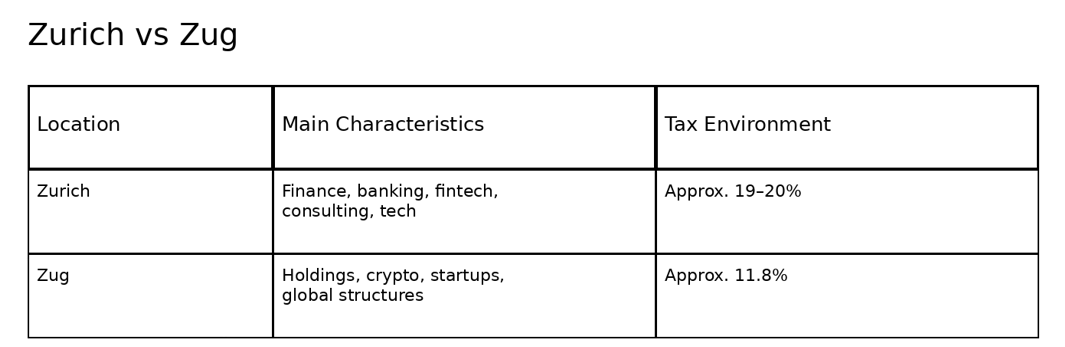
Zurich is Switzerland’s financial and business hub. Zug is known for its low taxes, international holding structures, startups and crypto ecosystem.
1. Swiss Company Forms: GmbH and AG
The two most relevant company forms for foreign investors are:
GmbH
A Swiss GmbH is a limited liability company. It is often used for small and medium-sized businesses, subsidiaries and owner-managed companies.
Minimum capital: CHF 20,000, fully paid in.
AG
A Swiss AG is a stock corporation. It is often preferred for larger businesses, international investors, startups, venture capital structures and holding companies.
Minimum capital: CHF 100,000, with at least CHF 50,000 generally paid in at incorporation.
For international investors, the AG is often more flexible and investor-friendly than the GmbH, especially if future financing rounds, multiple investors or share transfers are expected.
2. Can Foreign Investors Own a Swiss Company?
Yes. Foreign individuals and foreign companies can generally own 100% of a Swiss GmbH or AG. However, at least one person authorized to represent the company must be resident in Switzerland.
This is an important practical point. International investors often solve this through:
a Swiss resident director,
a local fiduciary,
a Swiss management structure,
or a local board member.
3. Zurich vs. Zug
Zurich
Zurich is ideal for:
banking,
finance,
fintech,
consulting,
international headquarters,
technology companies,
scale-ups,
and businesses requiring a deep talent pool.
Zurich has higher costs and higher taxes than Zug, but it offers excellent infrastructure, access to investors, banks, lawyers, accountants and international talent.
The effective combined corporate tax rate in Zurich city is often around 19%–20%, depending on the municipality and structure.
Zug
Zug is especially attractive for:
holding companies,
international investment structures,
crypto and blockchain companies,
startups,
family offices,
asset-light businesses,
and international trading structures.
The Canton of Zug states that the total regular corporate tax rate on company earnings is about 11.8%, including federal, cantonal and communal taxes.
This makes Zug one of the most tax-attractive locations in Switzerland.
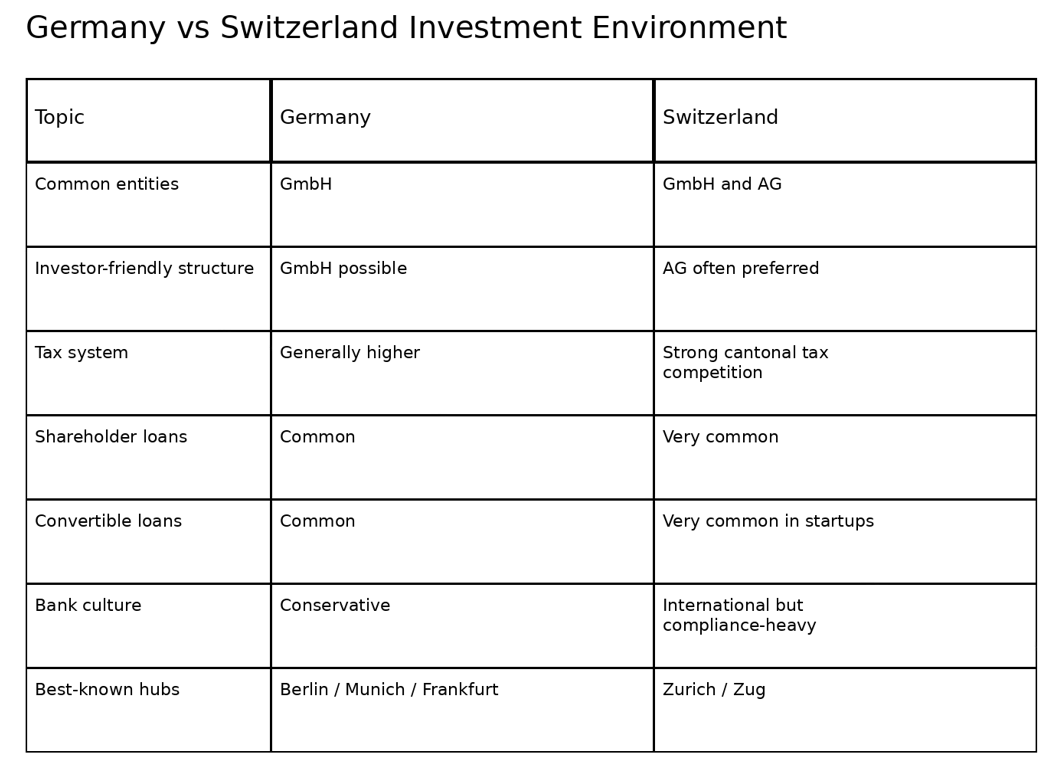
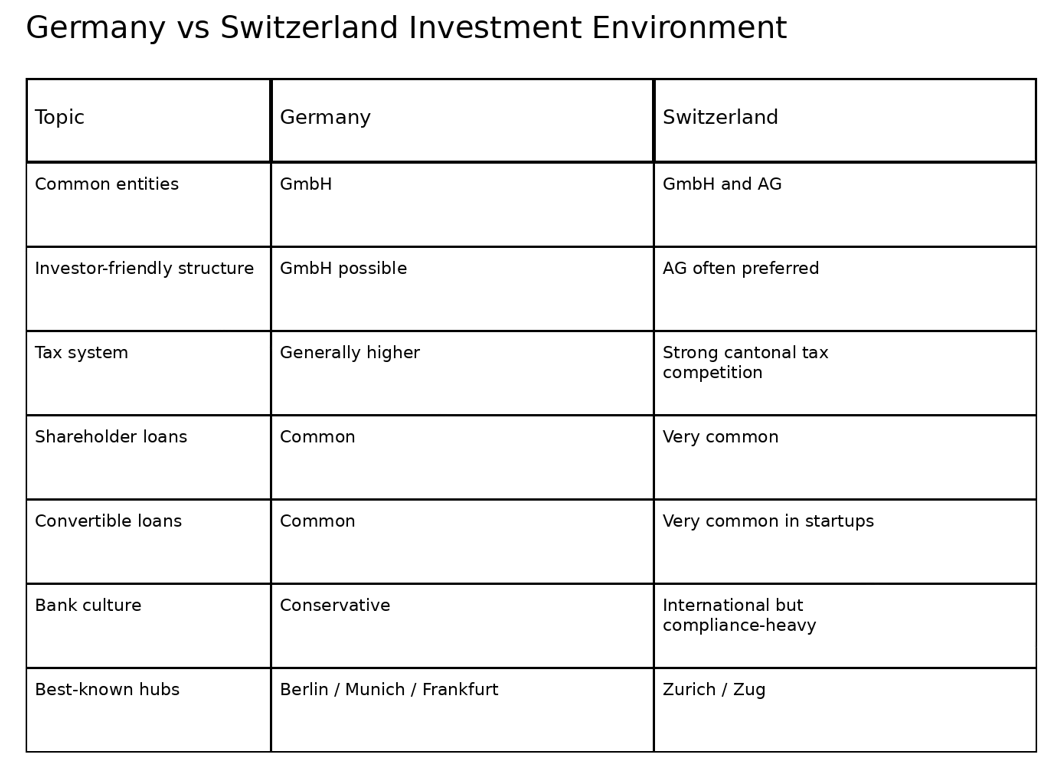
4. Is Switzerland Similar to Germany? : Yes, but only partly.
Switzerland and Germany both offer strong legal systems, stable companies and well-established financing structures. However, Switzerland is often more flexible, more international and more tax-competitive.
5. Investment Method 1: Direct Equity Investment
An international investor may acquire shares in a Swiss GmbH or AG.
This can be done through:
direct share purchase,
capital increase,
new share issuance,
or participation in a financing round.
For a small first step, an investor may acquire for example:
1%,
5%,
or 10%.
This gives the investor formal shareholder status and can be combined with additional financing.
6. Investment Method 2: Capital Increase
A capital increase means the company issues new equity to the investor.
This is common in Swiss AG structures, especially in startup and venture capital financing.
Advantages:
official equity participation,
stronger balance sheet,
clear shareholder position.
Disadvantages:
formal corporate procedures,
possible dilution of existing shareholders,
valuation discussions,
legal documentation.
For early-stage investments, Switzerland often uses convertible loans before a formal capital increase.
7. Investment Method 3: Shareholder Loan
A shareholder loan is very common in Switzerland.
The investor becomes a shareholder and provides an additional loan to the company.
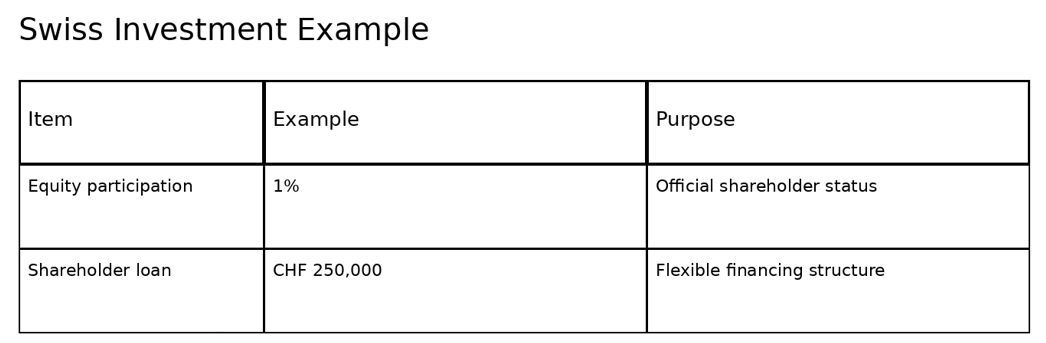
The investor receives:
interest,
repayment claim,
shareholder status.
The company receives:
flexible financing,
less dilution,
fast access to capital.
However, the interest rate and terms should be at arm’s length. Swiss tax practice pays attention to hidden equity, excessive interest and non-market conditions.
8. Investment Method 4: Subordinated Loan
A subordinated loan ranks behind ordinary creditors.
This is often used when:
the company needs quasi-equity,
banks require additional comfort,
the company wants to improve its balance sheet,
or the business is in a growth or restructuring phase.
In Switzerland, subordination agreements are highly relevant, especially in connection with over-indebtedness, financing rounds and convertible loans.
9. Investment Method 5: Convertible Loan
Convertible loans are extremely common in Switzerland, particularly in Zurich and Zug startup ecosystems.
A convertible loan starts as debt and may later convert into equity.
Advantages:
fast financing,
valuation can be postponed,
suitable for startups and growth companies,
flexible for international investors.
However, Swiss tax rules must be considered carefully. If convertible loans are structured like bonds or bond-like instruments, Swiss withholding tax issues may arise. Swiss practice often refers to the 10/20 non-bank rule in this context.
10. Investment Method 6: Capital Contribution Reserve
Capital contribution reserves are also important in Switzerland.
An investor may contribute capital to the company without necessarily receiving proportional new shares.
This can:
strengthen equity,
improve the balance sheet,
support bank financing,
improve creditworthiness.
This structure is particularly attractive for holding companies, subsidiaries and long-term strategic investments.
11. Investment Method 7: Silent Participation or Profit Participation
Switzerland allows flexible contractual investment structures.
Depending on the legal and tax design, international investors may participate economically without becoming visible shareholders.
Possible structures include:
silent participation,
profit participation rights,
mezzanine financing,
hybrid financing,
contractual revenue participation.
These structures can be useful for:
private investors,
family offices,
confidential investments,
joint ventures,
or project financing.
12. Important Swiss Tax Points
Corporate tax
Swiss corporate tax consists of federal, cantonal and communal taxes. The direct federal corporate income tax is 8.5% on profit after tax, which corresponds to an effective rate of about 7.83% on profit before tax. Cantonal and communal taxes are added on top.
Because cantons set their own tax rates, the final tax burden can vary significantly.
Zug vs. Zurich
Zug is usually much more tax-attractive than Zurich. Zug currently states an overall corporate tax rate of about 11.8%, while Zurich city is often around 19%–20%.
Withholding tax
Switzerland generally does not impose withholding tax on interest from ordinary loan agreements. However, 35% Swiss withholding tax may apply to bonds or bond-like loans.
This is why the structure of shareholder loans and convertible loans must be carefully reviewed.
13. Common Swiss Investment Structures
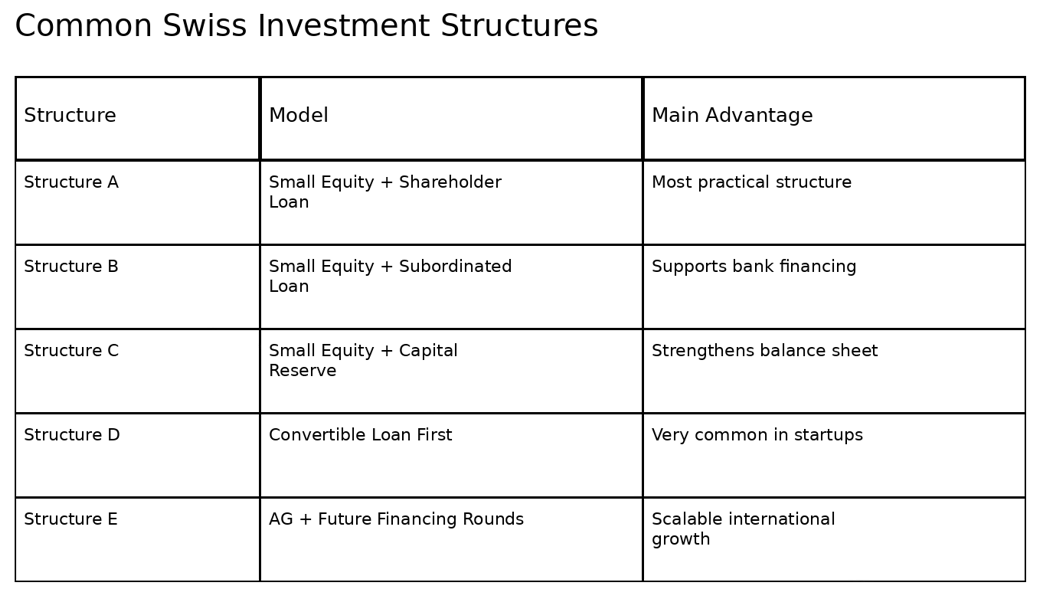
Structure A
Small Equity Stake + Shareholder Loan
This is one of the most practical structures for international investors.
The investor receives shareholder status and provides additional loan financing.
Structure B
Small Equity Stake + Subordinated Loan
Useful where the company needs quasi-equity or bank financing support.
Structure C
Small Equity Stake + Capital Contribution Reserve
Suitable for long-term investors who want to strengthen the company’s equity base.
Structure D
Convertible Loan First, Equity Later
Very common in Zurich and Zug startups.
The investor provides financing today and converts into shares later.
Structure E
AG Structure with Future Financing Rounds
Often the preferred structure for scalable companies, startups, venture-backed businesses and international investors.
14. Practical Recommendation
For international investors, Switzerland offers several attractive entry models.
For smaller or cautious investors:
small equity stake,
shareholder loan,
subordinated loan,
or convertible loan.
For startups and venture capital:
Swiss AG,
convertible loan,
future capital increase.
For holding and international structures:
Zug AG,
capital contribution reserve,
shareholder loan,
tax planning.
For financial, tech and talent-driven companies:
Zurich AG or GmbH,
stronger local presence,
access to banks, talent and institutional investors.
Conclusion
Switzerland is not simply “Germany with lower taxes.” It has its own legal, tax and investment culture.
For international investors, the most important difference is the combination of:
strong legal certainty,
flexible financing instruments,
cantonal tax competition,
international banking culture,
and investor-friendly AG structures.
Zurich is usually the better choice for finance, talent, infrastructure and scale. Zug is often the better choice for holding structures, tax efficiency, crypto, startups and international investment vehicles.
A well-structured Swiss investment may combine:
a small equity stake,
shareholder loan,
subordinated loan,
convertible loan,
capital contribution reserve,
or profit participation rights.
For international investors, careful legal and tax structuring is essential before investing in a Swiss GmbH or AG.
Free Consultation
Have questions about entering the German market? Request a free consultation.
Request Free Consultation