Germany and Switzerland are two European countries often compared by international property buyers. Both countries are known for economic stability, legal reliability, strong infrastructure, and attractive living conditions.
However, the legal conditions for foreign buyers are very different.
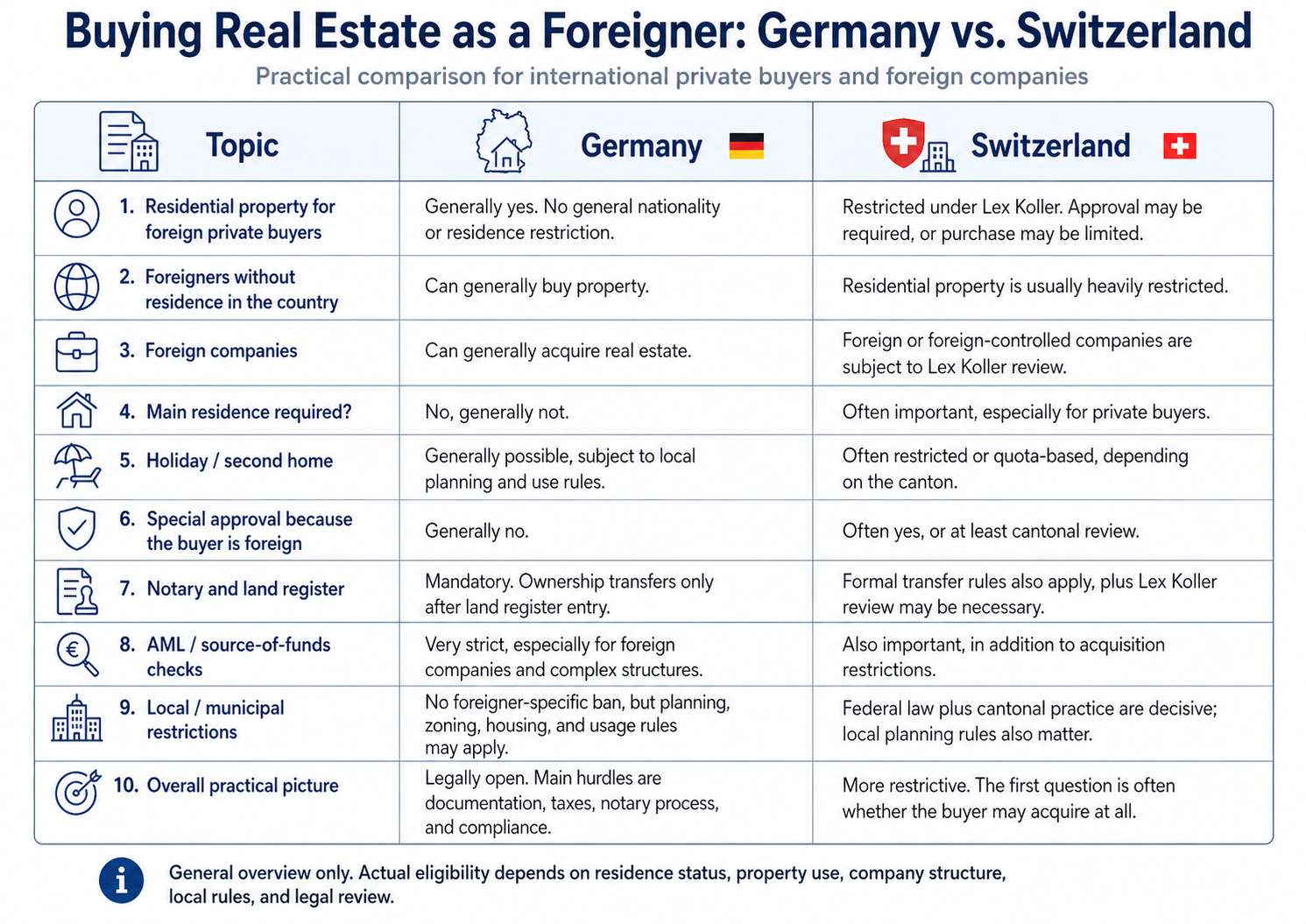
In simple terms: Germany is comparatively open to foreign buyers, while Switzerland applies much stricter restrictions on foreign real estate acquisition.
1. Germany: Foreigners Can Generally Buy Real Estate
In Germany, there is generally no nationality-based restriction on foreign individuals or foreign companies acquiring real estate.
This means that a foreign buyer can, in principle, purchase real estate in Germany even if they are not a German citizen and do not live in Germany.
Foreign buyers may generally acquire, for example:
Apartments
Single-family homes
Multi-family houses
Retail units
Offices
Hotels
Land
Investment properties
Germany does not generally have a system comparable to Switzerland’s Lex Koller, which restricts foreign real estate acquisitions.
Therefore, the main question in Germany is usually not: “Is the foreigner allowed to buy?”
The more practical question is:
“Are the documents, source of funds, taxes, notarial process, and land register procedures properly prepared?”
2. Foreign Private Buyers in Germany
A foreign private individual does not generally need to live in Germany in order to buy real estate there.
A German residence permit or registered address in Germany is also not generally required for the acquisition itself. Of course, if the buyer intends to live in the property, rent it out, obtain financing, open a German bank account, or file tax returns in Germany, additional administrative steps may become relevant.
For the purchase itself, however, being a foreigner is normally not a general obstacle.
In practice, the following points are important:
Passport or identity verification
Proof of source of funds
German notarial process
Review of the purchase agreement
Payment of real estate transfer tax
Registration in the land register
Bank transfer or international payment arrangements
Tax compliance if the property will be rented out
In Germany, a real estate purchase agreement must be notarized by a German notary. A simple private signature between buyer and seller is not sufficient to transfer ownership.
Ownership is legally transferred only after the buyer is registered as owner in the German land register.
3. Foreign Companies Buying Real Estate in Germany
Foreign companies can also generally acquire real estate in Germany.
For example, companies from the United States, the United Kingdom, South Korea, Japan, Singapore, Hong Kong, the United Arab Emirates, or other countries may structure a German real estate acquisition.
However, foreign companies usually need to prepare more documentation than private individuals.
Typically, the following documents may be required:
Company register extract or certificate of incorporation
Proof of representation authority of directors or managers
Articles of association or constitutional documents
Information on beneficial owners
Source-of-funds documentation
Apostille or legalization, if required
Certified German translations
Transparency register review
Anti-money laundering documentation
Germany has strengthened anti-money laundering controls in real estate transactions. This is particularly relevant where foreign companies, holding structures, trusts, nominees, or complex ownership chains are involved.
In other words: foreign companies can generally buy real estate in Germany, but the ownership structure and the source of funds must be clear and well documented.
4. Key Practical Points in German Real Estate Transactions
Germany is open to foreign buyers, but the transaction process is formal and document-heavy.
The following points are especially important.
Notarial process
A German real estate purchase agreement must be notarized. The notary reads and explains the contract and ensures that the formal legal requirements are met.
Land register
Even after notarization, the buyer does not immediately become the legal owner. Ownership is transferred only once the buyer is entered into the land register.
Real estate transfer tax
Germany charges real estate transfer tax on property acquisitions. The rate depends on the federal state and is generally between approximately 3.5% and 6.5% of the purchase price.
Source of funds
The purchase price must be paid through traceable banking channels. Cash payments for real estate transactions are not accepted in practice and are legally restricted.
Local rules
Germany does not generally impose special restrictions on foreign buyers. However, local rules may apply to all buyers, regardless of nationality.
These may include:
Urban planning rules
Zoning restrictions
Housing protection areas
Rental regulations
Short-term rental restrictions
Holiday home restrictions
Building restrictions
Monument protection
Municipal pre-emption rights
Therefore, in Germany the key issue is not usually whether the buyer is foreign, but whether the specific property is affected by local planning, use, housing, or tax rules.
5. Switzerland: Foreign Real Estate Acquisition Is Much More Restricted
Switzerland differs significantly from Germany.
The main legal framework restricting foreign real estate acquisitions is known as Lex Koller.
Lex Koller limits the acquisition of Swiss real estate by foreign persons and foreign-controlled companies.
In Switzerland, the fact that a buyer has sufficient money is not enough. The first question is often whether the foreign individual or foreign company is legally allowed to acquire the property at all.
6. Foreign Private Buyers in Switzerland
In Switzerland, acquisition rights depend on nationality, residence status, actual place of residence, and intended use of the property.
EU/EFTA citizens who actually live in Switzerland may be in a more favorable position.
However, citizens of non-EU/EFTA countries — so-called third-country nationals — are usually subject to stricter rules.
A third-country national with a valid Swiss residence permit who actually lives in Switzerland and wants to buy a home for personal use may have a possible route to acquisition.
However, foreign individuals who do not live in Switzerland generally face strict limitations when trying to buy residential real estate.
Holiday homes and second homes may also be restricted by cantonal quotas and local rules.
7. Foreign Companies Buying Real Estate in Switzerland
For foreign companies, or companies controlled by foreign persons, Lex Koller review is a key issue.
The acquisition of residential real estate purely as an investment is generally very difficult.
However, real estate used for actual business operations may be possible in certain cases. This may include:
Offices
Hotels
Restaurants
Production facilities
Operational business premises
By contrast, acquisitions for rental income, pure property holding, residential investment, or land development without operational use must be reviewed very carefully.
8. The Main Difference Between Germany and Switzerland
The practical difference can be summarized as follows:
In Germany, the process often starts with the question:
“What documents and procedures are required?”
In Switzerland, the process often starts with the question:
“Is this foreign person or foreign company allowed to acquire the property at all?”
Germany is comparatively open, but requires proper documentation, tax compliance, notarial procedure, land register registration, and clear proof of funds.
Switzerland is more restrictive, because legal eligibility to acquire the property may itself be the central issue.
9. Practical Assessment for International Buyers
International buyers should approach Germany and Switzerland very differently.
In Germany, foreign buyers are not generally restricted simply because of their nationality or foreign residence. The main focus is on proper transaction execution: source of funds, taxes, notary, land register, financing, rental management, and company documentation.
In Switzerland, residential real estate investment by foreigners is far more restricted. A foreign resident outside Switzerland who wishes to buy Swiss residential property purely as an investment should obtain legal advice before taking any steps.
For foreign companies, Germany is generally more open, while Switzerland may restrict acquisitions under Lex Koller, especially if the property is residential or investment-driven rather than operational.
10. Conclusion
Germany and Switzerland are both stable and attractive European real estate markets. However, their rules for foreign buyers are very different.
Germany is comparatively open to foreign buyers.
Foreign private individuals and foreign companies can generally acquire real estate. The key issues are notarization, land register registration, taxes, source of funds, company documents, and local regulations.
Switzerland is much more restrictive.
Foreign private individuals and foreign companies must consider Lex Koller, residence status, actual residence, property use, and cantonal approval practice.
International buyers should therefore not compare Germany and Switzerland using the same assumptions.
In Germany, the main question is usually:
“How can the transaction be completed safely and properly?”
In Switzerland, the first question is often:
“Is the acquisition legally possible at all?”
Free Consultation
Have questions about entering the German market? Request a free consultation.
Request Free Consultation