Switzerland is an attractive real estate market for many international investors, entrepreneurs, and companies. Cities and cantons such as Zurich, Zug, and Geneva are especially appealing due to their economic stability, international business environment, strong infrastructure, and high quality of life.
However, buying real estate in Switzerland as a foreigner is not simply a matter of finding the right property. Switzerland has specific legal restrictions on the acquisition of real estate by foreign persons and foreign-controlled companies. The most important legal framework is commonly known as Lex Koller
The key question is not only whether a person has foreign citizenship, but whether the buyer is legally considered a “person abroad” under Swiss law. This can include foreign private individuals, foreign companies, and even Swiss companies that are controlled by foreign persons.
Whether a purchase is possible depends on several factors, including Swiss federal law, cantonal practice, residence status, actual place of residence, the intended use of the property, and the competent cantonal authority.
1. Foreign Private Individuals Buying Property in Switzerland
Foreign individuals are treated differently depending on their nationality, residence status, and the intended use of the property.
EU/EFTA citizens with actual residence in Switzerland
EU/EFTA citizens who are legally and actually resident in Switzerland are generally treated similarly to Swiss citizens when buying real estate.
In many cases, they may acquire residential property, a house, or land without requiring a special permit under Lex Koller, provided they have their real and lawful residence in Switzerland.
Third-country nationals
Citizens from countries outside the EU/EFTA are generally treated as third-country nationals. This includes, for example, citizens of countries such as the United States, the United Kingdom, China, India, Turkey, Japan, South Korea, Brazil, and many others.
If a third-country national holds a C permit, meaning a Swiss settlement permit, they are generally treated similarly to Swiss citizens for real estate acquisition purposes.
If a third-country national holds a B permit, meaning a Swiss residence permit, they may currently be able to purchase a property as their main residence, provided they actually live there. The property must normally be used for their own residential purposes and may not simply be acquired as an investment or rental property.
If land is acquired, construction usually has to take place within a reasonable period.
It is important to understand that merely registering an address in Switzerland is not always sufficient. Swiss authorities may examine whether the person’s actual center of life is really in Switzerland. Relevant factors may include family residence, tax residence, professional activity, social ties, vehicle registration, and overall living circumstances.
Foreign individuals without residence in Switzerland
For foreign individuals who do not actually live in Switzerland, the acquisition of residential real estate is significantly more restricted.
In many cases, the purchase of residential property requires a permit or may not be possible at all. Holiday homes and second homes are subject to strict limitations and quotas. In some cantons, including Zurich and Geneva, the sale of holiday homes to foreigners is generally not permitted.
Therefore, foreign individuals who live abroad and wish to buy Swiss residential property purely as an investment should seek legal advice before taking any further steps.
2. Foreign Companies and Foreign-Controlled Swiss Companies
Foreign companies face particularly strict rules when acquiring real estate in Switzerland.
A foreign company cannot normally acquire residential property in Switzerland purely as an investment. In addition, a Swiss company may also fall under Lex Koller if it is controlled by foreign persons or foreign entities.
The more realistic and legally accepted area is usually the acquisition of business premises used for actual commercial operations.
Examples may include:
Offices
Commercial premises
Production facilities
Hotels
Restaurants
Operational business locations
Properties directly required for a company’s business activity
This means that if a foreign company needs real estate in Switzerland for genuine business operations, the acquisition may be possible.
However, structures involving pure real estate investment, residential rental properties, property holding companies, land development without operational use, or foreign-controlled investment vehicles must be reviewed very carefully.
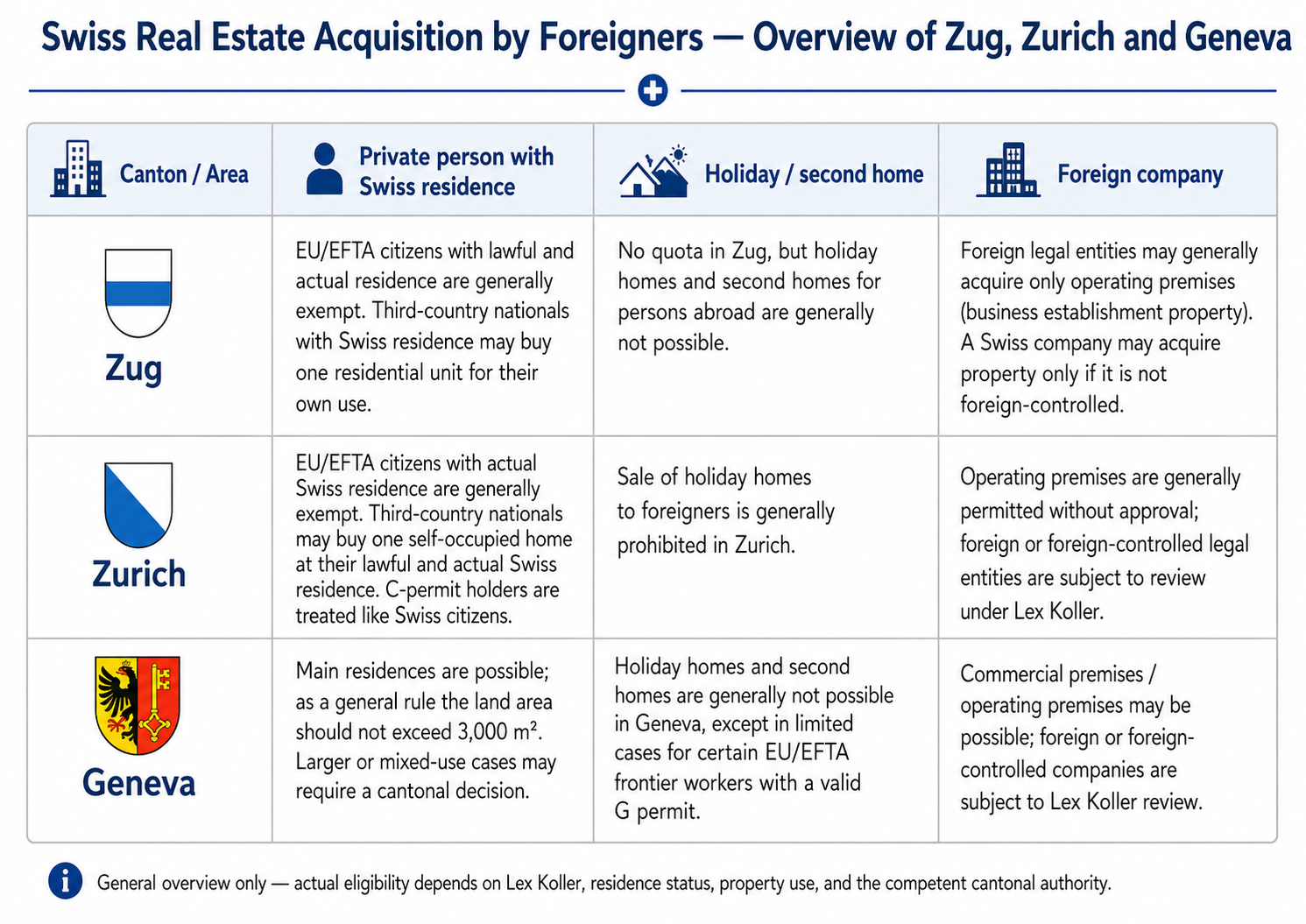
3. Examples: Zug, Zurich and Geneva
4. Possible Tightening of the Rules from 2026 Onwards
As of 2026, Switzerland is discussing a possible tightening of Lex Koller.
One of the key proposals concerns third-country nationals. In the future, even the purchase of a main residence by non-EU/EFTA citizens may require additional approval.
There are also discussions about requiring foreign owners to sell their property within a certain period if they later leave Switzerland. A period of two years has been discussed in this context.
Restrictions may also become stricter for commercial properties, especially where the property is acquired only for leasing or subleasing purposes rather than for the buyer’s own operational use.
These proposed changes are not necessarily final law yet, but they are highly relevant for international buyers and foreign companies considering real estate investments in Switzerland.
Practical Assessment for International Buyers and Companies
For foreign private individuals, the most realistic path is usually to establish lawful and actual residence in Switzerland, hold the appropriate residence permit, and acquire a property for personal use as a main residence.
For foreign companies, the most realistic scenario is usually the acquisition of real estate directly connected to genuine business operations. This may include offices, hotels, restaurants, commercial facilities, or production sites.
By contrast, pure residential investment, rental income structures, foreign holding companies, or investment-driven real estate acquisitions are likely to face much stricter scrutiny.
How Aec-Berlin Can Support International Clients
Aec-Berlin supports international private clients, entrepreneurs, and companies interested in Swiss real estate. All support is provided strictly within the applicable legal framework.
Aec-Berlin can assist with:
Initial assessment of whether a real estate acquisition may be possible
Clarification of residence status and permit-related questions
Review of whether the buyer may be considered a “person abroad”
Preliminary assessment of company structures and foreign control issues
Differentiation between residential, commercial, and operational real estate
Coordination with local lawyers, tax advisors, notaries, real estate professionals, and competent authorities
Support in identifying the relevant cantonal procedures
Communication support in German, English, and other relevant languages
Aec-Berlin helps international clients reduce language, administrative, and procedural barriers when approaching the Swiss real estate market.
However, every case must be assessed individually. Before making any binding purchase decision, buyers should obtain advice from qualified Swiss legal professionals and, where necessary, confirmation from the competent cantonal authority.
Conclusion
Swiss real estate can be attractive for international private buyers and companies, but foreign acquisitions are subject to strict legal restrictions.
The decisive factors are not only nationality, but also residence status, actual residence, property use, company structure, and cantonal approval practice.
Aec-Berlin supports international clients in identifying legally permissible and practically realistic options for acquiring real estate in Switzerland.
Free Consultation
Have questions about entering the German market? Request a free consultation.
Request Free Consultation