For many international employers, Germany is one of the most familiar European entry points for hiring highly qualified non-EU professionals. The German EU Blue Card system is relatively structured and predictable: if the candidate has the right qualification, a qualifying job offer and a salary above the required threshold, the immigration route is often clear.
Switzerland works differently.
Switzerland is not a member of the European Union and does not participate in the EU Blue Card system. A company in Zurich, Zug, Basel, Geneva or any other Swiss canton that wants to hire a foreign executive, manager or specialist from outside the EU/EFTA area must follow the Swiss national work permit system.
This system is more selective, more discretionary and more employer-driven than the German EU Blue Card route.
Germany as a Useful Comparison
Germany’s EU Blue Card is designed to attract highly qualified professionals from non-EU countries. It is a residence title for university graduates and certain highly qualified third-country nationals, and German authorities state that there is generally a legal entitlement to the EU Blue Card if the conditions are met.
For 2026, the regular German EU Blue Card salary threshold is €50,700 gross per year. A lower threshold of €45,934.20 gross per year applies to shortage occupations, young professionals and certain IT specialists, subject to the specific requirements.
This makes Germany relatively easy to assess in advance. A German employer can often ask:
Does the candidate have the required qualification?
Is there a suitable employment contract?
Does the salary meet the Blue Card threshold?
If the answer is yes, the case is often fairly predictable.
In Switzerland, this is not enough.
Switzerland Has No Blue Card-Style Shortcut
Switzerland does not have a permit that works like the German EU Blue Card. A high salary and a qualified candidate are important, but they do not automatically create a right to work in Switzerland.
The Swiss employer must prove that the hire is justified under Swiss labour market and immigration rules. The candidate must normally be a manager, specialist or otherwise qualified worker. The employer must also respect the priority of Swiss and EU/EFTA workers, offer salary and employment conditions customary for the location and industry, and the permit must be available within Switzerland’s annual quota system.
The key difference is:
Germany is mainly qualification-and-salary driven. Switzerland is qualification, labour-market, economic-interest, salary and quota driven.
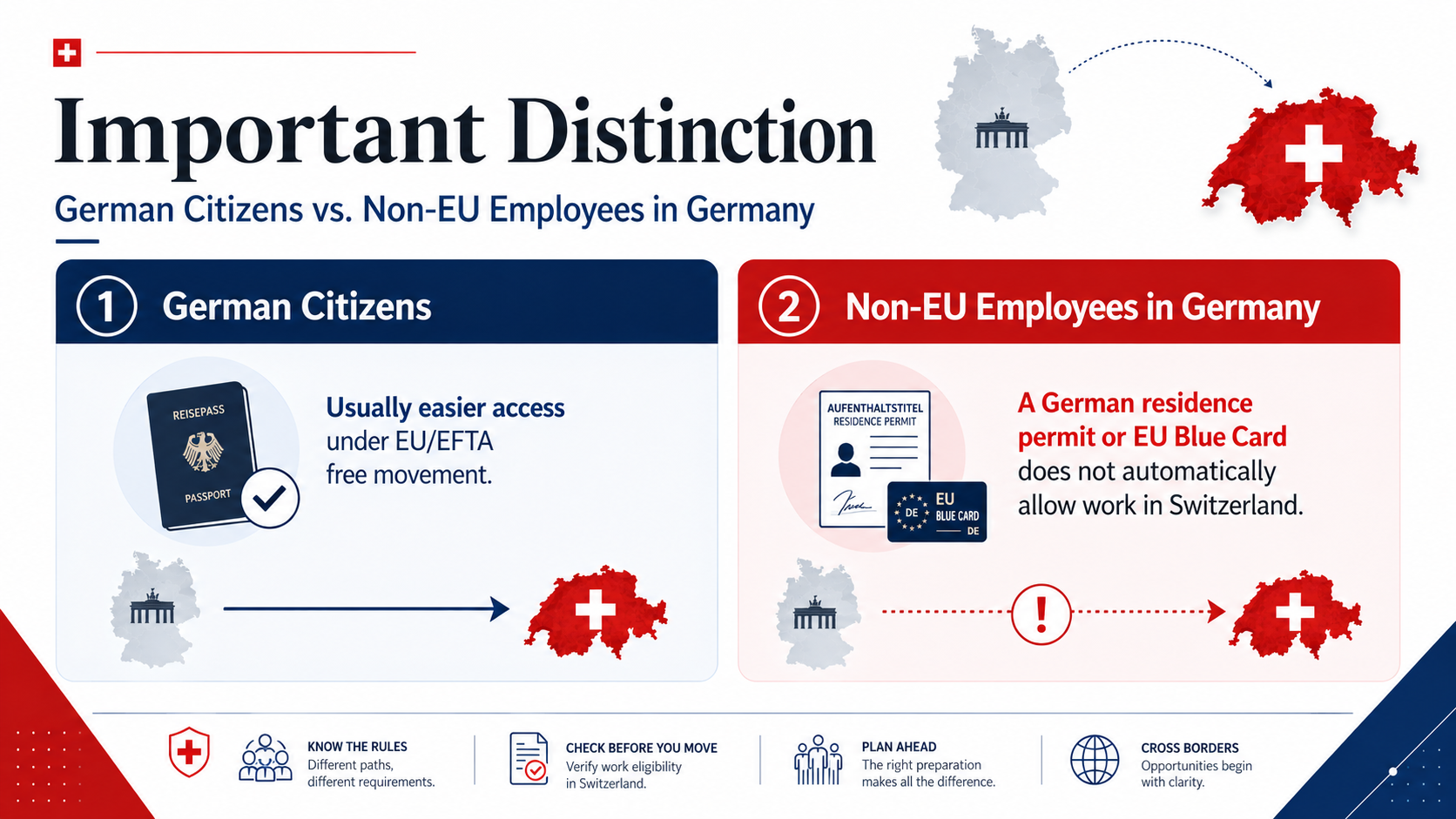
Important Distinction: German Citizens vs. Non-EU Employees in Germany
When comparing Germany and Switzerland, one distinction is important.
A German citizen moving to Switzerland for employment is generally treated as an EU/EFTA national under the Swiss-EU free movement rules. This is a different and usually much easier category.
However, a non-EU employee living or working in Germany does not automatically have the right to work in Switzerland. The Swiss State Secretariat for Migration makes clear that holding a residence permit in an EU/EFTA state does not automatically entitle a third-country national to work in Switzerland. Such a person may still be subject to Swiss third-country admission rules.
This point is especially important for German companies with international employees. A non-EU specialist who already has an EU Blue Card in Germany may be legally employed in Germany, but this does not automatically allow that person to take up employment in Switzerland.
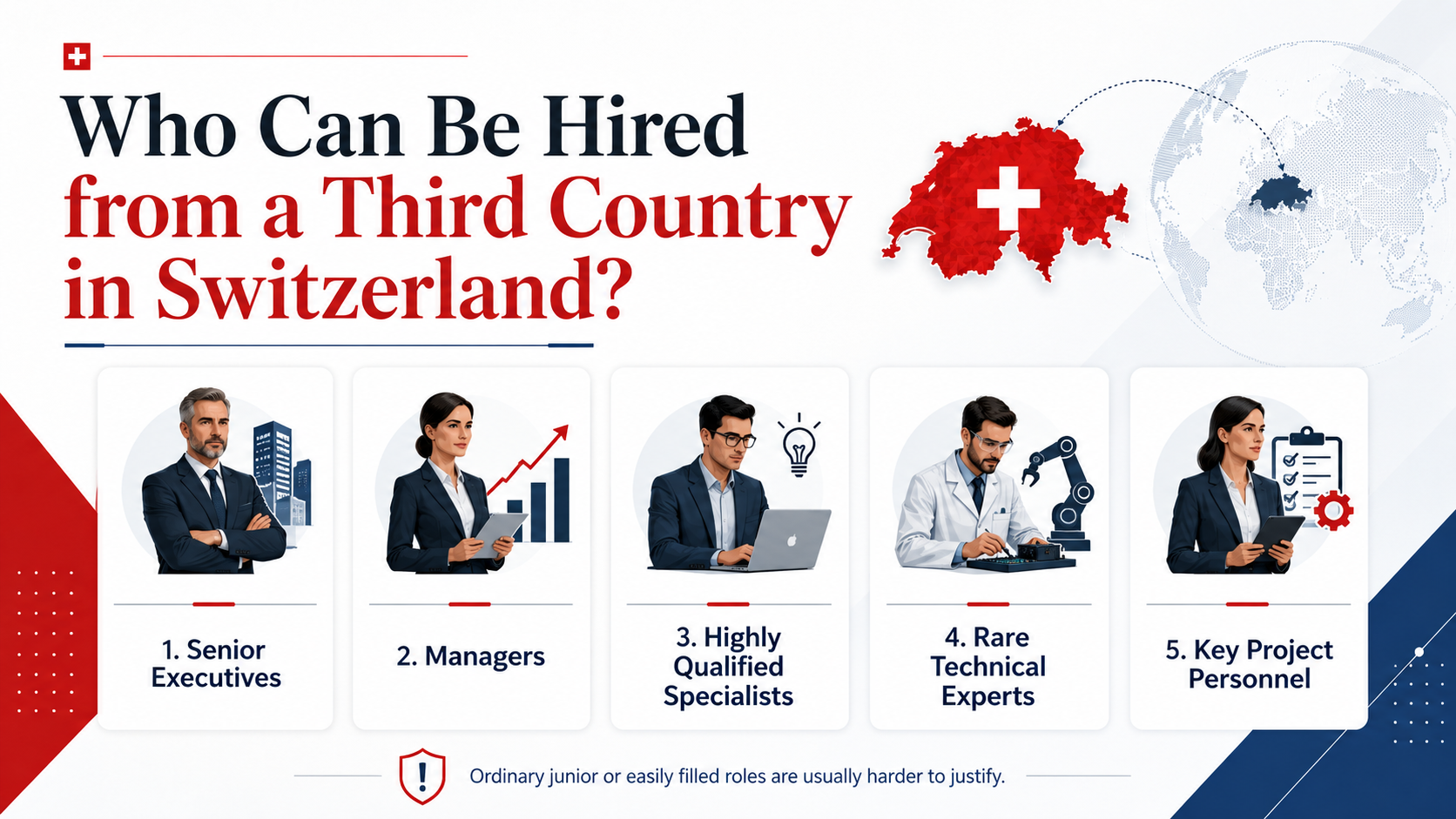
Who Can Be Hired from a Third Country in Switzerland?
Swiss work permits for third-country nationals are generally reserved for:
senior executives,
managers,
highly qualified specialists,
experts with rare technical or industry-specific know-how,
key personnel for strategic business projects,
professionals whose role is clearly important for the Swiss employer and the Swiss economy.
The Canton of Zurich states that permission is granted only to managers, specialists or other qualified workers, and that the admission must correspond to the general interest of the Swiss economy.
This means that Switzerland is not an easy route for ordinary administrative roles, junior positions, general office jobs or roles for which suitable candidates are realistically available in Switzerland or the EU/EFTA labour market.
The Swiss Employer Must Apply
In Switzerland, the work permit process is mainly employer-driven. The foreign employee does not simply apply independently for a “Swiss Blue Card.”
The Swiss employer must submit the work permit application to the competent cantonal authority, usually in the canton where the work will take place.
For example:
A company in Zurich applies through the competent Zurich authority.
A company in Zug applies through the competent Zug authority.
A company in Basel applies through the competent Basel authority.
The canton reviews the application first. If the canton supports the case, the application is usually forwarded to the Swiss State Secretariat for Migration, known as SEM, for federal approval.
The employee may only start working after the required approvals have been granted.
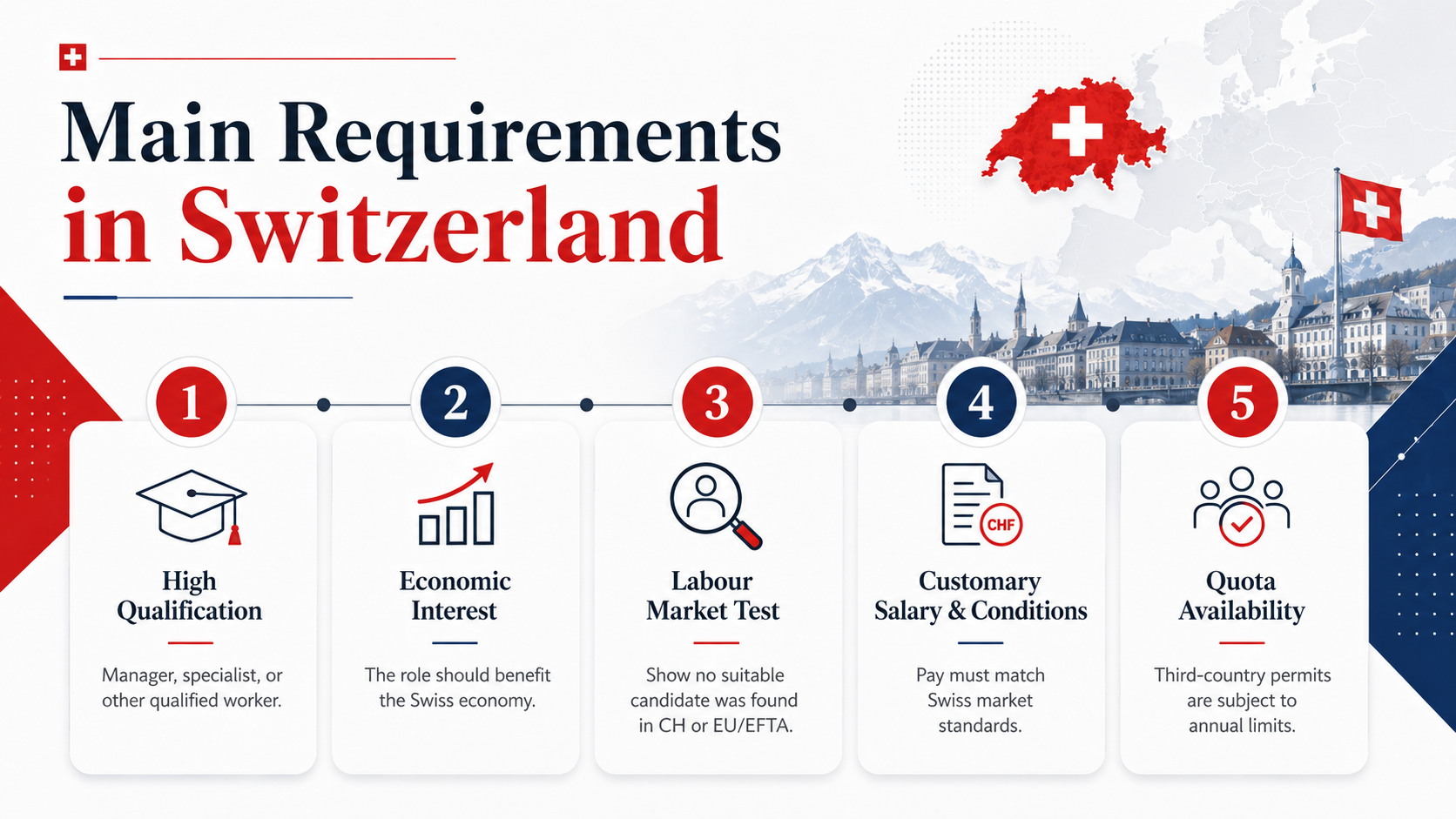
Main Requirements in Switzerland
A Swiss employer usually has to prove several points.
1. The Candidate Must Be Highly Qualified
The candidate should normally be a manager, specialist or otherwise highly qualified worker.
Useful evidence includes:
university degree,
professional certificates,
detailed CV,
reference letters,
employment history,
proof of special technical or industry expertise.
The qualification must match the specific role in Switzerland.
2. The Employment Must Be in Switzerland’s Economic Interest
The role should have a clear business justification. This may include:
know-how transfer,
innovation,
international expansion,
development of new markets,
creation or preservation of jobs,
strategic importance for the Swiss company,
need for a key person in a specific project.
The more ordinary the role, the harder it is to justify. The more specialised or strategic the role, the stronger the case.
3. Labour Market Priority Must Be Respected
This is one of the biggest differences from the German EU Blue Card system.
In Switzerland, the employer must usually show that no suitable candidate could be found in Switzerland or in the EU/EFTA labour market.
Typical evidence may include:
job advertisements,
recruitment agency records,
LinkedIn or industry portal postings,
applicant overview,
reasons why other candidates were not suitable,
explanation why the third-country candidate is uniquely qualified.
This is often called the priority rule or labour market test.
4. Salary Must Be Customary for the Swiss Market
Germany uses clear EU Blue Card salary thresholds.
Switzerland does not use one simple nationwide Blue Card-style salary threshold. Instead, the salary must be customary for the location, profession, sector and seniority of the role.
For a senior manager or specialist, the authorities will expect a salary that reflects a genuine senior or specialist position in the Swiss market.
5. Quotas Apply
Swiss permits for third-country workers are subject to annual quotas.
For 2026, Switzerland allows a maximum of 8,500 qualified workers and specialists from third countries. This consists of 4,500 B residence permits and 4,000 L short-stay permits.
This is another major difference from Germany. Even a strong candidate with a good salary and a valid employment contract still depends on quota availability and official approval.
L Permit or B Permit?
In Switzerland, third-country employees usually receive either an L permit or a B permit.
An L permit is a short-stay permit. It is often used for temporary assignments, project work or initial employment phases.
A B permit is a residence permit. It is usually used for longer-term employment relationships. However, for third-country nationals it is normally limited in time and must be renewed.
Neither permit should be confused with permanent residence.
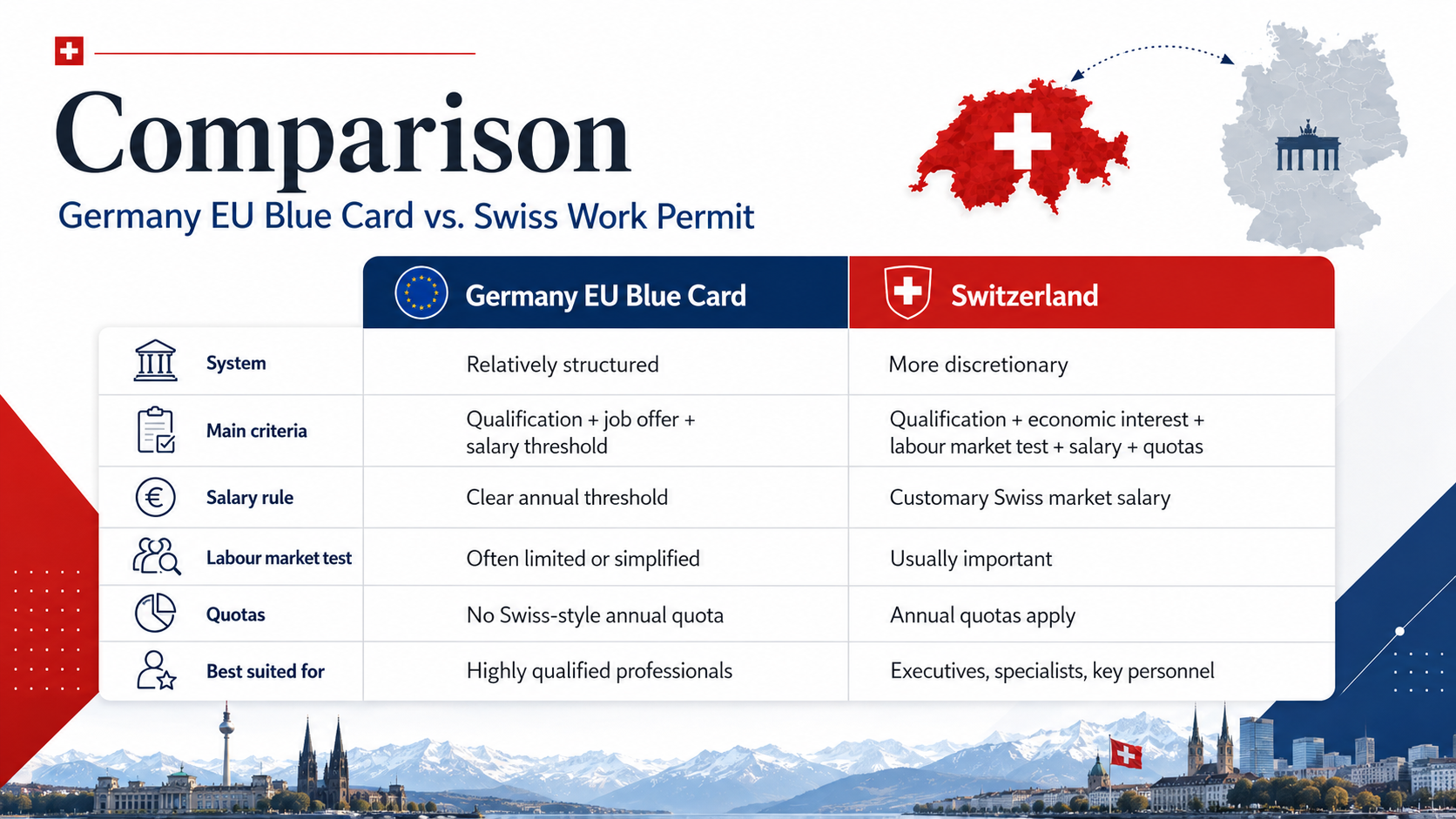
Comparison: Germany EU Blue Card vs. Swiss Work Permit
TopicGermany EU Blue CardSwitzerland Third-Country Work PermitLegal systemEU Blue Card under German lawSwiss national immigration lawPredictabilityRelatively structuredMore discretionaryMain criteriaQualification, job offer, salary thresholdQualification, economic interest, labour market test, salary, quotasSalary ruleClear annual salary thresholdsCustomary salary by canton, sector, role and seniorityLabour market testOften simplified or less centralUsually very importantQuotasNo Swiss-style annual quota systemAnnual quotas applyApplicantOften employee/employer depending on procedureMainly employer-drivenLegal entitlementOften yes if requirements are metNo automatic Blue Card-style entitlementBest suited forHighly qualified professionals meeting salary thresholdExecutives, specialists and key personnel
Practical Example: A German Company Expanding to Switzerland
Imagine a German company has successfully hired several non-EU IT specialists in Germany through the EU Blue Card system. The company now opens a Swiss subsidiary in Zurich or Zug and wants to transfer one of these specialists to Switzerland.
This cannot simply be handled as a continuation of the German Blue Card.
The Swiss subsidiary must check whether the person qualifies under Swiss work permit rules. The fact that the employee already holds a German EU Blue Card may help demonstrate qualification and professional background, but it does not replace the Swiss permit procedure.
The Swiss company must still prepare a Swiss work permit application and show why this person is needed in Switzerland.
Short-Term Assignments from Germany to Switzerland
Another common case is a German company sending an employee to Switzerland for a project.
For EU/EFTA service providers and posted workers, Switzerland has special notification and permit rules. However, third-country nationals employed by a company in an EU/EFTA state are treated differently. In many cases, they must have been admitted permanently to the labour market of that EU/EFTA state before they can be posted to Switzerland under the simplified notification procedure. SEM generally considers this condition met if the person has held a standard or permanent residence permit in that EU/EFTA state for at least twelve months.
This means that a German company should not assume that every non-EU employee on its German payroll can freely work on a Swiss project.
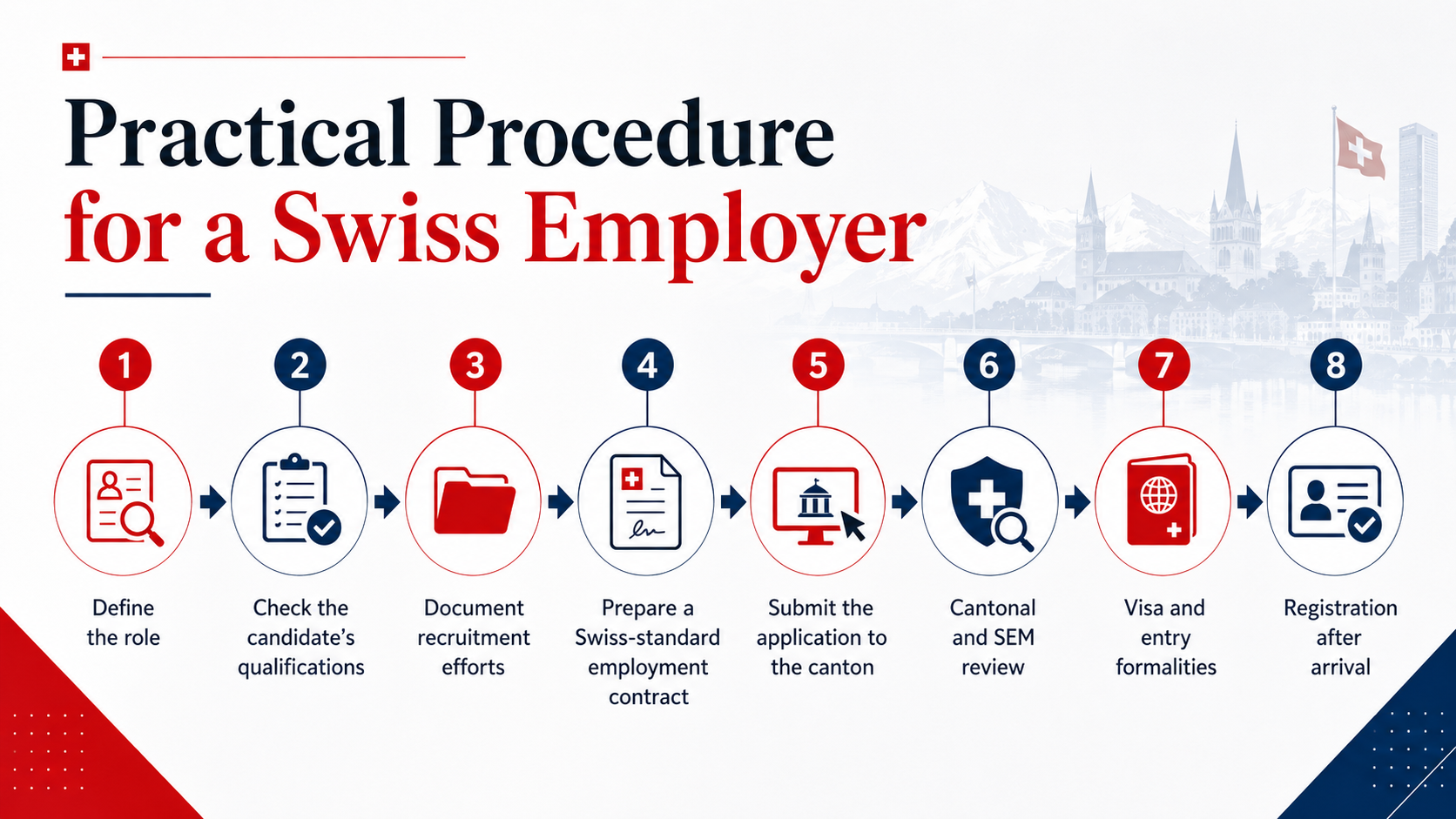
Practical Procedure for a Swiss Employer
A Swiss company that wants to hire a third-country executive or specialist should usually proceed as follows:
Define the role carefully
The job description should show why the position is senior, specialised or strategically important.Check whether the candidate is truly qualified
CV, diplomas, certificates, reference letters and previous experience should match the Swiss role.Document recruitment efforts
The employer should be able to show that suitable candidates were not available in Switzerland or the EU/EFTA area.Prepare a Swiss-standard employment contract
Salary, working hours, benefits and employment conditions should be customary for the location and sector.Submit the application to the canton
The Swiss employer files the application with the competent cantonal labour market or migration authority.Wait for cantonal and federal approval
The canton reviews the file first. If approved, the case is generally forwarded to SEM for federal approval.Complete visa and entry formalities
Depending on nationality and length of stay, the employee may need a national visa before entering Switzerland for work.Register after arrival
After entering Switzerland, the employee must register with the local municipality and receive the relevant residence/work permit documentation.
Practical Conclusion
Switzerland is highly attractive for international companies because of its stability, strong economy, tax environment and reputation as a global business hub.
However, hiring third-country nationals in Switzerland is much more selective than obtaining an EU Blue Card in Germany.
The most important message for employers is:
Switzerland does not have a Blue Card-style shortcut. A Swiss employer must build a strong business case, prove the candidate’s high qualification, respect Swiss salary standards, document labour market efforts and obtain approval from the cantonal and federal authorities before the employee starts working.
For true executives, specialists and strategically important hires, the Swiss route is possible. But it requires careful preparation and should not be treated as a simple visa formality.
Free Consultation
Have questions about entering the German market? Request a free consultation.
Request Free Consultation