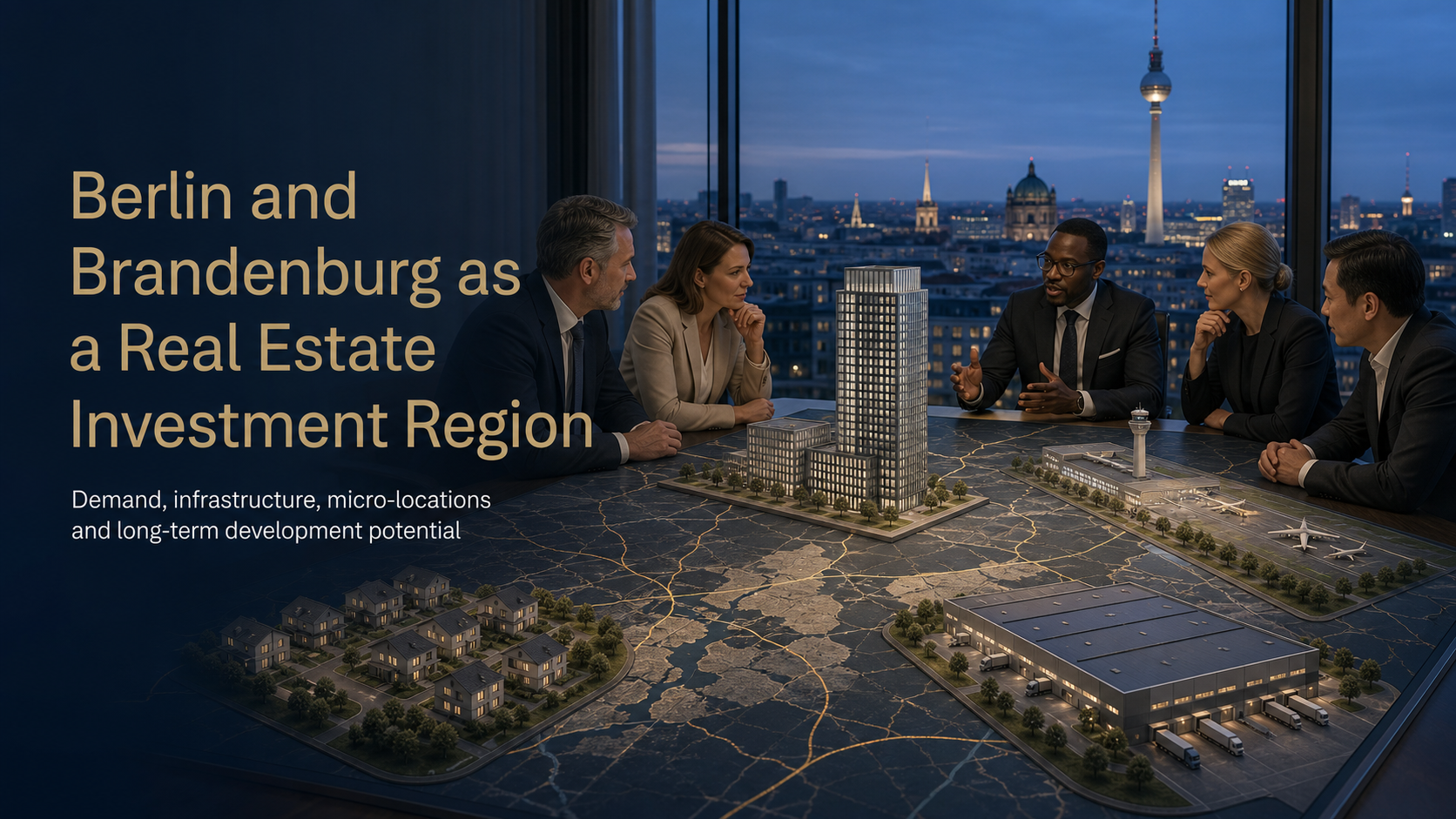
Demand, infrastructure, micro-locations and long-term development potential
Berlin and Brandenburg form one interconnected metropolitan region, but their real estate markets are far from uniform.
Berlin offers the economic strength, international profile and density of a major European capital. The surrounding parts of Brandenburg provide additional land, commercial development areas, logistics locations and expanding residential communities.
For international investors, this combination can create attractive opportunities. However, success depends less on the general reputation of Berlin and more on selecting the right property, use concept and micro-location.
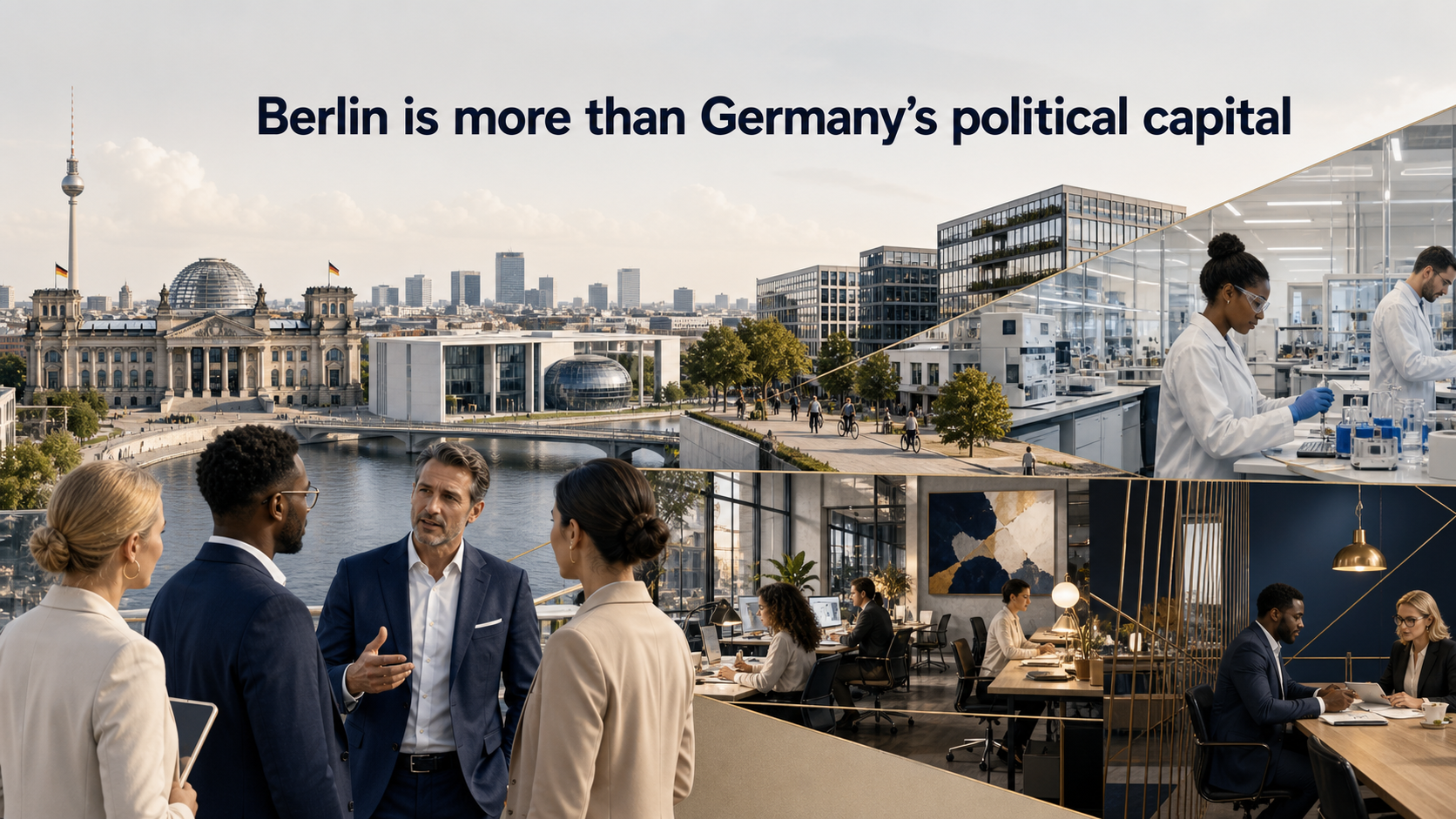
Berlin is more than Germany’s political capital
Berlin is the seat of the German government, but its economic importance extends far beyond public administration.
The city is an established location for technology, life sciences, healthcare, media, creative industries, mobility and professional services. Its universities, research institutions, international workforce and start-up environment support demand for offices, laboratories, commercial space and housing.
Berlin’s economy also continued to grow in 2025 despite the comparatively weak performance of the German economy as a whole. Official statistics recorded real economic growth of 1.1% in Berlin, compared with 0.2% for Germany. Official economic data for Berlin
This economic diversity does not protect every property from market risk. It does, however, give the region a broader demand base than locations dependent on a single industry or major employer.
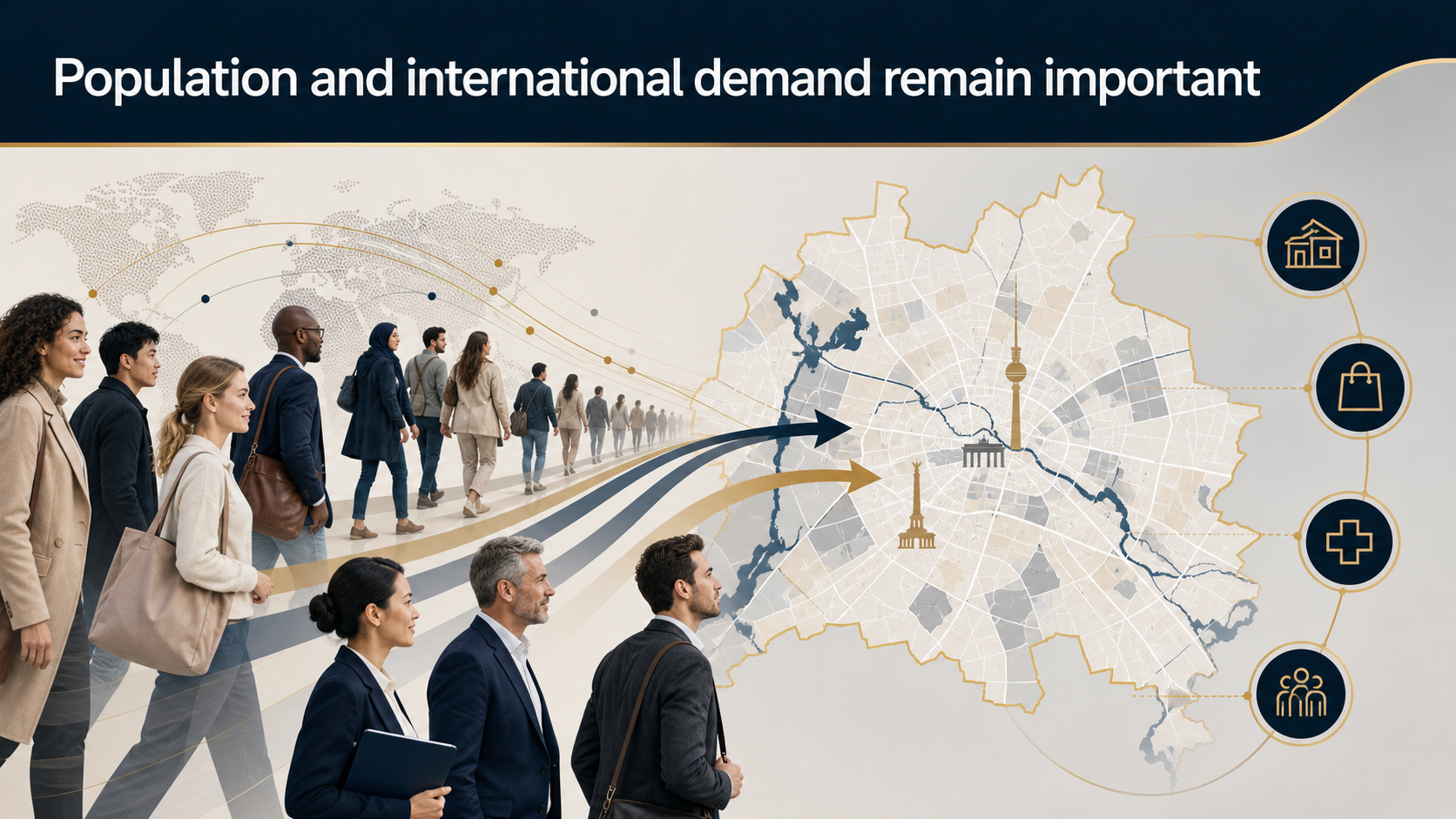
Population and international demand remain important
According to the official population calculation, Berlin exceeded 3.7 million residents at the end of 2025. Its population increased moderately, primarily because more people moved to Berlin than left the city.
Berlin is also highly international. People from 194 nationalities were living in the city at the end of 2025. Official Berlin population statistics
Population growth can support demand for housing, retail, healthcare facilities and local services. Nevertheless, demographic development differs considerably between districts and neighbourhoods.
An increasing city-wide population does not automatically guarantee higher rents or values for every individual property.
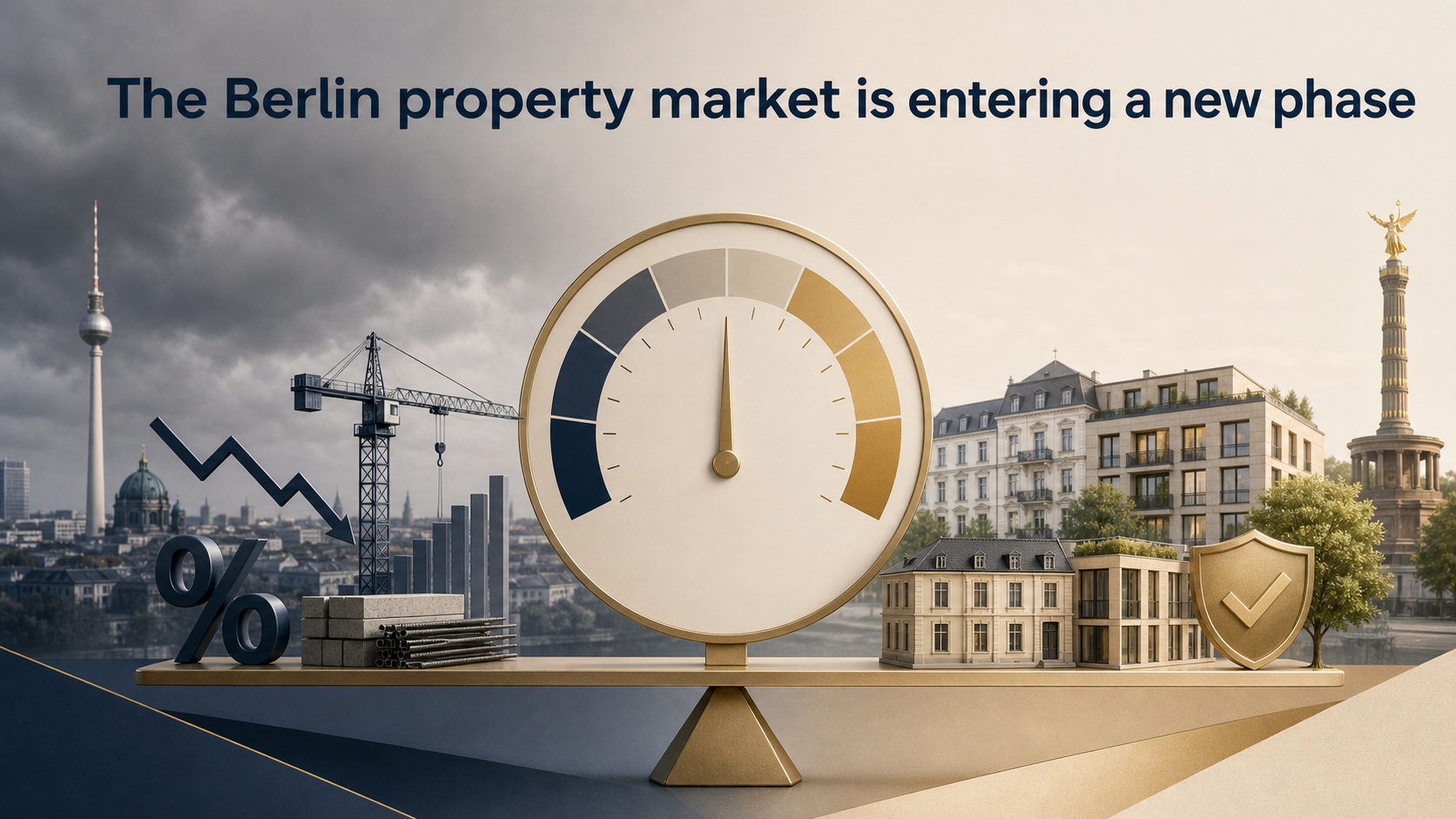
The Berlin property market is entering a new phase
The sharp rise in interest rates and construction costs changed the German property market. Financing became more expensive, transactions declined and buyers became more selective.
This correction did not eliminate Berlin’s structural demand. Instead, it created a market in which prices, financing and property quality must be assessed more carefully.
The 2025 IBB Housing Market Report described a challenging environment with continuing high housing demand and difficulties in new construction. Median asking rents stagnated in 2025 after two years of strong increases, while asking prices for condominiums showed moderate recovery. IBB Housing Market Report 2025
Investors should not interpret short-term stabilisation as proof that the market has reached its definitive lowest point. A purchase should remain viable under conservative assumptions concerning interest rates, vacancies, renovation costs and achievable rents.
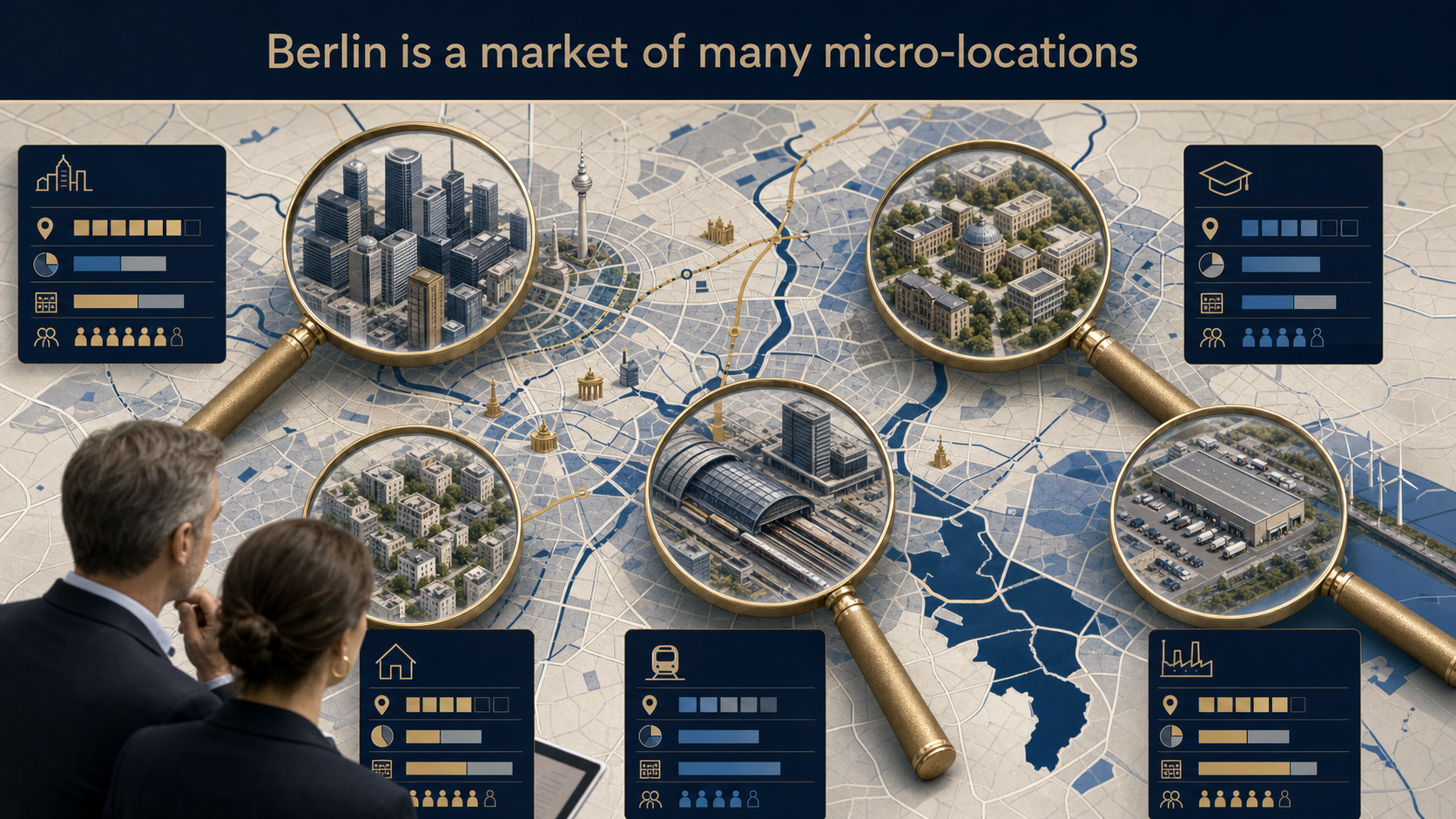
Berlin is a market of many micro-locations
The expression “Berlin property” is too broad for a serious investment decision.
A property in an established central office district has a different risk profile from a mixed-use building in an outer district. A logistics facility near the motorway must be assessed differently from a neighbourhood retail property or a development site.
Important micro-location factors include:
public transport and road connections;
proximity to employment centres and universities;
population and household development;
the surrounding commercial structure;
competing projects and available space;
planning and construction law;
local rent and vacancy levels; and
the property’s future suitability for alternative uses.
Even within the same district, two properties located only a short distance apart may have very different investment prospects.
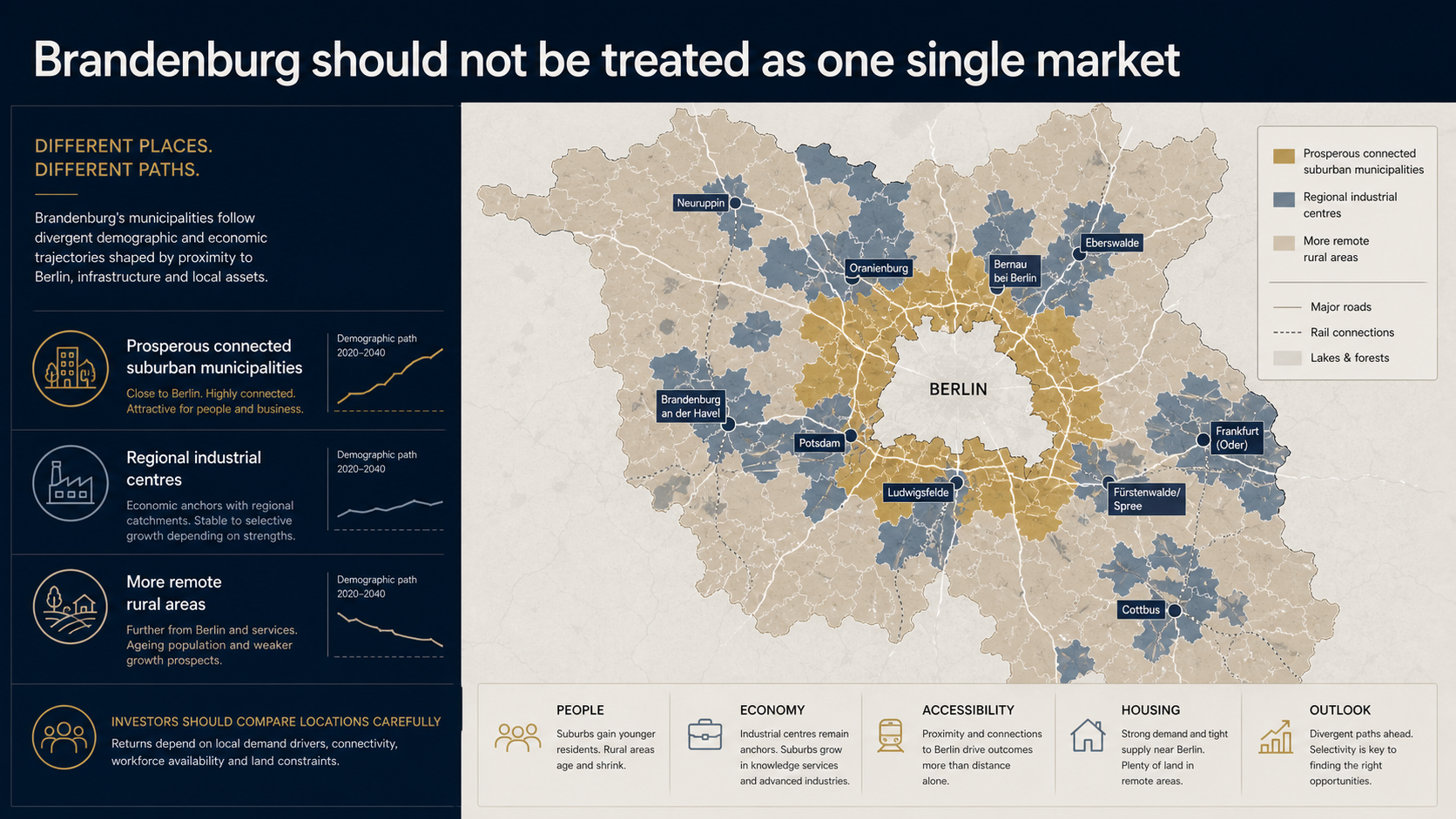
Brandenburg should not be treated as one single market
Brandenburg surrounds Berlin, but the state contains very different economic and demographic areas.
Municipalities close to Berlin can benefit from commuters, residential demand, business relocations and infrastructure connections. Locations farther away may follow different economic and population trends.
Official statistics illustrate this distinction. In 2024, the population of the area surrounding Berlin increased, while the more distant metropolitan area recorded an overall decline. Official Brandenburg population statistics
For an investor, the label “Brandenburg” therefore says very little by itself. Accessibility, municipal planning, employers, infrastructure and local demand must be examined for the specific town and site.

The airport region creates a separate investment corridor
Berlin Brandenburg Airport is not only a transport facility. It forms part of a wider development corridor in the south-east of the capital region.
The surrounding locations can be relevant for logistics, hotels, offices, light industrial property, data-related infrastructure and airport-oriented services. In 2025, approximately 26.1 million passengers travelled through BER Airport. BER Airport Annual Report 2025
However, proximity to the airport alone does not guarantee investment success.
Investors must examine road and rail access, noise restrictions, planning law, competing developments, utility capacity and the actual demand from potential occupiers. A site marketed as being in the “airport region” may still be poorly connected in practice.
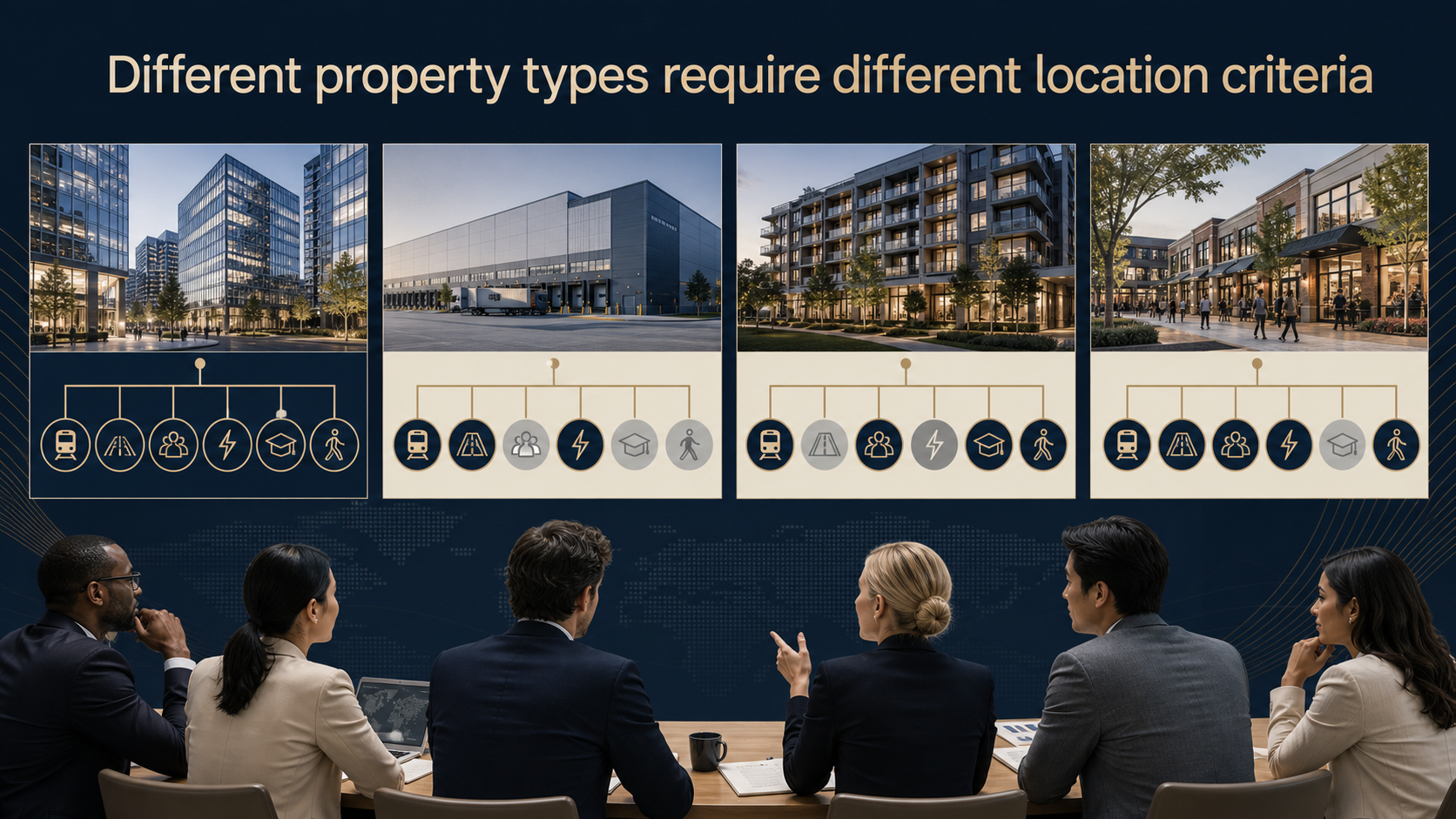
Different property types require different location criteria
Berlin and Brandenburg offer opportunities across several real estate segments, but each segment follows its own logic.
Office investments depend on public transport, building quality, energy performance, flexible floor plans and the strength of the local employment market.
Logistics and light industrial properties require motorway access, delivery capability, suitable land, sufficient electricity and realistic distances to customers and labour.
Residential investments depend on local household structures, affordability, schools, everyday services and legal rent restrictions.
Retail property must be assessed according to purchasing power, footfall, accessibility, competition and the long-term viability of the tenant’s business model.
Development land requires particularly careful examination because its value depends heavily on planning law, infrastructure and the realistic timetable for obtaining permission.

Infrastructure can create value—but expectations must be realistic
New railway links, public transport improvements, roads, schools and commercial developments can strengthen a location over time.
However, investors should distinguish between:
infrastructure that is already operational;
projects that have secured financing and approval;
projects that are politically planned but not yet binding; and
purely promotional expectations.
A future transport connection may increase a site’s potential, but delays of several years can fundamentally change the investment calculation.
The purchase price should therefore reflect the location as it exists today. Future infrastructure should normally be treated as an additional opportunity rather than a guaranteed component of value.

Existing buildings and development projects involve different risks
An existing property with stable tenants can provide immediate rental income. Its risks may include technical defects, expiring leases, inefficient energy performance and future renovation requirements.
A development project can offer greater value-creation potential but introduces additional risks:
planning and building permission;
construction costs and delays;
financing during the development period;
environmental and soil conditions;
infrastructure contributions;
letting or selling the completed space; and
changes in demand before completion.
International investors should avoid evaluating development land solely by comparing its price per square metre with completed properties. The legal and practical ability to develop the site is the decisive factor.
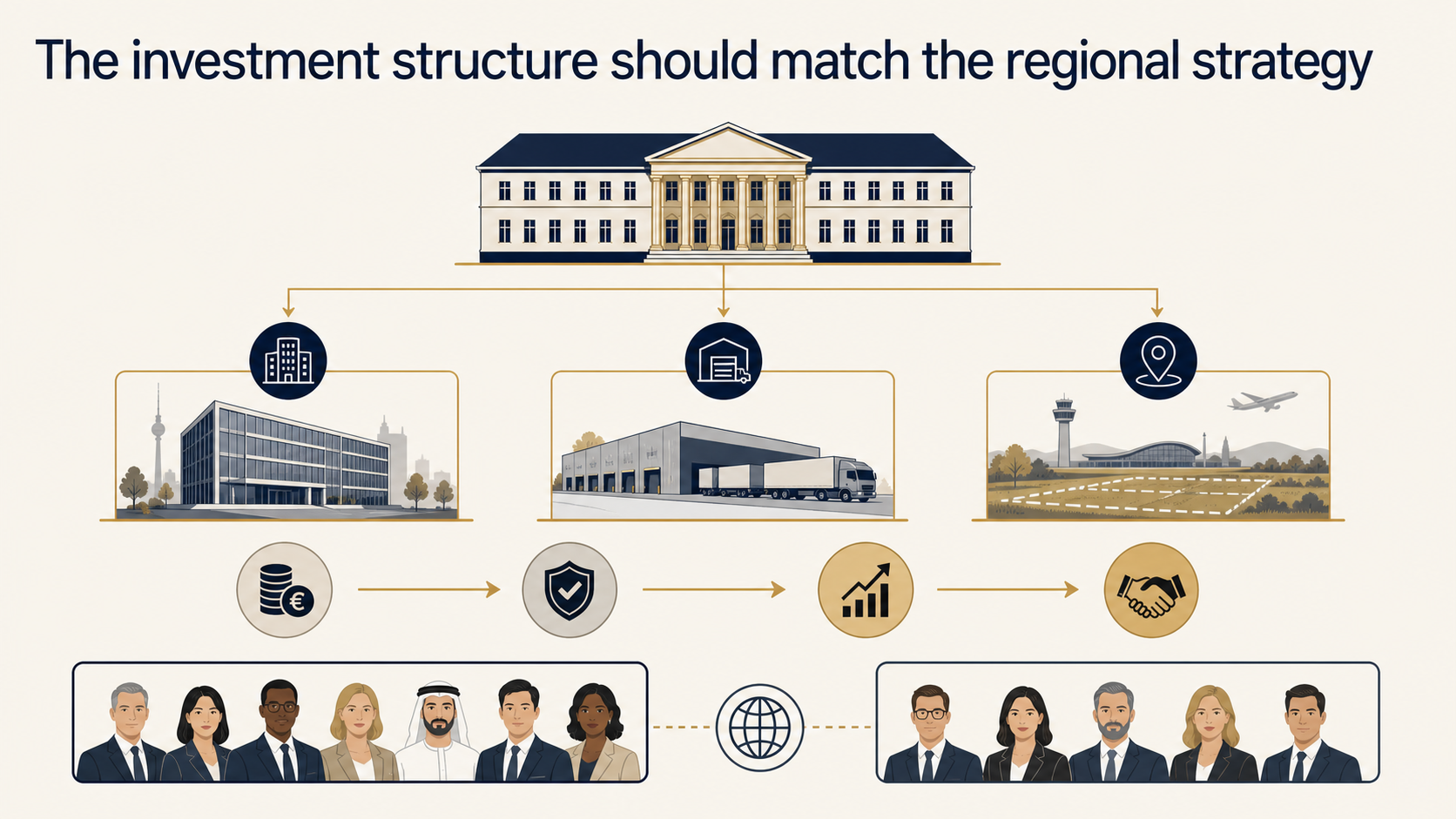
The investment structure should match the regional strategy
The legal structure should reflect the number, location and risk profile of the planned investments.
A single property may be held through one German property company. A larger portfolio can justify a holding company with separate subsidiaries for different properties or development projects.
For example, a Berlin office property, a Brandenburg logistics facility and a development site near the airport may be placed in separate companies. This can improve risk separation, financing transparency and the later sale of an individual investment.
The structure should be established before the relevant acquisition whenever possible. Moving a property or company into a different structure later can create taxes, financing issues and additional transaction costs.
Conclusion
Berlin and Brandenburg offer international investors a combination of metropolitan demand, international business activity, infrastructure and available development space.
Berlin provides density, economic diversity and global visibility. Brandenburg can offer additional land, specialised commercial locations and access to the wider metropolitan growth corridor.
But the region should never be assessed through a general slogan such as “Berlin will always grow.” Property type, micro-location, financing, planning law, energy condition and local demand remain decisive.
The strongest investment is not necessarily the property closest to central Berlin. It is the property whose location, use concept, legal structure and financial assumptions continue to work under realistic long-term conditions.
This article provides general information only and does not constitute legal, tax, financial or investment advice. Every property and location should be reviewed individually before an acquisition decision is made.
Free Consultation
Have questions about entering the German market? Request a free consultation.
Request Free Consultation