
Market access, the notary, the land register, proof of funds, anti-money-laundering checks and sanctions
Germany is generally open to international property investors. Foreign individuals and foreign companies can normally acquire apartments, houses, commercial buildings and development sites without German citizenship or permanent residence.
This distinguishes Germany from countries that impose special quotas, residency requirements or general approval procedures on foreign property buyers.
Nevertheless, access to the market does not mean that every transaction is easy. International investors must pass identity, beneficial-ownership, source-of-funds and sanctions checks. They must also understand the role of the German notary, the land register and the banking system.
The practical question is therefore not merely:
“Am I legally permitted to buy?”
It is also:
“Can I provide all the documents and operational structures required to complete the transaction safely and on time?”
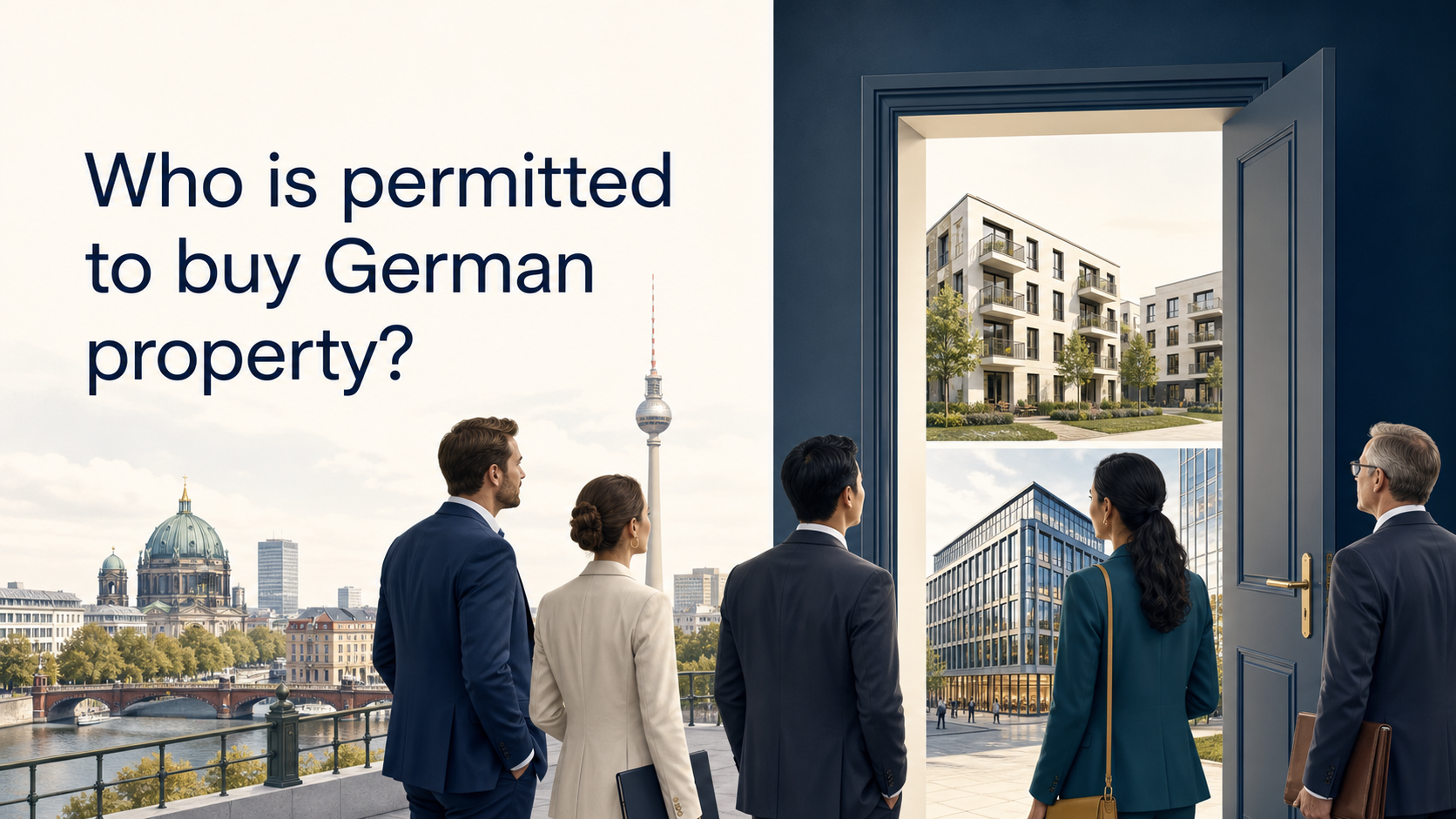
Who is permitted to buy German property?
As a general rule, German real-estate law does not distinguish between German and foreign buyers solely on the basis of nationality.
Property may usually be acquired by:
a foreign private individual;
several private investors jointly;
a foreign company;
a German GmbH owned by foreign shareholders;
a partnership or investment vehicle; or
a German property company within an international holding structure.
A German residence permit is generally not required to acquire property. However, buying property does not automatically give the investor the right to live or work in Germany. Property ownership and immigration status are separate legal matters.
Special rules can apply to particular assets, including agricultural or forestry land, properties in protected areas and acquisitions involving companies in security-sensitive sectors. An ordinary apartment, residential building or commercial property is not normally subject to a general foreign-investor approval procedure.

The buyer must be identified precisely
Before preparing the purchase agreement, the notary must establish who is buying the property.
For a private investor, the required information and documents will normally include:
a valid passport;
the buyer’s full legal name;
date and place of birth;
residential address;
nationality;
marital status and, where relevant, the applicable matrimonial-property regime; and
German tax information, where required.
If the buyer acts through a representative, the notary must examine the power of attorney. Documents signed abroad may require notarisation, an apostille, legalisation or a certified German translation.
The requirements become more extensive when the purchaser is a foreign company. The notary may request:
a current commercial-register extract;
the articles of association;
evidence that the company legally exists;
documents identifying its directors;
proof of their authority to represent the company;
a complete shareholder structure; and
information identifying the ultimate beneficial owners.
Documents from foreign registers may need to be certified, apostilled and translated. Obtaining and verifying these documents can take much longer than international investors initially expect.
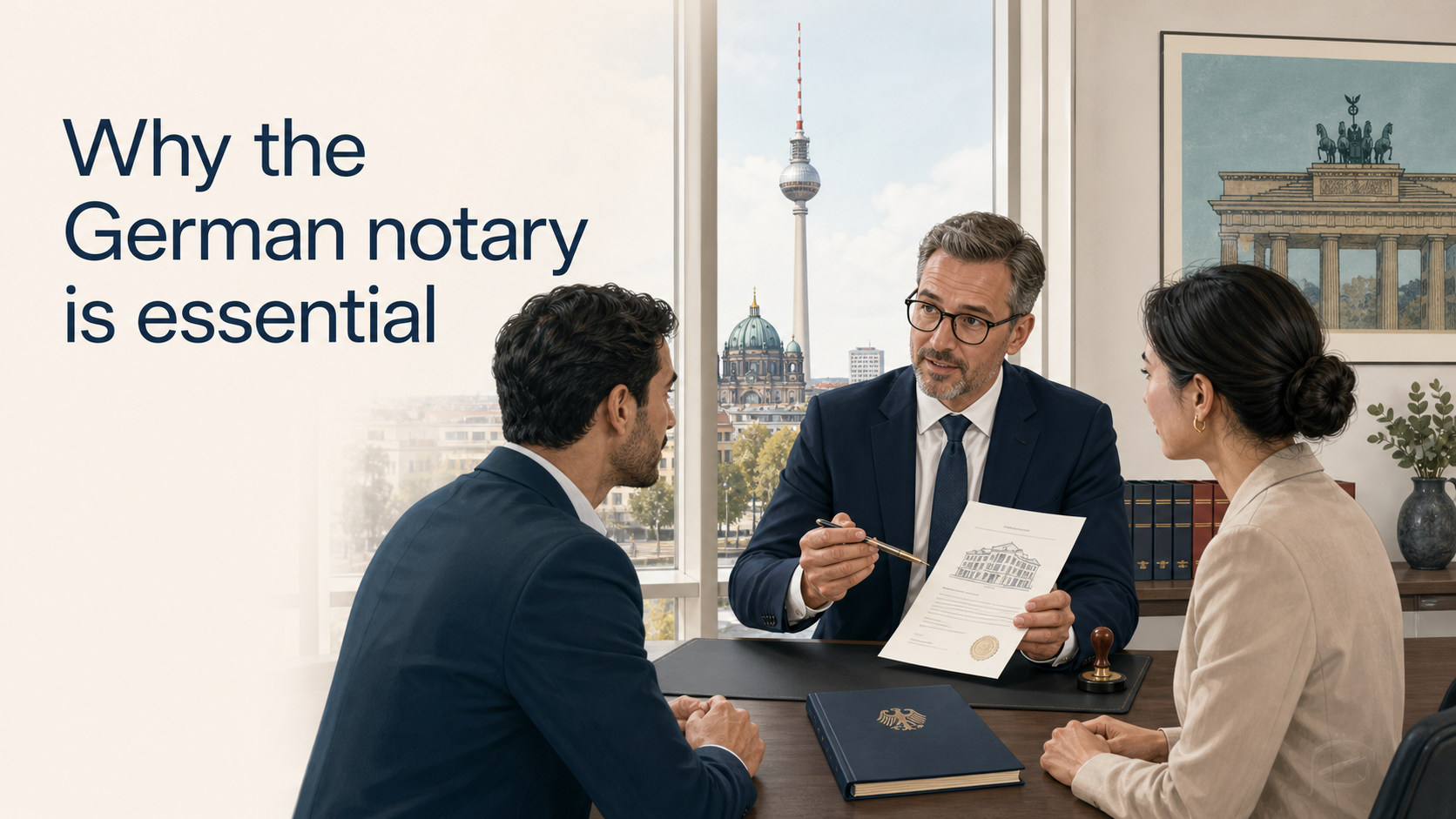
Why the German notary is essential
A contract for the purchase of German real estate generally requires notarisation. A privately signed purchase agreement is not sufficient to complete an ordinary property transfer.
The notary is a public officeholder who must act independently and impartially. The notary does not represent only the seller or only the buyer.
The notary normally:
prepares or reviews the purchase agreement;
verifies the identity and authority of the parties;
explains the legal content of the deed;
records the parties’ declarations;
arranges the priority notice protecting the buyer;
obtains certain official confirmations and approvals;
submits applications to the land registry; and
coordinates the legal steps leading to the transfer of ownership.
However, the notary does not replace the investor’s own legal, tax, financial or technical advisers. The notary does not normally determine whether the purchase price is commercially reasonable, whether the building requires extensive renovation or whether the chosen ownership structure is tax-efficient.
International investors should therefore complete their own due diligence before signing the notarised agreement.

The land register determines legal ownership
German real estate is recorded in the land register, known as the Grundbuch. The registers are maintained by the local courts acting as land-registry offices.
The land register contains important information about the property, including:
the registered owner;
the legal description of the land;
mortgages and land charges;
rights of way;
residential or usufruct rights;
pre-emption rights; and
other registered encumbrances.
Signing the purchase agreement and paying the purchase price do not by themselves make the buyer the registered owner.
Ownership normally passes only after the required conveyance declarations have been made and the buyer has been entered in the land register. Before payment, a priority notice—an Auflassungsvormerkung—is usually registered to protect the buyer’s future ownership claim.
The purchase price ordinarily becomes due only after the agreed legal safeguards are in place. The notary sends the buyer a formal payment notice once the relevant conditions have been satisfied.
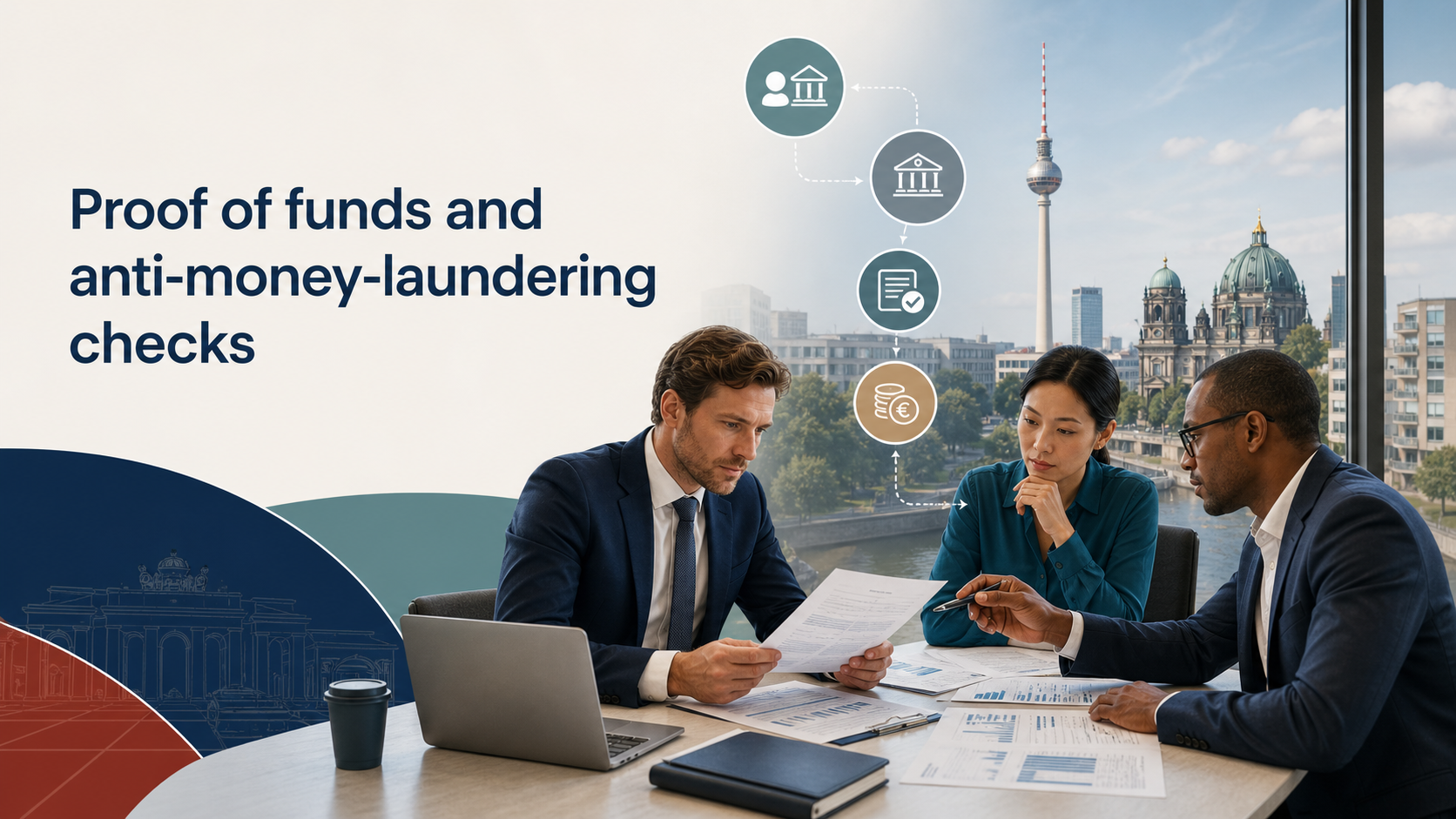
Is proof of funds required?
There is no single standard certificate that every foreign buyer must obtain before purchasing German property. Nevertheless, proof of available capital is extremely important in practice.
A seller or estate agent may request evidence of liquidity or financing before reserving the property or entering into serious negotiations. If the acquisition is financed by a bank, the seller will normally expect a financing confirmation.
Banks, notaries and other obligated parties may also request information about the origin of the money. Depending on the transaction, suitable evidence may include:
bank statements;
savings and investment records;
audited company accounts;
tax returns;
loan agreements;
dividend resolutions;
contracts documenting the sale of a company or another property;
inheritance documents; or
records showing the relationship between the investor and the paying company.
It is not always enough to demonstrate that the money exists. The investor may also have to show how it was accumulated, who legally owns it and why a particular person or company is transferring it.
Large last-minute transfers through several companies, family members or unrelated third parties can delay the transaction substantially.

Anti-money-laundering checks are part of the transaction
German notaries are subject to strict anti-money-laundering obligations. They must identify the parties and, where a company or another legal structure is involved, determine the natural persons who ultimately own or control it.
An investor should therefore expect questions about:
the ownership and control structure;
the ultimate beneficial owners;
the investor’s occupation or business activity;
the economic purpose of the acquisition;
the relationship between the buyer and the source of the money;
the countries through which the funds will be transferred; and
unusual payment arrangements.
A complex company structure is not prohibited merely because it is complex. However, every level should have a comprehensible commercial or legal function, and the beneficial owners must be disclosed to the parties legally required to identify them.
If the necessary information cannot be obtained or the transaction appears suspicious, the notary may be unable to proceed.
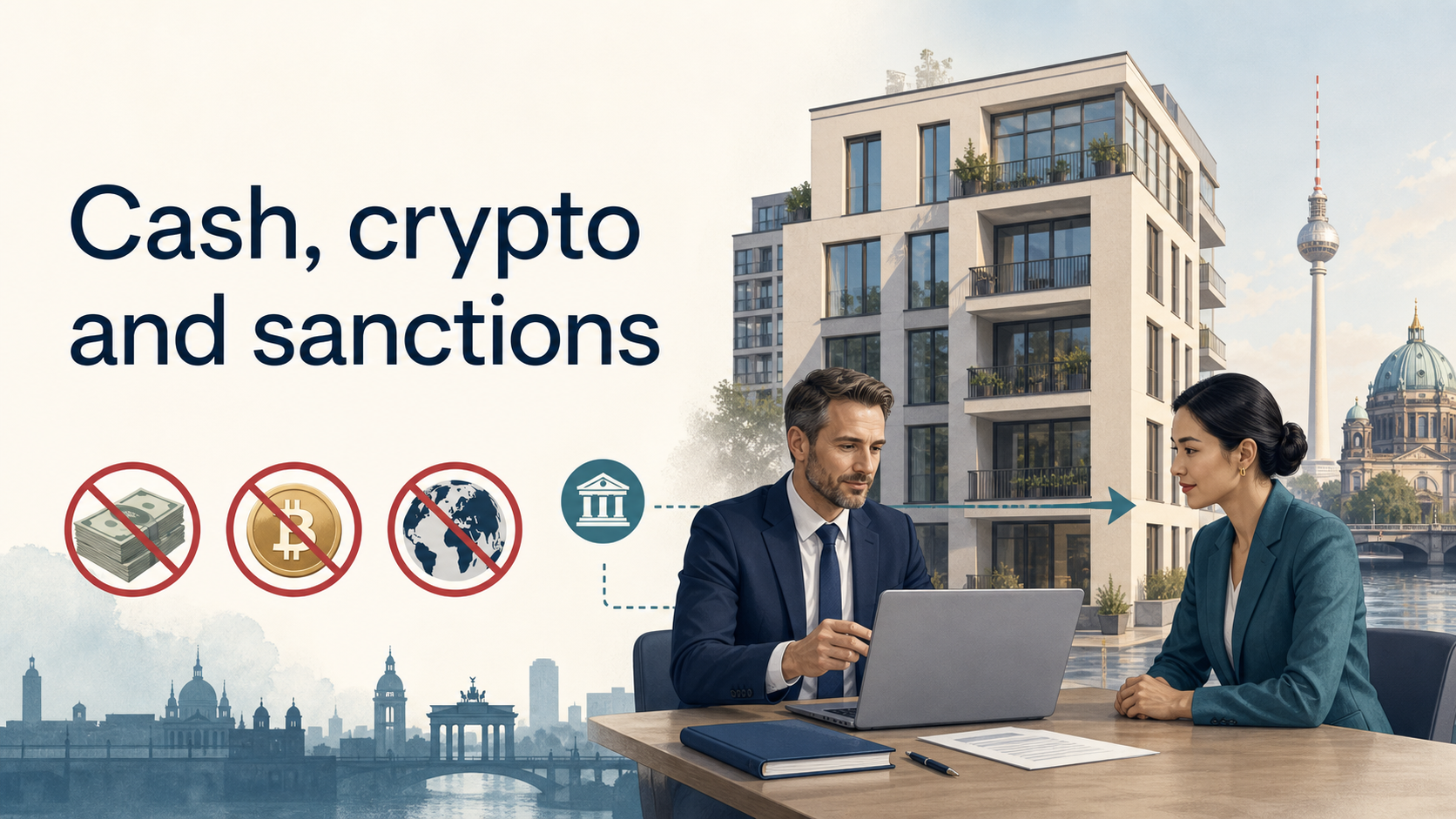
Cash and crypto payments are not permitted
German anti-money-laundering legislation prohibits the purchase price for German real estate from being paid in cash, crypto-assets, gold, platinum or precious stones. The prohibition also covers certain acquisitions of shares in companies that directly or indirectly own German real estate.
The parties must demonstrate to the notary that the purchase price was paid by permitted means. Bank confirmations or suitable account records can serve as evidence.
The payment route should therefore be planned before the agreement is signed. The account holder, contractual buyer and documented source of the funds should fit together coherently.
Using a third party to transfer the purchase price without a clearly documented reason can create additional compliance questions.
What happens when sanctions apply?
Market access is also limited by German, European Union and international financial sanctions.
Sanctions may prohibit making funds or economic resources available to listed persons, companies or organisations. A property transaction can therefore be blocked when:
the buyer or seller is sanctioned;
a sanctioned person owns or controls one of the companies involved;
the purchase money comes from a blocked account;
a bank is prohibited from processing the payment; or
the transaction would indirectly make an economic resource available to a sanctioned person.
The review is not limited to the names appearing in the purchase agreement. Ownership and control behind companies, trusts, nominees and holding structures may also be relevant.
A buyer who is not personally listed can therefore still face restrictions if a sanctioned person ultimately owns or controls the purchasing entity.
Sanctions rules can change quickly. Transactions involving higher-risk countries, politically exposed persons or complicated international structures should be examined before a binding commitment is made.
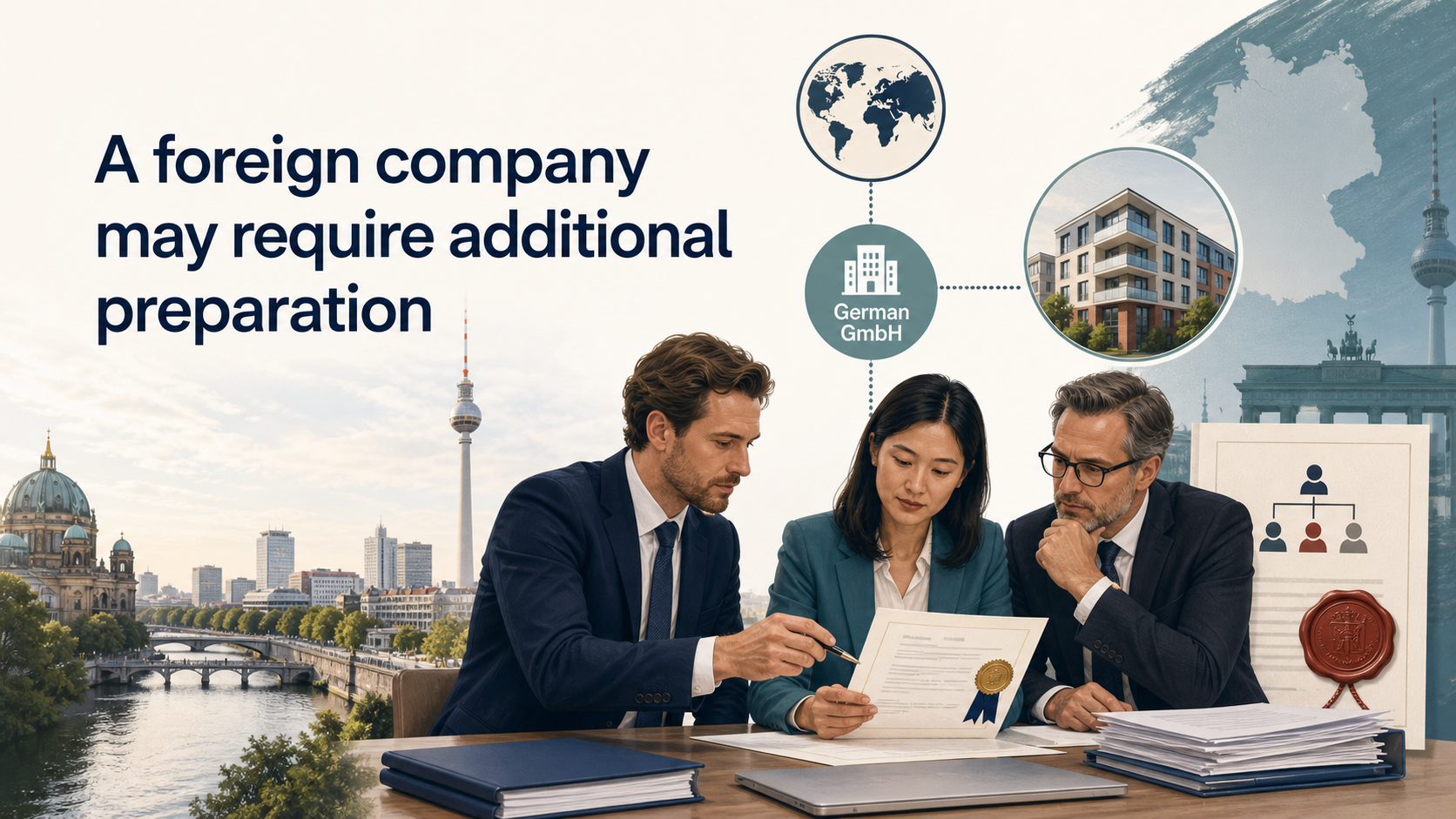
A foreign company may require additional preparation
An international company can generally purchase German property directly. However, direct acquisition is not always the most practical solution.
The foreign company may need to address:
German tax registration;
beneficial-ownership reporting;
recognition of foreign corporate documents;
German accounting and tax-return obligations;
local bank accounts;
financing and security arrangements; and
taxation of rental income and a later sale.
For some investors, establishing a German property company can simplify administration, financing and future acquisitions. For others, direct acquisition by the foreign company may be more efficient.
The correct structure depends on the investment purpose, financing, number of properties, expected holding period and exit strategy. It should be selected before the notarised property agreement is concluded.

An existing German company can save valuable time
Foreign investors do not necessarily have to establish a new German company. Acquiring an existing GmbH can be a practical alternative and may save considerable time.
In theory, establishing a German GmbH appears relatively straightforward. In practice, the process can become much more time-consuming when the sole shareholder is a foreign company.
The incorporation itself is only one part of the process. The company may also need:
registration in the German Commercial Register;
a German business address;
tax registration;
beneficial-ownership registration;
a functioning business bank account;
documentation concerning the foreign shareholder; and
verification of all ultimate beneficial owners.
Foreign corporate documents may have to be certified, apostilled and translated. If the international ownership structure contains several corporate levels, banks and other institutions may request documents for every level.

The business bank account is often the real bottleneck
Opening a German business bank account can take considerably longer than the formal incorporation of the GmbH.
This is particularly relevant when a foreign company owns 100 percent of the German subsidiary. The bank may examine:
the foreign parent company;
its directors and authorised representatives;
all direct and indirect shareholders;
the ultimate beneficial owners;
the source of the share capital;
the expected business activities;
the countries from which payments will be received; and
the commercial reason for establishing the German company.
Requests for additional documents, certified translations and explanations can extend the process over several weeks or even months. Some banks may ultimately decide not to open the account despite the time already invested.
This is an area in which theory and practice frequently differ. A company may already exist legally but still be unable to conduct ordinary business because it does not have an operational bank account.
A German holding structure can take even longer
The practical difficulty becomes greater when the foreign investor intends to establish a German holding structure consisting of at least two companies:
a German holding company; and
a German property or operating subsidiary.
The holding company must be established so that it can act as the shareholder of the subsidiary. Certain preparatory steps may be coordinated, but both companies require their own corporate documentation, registrations, tax treatment and banking arrangements.
The investor may consequently face similar compliance procedures more than once. The bank must understand not only the foreign parent company but also the complete ownership chain from the ultimate beneficial owner through the German holding company to the property company.
A structure that looks simple on an organisational chart may therefore require several months before it becomes fully operational.
Why an existing GmbH may be valuable
An existing German company may already have:
a completed Commercial Register entry;
a German tax number;
an established company address;
accounting records;
administrative processes; and
a functioning bank relationship.
Acquiring such a company can eliminate some of the waiting periods connected with a new formation. This can be particularly valuable when the investor has already identified a property and must comply with financing, signing or payment deadlines.
The transfer of GmbH shares still requires notarisation. The new shareholder and beneficial owners must also be disclosed. Furthermore, the company’s bank will normally conduct a new customer and ownership review. A change of ownership does not guarantee that the existing account will remain available without further examination.
Nevertheless, updating an existing and transparent structure may be considerably faster in practice than establishing a completely new foreign-owned company and opening its first business account from the beginning.
The company’s history must still be examined
Before acquiring an existing GmbH, the investor should confirm that the company has no undisclosed liabilities, outstanding creditor claims or other legacy risks.
The notarised share-purchase agreement should contain appropriate warranties from the seller and an indemnity protecting the purchaser against undisclosed obligations originating before the transfer. Such provisions normally regulate the relationship between buyer and seller; they do not eliminate valid claims that third-party creditors may have against the company.
A limited legal, financial and tax review therefore remains necessary to prevent unexpected liabilities after the acquisition.

Structure and timing must be planned together
For international investors, the legal form cannot be considered separately from the practical timetable.
Before entering into a binding property transaction, the investor should determine:
whether to buy personally or through a company;
whether a German GmbH is required;
whether a holding structure is appropriate;
how long incorporation and registration may take;
which bank is prepared to accept the ownership structure;
which foreign documents will be required;
how the purchase price will be transferred; and
whether acquiring an existing company would be more efficient.
The correct structure may offer tax, liability and organisational advantages. However, those advantages are of limited value if the structure is not operational by the time the property must be acquired.
For foreign investors, early preparation is therefore not merely a legal recommendation. It is a practical requirement.
A practical document checklist
A foreign investor should ideally prepare the following before making a binding offer:
passports and address documents;
details of marital status;
company and shareholder documents, where applicable;
evidence of representation authority;
beneficial-ownership information;
certified translations and apostilles where necessary;
proof of equity;
a financing confirmation if external finance is required;
documents explaining the source of funds;
the intended payment route;
tax advice on the proposed acquisition structure; and
a preliminary sanctions and compliance review.
Preparing these items early can prevent the expiry of financing offers, missed payment deadlines and conflicts with the seller.

Conclusion: an open market with a demanding process
Foreigners can generally buy property in Germany. Citizenship and residence are not normally the decisive barriers.
The real challenges arise during the execution of the transaction: establishing the buyer’s identity, documenting corporate authority, identifying beneficial owners, explaining the origin of the investment capital and completing sanctions and anti-money-laundering checks.
For corporate investors, another challenge is making the acquisition structure operational. A newly incorporated GmbH may exist legally while still waiting for tax registration or a business bank account. Establishing a two-level German holding structure can require even more time.
Acquiring an existing, transparent and operational German company can therefore offer a genuine practical advantage. However, its history, liabilities and banking relationship must be examined carefully.
Germany offers international investors broad market access, but it combines that openness with a formal acquisition process and demanding practical compliance requirements.
The best preparation is not simply finding a suitable property. The investor should also ensure that the intended purchaser, ownership structure, bank account, financing and source of funds are ready before the notarial process begins.
Disclaimer: This article provides general information only. It does not constitute legal, tax, financial, sanctions or investment advice. The requirements applicable to a particular transaction depend on the property, the buyer, the ownership structure, the source of funds and the countries involved.
Free Consultation
Have questions about entering the German market? Request a free consultation.
Request Free Consultation