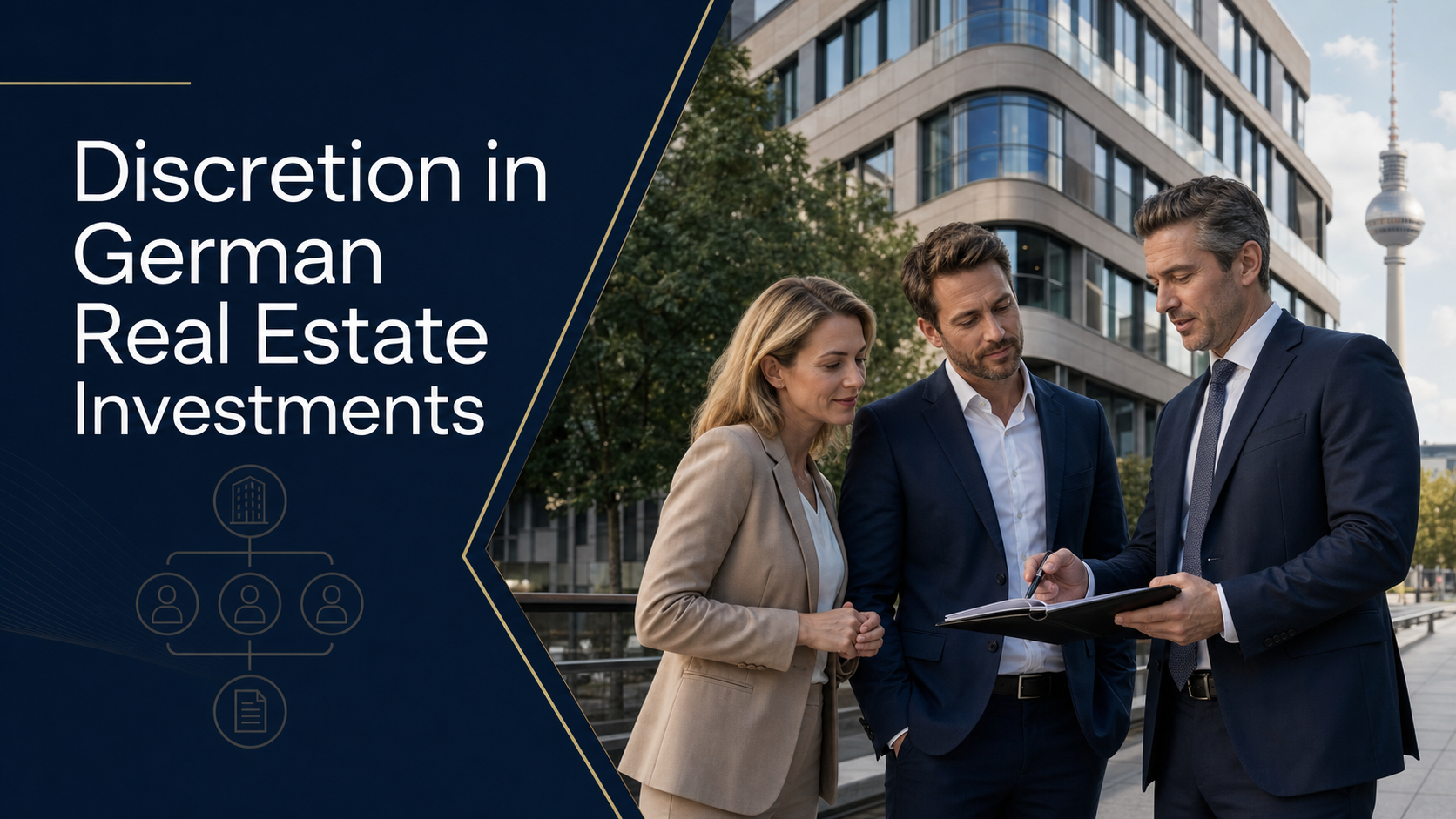
Trust arrangements, silent partnerships and corporate structures - without unlawfully concealing beneficial owners
This article provides general information for international investors. Legal, tax and transparency consequences depend on the individual ownership and control structure.
Privacy is legitimate - but anonymity has limits
International investors often ask whether they can acquire German real estate without making their personal wealth and investment strategy easily visible to competitors, business partners or the wider public.
This is a legitimate concern. German law allows investors to organise their activities with a reasonable degree of discretion. Possible solutions include a German real estate company, a holding structure, an existing foreign company, a trustee arrangement or a silent partnership.
However, discretion must be distinguished from concealment.
A structure may reduce an investor’s visibility in commonly accessed documents. It may not be used to hide the true beneficial owner from banks, notaries, tax authorities or other institutions subject to anti-money-laundering obligations.
The guiding principle is simple:
Privacy can be structured. Beneficial ownership cannot lawfully be concealed.
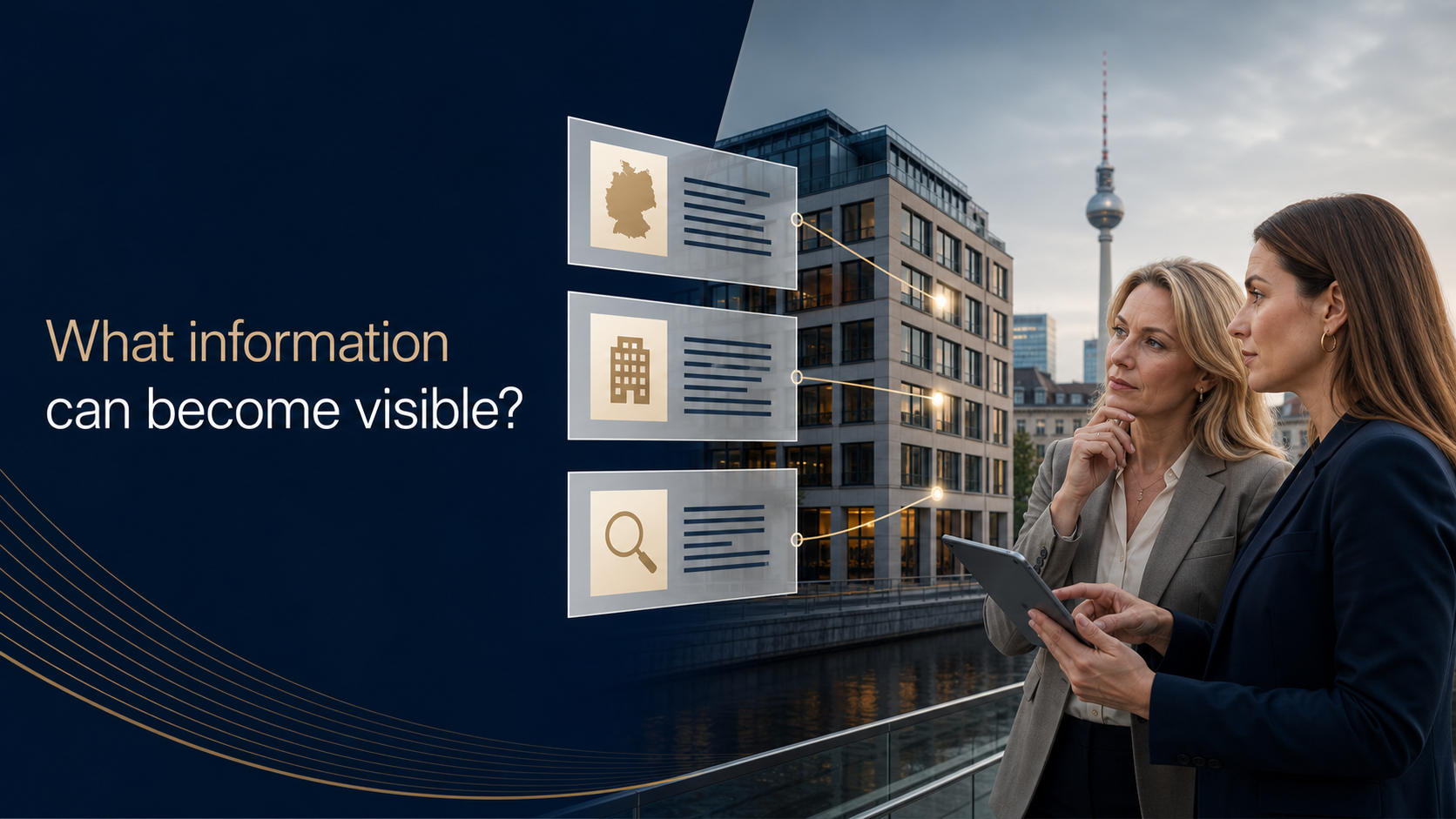
What information can become visible?
When an individual acquires German real estate personally, that person is entered in the land register as the owner.
The land register is not freely accessible to everyone. A person generally needs to demonstrate a legitimate interest before being permitted to inspect it under Section 12 of the German Land Register Code.
If a GmbH purchases the property, the company is entered as the legal owner. The investor’s name does not appear in the land register as the direct owner.
Nevertheless, company information may be available elsewhere. A German GmbH must submit a shareholder list to the Commercial Register. Depending on the shareholder, the list identifies either the individual shareholder or the participating company, together with information about the shareholding.
In addition, German entities must report their beneficial owners to the Transparency Register. Access to this register is regulated: authorities and obligated institutions have statutory access, while other applicants generally need to demonstrate a legitimate interest.
A company structure therefore creates separation between the investor and the property, but it does not provide complete anonymity.

Discretion through a German holding structure
For a substantial investor planning to acquire several properties, a German holding structure may provide both organisational advantages and a reasonable level of public discretion.
A simplified structure could consist of:
International investor or foreign company
↓
German Holding GmbH
↓
Separate German property companies
Each subsidiary may hold a different building or project. The holding company is then recorded as the direct shareholder of the individual property companies.
This can prevent the investor’s personal name from appearing in the shareholder list of every subsidiary. It can also provide genuine commercial benefits:
Separation of liability between properties
Easier participation by co-investors
Clear allocation of financing
Centralised portfolio management
Greater flexibility when individual investments are sold
However, the ownership chain must still be traceable to the natural person or persons who ultimately own or control it.
A holding structure should therefore be established for genuine purposes such as governance, financing and risk separation—not as a false barrier intended to mislead authorities or financial institutions.
For an investor purchasing only one property, a full holding structure may not always be necessary. It becomes more relevant when several acquisitions, different partners or later sales are planned.

Investing through a foreign company
An international entrepreneur may already own a successful company outside Germany with sufficient capital to finance a German real estate investment.
In that case, the foreign company may become the shareholder of the German holding company. This can be commercially sensible when the investment funds belong to the foreign business rather than to the investor personally.
The German shareholder list would generally identify the foreign company as the direct shareholder. Nevertheless, the full ownership and control chain must be documented.
Banks, notaries and other institutions may request:
Foreign commercial-register documents
Articles of association
Shareholder and director information
Evidence of the ultimate beneficial owners
Proof of the source of funds
Certified translations or apostilles
This structure can provide more public discretion than a direct personal investment. At the same time, it normally increases the amount of compliance documentation required.
The structure should therefore be chosen because it matches the origin of the capital, the investor’s business organisation and the long-term investment strategy—not merely because the investor wishes to keep a name out of a particular document.
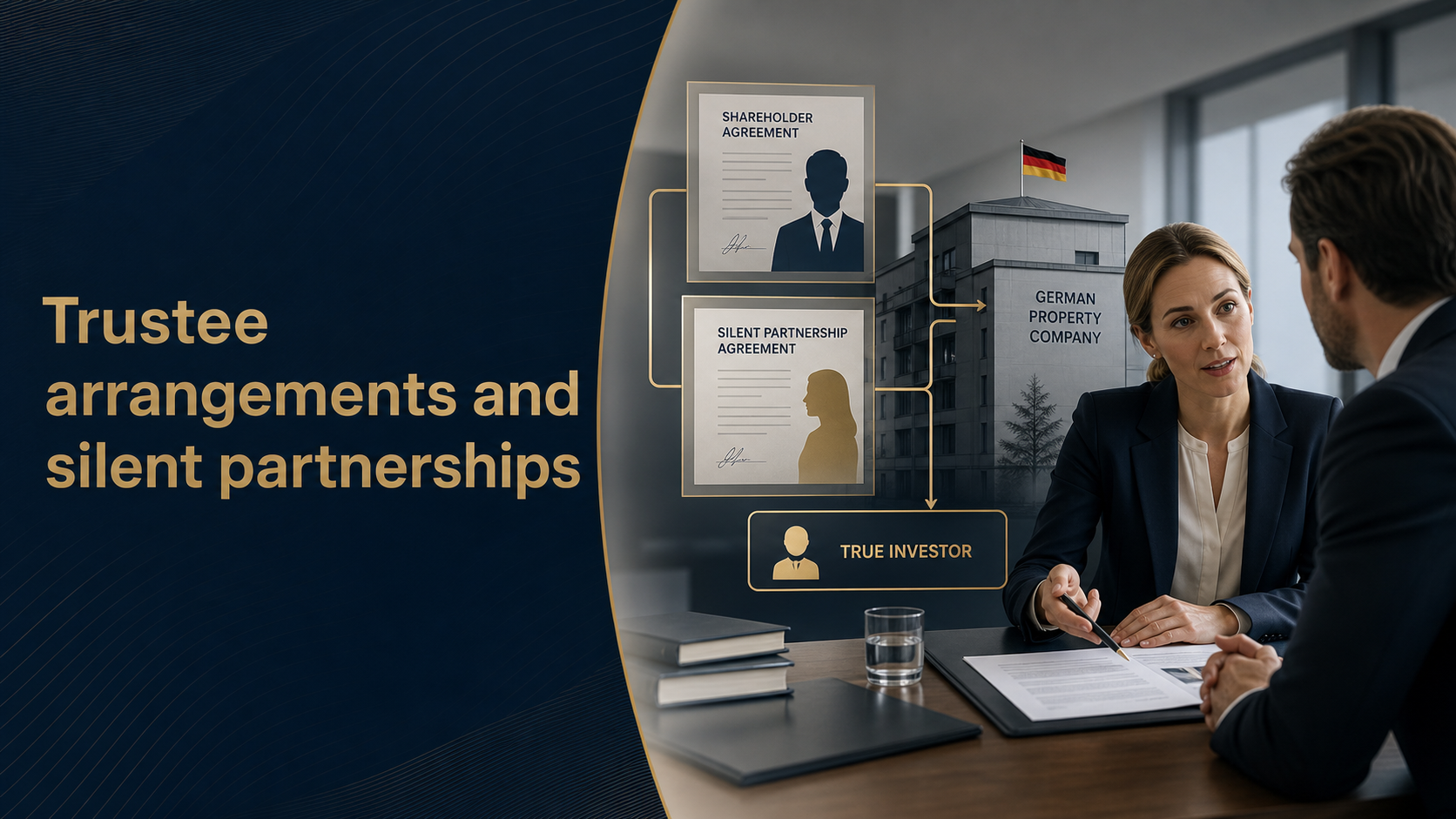
Trustee arrangements and silent partnerships
A trustee may legally hold GmbH shares on behalf of an investor under a separate agreement. The trustee can appear in the shareholder list as the formal shareholder, while the internal contract defines the investor’s economic rights.
Such an arrangement can provide discretion in the shareholder list. It does not remove the obligation to identify the beneficial owner.
If the investor ultimately controls the shares or otherwise meets the legal criteria, that person must still be disclosed to the relevant institutions and, where required, the Transparency Register.
Trustee agreements must carefully regulate voting rights, profit distributions, instructions, liability and the later transfer of shares. GmbH share transfers and agreements establishing an obligation to transfer such shares may also require notarisation under Section 15 of the German Limited Liability Companies Act.
A silent partnership offers another possibility. A silent investor contributes capital to a business and participates in its profits without becoming an ordinary GmbH shareholder.
This can be useful as a financing instrument and may avoid the investor appearing in the shareholder list. But “silent” does not mean invisible to banks, tax authorities or anti-money-laundering checks.
The contractual control rights, participation in losses and company value, tax treatment and exit arrangements must all be examined. A silent partnership should serve a genuine investment purpose rather than act as a mechanism for hiding ownership.

Local minority shareholders
International investors may involve a German partner with a minority shareholding of approximately 10% to 20%.
This can make commercial sense when the local partner provides a real contribution, such as:
Access to investment opportunities
Knowledge of the German property market
Project or construction management
Relationships with banks and service providers
Ongoing representation in Germany
However, the German partner should not be used merely to create the misleading appearance of local ownership.
The actual ownership and control structure must remain correctly documented. Side agreements, voting arrangements, options and powers of attorney may all be relevant when determining who ultimately controls the company.
The partner’s commercial rights should also be clearly defined, including voting rights, profit participation, additional financing obligations and exit arrangements.
A genuine local partner can strengthen an investment. A nominal shareholder used only to disguise the true investor can create serious legal and compliance risks.

Beneficial ownership and compliance
German anti-money-laundering law focuses on the natural person who ultimately owns or controls a legal entity.
A person is generally regarded as a beneficial owner if that person directly or indirectly:
Holds more than 25% of the capital
Controls more than 25% of the voting rights
Exercises comparable control in another way
Indirect ownership through foreign companies, holding companies, trustees or contractual arrangements must also be considered. The relevant criteria are contained in Section 3 of the German Anti-Money Laundering Act.
German entities must obtain, maintain and report information concerning their beneficial owners. Under certain circumstances, foreign entities acquiring or holding German real estate can also have German reporting obligations. Further rules are contained in Section 20 of the Anti-Money Laundering Act.
Banks and notaries may examine:
The complete ownership chain
Trustee and silent-partnership agreements
Voting and control rights
Shareholder loans and capital contributions
The source of wealth and source of funds
Sanctions and politically exposed person status
An unnecessarily complex structure can delay financing and notarisation. Before approaching a German bank or signing a purchase agreement, the investor should therefore prepare a complete ownership chart and consistent supporting documents.
Conclusion
Germany permits international investors to protect their legitimate privacy through appropriate corporate and contractual structures.
A German company can appear as the property owner. A holding structure can separate individual investments. A foreign company may act as shareholder. Trustee arrangements and silent partnerships can also serve genuine commercial purposes.
But none of these solutions provides lawful anonymity from banks, notaries, tax authorities or the Transparency Register.
The best structure is one that combines:
Reasonable public discretion
Clear commercial purposes
Correct identification of beneficial owners
Reliable documentation
Practical acceptance by banks and notaries
The ownership structure, financing, transparency obligations and eventual exit should therefore be planned together before the first property is acquired.
The objective is not to hide the investor. It is to protect legitimate privacy while remaining fully compliant with German law.
Free Consultation
Have questions about entering the German market? Request a free consultation.
Request Free Consultation