
Why the Market Remains Relevant Despite Economic Uncertainty
Germany is going through a period of economic and political uncertainty. Higher financing costs, rising construction expenses, regulatory requirements and weaker economic growth have also affected its real estate market.
Some domestic investors are reducing their portfolios, postponing projects or exploring opportunities outside Germany. International investors, however, do not necessarily have to interpret this development as a reason to avoid the German market.
When domestic market participants become more cautious, new entry opportunities may emerge. This does not mean that every German property is inexpensive or that the market has reached its final bottom. It means that sellers, developers and financing banks must once again pay closer attention to pricing, cash flow, equity and transaction structures.
For internationally diversified and long-term investors, German real estate may therefore remain a relevant component of a broader investment strategy.

A Market in a Phase of Revaluation
For many years, the German real estate market benefited from exceptionally low interest rates and rising property values. Once financing costs increased, the economic basis of many transactions changed.
Some buyers could no longer finance properties at previous price levels. Sellers had to revise expectations, developments were postponed and transaction volumes declined. At the same time, banks increased their requirements regarding equity, property quality and sustainable cash flow.
The adjustment did not affect every part of the market equally. Residential property, offices, logistics facilities, hotels and development sites followed different patterns. Considerable differences also remained between cities, districts and individual micro-locations.
In Berlin, median asking prices for condominiums declined slightly in 2023 and 2024. According to Investitionsbank Berlin, the market showed signs of stabilisation in 2025. The median asking price rose by 2.1% to €5,807 per square metre. The median asking price for single- and two-family homes increased by 2.8%.
These figures do not guarantee a lasting recovery, but they show that the previous downward development did not continue unchanged. IBB Housing Market Report 2025
International investors should therefore avoid focusing exclusively on one question:
Has the market reached its absolute lowest point?
A more useful question is:
Does the individual property offer an appropriate relationship between purchase price, sustainable income and risk under conservative financing assumptions?
Open Access for International Investors
Germany is generally open to international real estate investors. Foreign individuals and foreign companies can acquire German property. Foreign nationality alone does not normally result in a prohibition on purchasing real estate.
Depending on the circumstances, an investment can be made:
directly by a foreign individual;
through an existing foreign company;
through a newly established German company;
through a German property company owned by a foreign holding company;
or through a multi-company real estate holding structure.
Open market access does not mean that a transaction can be completed without compliance checks. Banks, notaries and other parties may have to verify:
the buyer’s identity;
the ultimate beneficial owners of participating companies;
the source of the investment funds;
the ownership and control structure;
applicable international sanctions;
tax registrations;
and any sector-specific regulatory requirements.
These checks should not be confused with discrimination against foreign investors. They form part of the legal, banking and anti-money-laundering framework surrounding German property transactions.
An international investor should therefore be prepared to document the corporate structure, beneficial ownership and source of funds in a transparent and consistent manner.
The detailed acquisition process—including the notary, land register, source-of-funds review and compliance requirements—will be examined in the next article in this series.
Why Germany Still Matters in a Global Portfolio
Germany should not be marketed as a country in which rapid property appreciation is guaranteed. Financing costs, regulation and major regional differences make such a promise unrealistic.
Its relevance lies elsewhere.
German real estate can offer international investors access to:
one of Europe’s largest economies;
euro-denominated rental income;
different regional and sectoral markets;
a developed legal and financial system;
international cities and industrial regions;
and corporate structures suitable for holding multiple properties.
Germany is also more than a small number of expensive metropolitan markets. Investors can examine residential property, logistics, offices, healthcare facilities, assisted living, student housing, light industrial property and mixed-use developments across many different regions.
The investment case therefore does not have to depend exclusively on rising market prices. It may also be based on recurring rental income, active asset management, refurbishment, repositioning or long-term portfolio diversification.
Diversification Rather Than Short-Term Speculation
A German property can help an international investor diversify geographically, economically and, in some cases, by currency.
An investor whose entire property portfolio is concentrated in one country may be highly exposed to that country’s political decisions, currency, banking system and economic cycle.
Adding German property may help distribute these risks across more than one jurisdiction. It can also create income and asset exposure denominated in euros.
International investors may use German real estate to:
diversify assets across several countries;
combine residential and commercial property;
establish a long-term presence in the European Union;
separate properties into individual holding companies;
and build a portfolio that is not dependent on one domestic market.
Diversification does not prevent losses. It can, however, reduce dependence on the development of one country or one currency.
For investors from markets with significant currency volatility or less predictable ownership systems, a German property may therefore be relevant even when its initial yield is not exceptionally high.
The objective should be resilient wealth allocation—not a short-term bet on rapidly rising prices.
Berlin and Brandenburg in Focus
Berlin is an internationally recognised centre of politics, science, technology, education and culture. It attracts companies, professionals, students and families from Germany and abroad.
Nevertheless, Berlin is not one uniform property market.
A condominium in Mitte, an office building in Charlottenburg, a residential development in Marzahn-Hellersdorf and a logistics property near the airport follow very different economic conditions.
Official data continue to indicate pressure on the residential market. Berlin’s population grew by approximately 22,900 people in 2024, while housing remained limited in many segments. Median asking rents stagnated in 2025 but remained at a comparatively high level of €15.78 per square metre. Investitionsbank Berlin
Brandenburg, particularly the area surrounding Berlin, is also becoming increasingly relevant. Locations with good rail and road connections, population growth, business development or proximity to Berlin Brandenburg Airport may present different opportunities from those available in central Berlin.
The wider capital region can include:
residential property in Berlin and connected surrounding municipalities;
logistics facilities along major transport corridors;
commercial property in the airport region;
development land;
mixed-use neighbourhoods;
and specialised properties for education, healthcare or assisted living.
However, the internationally recognised name “Berlin” does not automatically make an investment commercially viable. In many cases, the micro-location is more important than the city’s global reputation.
Legal Certainty as a Location Advantage
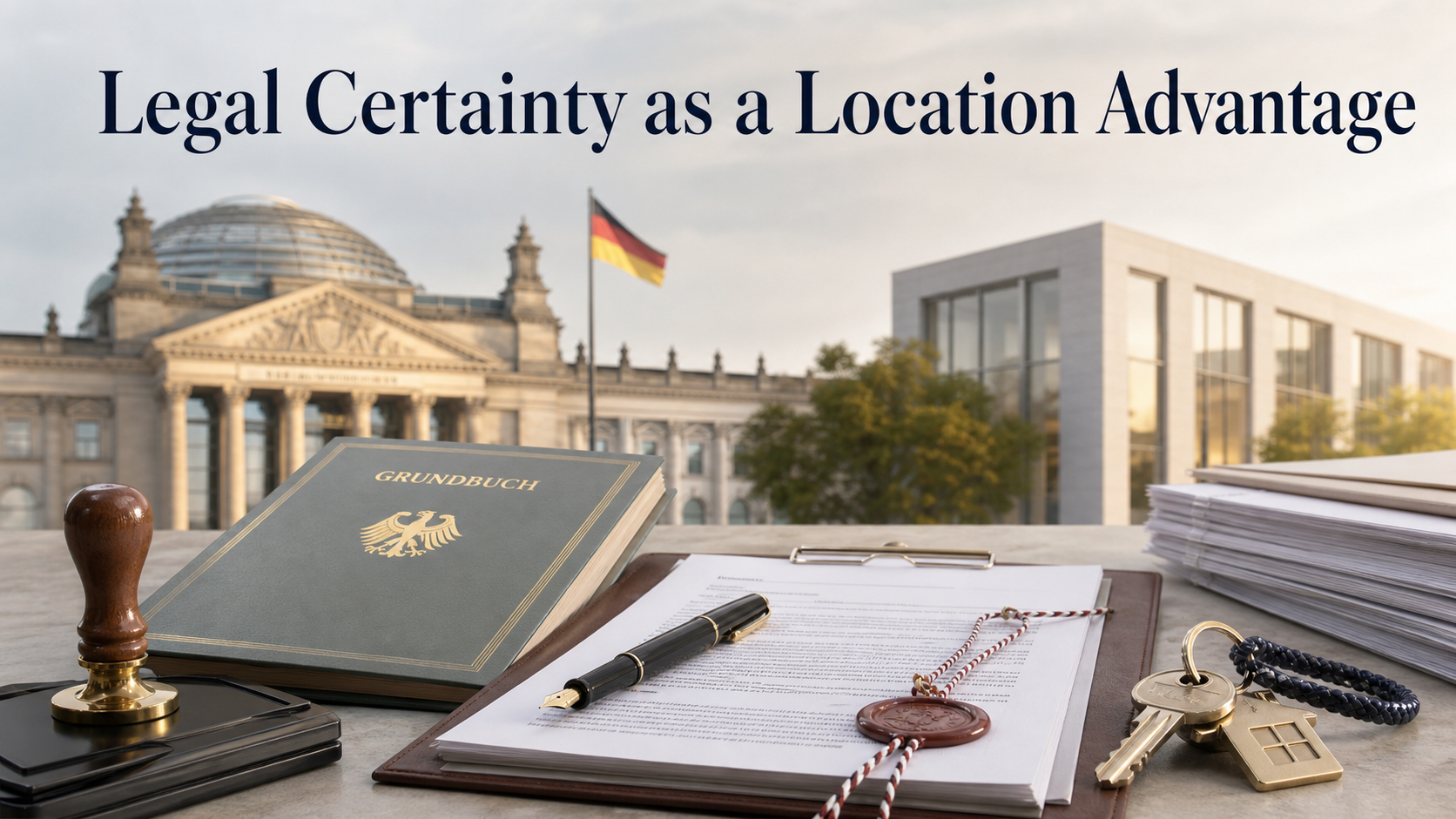
German property transactions are formal and document-intensive. For international investors, that formality can also be an advantage.
A direct property purchase must normally be notarised. Ownership, mortgages and certain legal burdens are recorded in the land register. The transfer of title, payment of the purchase price and registration of security interests follow established procedures.
This framework can make transactions slower than in some other jurisdictions. At the same time, it provides a documented legal basis for ownership and financing.
International investors can also use German corporate structures to organise ownership, liability and financing. Depending on the investment volume, a German property company or holding structure may be appropriate.
Legal certainty should not be confused with an absence of regulatory risk. German tenancy law, planning law, energy requirements and tax provisions can change. The relevant advantage is that ownership rights, contracts and legal remedies operate within a developed legal system.
International investors should nevertheless commission independent legal, tax, technical and financial reviews. A formal legal system protects documented rights, but it does not compensate for an unsuitable contract or incomplete due diligence.

Opportunities Require Careful Selection
A property does not become a good investment merely because its price has declined.
A low price may reflect substantial technical, legal or commercial problems. The building may require extensive modernisation, contain difficult tenancy arrangements or be unsuitable for the investor’s intended use.
Before acquiring a property, an investor should examine at least:
the building’s actual physical condition;
required maintenance and modernisation;
energy performance;
existing tenancy agreements;
rent arrears and disputes;
legally permissible rent levels;
vacancy and reletting risk;
land-register burdens;
building permits and authorised use;
bankability;
tax consequences;
and the intended holding and exit period.
Commercial property requires additional attention to tenant creditworthiness, lease duration, concentration risk, alternative uses and future reletting prospects.
A successful investment therefore does not begin by searching for the property with the largest price reduction. It begins with a defined investment profile.
That profile should establish:
the intended property type;
target location;
acceptable risk;
required cash flow;
available equity;
financing strategy;
investment horizon;
and planned exit.
Only properties matching that profile should proceed to detailed due diligence.
Risks Belong in Every Investment Decision
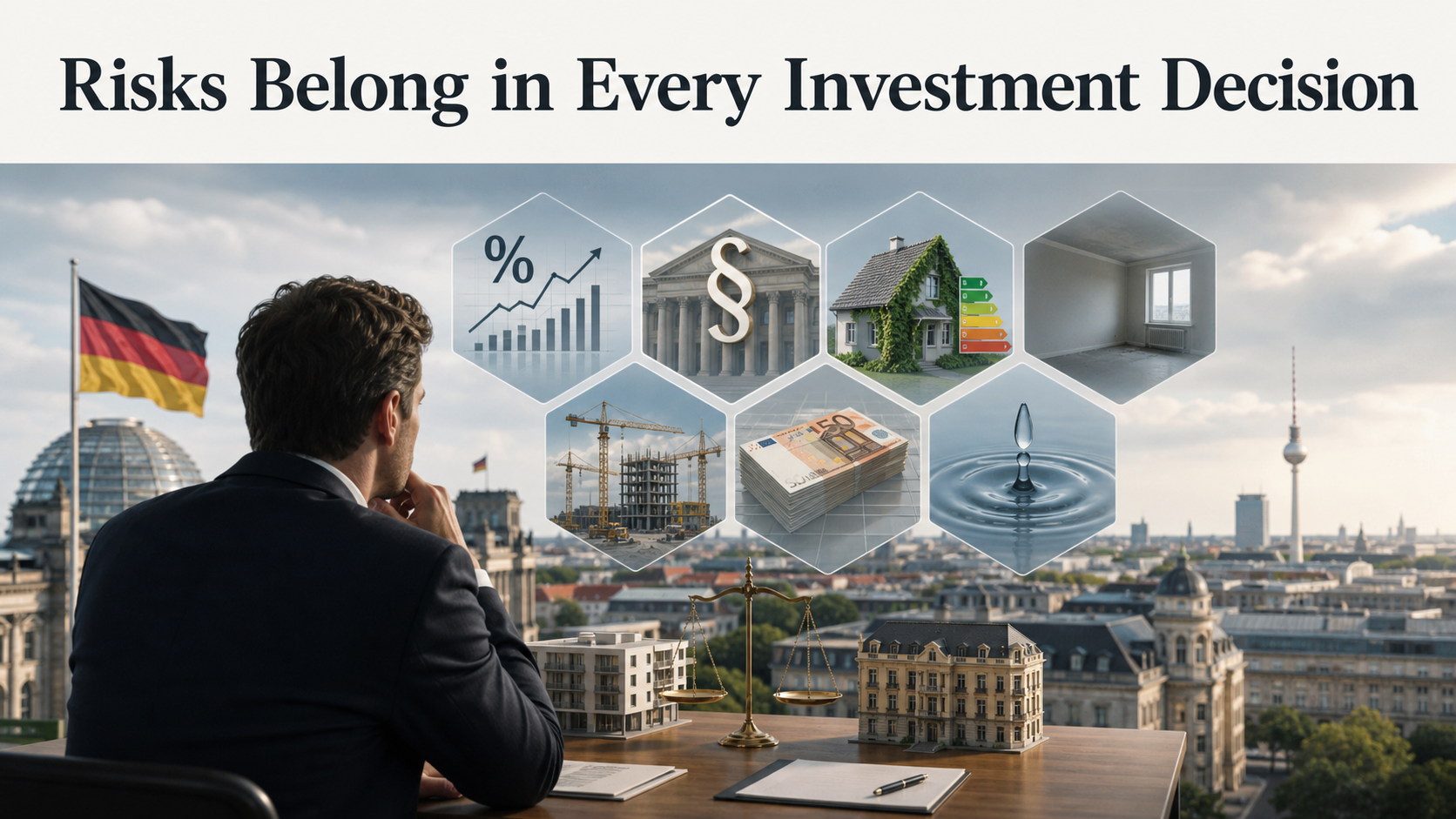
German real estate offers opportunities, but it is not a risk-free investment.
International investors should consider:
changes in property values;
interest rates and refinancing risk;
stricter lending standards;
regulatory changes;
tenancy and termination protection;
energy-related renovation costs;
construction and labour costs;
vacancy and rent default;
tax changes;
and limited liquidity during a future sale.
Currency risk may also be significant. An investor whose principal assets or income are not denominated in euros can experience additional gains or losses even when the euro value of the property remains stable.
The condition of the individual building is another major risk. An apparently inexpensive property can require substantial expenditure for roofs, façades, heating systems, fire protection, accessibility or energy efficiency.
The purpose of professional investment analysis is not to remove risks from the presentation. Risks must be identified, quantified and reflected in the purchase price, financing, reserves and ownership structure.
Conservative assumptions are especially important. The investment should not depend entirely on uninterrupted rent increases, falling interest rates or a rapid resale at a higher price.

The Structure Must Come Before the Purchase
Many investors search for a property first and consider the legal and tax structure only shortly before signing the purchase agreement.
That can be an expensive mistake.
Before making a binding acquisition decision, the investor should determine:
Who will be the buyer and registered owner?
Will the property be acquired personally or through a company?
Is a German property company appropriate?
Should a holding structure be established?
How will equity be contributed?
Will a German bank provide financing?
Can a foreign bank guarantee be used?
How should rental profits be retained or distributed?
Is the investment intended for long-term ownership or resale?
Could an asset deal or share deal be relevant?
A structure designed for long-term rental income may not be suitable for development or frequent property sales. A tax-efficient holding structure may also be too expensive for a small investment or too complex for a financing bank.
Changing the ownership structure after the acquisition can create additional taxes, notarial costs, financing complications and administrative work.
The appropriate structure must therefore be developed before the notarial purchase—not after the property has already been acquired.
Germany Remains Attractive -but Not for Every Strategy
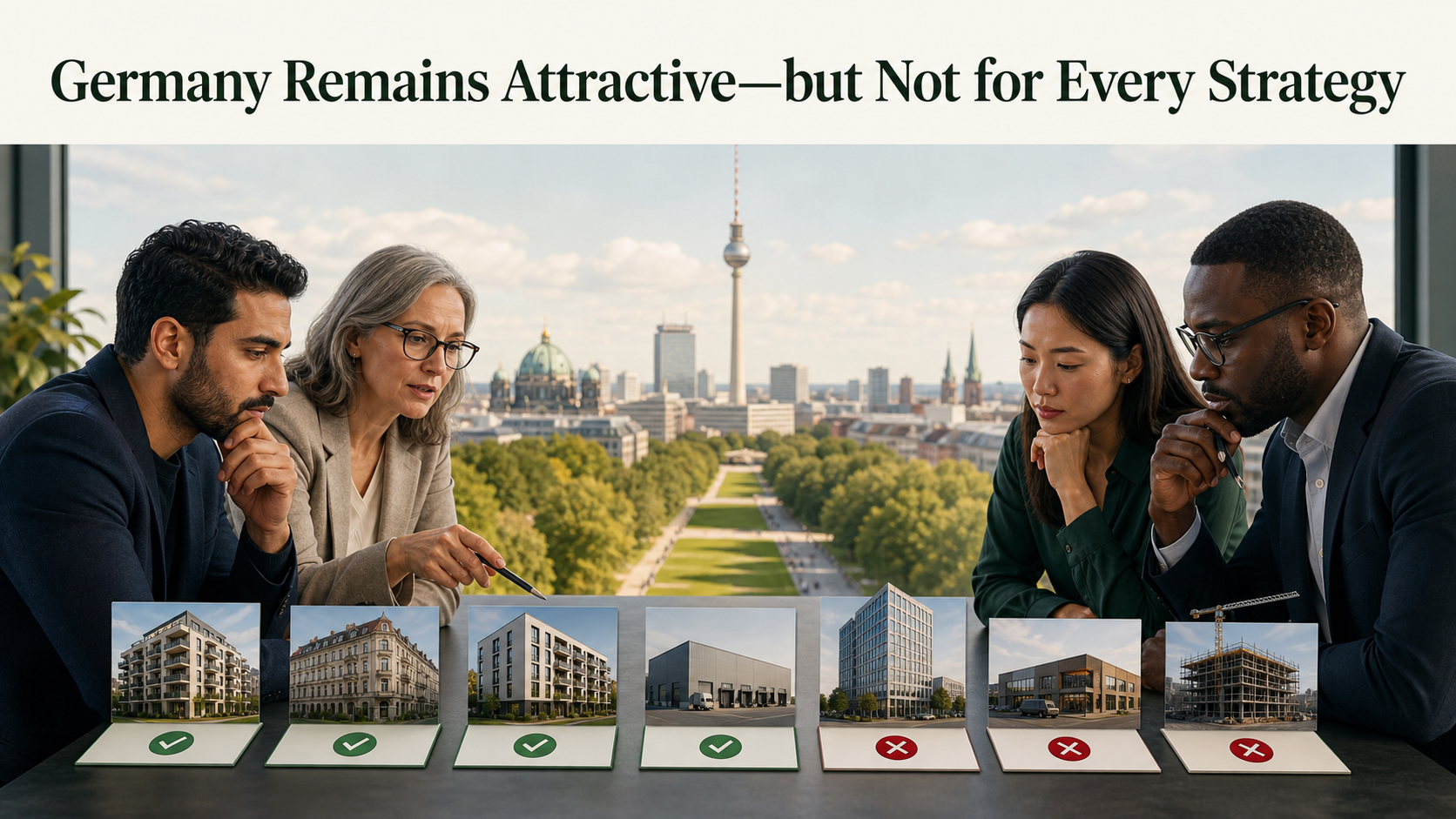
Germany is neither a risk-free market nor a country in which every property automatically appreciates.
It may nevertheless remain attractive for selected international investors because:
market access is generally open;
property ownership follows established legal procedures;
different corporate and financing structures are available;
Berlin and Brandenburg retain international relevance and structural property demand;
the previous market adjustment may create greater negotiating flexibility;
and German property can contribute to geographical and currency diversification.
Germany may be suitable for investors seeking long-term ownership, euro-denominated income, active asset management or a broader European portfolio.
It may be less suitable for investors expecting:
effortless short-term appreciation;
high leverage without substantial equity;
rapid and inexpensive transactions;
minimal regulatory involvement;
or complete anonymity regarding beneficial ownership.
The investment opportunity does not lie in describing Germany as universally inexpensive or guaranteed to be safe.
It lies in identifying a suitable property at an economically defensible price—and establishing the correct ownership, financing, tax and exit structure before the acquisition.
This article provides general information only. It does not constitute individual legal, tax, financing or investment advice. Every investment should be reviewed in light of the investor, the property, the financing structure and the intended exit strategy.
Free Consultation
Have questions about entering the German market? Request a free consultation.
Request Free Consultation