Trade tax, the BER airport region and the limits of a purely tax-driven registered office
Schönefeld is usually associated with Berlin Brandenburg Airport. For international real estate investors, however, the municipality may also be interesting as a location for holding companies, property companies and operating businesses.
Its appeal is based on two factors: its position directly next to Berlin and its comparatively low trade tax multiplier. Nevertheless, establishing a company in Schönefeld solely to obtain a lower tax rate can create problems if the company has no genuine business presence there.
The decisive question is therefore not simply: Where should the company be registered? It is: Where will the company actually be managed and conduct its activities?
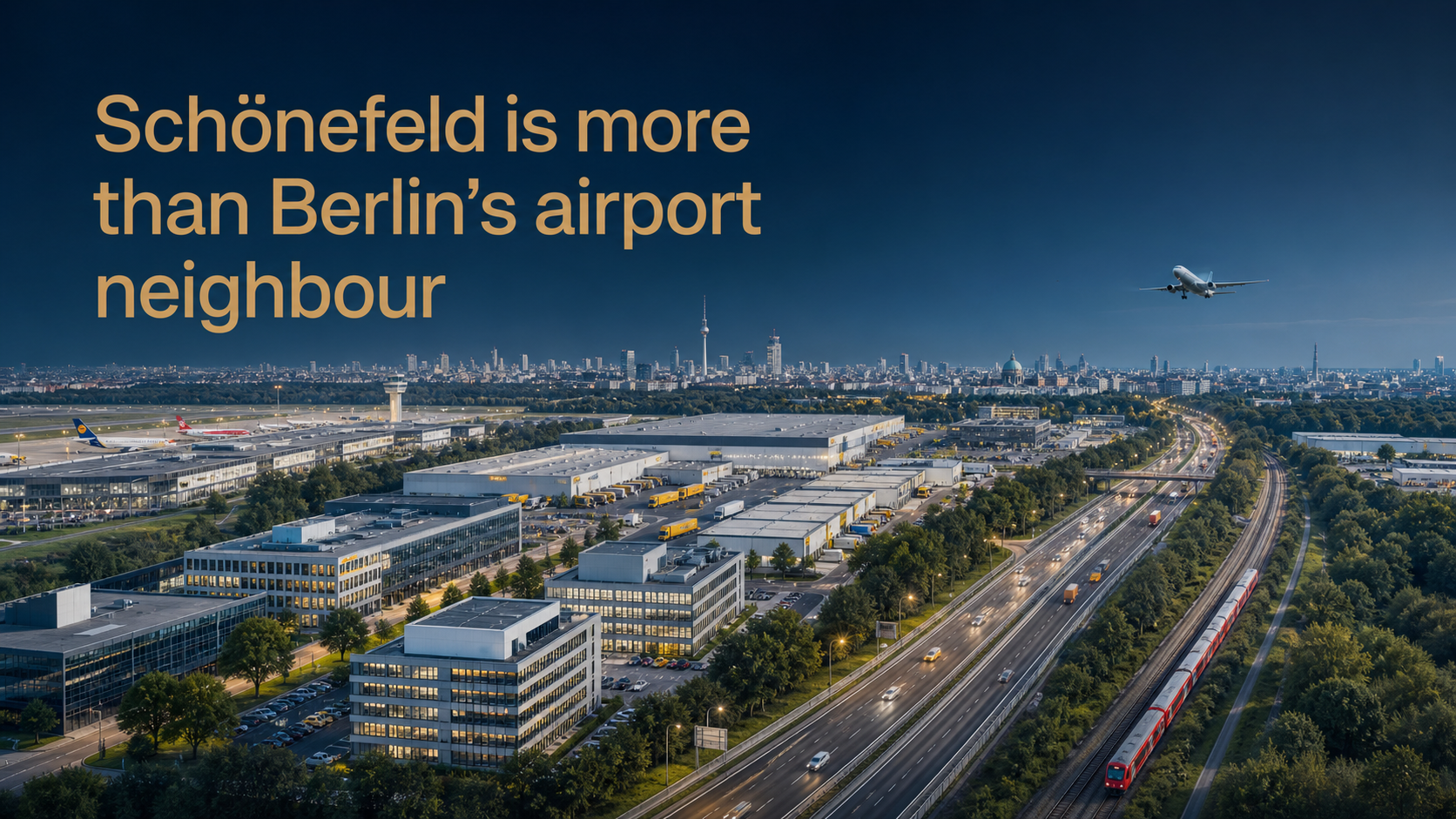
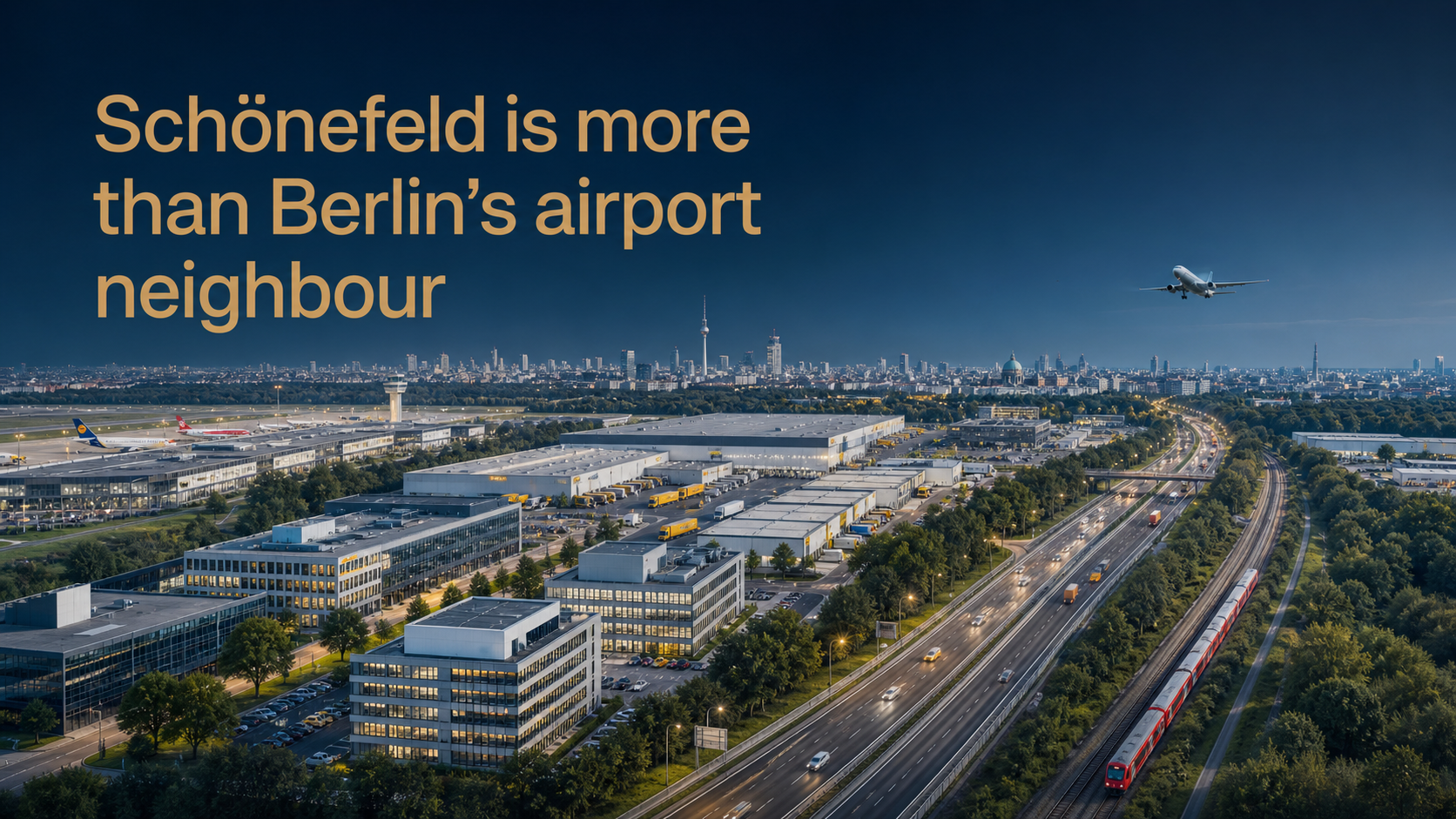
Schönefeld is more than Berlin’s airport neighbour
Schönefeld is located in the federal state of Brandenburg, immediately south-east of Berlin. Berlin Brandenburg Airport, motorway connections and proximity to the capital make the municipality particularly relevant for logistics, aviation-related services, hotels, offices and other commercial activities.
The municipality continues to develop commercial areas, including locations around Waltersdorf and major transport connections. This can create opportunities for investors seeking commercial property close to Berlin without necessarily acquiring inside the city boundaries.
However, proximity to an airport alone does not make every property a good investment. Accessibility, planning law, tenant demand, infrastructure, competition and the individual micro-location remain essential.

Why the trade tax multiplier attracts attention
German trade tax is calculated by applying a statutory assessment rate of 3.5 % to the taxable trade income and multiplying the result by the municipal trade tax multiplier.
For 2025 and 2026, Schönefeld has set its trade tax multiplier at 240 %. This produces a mathematical trade tax burden of approximately:
3.5 % × 240 % = 8.4 %
Berlin’s multiplier is 410 %, resulting in a mathematical burden of:
3.5 % × 410 % = 14.35 %
The difference can be significant for a profitable company. On taxable trade income of EUR 1 million, the simplified difference would amount to approximately EUR 59,500.
This comparison concerns trade tax only. Corporation tax, the solidarity surcharge, additions and reductions to the trade tax base and other tax consequences must be considered separately. The official Schönefeld rate is published in the municipality’s 2025/2026 budget statute, while Berlin has fixed its rate at 410 % for 2026 and 2027 in its budget legislation.
A lower multiplier is not a tax exemption
The Schönefeld rate does not mean that companies established there are exempt from trade tax. It merely reduces the municipal component of the tax calculation.
Under the German Trade Tax Act, corporations such as a GmbH are generally treated as commercial enterprises. The statutory assessment rate is 3.5 %, while the municipality determines the applicable multiplier. The relevant calculation principles can be found in Section 11 of the German Trade Tax Act.
Moreover, municipal multipliers are political decisions. They may be changed in future budget years. An investment structure should therefore not depend entirely on the assumption that today’s rate will remain unchanged indefinitely.

A registered office alone is not enough
An investor may consider registering a German holding company or property company in Schönefeld while purchasing and managing properties in Berlin or elsewhere in Germany.
A Schönefeld address in the commercial register does not automatically ensure that all trade tax will be levied there. The tax treatment depends on the company’s actual permanent establishments and, in particular, on where its effective management functions are performed.
A postal address, a virtual office or an occasionally used meeting room may be insufficient if all important decisions are made in Berlin or abroad.
The legal structure should therefore correspond to the economic reality.

Where is the business actually managed?
The place of management is generally the location where the central day-to-day management decisions are made. Relevant indications may include:
where the managing directors regularly work;
where contracts and financing decisions are negotiated;
where accounting and company documents are maintained;
where employees perform their functions;
where meetings and significant management decisions take place.
German tax law defines the place of management as the centre of commercial executive management. A permanent establishment may include a management office, branch, office, warehouse or other fixed place serving the business.
There is no universal checklist that guarantees recognition. The overall facts must demonstrate that the Schönefeld location performs genuine business functions.
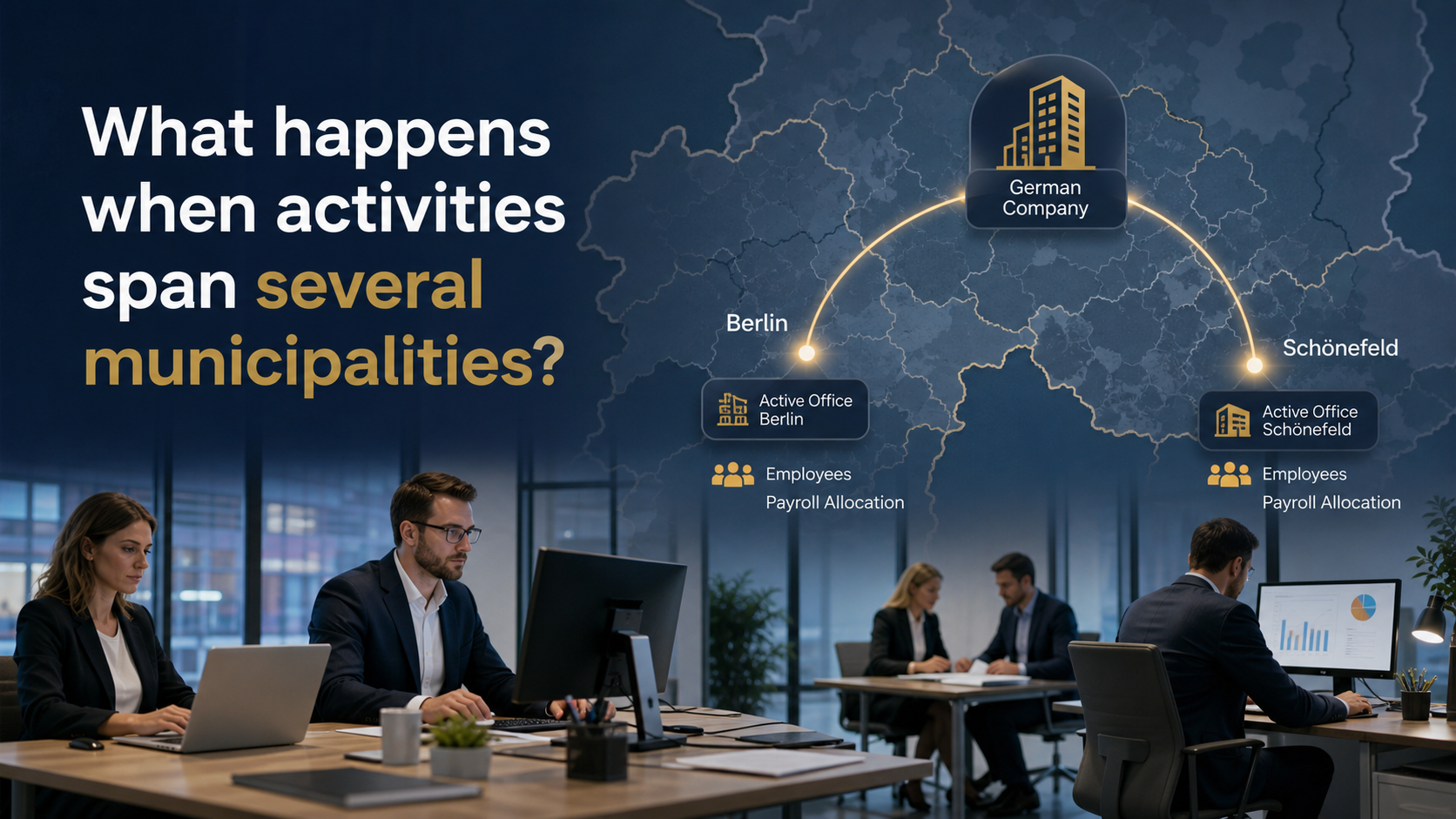
What happens when activities span several municipalities?
A company may have its management office in Schönefeld but also maintain employees, offices or operating facilities in Berlin or other municipalities.
In this case, the trade tax assessment may have to be allocated between the municipalities. As a general rule, the allocation is based on the proportion of wages paid at the respective permanent establishments, although special rules can apply.
This means that an investor cannot necessarily transfer the entire trade tax base to Schönefeld merely by locating one part of the company there. The distribution of staff, management functions and operating activities must be analysed carefully. The general allocation rule is set out in Section 29 of the German Trade Tax Act.

Real estate companies require a separate calculation
For a purely asset-managing real estate company, the low Schönefeld multiplier may be less important than it initially appears.
A property company that exclusively manages and uses its own real estate may, subject to strict conditions, qualify for the extended trade tax reduction. If the requirements are satisfied, rental profits may effectively be relieved from trade tax.
In that situation, the difference between a 240 % and a 410 % multiplier may have little or no effect on the qualifying rental income.
The multiplier becomes more relevant where the company also carries out development, trading, project-management or other operational activities—or where the extended reduction is unavailable because the company performs an incompatible secondary activity.
The location decision must therefore be based on the company’s actual business model, not merely on a comparison of municipal percentages.

Location advantages beyond tax
Schönefeld can be attractive even without the trade tax advantage. Potential strategic factors include:
direct access to Berlin Brandenburg Airport;
motorway and rail connections;
proximity to Berlin’s labour and consumer markets;
commercial development areas;
potential demand from logistics, hotel, service and airport-related businesses;
opportunities for larger commercial sites that may be difficult to find inside Berlin.
These factors may be particularly relevant for international investors combining real estate ownership with an operating business, European distribution, logistics or regional headquarters.
At the same time, investors should examine local planning restrictions, construction costs, noise protection, transport capacity, environmental requirements and the availability of utilities. “Near the airport” is not a substitute for property-level due diligence.
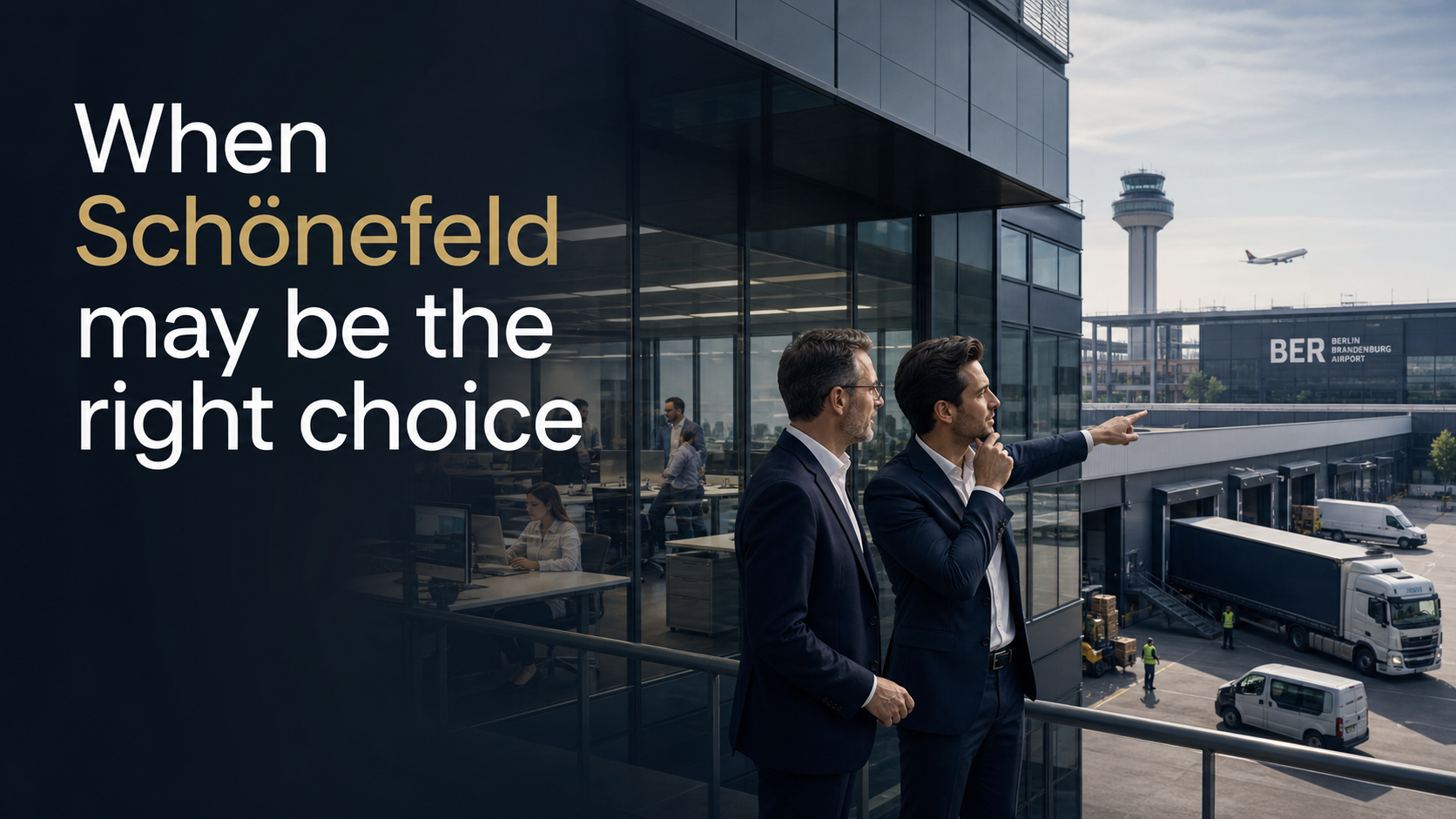
When Schönefeld may be the right choice
A Schönefeld structure may be commercially credible where the investor intends to establish real management functions, employees, offices or operational facilities there.
For example, an international group could locate its German management office in Schönefeld, acquire a logistics or commercial property in the airport region and manage its German activities from that location. In such a case, the business rationale and the tax position support each other.
By contrast, establishing a company at a Schönefeld address while conducting all business from Berlin or abroad creates a mismatch. Any projected tax advantage may then be challenged.
The strongest structure is one that would still make commercial sense even if the difference in trade tax rates were smaller.

Structure first, property second
Before incorporating a company or signing a real estate purchase agreement, the investor should determine:
which company will acquire the property;
whether a holding and separate property company are required;
where the management will actually work;
whether employees or additional permanent establishments are planned;
whether the company could qualify for the extended trade tax reduction;
whether operational activities should be separated from property ownership;
how financing, management agreements and future disposals will be organised.
A well-planned structure can combine tax efficiency, liability separation, financing flexibility and credible economic substance. A structure created only after the acquisition may no longer achieve the same result without additional tax and transaction costs.

Conclusion
Schönefeld can be an attractive business and real estate location for international investors. Its proximity to Berlin Brandenburg Airport, commercial development potential and low trade tax multiplier provide genuine advantages.
However, the tax benefit cannot safely be obtained through a registered address alone. The company’s actual management, permanent establishments, employees and business activities must support the chosen location.
For a purely asset-managing property company, the extended trade tax reduction may be more important than the municipal multiplier. For operating, development or trading companies, Schönefeld’s lower rate may produce substantial savings—provided that the location has real economic substance.
The objective should not be to create the appearance of a Schönefeld company. It should be to build a commercially convincing structure in which the legal seat, management functions, investment strategy and tax position fit together.
This article provides general information only. Trade tax, permanent-establishment rules, corporate structures and real estate transactions should be reviewed by qualified German tax and legal advisers based on the investor’s individual circumstances.
Free Consultation
Have questions about entering the German market? Request a free consultation.
Request Free Consultation