
How a Holding GmbH and separate property companies can help international investors manage multiple German real estate investments
This article provides general information for international investors. The appropriate corporate, financing and tax structure depends on the properties, investors, financing arrangements and intended exit strategy.

When does a real estate holding structure make sense?
An international investor planning to acquire only one German property may not need a complete holding structure. In such a case, a single German property company can sometimes be sufficient.
The situation changes when the investor intends to:
Acquire several residential or commercial properties
Involve different partners in different projects
Separate the risks of individual buildings
Retain rental income for future acquisitions
Finance each property independently
Sell individual projects at a later date
Develop a long-term German real estate portfolio
In these circumstances, establishing a holding structure from the beginning can provide a clear organisational framework.
The minimum structure normally consists of two companies:
German Holding GmbH
↓
German property GmbH
When additional properties are acquired, further subsidiaries can be added below the holding company.
The holding structure is therefore not merely a tax concept. It is also a system for organising ownership, financing, liability and decision-making across several investments.
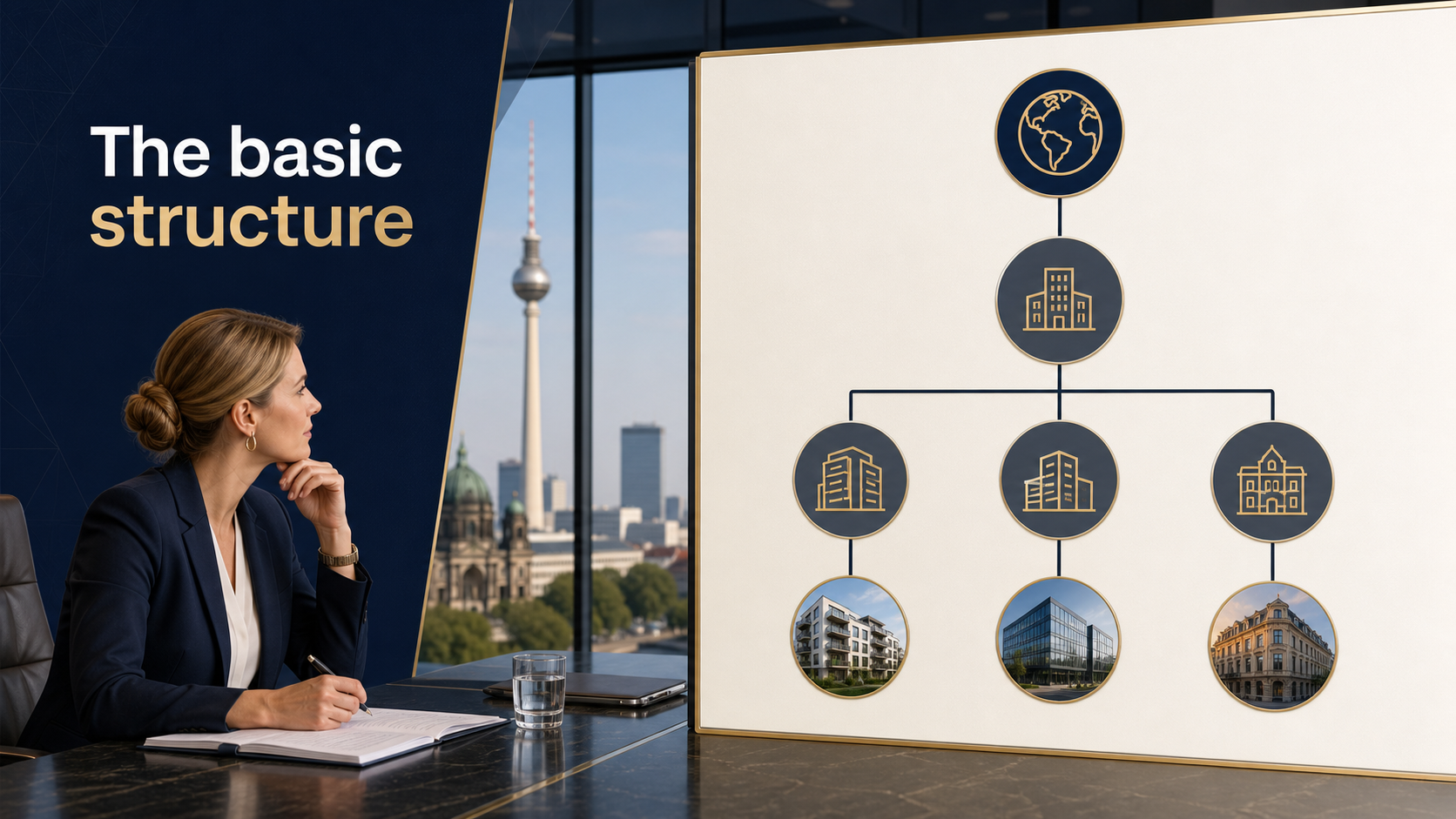
The basic structure
A typical international real estate holding structure may look like this:
International investor or foreign parent company
↓
German Holding GmbH
↓
Property GmbH 1 – Office building in Berlin
Property GmbH 2 – Retail property in Brandenburg
Property GmbH 3 – Development project
The international investor may hold the German holding company personally or through an existing foreign company.
Local partners can also participate. For example, a German partner may hold a minority interest in the holding company or participate only in a specific property subsidiary.
This flexibility is one of the principal advantages of the structure. The investor does not have to use exactly the same ownership arrangement for every property.
However, the ownership chain must remain transparent. The beneficial owners must be identified correctly, and banks and notaries will normally examine the complete structure.

Different roles for the holding company and property companies
The Holding GmbH normally owns and manages the shares in its subsidiaries. It may also coordinate strategy, provide capital and make decisions about acquisitions or sales.
The individual property companies own the real estate.
Their activities may include:
Purchasing the property
Entering into financing agreements
Concluding leases
Receiving rental income
Paying property-related expenses
Organising maintenance and renovation
Selling the property or project
The functions should be clearly separated.
If one property company is intended to qualify for Germany’s extended trade tax reduction, its activities must remain within the legally permitted scope. Development, consulting or operational services may therefore need to be performed by another company.
The holding company should not automatically invoice management fees to every subsidiary without examining the tax consequences. Contracts, services and remuneration must correspond to the actual activities performed.
A structure works best when each company has a clearly defined purpose rather than when several companies exist only on paper.

Liability separation—and its practical limits
A German GmbH is a separate legal person. Under Section 13 of the German Limited Liability Companies Act, the company’s own assets generally serve to satisfy its liabilities.
If separate companies own separate properties, a problem affecting one building does not automatically become a direct liability of every other property company.
For example, Property GmbH 1 may face:
Construction defects
Tenant claims
Environmental issues
Cost overruns
Financing difficulties
Litigation concerning the property
Keeping Property GmbH 2 in a different legal entity can help protect the second investment from the operational risks of the first.
However, the separation is not absolute.
A bank may require:
A guarantee from the holding company
Personal guarantees from the investor
Cross-collateralisation between properties
Security over shares in other subsidiaries
Letters of comfort or additional capital commitments
If several companies guarantee one another’s debts, part of the intended risk separation can be lost.
Liability separation also requires proper company administration. Each GmbH should have its own bank account, accounting records, contracts and corporate decisions. Funds should not be transferred informally between companies.

Financing and the movement of capital
The holding company can act as the central point through which the investor provides capital for German acquisitions.
Funds may reach a property company through:
Share capital
Contributions to the capital reserve
Shareholder loans
A combination of equity and debt
External bank financing at property-company level
A typical acquisition may be financed with equity from the holding company and a bank loan taken out by the property subsidiary.
This allows the financing to be allocated to the relevant property. Income and expenses remain visible at the level of the company that owns the building.
Profits may later be distributed from the property company to the holding company. The holding company can retain the funds and use them as equity for another acquisition.
However, capital cannot simply be moved between companies without documentation. Shareholder loans require appropriate agreements, interest terms and repayment provisions. Transactions between related companies must be commercially justifiable.
For an international investor, cross-border funding creates additional questions concerning withholding taxes, interest deductibility, transfer pricing and the tax treatment in the investor’s home country.
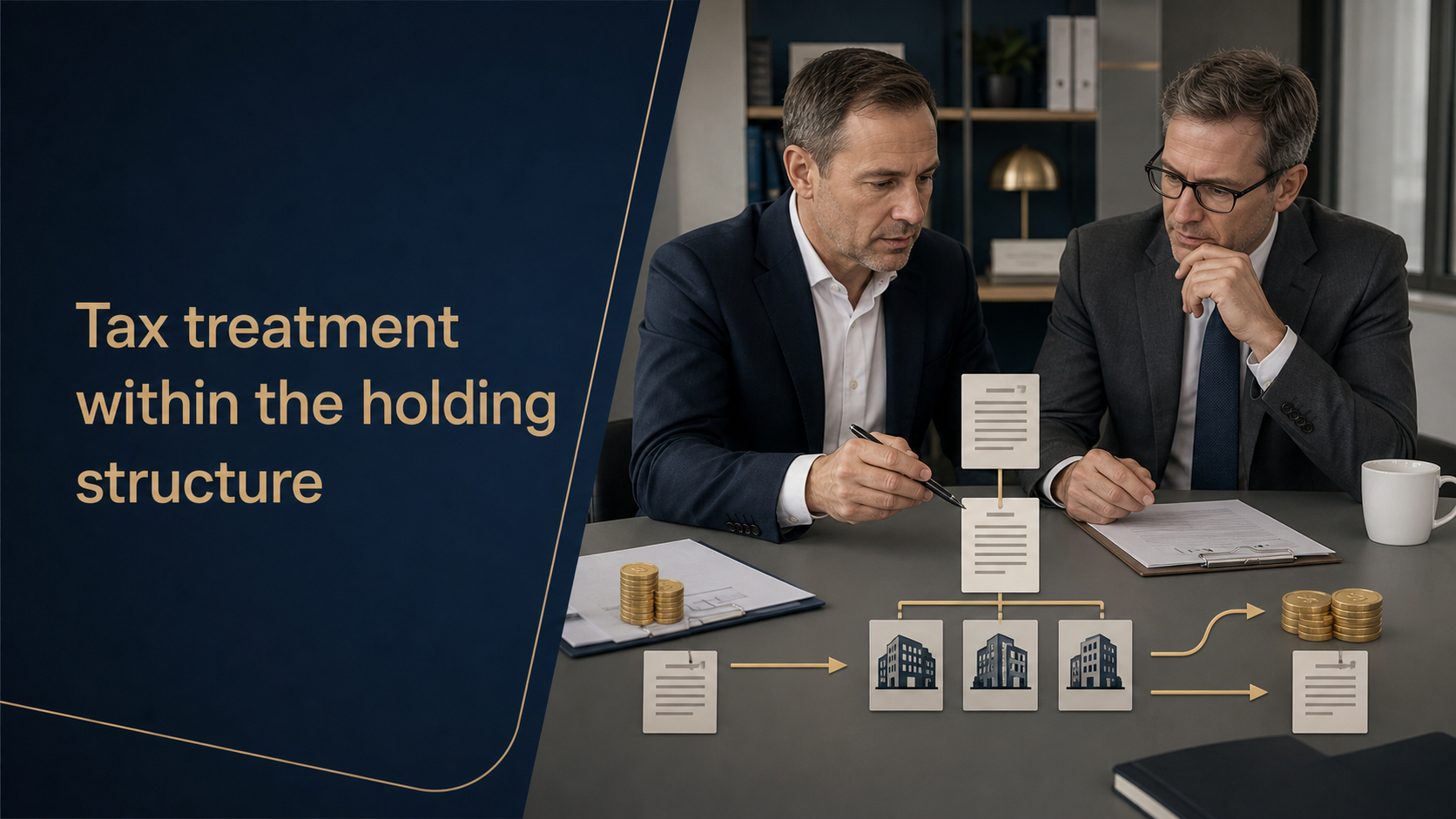
Tax treatment within the holding structure
One reason for using a holding structure is the potentially favourable treatment of income from corporate participations.
Under Section 8b of the German Corporation Tax Act, dividends and gains from the disposal of corporate shareholdings can be largely exempt from German corporation tax at holding-company level. In many qualifying cases, 5% is treated as non-deductible business expenditure, producing an effective 95% exemption.
However, the result is not automatic in every case.
The tax treatment can depend on:
The percentage of the shareholding
The date on which the holding was acquired
Corporation tax and trade tax rules
The nature of the income
The residence of the distributing company
Applicable double-taxation agreements
Anti-abuse and financing provisions
For domestic dividends, the German trade tax participation privilege generally requires a holding of at least 15% at the beginning of the relevant assessment period under Section 9 No. 2a of the German Trade Tax Act.
A holding company owning 100% of its property subsidiaries will normally be above the relevant participation thresholds. Nevertheless, acquisition timing and the complete tax structure still require examination.
The property company itself remains subject to its own taxation. If it exclusively manages its own real estate and meets the statutory requirements, it may apply for the extended trade tax reduction discussed in Blog No. 4.
The holding structure therefore does not make rental income or property sales automatically tax-free. It separates different levels of taxation and can make reinvestment within the corporate group more efficient.

Managing several properties and investors
A holding structure can make a growing portfolio easier to organise.
The investor can see clearly:
Which company owns each property
Which bank finances it
Which partner participates in it
How much equity has been invested
Which liabilities belong to which project
Which property produces distributions
Which investment is intended for long-term retention or later sale
Different partners can participate in different subsidiaries.
For example, the international investor may own the entire Holding GmbH, while a German development partner receives a minority interest only in Property GmbH 3. The partner then participates in the risks and profits of that project without acquiring rights in the remainder of the portfolio.
The structure can also facilitate succession planning or the admission of future investors.
However, additional flexibility creates additional administration. Each GmbH generally requires:
Its own bookkeeping and annual financial statements
Tax returns
A bank account
Corporate resolutions
Transparency Register information
Commercial Register maintenance
Separate contractual documentation
The costs must therefore be proportionate to the size of the investments. Creating a separate company for every small asset may not be economically efficient.
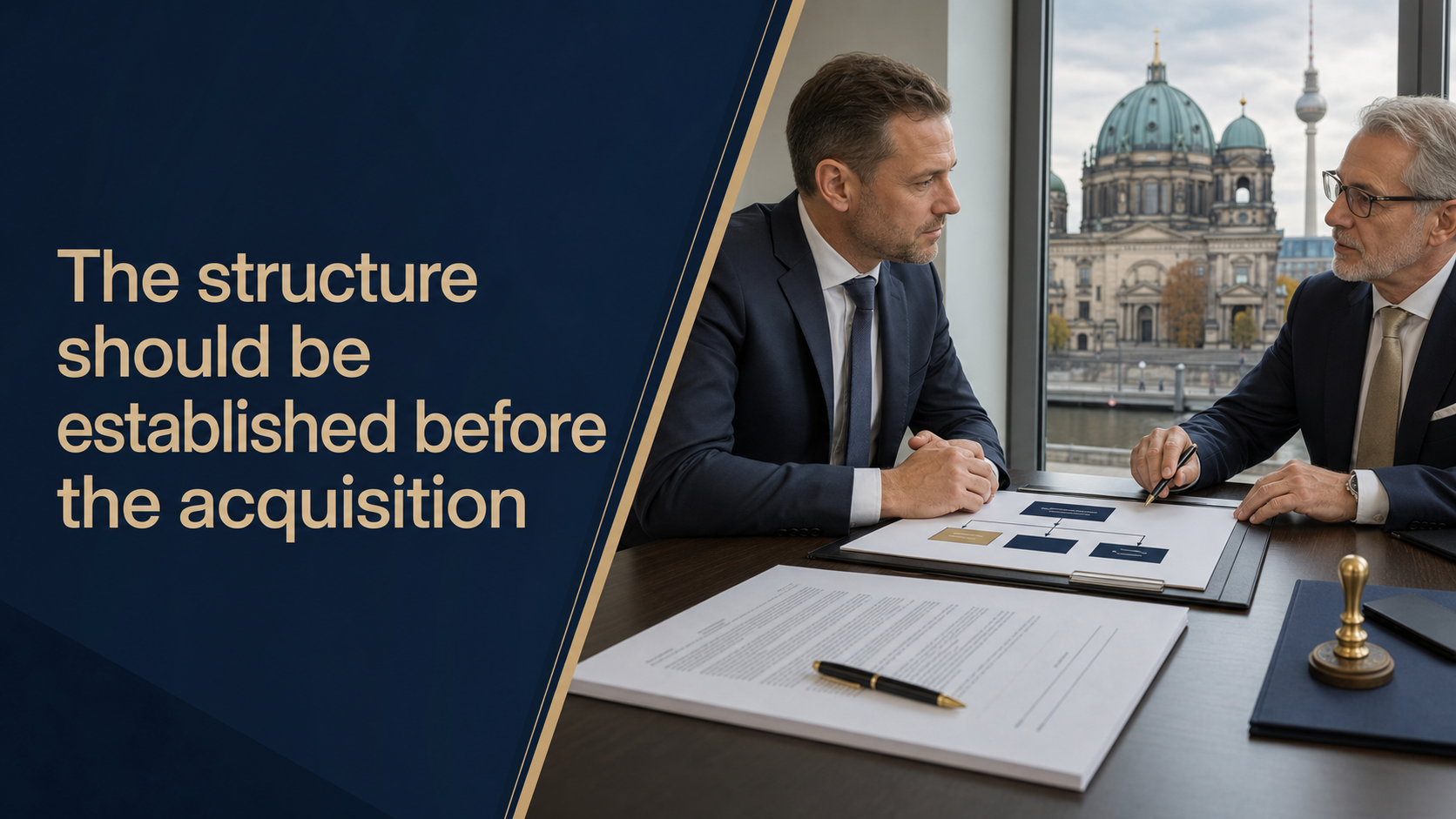
The structure should be established before the acquisition
The most important practical rule is to design the structure before signing the first property purchase agreement.
If the investor purchases a property in the wrong company and later transfers it to a newly created subsidiary, the transfer may create:
Additional real estate transfer tax
Notarial and land-register costs
New financing negotiations
Tax consequences from hidden gains
Additional bank approvals
Delays in the investment plan
Changes in the shareholders of a property-owning company can also trigger German real estate transfer tax. Current rules include relevant thresholds of 90% in certain share transactions and changes in ownership. These questions will be examined more closely in Blog No. 7 on asset deals and share deals.
Before the acquisition, the investor should determine:
Who will own the German holding company?
Which company will acquire the property?
Where will bank financing be arranged?
How will equity enter the structure?
Will local partners participate?
Is the property intended for long-term rental or development and sale?
How will profits be reinvested or distributed?
What is the intended exit?
The notary appointment should be the result of the planning process—not the moment when the structure is considered for the first time.

Conclusion
A German real estate holding structure can be highly useful for an international investor planning several substantial acquisitions.
The Holding GmbH provides the ownership and strategic level. Separate property companies hold individual buildings or projects. This can improve risk separation, financing, portfolio management, reinvestment and the participation of different partners.
But the structure also creates costs, reporting obligations and administrative work. Liability protection can be weakened by cross-guarantees, and tax advantages depend on detailed legal conditions.
A holding structure should therefore not be created simply because it appears sophisticated.
It should be established when the investor’s portfolio, financing needs and long-term strategy justify it.
For larger investors, the central advantage is not one isolated tax benefit. It is the ability to organise several German properties within a clear, expandable and professionally managed investment structure.
Free Consultation
Have questions about entering the German market? Request a free consultation.
Request Free Consultation