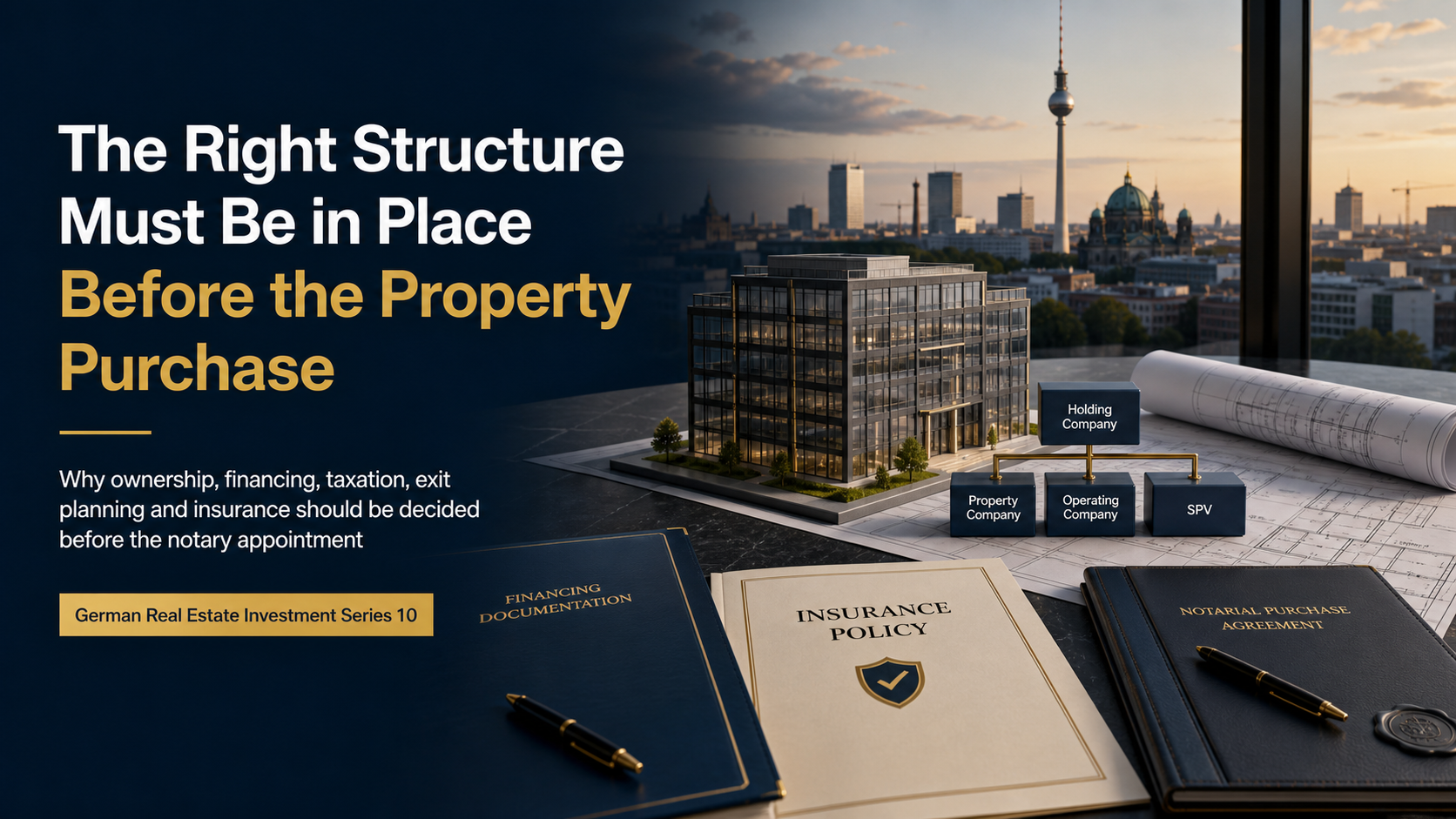
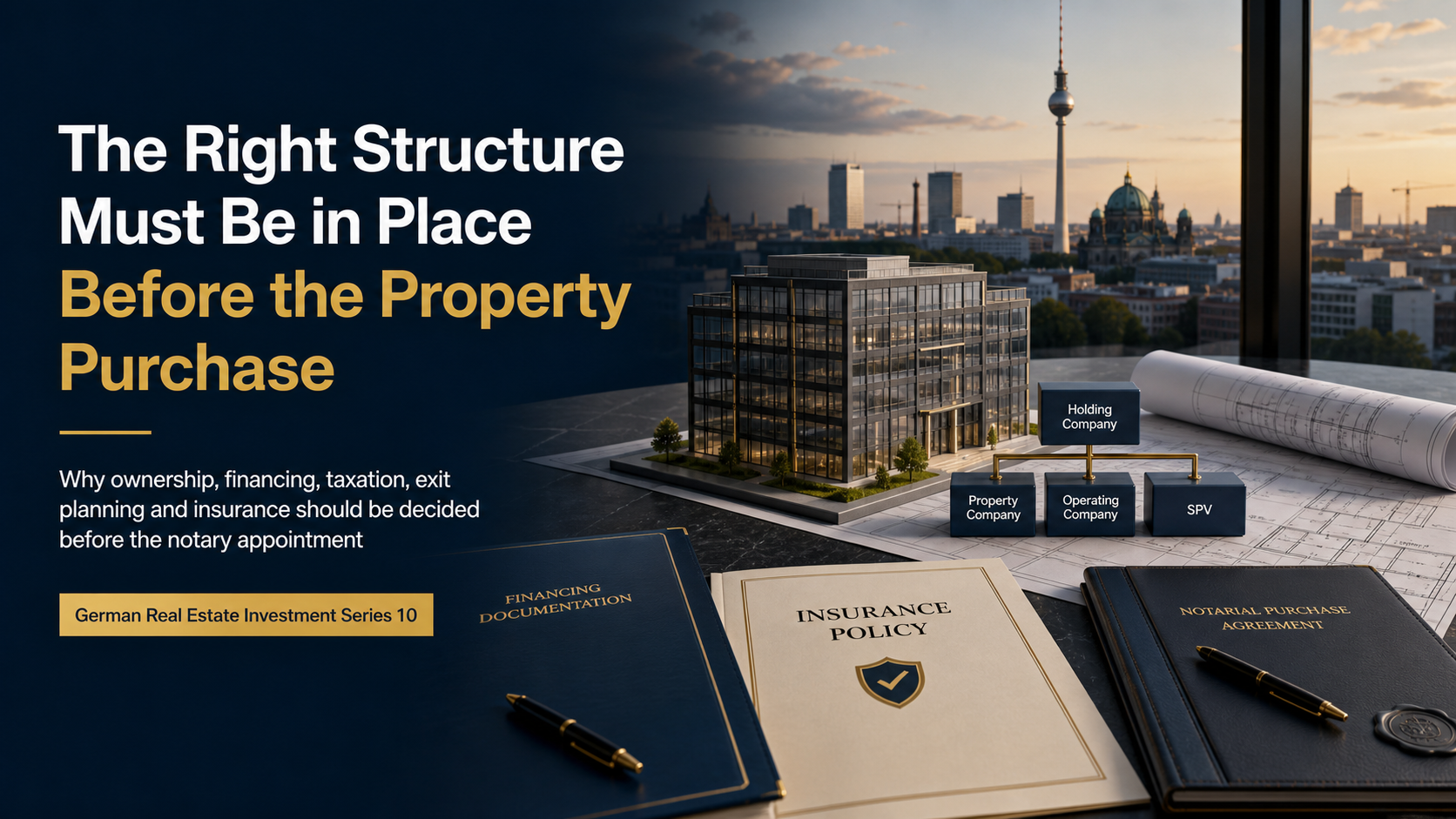
Why ownership, financing, taxation, exit planning and insurance should be decided before the notary appointment
International investors often begin with the property.
They identify an office building, logistics facility, hotel or development site, negotiate the price and then consider which company should become the purchaser.
For a substantial German real estate investment, this order can be risky.
The investor should first determine who will own the property, how the acquisition will be financed, where liabilities will be located, how profits will be distributed and how the investment may eventually be sold.
Once the purchase agreement has been notarised and the property has been transferred, correcting an unsuitable structure can become expensive or, in some cases, commercially impractical.
The final article in this series therefore begins with a simple principle:
The property may be the investment—but the structure determines how that investment will function.

The notary appointment is the end of the planning phase
Under German law, an agreement obliging a party to acquire or transfer ownership of real estate generally requires notarisation. This requirement is established in Section 311b of the German Civil Code.
The notary appointment should not be treated as the moment at which the investor first decides how to organise the acquisition. By that stage, the purchaser, financing, ownership structure and principal contractual protections should already have been determined.
Changing the purchaser after negotiations have been completed may require the seller’s consent, revisions to financing documents and additional tax analysis. If the property has already been acquired, transferring it to another group company may constitute a new taxable transaction.
The notary does not replace the investor’s tax adviser, transaction lawyer, financing adviser or technical consultant. Each adviser examines a different part of the investment.
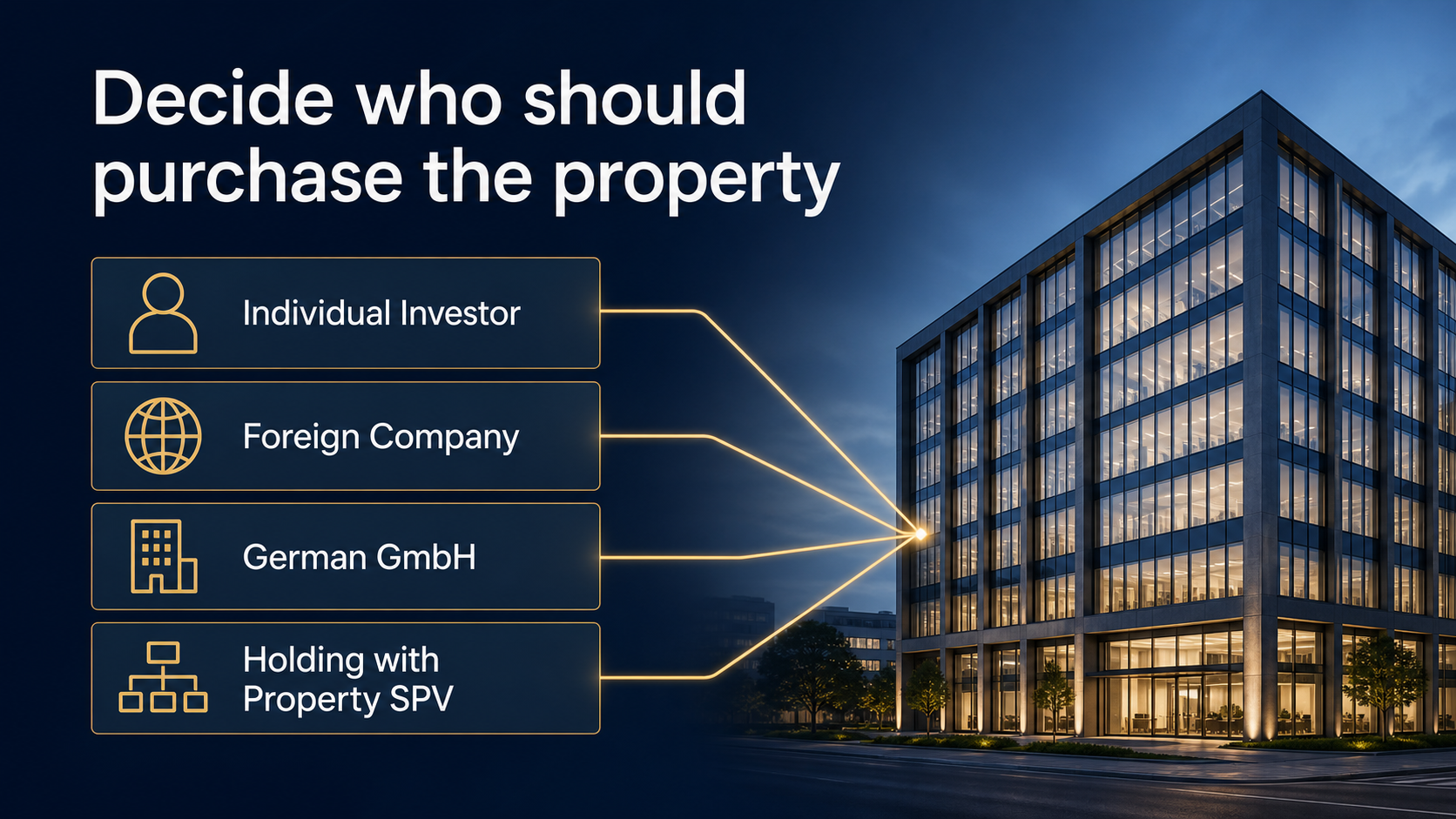
Decide who should purchase the property
The first structural question is whether the purchaser should be:
the investor personally;
the investor’s foreign company;
a newly established German GmbH;
a German property company held by a holding company;
a joint venture with German or international partners.
For a single property, a complex holding structure may not always be necessary. However, an investor planning to acquire several commercial properties, involve different financing partners or separate the risks of individual projects may benefit from establishing a German holding structure from the beginning.
A typical structure could consist of:
Foreign investor or foreign parent company
↓
German holding company
↓
Separate property companies
Each property company may own one property or one defined project. This can make financing, liability allocation, accounting and a later disposal easier to organise.
It does not mean that every investment requires a separate company. Formation, administration, accounting and compliance costs must remain proportionate to the size and strategy of the portfolio.

Determine the shareholders before capital is transferred
The German holding company may be owned directly by the international investor or by an existing foreign company.
Participation through the foreign company may be commercially appropriate where the investment capital originates from that company, the German investment forms part of a wider corporate strategy or profits are intended to remain within the international group.
Direct personal ownership may offer a simpler structure but can produce different tax, succession and profit-distribution consequences.
German business partners may also hold a minority participation, for example 10% or 20%, where they contribute capital, local market knowledge, project management or access to business relationships.
Such a participation should not be included merely for appearance. The shareholders’ agreement should clearly regulate:
voting rights;
reserved decisions;
additional financing obligations;
profit distributions;
transfer restrictions;
information rights;
deadlock situations;
exit rights;
consequences of default.
The appropriate ownership structure depends on the investor’s home country, applicable double-taxation agreements, the origin of the funds and the intended duration of the investment.
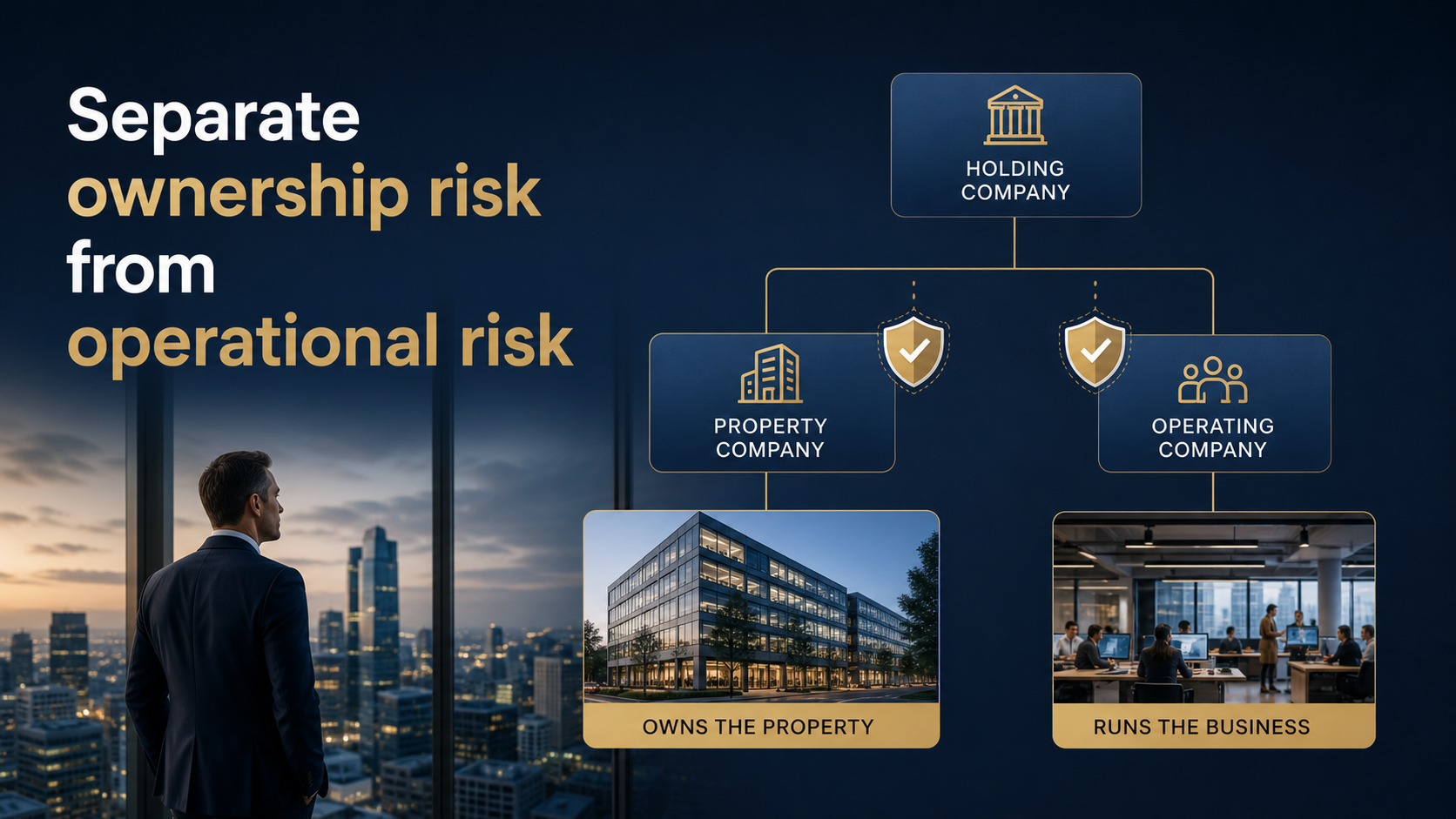
Separate ownership risk from operational risk
A commercial property may be used by a hotel operator, logistics business, serviced-office provider, development company or another operating enterprise.
Holding the property and operating the business in the same company can expose the real estate to operational risks. Claims arising from employees, customers, construction projects or commercial contracts may affect the same company that owns the property.
A possible alternative is to separate the functions:
Holding company
↓
Property company – owns and leases the building
↓
Operating company – conducts the commercial activity
This separation can improve liability management and make it easier to sell either the property or the operating business independently.
However, contracts between related companies must be commercially appropriate. Lease agreements, management fees, loans and service arrangements should reflect genuine functions and be properly documented.
For a property company seeking the extended trade tax reduction, operational or incompatible ancillary activities can also endanger the intended tax treatment. The statutory basis and permitted ancillary activities are addressed in Section 9 of the German Trade Tax Act.
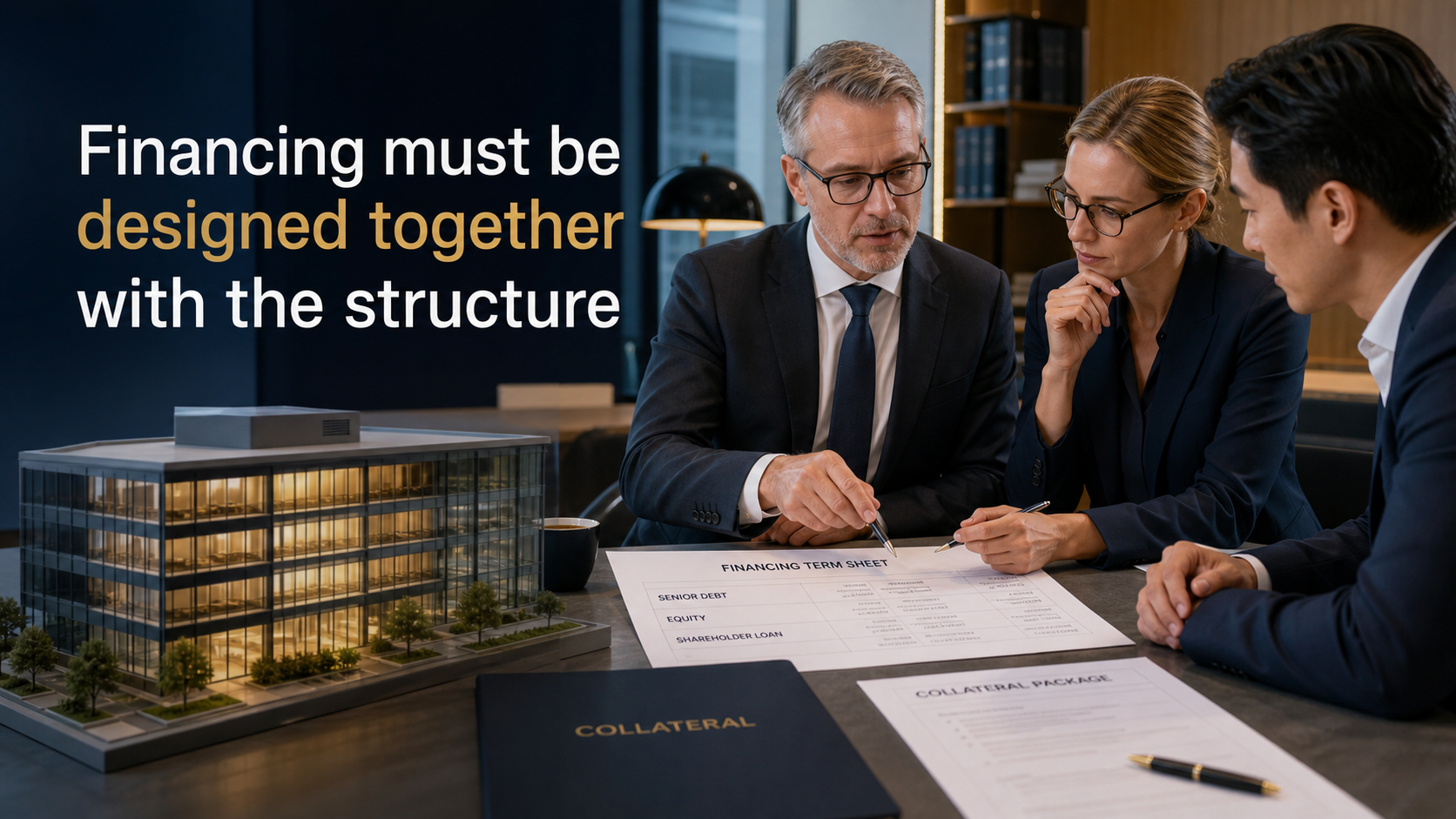
Financing must be designed together with the structure
Many international investors ask whether a German bank will finance a German property when the shareholder and part of the equity originate abroad.
Such financing is possible, but there is no universal percentage of debt financing available to every foreign investor.
A German bank may examine:
the market value and location of the property;
the quality and duration of the leases;
rental income and operating costs;
the debt-service capacity of the property;
the investor’s equity contribution;
the experience and financial strength of the sponsor;
the corporate and ownership structure;
the source of funds;
the borrower’s German financial history;
guarantees and additional collateral;
construction and letting risks.
A foreign bank guarantee may strengthen the financing package, but it does not automatically require a German bank to grant a loan. The German lender will still examine the issuing bank, the wording of the guarantee, its enforceability and the underlying transaction.
The investor should also decide whether funds will enter the German structure as share capital, capital reserves, shareholder loans or a combination of these instruments.
This decision affects repayment flexibility, interest deductibility, bank subordination requirements and future distributions. It should therefore be made before the acquisition—not after the money has already been transferred.
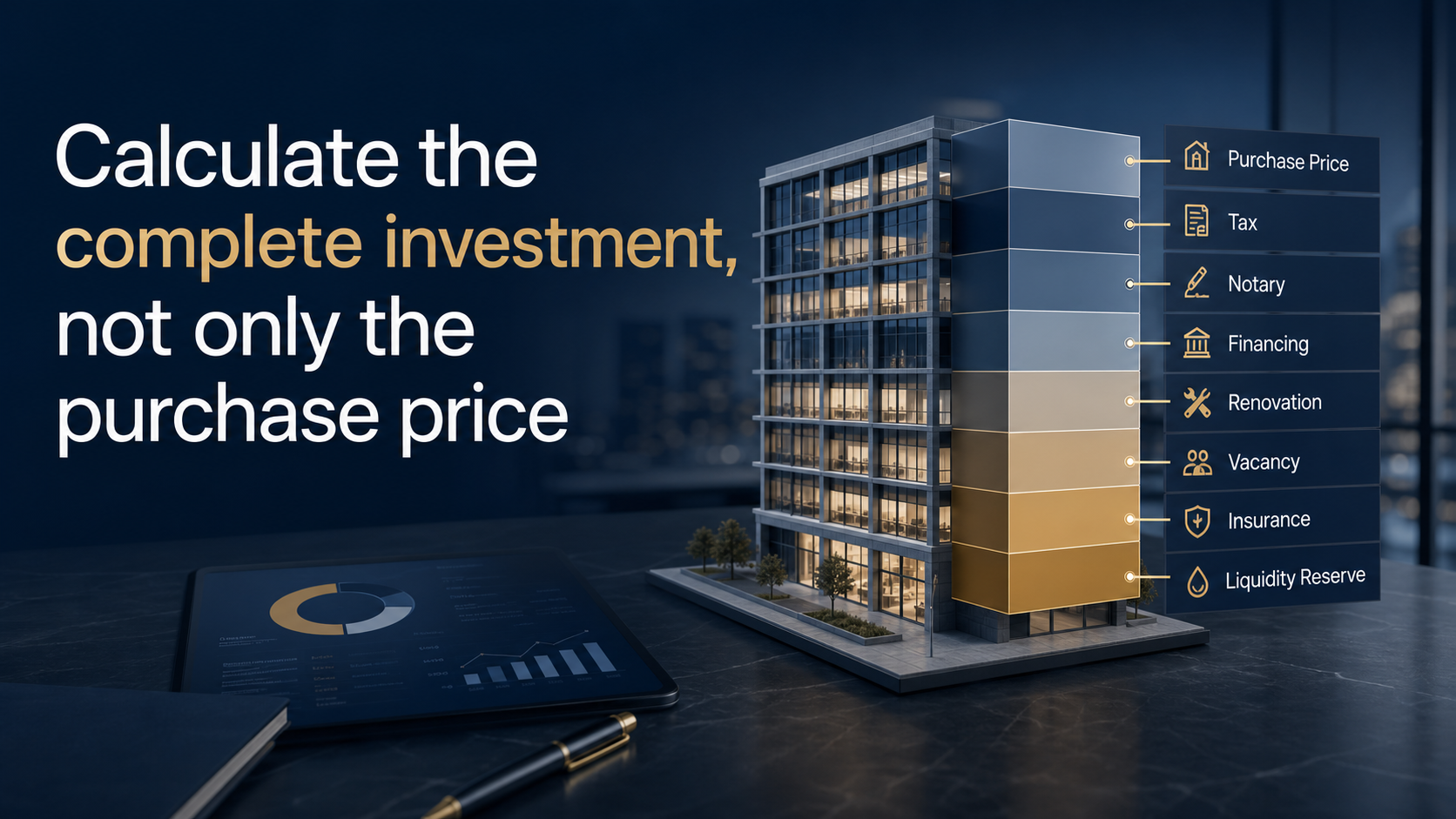
Calculate the complete investment, not only the purchase price
The purchase price is only one part of the capital requirement.
The financial plan should also account for:
real estate transfer tax;
notarial and land-register costs;
legal, tax and technical due diligence;
financing fees and interest;
valuation expenses;
brokerage fees;
renovation and construction costs;
environmental or contamination risks;
vacancies and rent-free periods;
ongoing company administration;
insurance premiums;
liquidity reserves.
The property company must remain capable of meeting its obligations even if renovation takes longer, interest costs rise or a major tenant leaves.
An investment that appears profitable before financing and transaction costs may produce a very different result once the complete cash flow is calculated.
The holding and financing structure should therefore be tested under several scenarios rather than only under the most optimistic forecast.

Conduct due diligence before becoming legally committed
Commercial real estate due diligence should normally cover more than the building’s physical condition.
Depending on the transaction, the review may include:
ownership and land-register information;
mortgages, easements and other encumbrances;
zoning and building permits;
construction defects and maintenance requirements;
environmental contamination;
leases, deposits and outstanding rent;
service and facility-management agreements;
operating costs;
energy and regulatory requirements;
tax documentation;
insurance history;
pending disputes.
In an asset deal, the investor acquires the property itself. In a share deal, the investor acquires shares in the company owning the property.
A share deal may preserve existing contracts and financing relationships, but the purchaser also acquires the history of the company. Tax exposures, contractual obligations, litigation and other liabilities can remain within it.
Contractual guarantees and indemnities can allocate risks between seller and purchaser, but they cannot make inadequate due diligence unnecessary. Their practical value also depends on the seller’s continuing ability to satisfy a claim.

Plan the exit before entering the investment
The investor should consider the future disposal even if the intended holding period is long.
Possible exit routes include:
selling the property through an asset deal;
selling the shares in the property company;
selling only part of the portfolio;
introducing a joint-venture partner;
refinancing and retaining the property;
transferring the investment within the international group.
A German corporate holding may offer advantages when it sells shares in a subsidiary. Under Section 8b of the German Corporation Tax Act, gains from the disposal of qualifying corporate shareholdings can generally receive substantial corporation-tax relief, although statutory exceptions and a non-deductible portion must be considered.
This does not mean that every real estate share deal is automatically tax-free.
German real estate transfer tax rules also apply to certain direct and indirect changes in the ownership of property-owning companies. The relevant ownership percentages, holding periods, associated persons and transaction sequence must be examined before shares are transferred.
The exit structure cannot safely be designed on the day a buyer submits an offer. If a later share sale is intended, the property and corporate structure should support that possibility from the beginning.
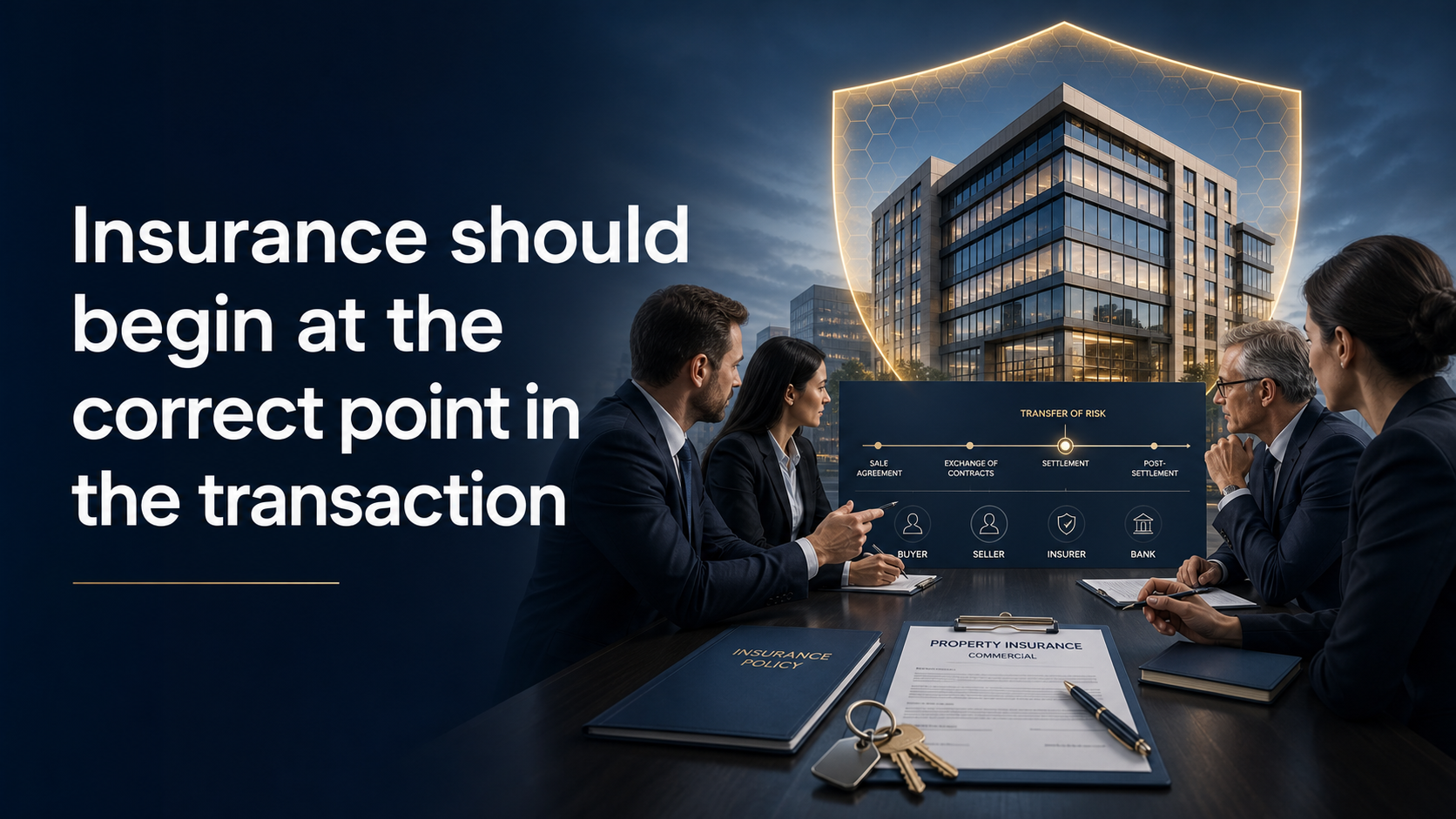
Insurance should begin at the correct point in the transaction
Insurance is sometimes treated as an administrative task to be completed shortly before closing. For a commercial property, it belongs in the transaction planning.
Depending on the asset and project, relevant coverage may include:
building insurance;
property-owner liability insurance;
construction insurance;
business-interruption or rental-loss coverage;
environmental liability insurance;
coverage for technical equipment;
directors’ and officers’ liability insurance;
legal-expenses or cyber coverage for the operating business.
The purchase agreement should specify when risks, benefits, costs and responsibilities transfer from the seller to the purchaser. The insurance cover must be coordinated with that date.
Banks may also impose minimum insurance requirements and request assignment of insurance claims as security.
Existing policies should not simply be assumed to provide sufficient protection. The insurer must understand the future use of the building, planned construction work, vacancy situation and ownership structure.
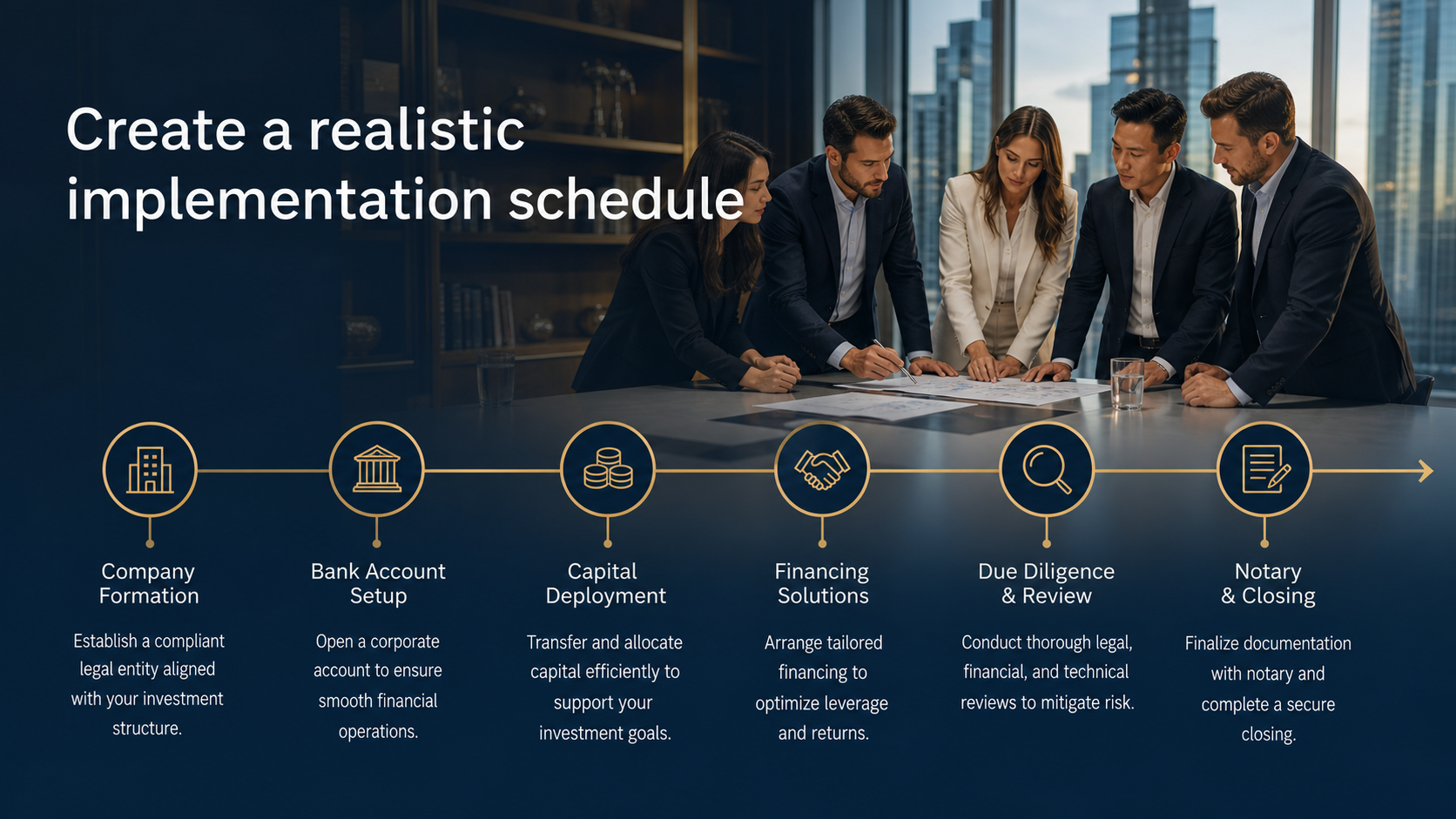
Create a realistic implementation schedule
International investors often underestimate how long it can take to establish the acquisition structure.
The timetable may need to include:
incorporating the holding company;
incorporating one or more property companies;
completing foreign shareholder documentation;
identifying beneficial owners;
opening German bank accounts;
transferring equity;
negotiating shareholder agreements;
obtaining financing approval;
completing tax and legal analysis;
performing property due diligence;
negotiating the purchase agreement;
arranging insurance;
obtaining internal and regulatory approvals.
Opening a business account for a German company with foreign shareholders can take considerably longer in practice than the formal company incorporation itself.
If a two-level holding structure is required, the holding company may need to be established and operational before it can form or acquire the property company. Starting the process only after the ideal property has been identified can place the investor under unnecessary time pressure.
A carefully negotiated exclusivity period or a purchase agreement containing appropriate conditions may provide time to complete essential preparations. However, such arrangements depend on the seller’s willingness and the individual transaction.

A practical pre-purchase checklist
Before attending the notary appointment, the investor should be able to answer the following questions:
Who is the purchaser?
Who owns the purchasing company?
Will local partners participate?
Which entity provides the equity?
Will shareholder loans be used?
Has bank financing been approved?
Which company will conduct operational activities?
Can property ownership and operations be separated?
Has the extended trade tax reduction been considered?
Have real estate transfer tax consequences been analysed?
Has legal, technical and tax due diligence been completed?
Is the planned exit an asset deal, share deal or long-term hold?
Are shareholder and joint-venture agreements ready?
When does insurance coverage begin?
Are sufficient liquidity reserves available?
Can all foreign funds and beneficial owners be documented?
If several of these questions remain unanswered, the transaction may not yet be ready for notarisation.
Conclusion
The correct structure does not turn an unsuitable property into a good investment. But an unsuitable structure can weaken an otherwise excellent property investment.
For international investors, the German acquisition company, holding structure, shareholder participation, financing, tax treatment, liability separation, insurance and future exit should be considered as parts of one plan.
The best structure is not necessarily the most complicated one. It is the structure that corresponds to the number and type of properties, the source of the capital, the financing strategy, the investor’s home country and the intended exit.
Once the property has been acquired, changing the structure may require additional transactions, taxes, financing approvals and notarial work.
For that reason, the decisive planning should take place before the purchase agreement is signed.
First design the investment structure. Then acquire the property.
This article provides general information only and does not constitute legal, tax, financing or investment advice. Every transaction should be reviewed by qualified German legal and tax advisers, financing professionals and technical specialists based on its individual circumstances.
Free Consultation
Have questions about entering the German market? Request a free consultation.
Request Free Consultation