
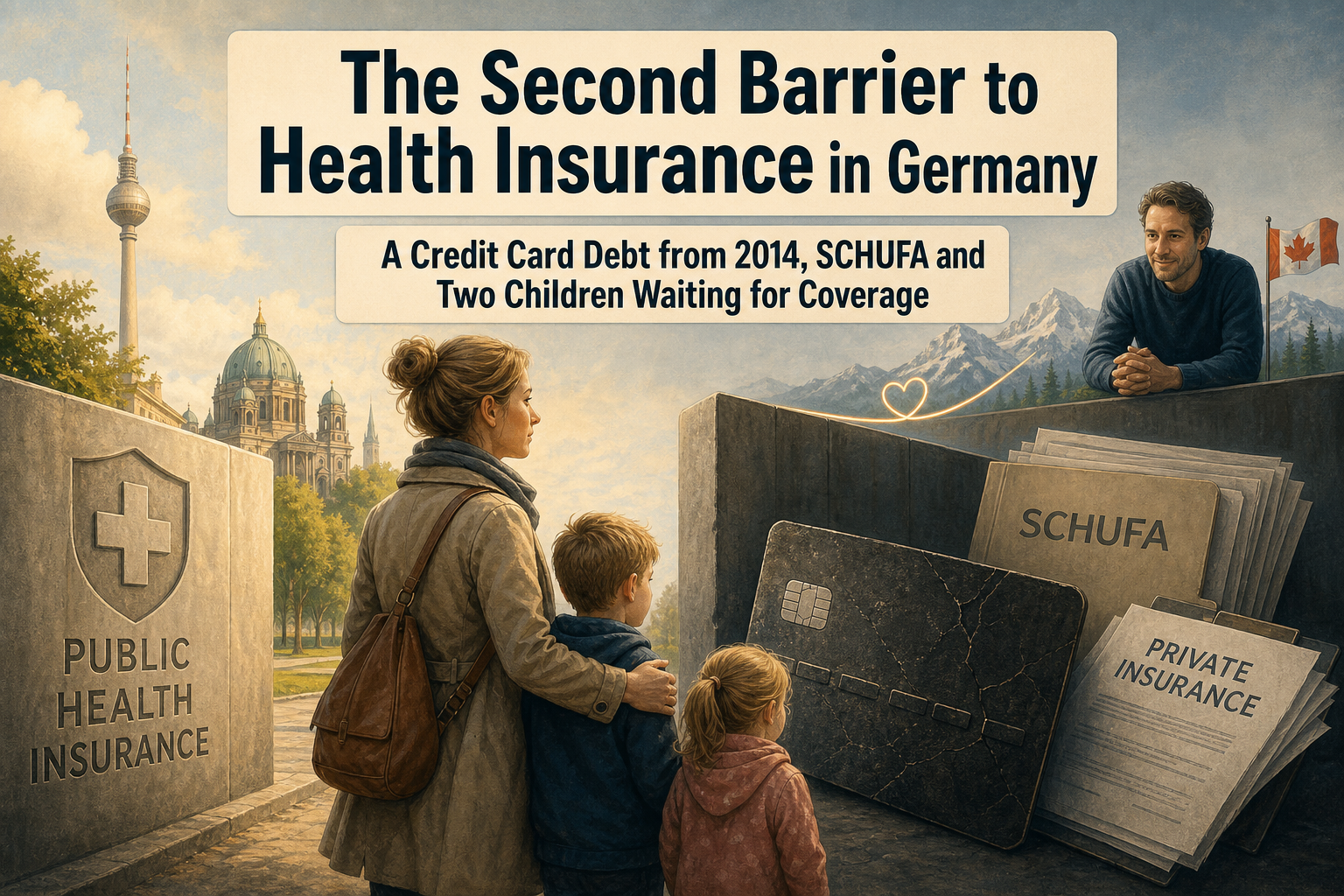
A credit card debt from 2014, a SCHUFA record and two children still waiting for coverage
This is the continuation of Emma Collins’s story.
Emma moved from Canada to Germany with her two school-age children after accepting a position with the German subsidiary of a Canadian company. Her husband, Daniel Brooks, remained in Canada to continue managing the family’s business interests.
Emma became a member of Germany’s statutory health insurance system. However, her children were refused free family insurance because Daniel was not a member of a German statutory health insurance fund and earned more than Emma while continuing to work in Canada.
An attempt to enrol the children as voluntary members of the German public system was also unsuccessful.
Emma therefore applied for private health insurance for both children. She believed that this would finally resolve the problem.
Instead, the family encountered a second and entirely unexpected barrier.

A previous life in Germany
Emma had already lived in Germany once before.
She studied business administration at a German university and was close to completing her studies in 2014 when an urgent family matter required her to return to Canada much sooner than planned.
She had very little time to organise her departure. She terminated her accommodation, packed her belongings and completed her German departure registration, known as Abmeldung.
In the rush, Emma overlooked the outstanding balance on a German credit card.
Approximately €1,400 remained unpaid.
The credit card had been used exclusively for private expenses during her studies. It was not connected to a company, a business activity or her future German employer.
Emma returned to Canada believing that her affairs in Germany had been concluded.
Departure registration does not end a debt
An Abmeldung records that a person has moved away from a German address. It does not automatically terminate bank accounts, credit cards, telephone contracts or other private agreements.
It also does not extinguish existing debts.
Emma had correctly deregistered her German residence. However, the credit card account and its outstanding balance were separate legal matters.
During the following years, Emma says she did not receive any letters, emails or other messages concerning the debt. She was not aware of a payment reminder, collection procedure, court claim or enforcement action.
She therefore assumed that no unresolved problem remained in Germany.
Years later, she discovered that this assumption had been wrong.

From €1,400 to more than €2,400
When Emma applied for private health insurance for her children, the process initially appeared to be progressing normally.
She completed the children’s health questionnaires and submitted their existing insurance records. The insurer explained the available coverage and calculated the premiums.
Before issuing the final policy, however, the company examined Emma’s creditworthiness. Although the children would be the insured persons, Emma would enter into the contract and be responsible for paying the premiums.
The insurer discovered negative information connected to Emma in the German SCHUFA credit-reporting system.
The original credit card balance of approximately €1,400 had apparently increased to more than €2,400.
At first, Emma assumed that the difference was the result of compound interest accumulating for around ten years. That explanation, however, would be too simplistic.
German law generally prohibits charging default interest on accrued interest. The increased amount could instead consist of several components, including:
the original credit card balance;
contractual interest;
statutory default interest;
reminder charges;
debt-collection costs;
legal fees;
court costs; or
expenses connected with attempted enforcement or address searches.
Emma needed a complete itemised statement before she could determine whether the additional €1,000 was correct and legally recoverable.

Had the debt already become time-barred?
Emma had heard that ordinary civil claims in Germany generally become time-barred after three years.
She therefore asked an obvious question: How could a credit card debt from 2014 still be enforceable approximately ten years later?
The answer depends on the exact legal classification and procedural history of the claim.
The standard limitation period under German civil law is three years. It generally begins at the end of the year in which the claim arose and the creditor knew, or should have known, the relevant circumstances and the identity of the debtor.
However, special rules may apply if the credit card agreement qualifies as a consumer loan.
For certain consumer-loan claims, the limitation period for repayment and interest may be suspended after the borrower enters into default. This suspension may continue for up to ten years from the date on which the particular claim arose.
The position may also be different if:
Emma acknowledged the debt;
she made a partial payment;
the parties entered into negotiations;
a court payment order was issued;
legal proceedings were started;
the claim was established by a judgment; or
an enforceable legal title was obtained.
A claim established by a final judgment or another enforceable title may generally remain enforceable for 30 years.
Consequently, the statement “the debt automatically disappeared after three years” would not be legally reliable.
Even when a limitation period has expired, the debt does not simply delete itself. Limitation is generally a defence that the debtor must assert. Paying an old claim without first examining it can therefore have consequences.
Emma had never received a reminder
From Emma’s perspective, the most confusing part was that she had never received any correspondence about the debt.
She did not remember receiving a warning, a debt-collection letter, a court payment order or notice of enforcement. During most of the relevant period, she had been living in Canada.
That fact was important, but it did not answer every legal question.
It was necessary to establish:
which address the creditor had used;
whether letters had been returned;
whether a court attempted formal service;
whether an alternative method of service was used;
whether an enforceable title existed;
when any legal proceedings began; and
whether the creditor knew that Emma had moved abroad.
Not receiving a letter personally does not always prove that no legally effective service occurred. Equally, a creditor cannot assume that every document sent to an old address was necessarily served correctly.
Emma therefore had to request the complete file rather than rely only on her memory of events.
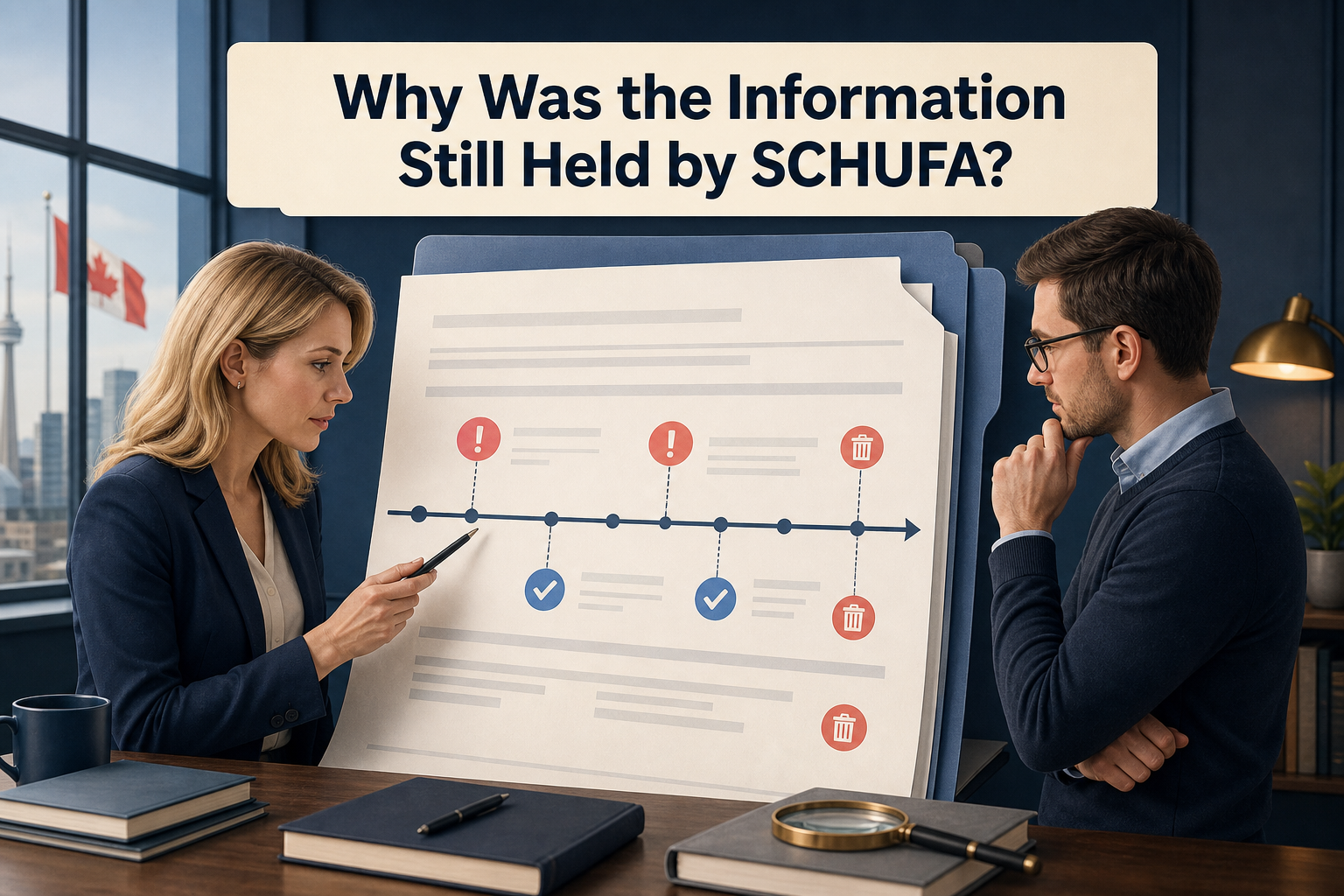
Why was the information still held by SCHUFA?
Limitation of the underlying debt and storage of information by SCHUFA are two different legal questions.
The first question is whether the creditor can still enforce the debt.
The second is whether SCHUFA may continue to store and disclose particular information about it.
Emma’s German departure registration did not automatically delete SCHUFA data. However, leaving Germany does not give SCHUFA or a creditor an unlimited right to retain negative information forever.
If a simple non-payment entry from 2014 was still appearing without any subsequent event, Emma needed to examine its accuracy and the applicable retention period carefully.
She requested a free copy of the personal data held about her. She then needed to check:
the name of the company that reported the information;
the date of the original entry;
the amount reported;
the date of the most recent update;
whether the debt was shown as open or settled;
whether the same debt appeared more than once;
whether a court judgment existed;
whether she had been entered in a public debtors’ register; and
the legal basis for continuing to store the information.
An incorrect, outdated or duplicated entry may be challenged. If the accuracy of an entry is formally disputed, the responsible organisations should investigate it and consider whether its further use must be restricted while the dispute is examined.
An accurate entry, however, may not be deleted immediately merely because the debt has now been paid. Different retention rules can apply depending on the type and status of the information.

The children’s private insurance application is suspended
The private insurer told Emma that the children’s medical histories were not the problem.
The difficulty concerned Emma as the proposed policyholder and premium payer.
Although she now had regular employment and a stable salary in Germany, the insurer viewed the unresolved SCHUFA information as an indication of possible payment risk.
The insurer said it would reconsider the children’s application once the debt and the negative credit information had been resolved.
This was an underwriting decision concerning an ordinary private insurance product. It should not be confused with the legal rules governing the private Basistarif.
An ordinary private insurer may assess whether it wishes to offer a particular standard tariff. Depending on the product, it may consider health risks, contractual risks and the likelihood that premiums will be paid.
The Basistarif is different. Private health insurers must, in principle, accept eligible applicants into that tariff, subject to the statutory conditions and limited exceptions.
Emma therefore needed to ask a more precise question: Was the insurer rejecting only its regular private product, or had it also examined whether the children were legally eligible for the Basistarif?
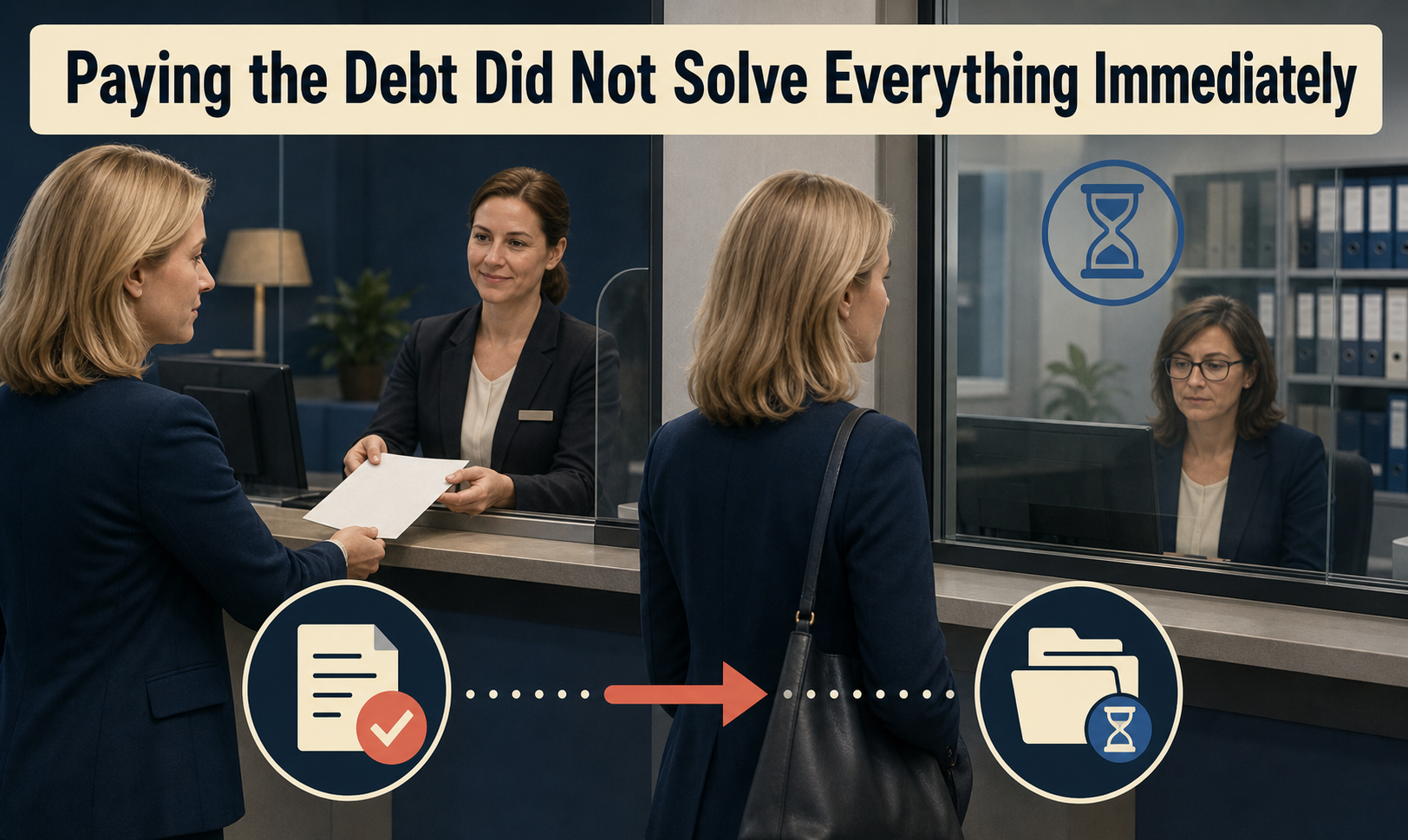
Paying the debt did not solve everything immediately
Emma was prepared to pay any amount that was genuinely owed.
However, before transferring more than €2,400, she requested an itemised calculation and evidence showing who currently owned the claim.
The original credit card issuer might still have been the creditor, or the claim might have been assigned to a collection company. Emma also needed to determine whether a court order or judgment existed.
After the amount was clarified, Emma paid the sum that was confirmed as outstanding and requested written confirmation that the debt had been settled.
She expected the SCHUFA record to disappear immediately.
That did not happen.
Payment of a debt and deletion of credit information are separate steps. The creditor first needed to report that the claim had been settled. SCHUFA then had to update the record and determine whether immediate deletion or a further retention period applied.
Emma also disputed entries that appeared inaccurate or duplicated. This resulted in correspondence between the credit card issuer, a collection company, SCHUFA and the private insurer.

Five months of correspondence
Almost five months passed while Emma attempted to reconstruct events dating back to 2014.
She requested:
the original credit card agreement;
historical account statements;
the applicable contractual interest rate;
the date on which the account entered default;
an itemised calculation of the increase from €1,400 to more than €2,400;
evidence of any assignment to a collection company;
copies of reminders and collection letters;
evidence of the addresses used;
documents relating to any court proceedings;
evidence of formal service;
details of any enforceable title; and
the reporting history supplied to SCHUFA.
Some organisations took weeks to respond. Others referred Emma to a different company. Documents from 2014 were not always immediately available.
Throughout this process, her two children still had no confirmed permanent German health insurance.
A four-person family under pressure
Emma was living in Berlin with the children, while Daniel remained in Canada.
Daniel offered to pay the premiums, provide a guarantee or pay several months in advance. The family had sufficient financial resources and Emma had secure employment.
Nevertheless, the unresolved credit information continued to delay the application for the insurer’s regular product.
Meanwhile, the children were attending school and living permanently in Germany. Emma worried about what would happen if one of them became ill or had an accident.
The family’s problem was no longer simply an old credit card bill. It had become a combination of:
German public health insurance rules;
private insurance underwriting;
an old consumer debt;
limitation periods;
possible court proceedings;
SCHUFA retention rules; and
immigration-related insurance requirements.
Several processes must run at the same time
The family could not afford to wait until every SCHUFA question had finally been answered.
Emma needed to pursue several routes simultaneously.
Concerning the debt and SCHUFA data, she had to:
obtain her complete SCHUFA data copy;
identify every negative entry;
determine the current creditor;
request an itemised statement;
check whether the claim was time-barred;
establish whether a judgment or enforceable title existed;
challenge inaccurate or duplicated information;
request confirmation of settlement; and
retain copies of all correspondence and payment evidence.
Concerning the children’s insurance, she also needed to:
approach other private health insurers;
ask whether advance payment or another policyholder would be accepted;
obtain a written decision concerning the regular tariff;
examine the children’s eligibility for the Basistarif;
review the earlier statutory insurance decisions;
clarify whether any temporary coverage met German requirements; and
obtain specialist legal advice without waiting for the credit dispute to end.

Lessons for former residents returning to Germany
Emma’s experience is relevant to anyone who previously studied or worked in Germany and later plans to return.
Completing an Abmeldung does not necessarily close every private contract. Before returning to Germany, former residents should examine whether any unresolved obligations remain.
Possible issues include:
bank accounts and overdrafts;
credit cards;
mobile telephone contracts;
internet contracts;
rent and service charges;
electricity or gas bills;
insurance premiums;
taxes;
transport penalties; and
old collection or court proceedings.
Obtaining a SCHUFA data copy before submitting important rental, banking or insurance applications can reveal problems at an earlier and less critical stage.
Conclusion
Emma’s first obstacle was the refusal of free family insurance for her children.
Her second obstacle was an unresolved credit card balance from 2014 and the credit information connected to it.
The original debt was approximately €1,400. By the time Emma returned to Germany, the amount being claimed had risen to more than €2,400. She had not been aware of reminders, collection proceedings or enforcement while living in Canada.
That did not automatically mean that the claim was invalid. It also did not prove that every charge and every SCHUFA entry was correct.
The family needed to separate three questions:
Was the debt still legally enforceable?
Were the additional interest and costs justified?
Was the SCHUFA information accurate and still lawfully stored?
Most importantly, Emma could not wait for the credit dispute to be resolved before looking for other health insurance routes.
For international families, relocation planning is not limited to visas, employment and schools. It should also include a review of previous German contracts, debts, court correspondence and credit records.
A forgotten account from a former period of residence can become a serious obstacle years later—especially when the health insurance of children depends on a new contract being accepted.
Disclaimer: This fictional case provides general information only. It does not constitute legal, debt, credit-reporting, immigration or insurance advice. Limitation periods, service of documents, SCHUFA retention and eligibility for private insurance must be assessed individually.
Free Consultation
Have questions about entering the German market? Request a free consultation.
Request Free Consultation