
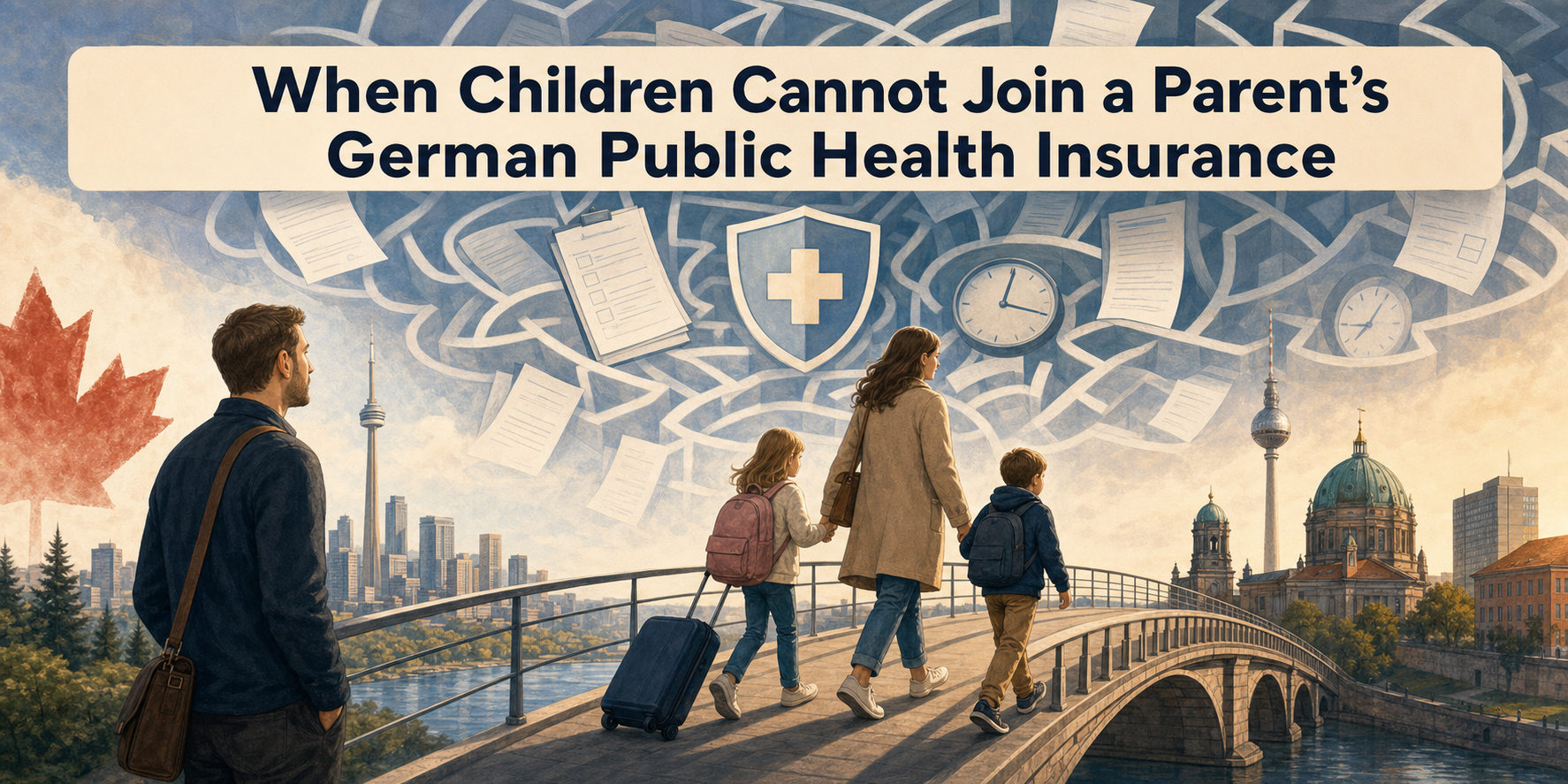
A hidden risk for international families moving to Germany
Many international families do not move to Germany together at the same time. One parent may take up employment in Germany while the other continues working in the family’s home country. The children may move with the parent coming to Germany, especially when education, an international school or a new professional opportunity is involved.
This arrangement can work well for the family. However, it can create an unexpected problem under German health insurance law.
The following fictional example illustrates why the children’s health insurance should be clarified before applying for visas and travelling to Germany.

Emma Collins moves to Germany with her children
Emma Collins and her husband, Daniel Brooks, live in Canada. Daniel is the managing director of Northbridge Systems Inc., a Canadian technology company.
When the company establishes a German subsidiary, Emma is offered a regular position with the new German entity. She qualifies for an EU Blue Card and plans to move to Germany with the couple’s two school-age children.
The marriage is intact. Daniel will remain in Canada for professional reasons, while Emma and the children establish their main residence in Germany.
Because of her employment, Emma becomes a member of a German statutory health insurance fund, commonly referred to as public health insurance or GKV.
She assumes that her children can be included in her insurance under the free family insurance scheme.
During the application process, however, the health insurance fund asks for information about Daniel’s income in Canada. Emma provides the requested information and confirms that her husband earns more than she does.
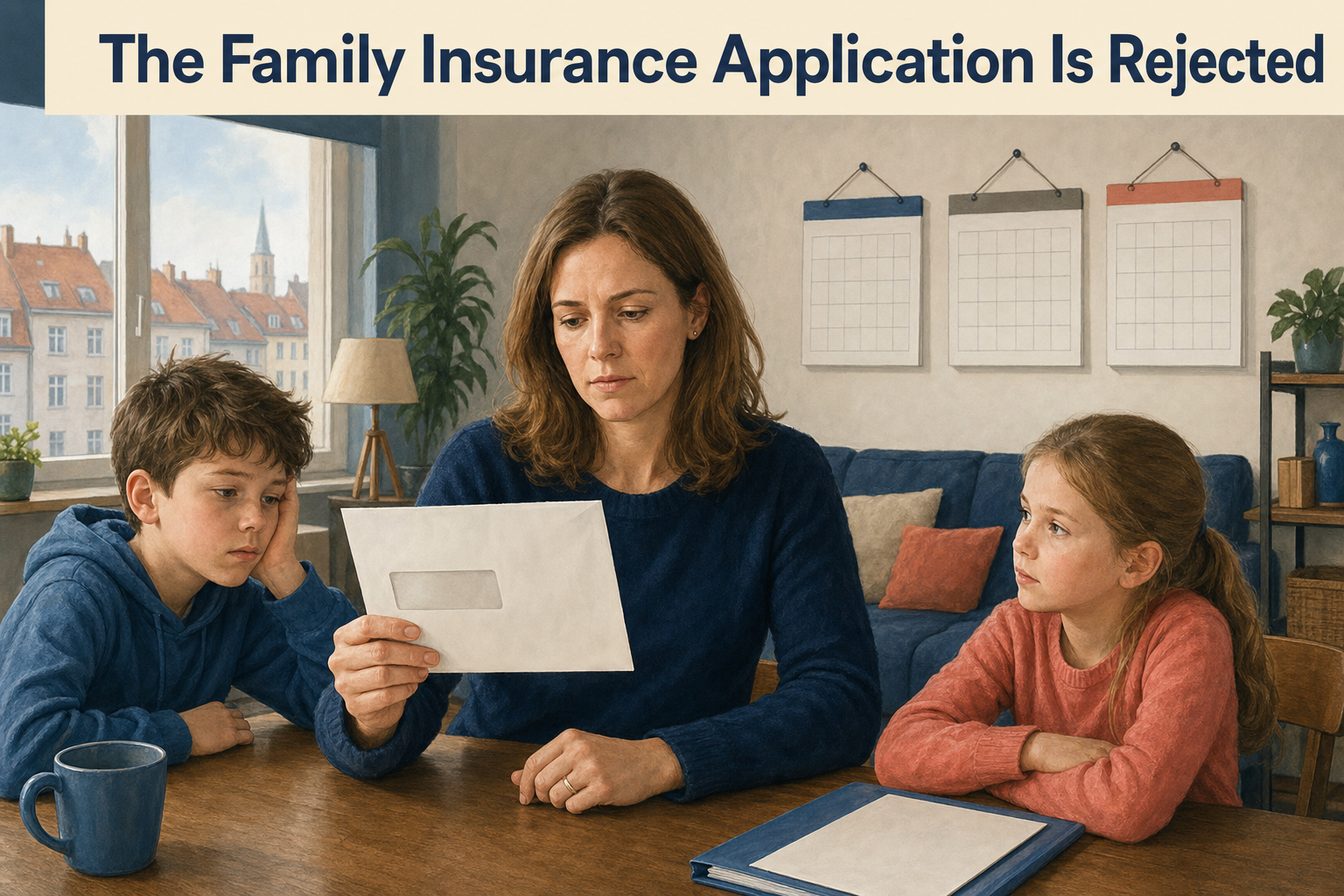
The family insurance application is rejected
Approximately two months later, the health insurance fund informs Emma that her children cannot be included in her free family insurance.
The decision is based on Section 10(3) of Book V of the German Social Code.
Under this provision, free family insurance for children may be excluded when all the following conditions are met:
The other parent is married to or in a registered civil partnership with the publicly insured parent.
The other parent is related to the children.
The other parent is not a member of a German statutory health insurance fund.
The other parent’s regular total income exceeds the applicable monthly income threshold.
The other parent’s regular total income is also higher than that of the parent insured under the German public system.
All relevant conditions must be examined. The fact that the parent abroad simply earns more than the parent in Germany is not, by itself, always sufficient.
The exact type, amount and regularity of the foreign income must be assessed under German social insurance rules.
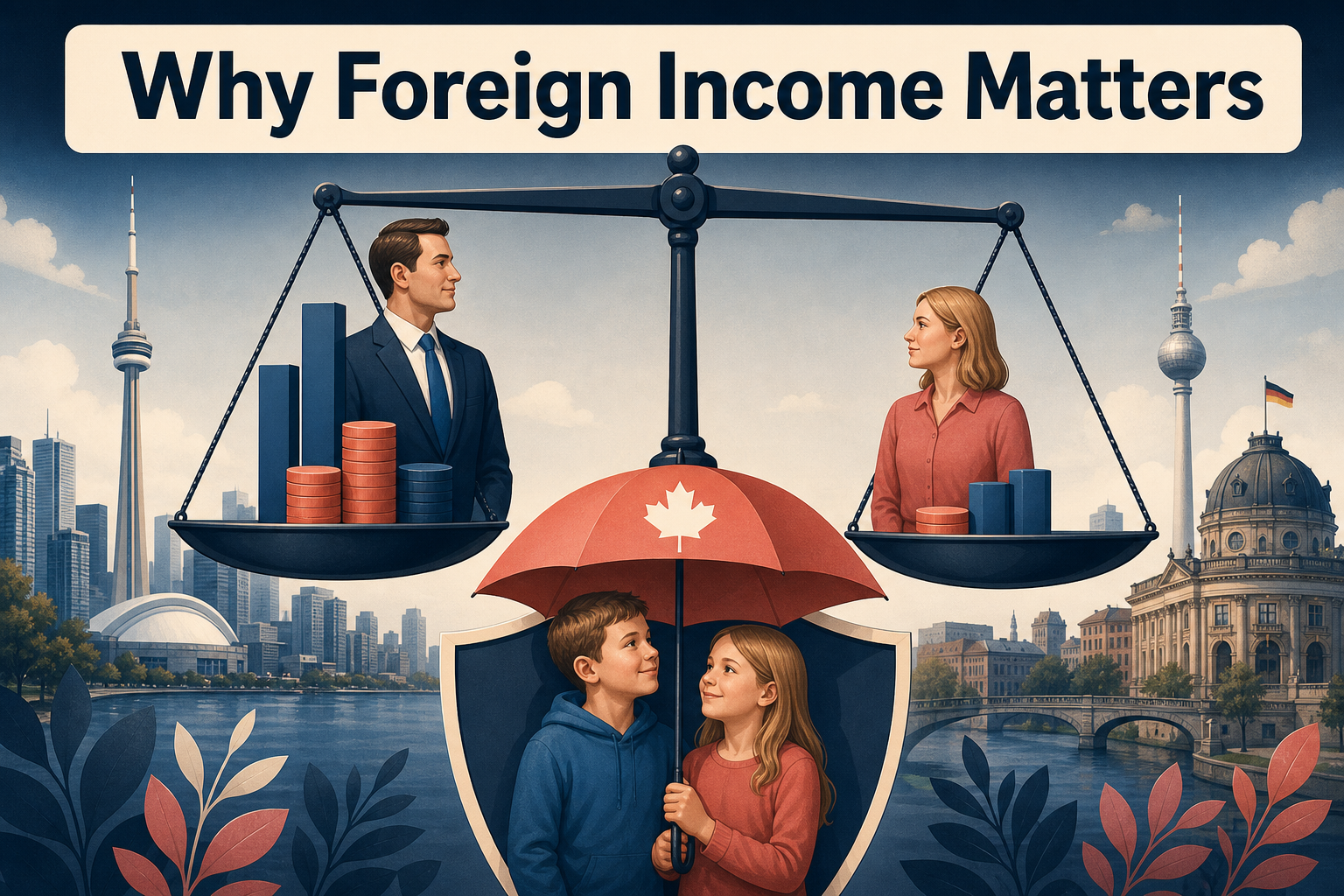
Does foreign income have to be disclosed?
Families sometimes assume that the income of a spouse living outside Germany is irrelevant. This is not necessarily correct.
A German health insurance fund may request the information it needs to determine whether the legal requirements for family insurance are satisfied. This can include information about a spouse’s income abroad.
The health insurance fund should nevertheless examine the foreign income carefully. Among other matters, it may be necessary to determine:
which payments qualify as income under German law;
whether bonuses, dividends or other payments are regular;
which exchange rate should be applied;
whether business income is comparable to employment income; and
whether the income exceeds the legally relevant threshold.
A general statement that the foreign spouse “earns more” should not replace a proper legal and financial assessment.
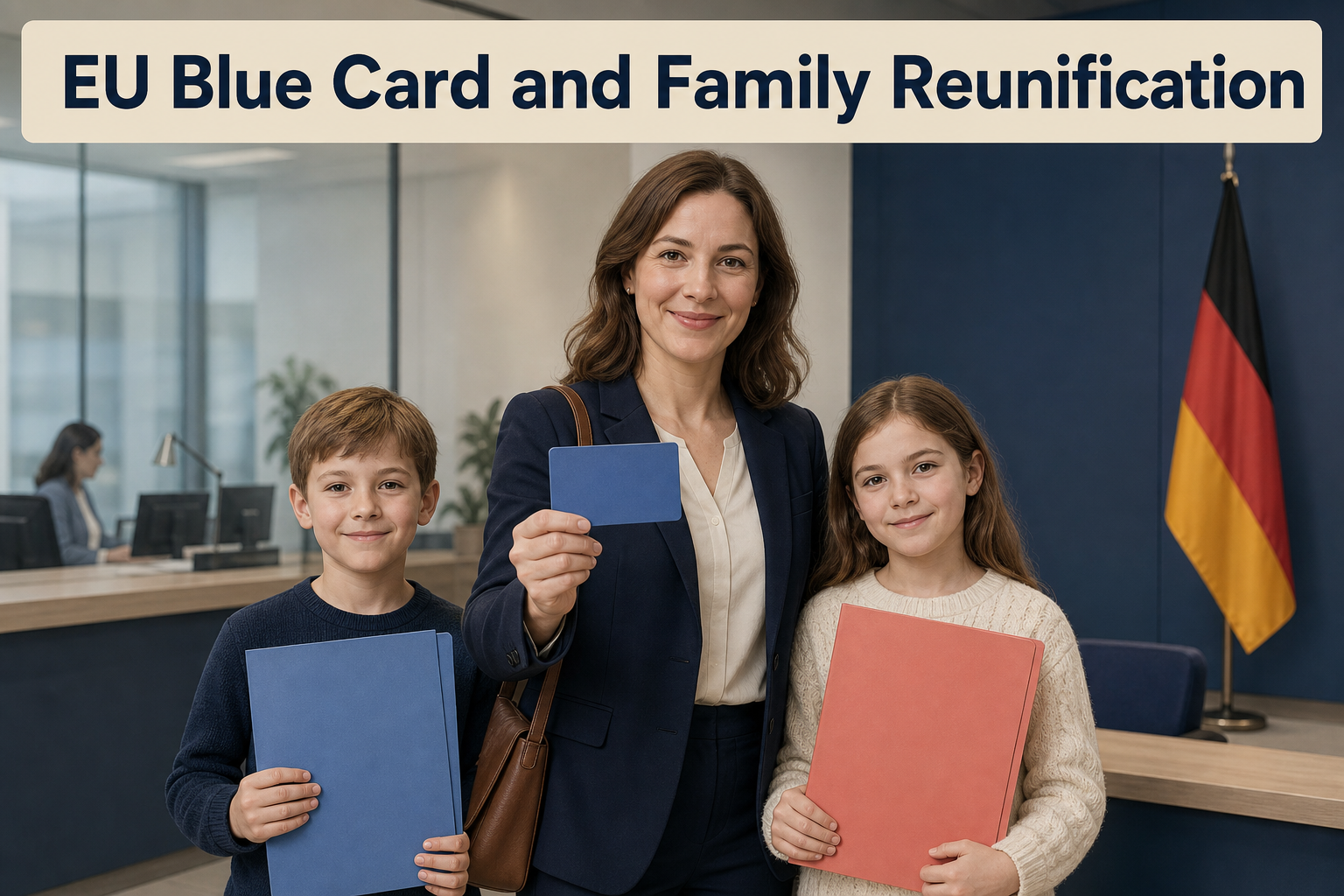
EU Blue Card and family reunification are different statuses
Emma receives an EU Blue Card because she personally satisfies the employment, qualification and salary requirements.
Her children do not receive EU Blue Cards. They generally receive visas and residence permits for family reunification.
This distinction matters because the residence status of each family member can affect the available health insurance options.
Proof of sufficient health insurance may be required during the immigration process. A visa, a residence permit and membership in a German health insurance fund are related issues, but they are not the same thing.
Approval in one area does not automatically guarantee approval in another.
A second attempt: voluntary public insurance
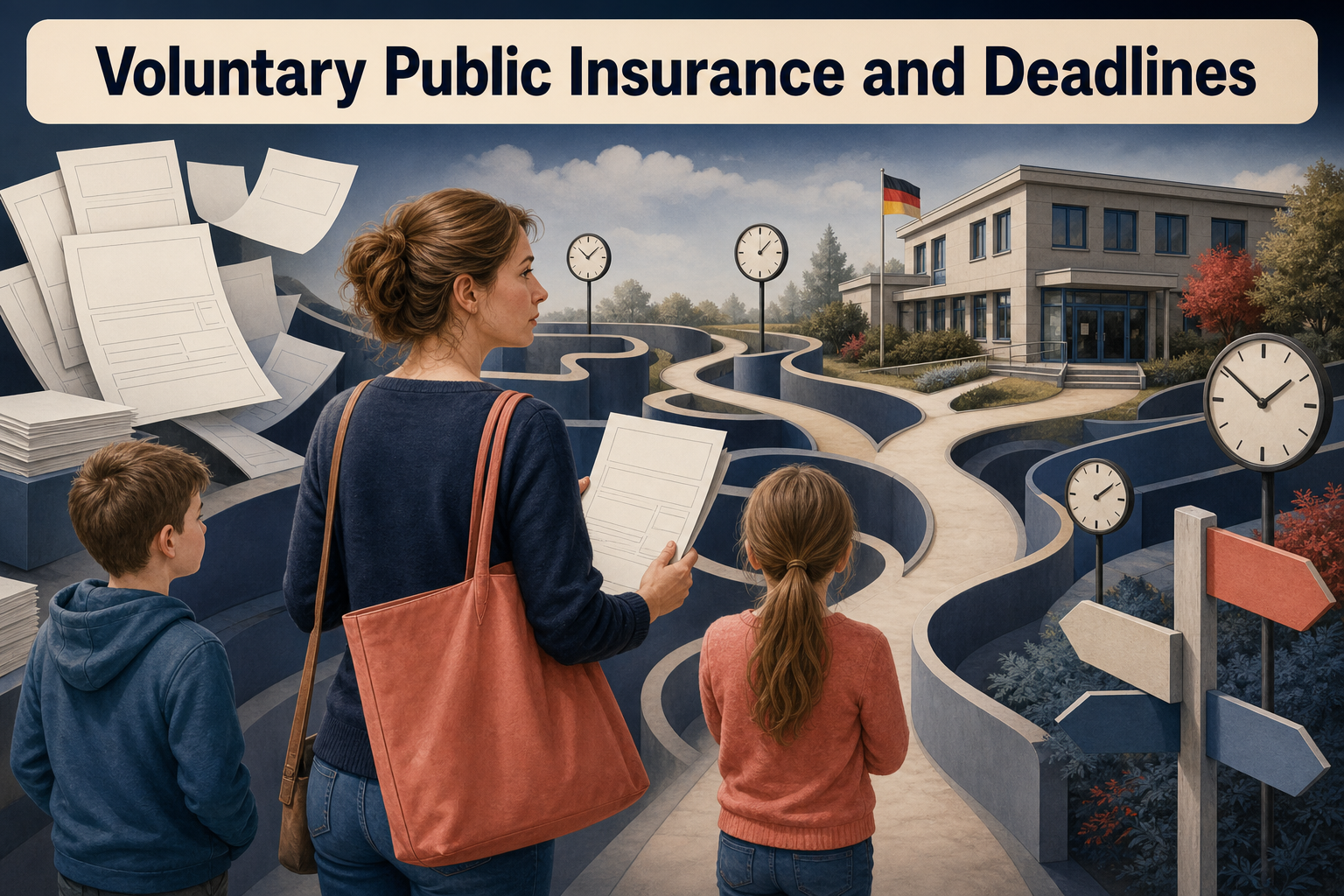
After rejecting the children’s family insurance, the health insurance fund tells Emma that the children might be able to join the same fund as voluntary members.
Emma submits new applications.
Several weeks later, the fund rejects these applications as well. It explains that the children do not meet the statutory requirements for voluntary membership or that a relevant application deadline has expired.
By this point, several months have passed since the visas were issued.
This creates a particularly difficult situation. The family relied on the possibility of public insurance, but no binding membership confirmation was ever issued.
Is voluntary insurance available only during the visa application?
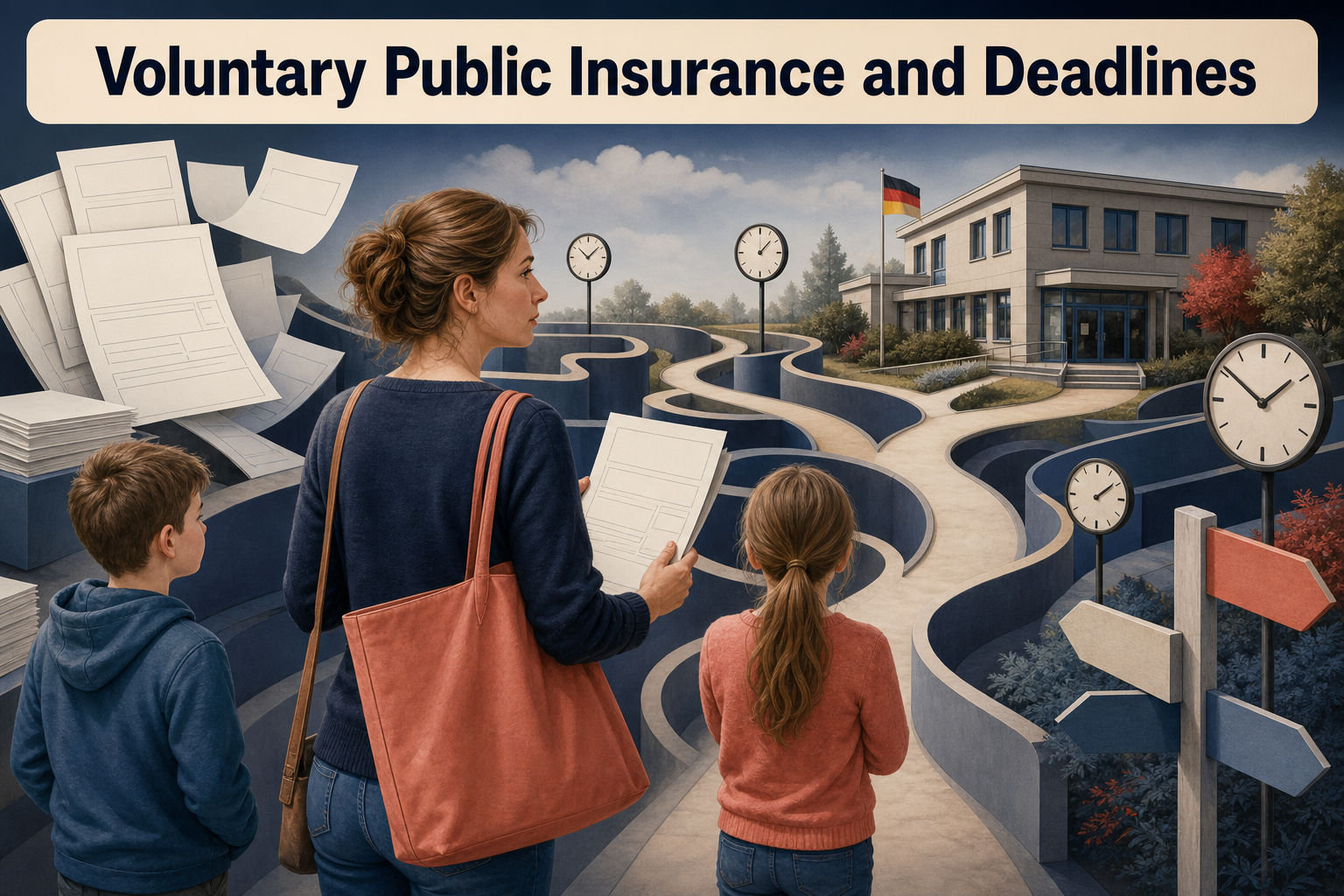
There is no general rule stating that every foreign national can join German public health insurance voluntarily only at the time of the visa application.
German law provides several routes to voluntary membership. Each route has its own eligibility criteria, previous-insurance requirements and deadlines.
In certain cases, an application must be made within three months of a legally relevant event. The starting point of that period depends on the particular legal provision. It is therefore essential to identify the correct legal basis instead of relying on a general reference to a “three-month visa deadline.”
A major problem for newly arriving children is that they may have no previous membership in the German or another qualifying public insurance system. If the required previous-insurance periods are not satisfied, voluntary membership may not be available even after family insurance has been denied.
A verbal statement from a customer-service representative should never be treated as a final insurance commitment. Families should request written confirmation of:
the legal basis for membership;
the date on which coverage begins;
the monthly contribution;
any documents still required; and
whether the children have already been formally registered as members.

The children are suddenly without confirmed coverage
After several months of applications and correspondence, Emma’s children still do not have confirmed German public health insurance.
Emma must now approach private health insurers.
A private insurer may request information about the children’s medical history, previous treatment and existing insurance coverage. It may also ask why there has been a period without confirmed German insurance.
Depending on the product and the applicable legal framework, private insurance may involve:
an individual health assessment;
separate premiums for each child;
contractual exclusions or limitations;
waiting periods in certain policies;
a risk surcharge; or
a decision based on the insurer’s underwriting rules.
An inexpensive travel insurance policy is not automatically equivalent to comprehensive German health insurance. Its duration, benefits, exclusions and acceptance for immigration purposes must be examined carefully.

Why the issue must be resolved before travelling
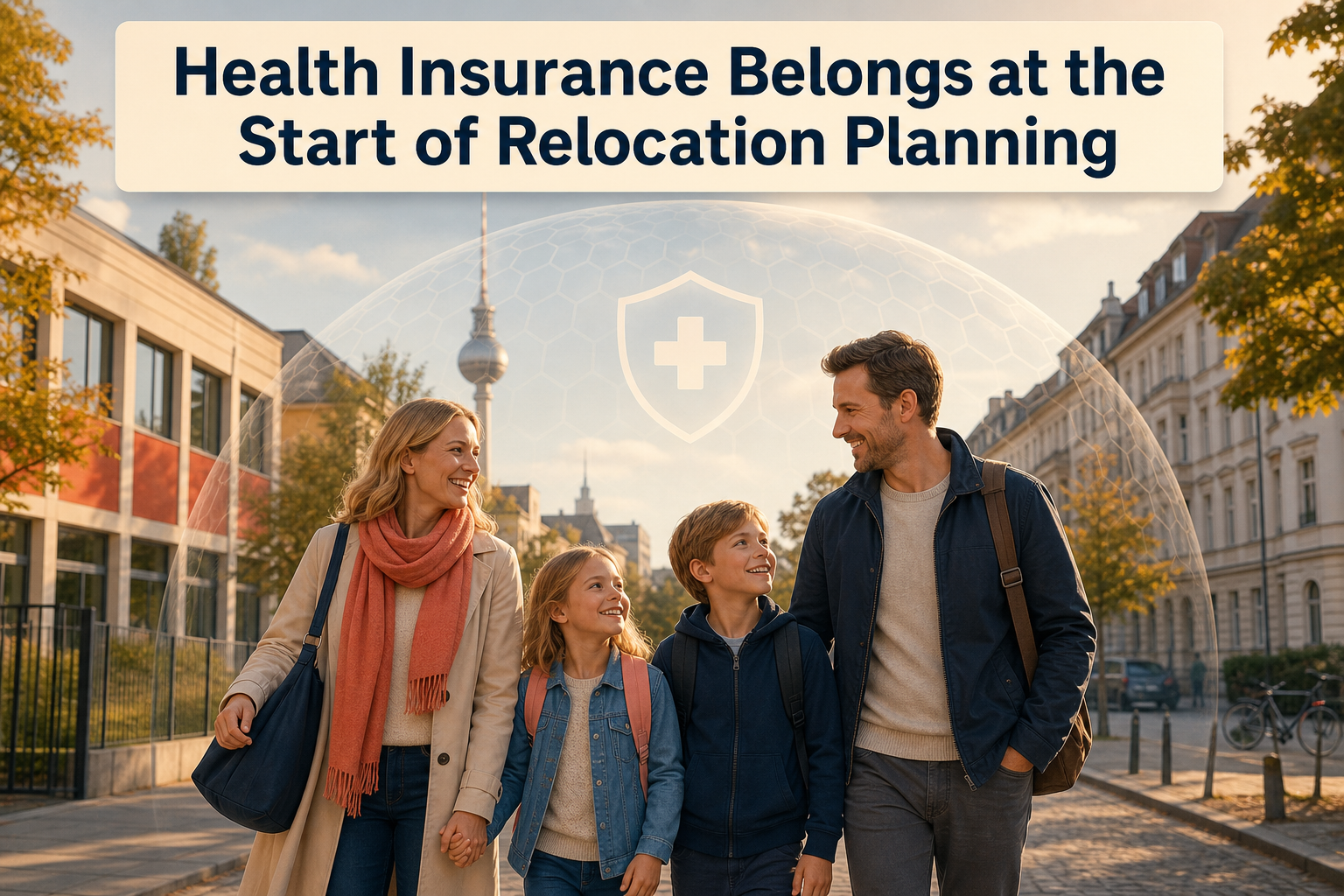
Health insurance should not be treated as a minor administrative formality to be completed after arrival.
It should be addressed at the beginning of the relocation process, particularly where:
the parents will live in different countries;
one spouse will continue earning a high income abroad;
only one parent will join the German public health insurance system;
the children have no previous German public insurance history;
the family is relying on free family insurance;
the children are moving to attend school in Germany; or
the residence permits require proof of secure financial support and health coverage.
The family should present its complete situation to the selected health insurance fund before the move. This includes the parents’ marital status, places of residence, income, employment, previous insurance and intended date of entry.
Information to provide to the health insurance fund
Before relying on family insurance, international families should provide or clarify:
the family relationship between the parents and children;
whether the parents are married or in a registered civil partnership;
whether they are legally separated or merely living in different countries;
the residence of each parent;
the expected residence of the children;
the type of German employment;
the expected German salary;
the other parent’s foreign income and income structure;
the children’s previous health insurance;
the planned immigration date; and
the requested start date of German coverage.
If documents are issued in another language, certified translations may be required. Foreign income documents should be sufficiently detailed to distinguish salary, bonuses, dividends and business income.

Possible solutions to investigate
The appropriate solution depends on the individual family’s circumstances. Options that may require examination include:
free family insurance under Section 10 of Book V of the German Social Code;
voluntary membership in a statutory health insurance fund;
another form of compulsory statutory insurance;
comprehensive German private health insurance;
an immigration-compliant temporary policy followed by permanent coverage, where legally possible;
insurance through the other parent, if suitable cross-border coverage exists;
an objection against the health insurance fund’s decision; or
legal review of how the foreign income and insurance history were assessed.
Not every option is available to every family. The correct solution depends on income, employment, marital status, previous insurance, residence permits and timing.
What to request in writing
Before finalising the move, families should obtain written answers to the following questions:
Can the children join the publicly insured parent under free family insurance?
Which foreign-income documents are required?
How will the foreign income be assessed under German law?
What exact income thresholds will be applied?
What alternative is available if family insurance is refused?
Does that alternative require previous public insurance?
Is there an application deadline?
On which date does the deadline begin?
When will the children’s coverage officially start?
Is the proposed insurance sufficient for visa and residence-permit purposes?
A written answer is particularly important when the family’s immigration schedule depends on the insurer’s assessment.
What to do after receiving a rejection
A rejection should be examined immediately. Families should check whether the document is a formal decision and whether it includes instructions explaining how and when an objection may be filed.
They should also ask the insurance fund to identify:
the exact statutory provision used;
the income figures on which the decision was based;
the applicable exchange rate;
the relevant assessment period;
any missing documents; and
the deadline for challenging the decision.
Waiting for informal discussions to be completed can be risky if a legal objection or membership deadline is already running.
Professional advice from a lawyer specialising in German social security or immigration law may be appropriate, especially when the family has already entered Germany or the children remain without confirmed coverage.
Lessons for international families
This example does not mean that German statutory health insurers generally discriminate against international families.
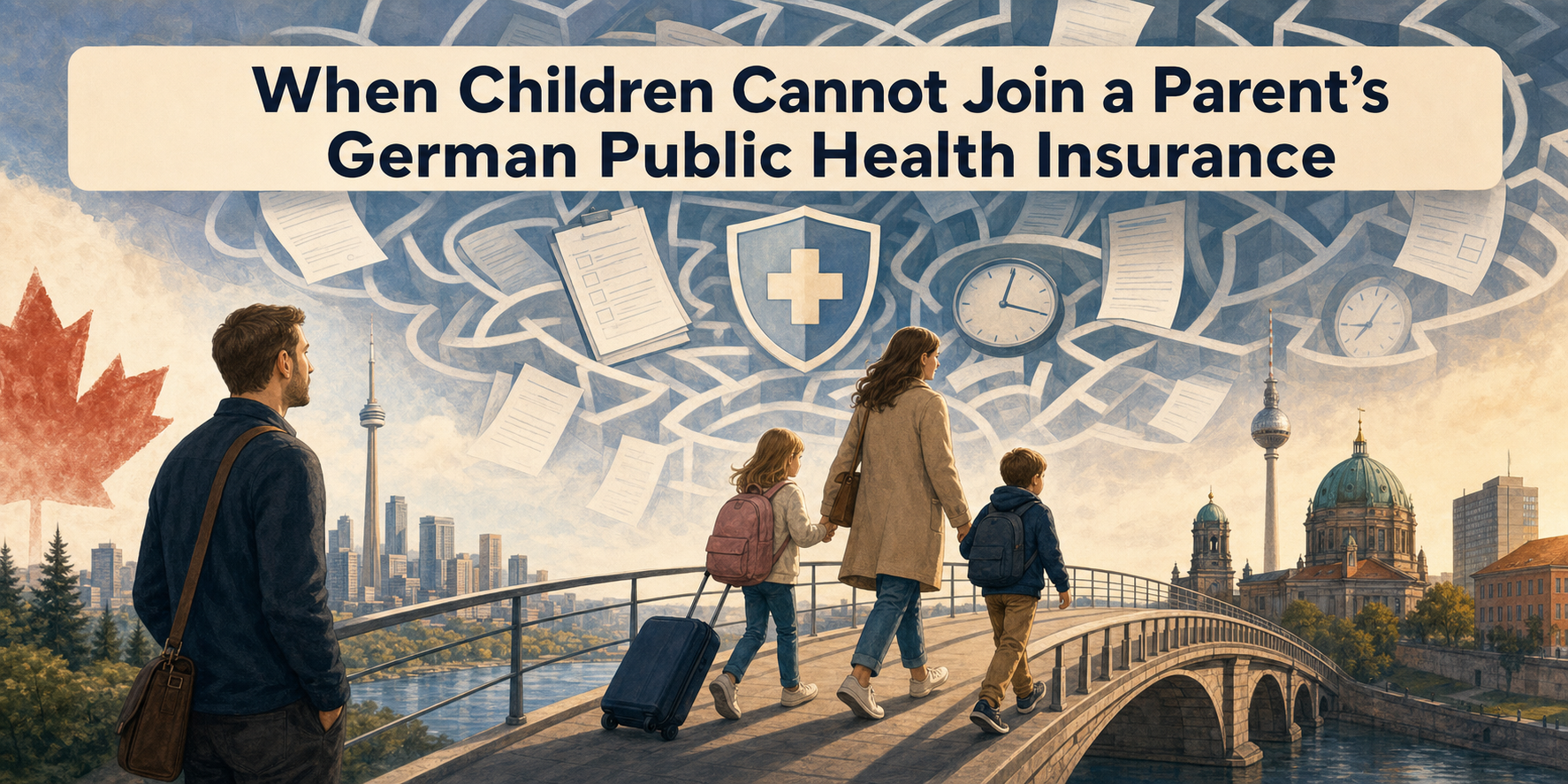
It demonstrates, however, that German health insurance rules do not always fit international family arrangements easily. The rules may still consider the income of a spouse who lives and works abroad, even when the family’s decision to live in two countries is reasonable and the marriage remains intact.
The greatest risk is often not the initial question about foreign income. It is the amount of time that passes before the family receives a binding decision.
If family insurance is rejected only after several months, other insurance options may have become more difficult. Application deadlines may have expired, the family may already have entered Germany, and a private insurer may need to examine the period without confirmed coverage.
Conclusion
A financially secure family can still face a serious insurance problem when moving to Germany.
International families should not assume that children will automatically receive free public health insurance through the parent employed in Germany. This is especially important when the other spouse remains abroad and earns a higher income.
The safest order is:
examine the family’s legal and financial situation;
obtain a written assessment of the children’s insurance;
identify an alternative solution and all relevant deadlines;
secure confirmation of the coverage start date; and
only then finalise visas, travel and school arrangements.
Children’s health insurance should be planned as carefully as the employment contract, residence permit and school place.
Disclaimer: This article provides general information only. It does not constitute legal, immigration or insurance advice. Eligibility depends on the family’s individual circumstances, and the applicable rules and income thresholds may change.
Free Consultation
Have questions about entering the German market? Request a free consultation.
Request Free Consultation