
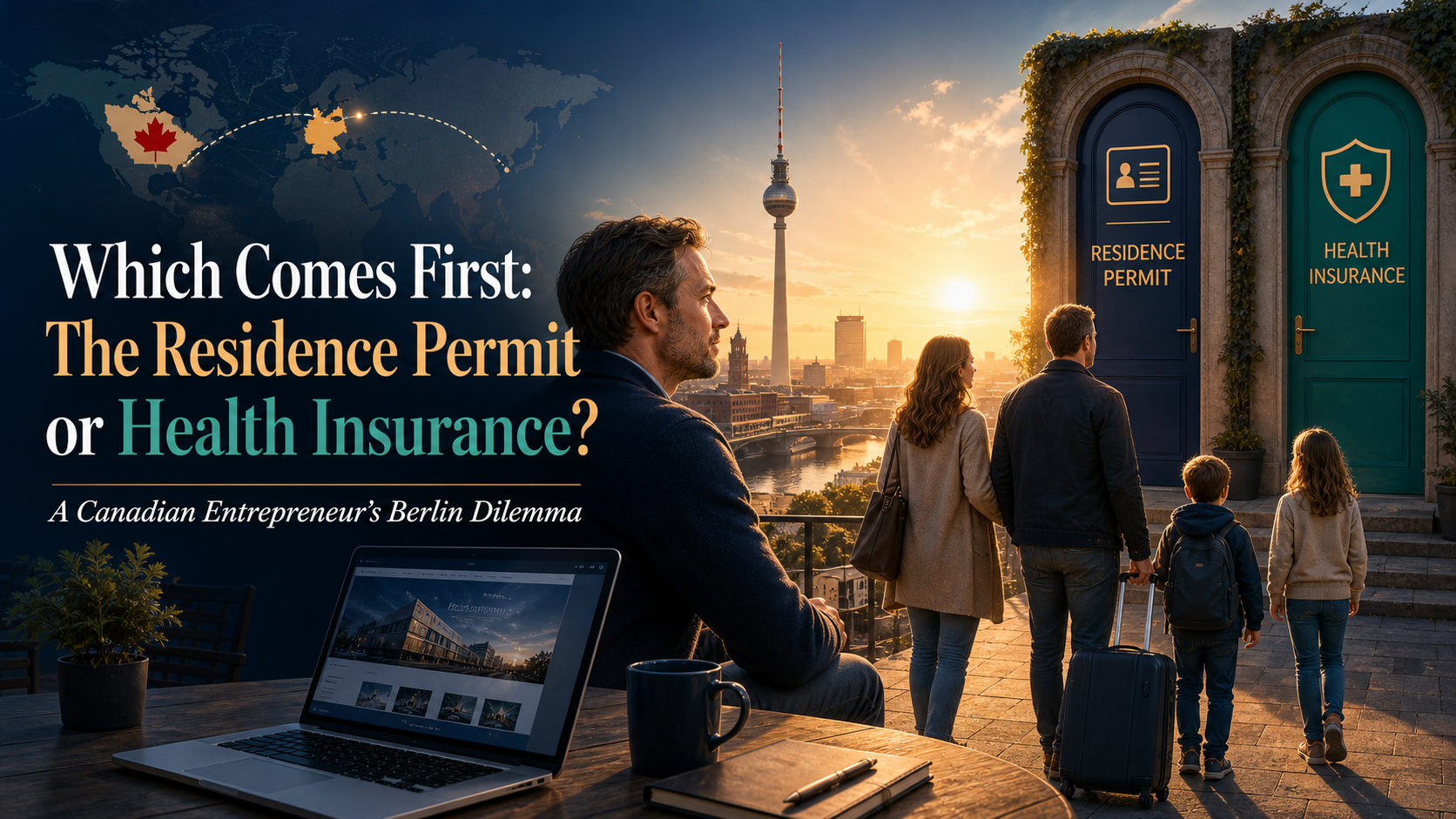
How a Canadian entrepreneur and his family became trapped between German immigration rules and private health insurance
The people and company in this article are fictional. The story combines situations that international entrepreneurs may encounter when relocating to Germany. Insurance premiums, admission requirements and immigration decisions always depend on the individual case.
A successful digital entrepreneur in Canada
Daniel Mercer had worked independently in Canada for many years. As a web designer and software developer, he created corporate websites, developed customised business applications and advised companies on digital transformation.
His business was successful. He had built a stable portfolio of Canadian clients, accumulated savings and developed services that did not depend on a particular location.
Daniel could work from Toronto, Vancouver, Berlin or almost anywhere else with a reliable internet connection. His Canadian clients were prepared to continue working with him after his move.
He therefore began looking beyond Canada. His next goal was to enter the European market.

Berlin: A city of international opportunity
Daniel chose Berlin because of its international technology and design community. The city is home to software companies, creative agencies, start-ups and professionals from many different countries.
He planned to retain his Canadian clients while gradually attracting German and European customers. In the longer term, he wanted to employ developers and designers in Berlin.
To implement this plan, Daniel established a fictional German company called Northstar Digital GmbH.
His business plan appeared convincing. He had professional experience, existing clients, capital and a clear strategy for entering the European market.
But the greatest threat to his plans was not a lack of customers.
It was the relationship between his residence status and health insurance.

Starting with a six-month visa
In January 2026, Daniel moved to Berlin with a visa valid for six months. The visa expressly permitted him to carry out his self-employed business activities during that period.
He was therefore allowed to manage Northstar Digital GmbH and continue providing software and consulting services to his Canadian clients while the visa remained valid.
For the initial immigration process, Daniel had obtained temporary international medical insurance. This allowed him to begin his stay in Germany, but it was not intended to provide a permanent solution for his life in the country.
His visa was due to expire around June 2026. To continue living and working in Germany, he would have to apply for an extension or a subsequent residence permit for self-employment.
For that application, he needed to prove that he had adequate comprehensive health insurance.
Why temporary international insurance was not enough
International or incoming insurance can be useful during an initial or temporary stay. Some policies can even be purchased for several years.
However, the contractual duration of a policy does not by itself determine whether it is suitable for a long-term German residence permit.
A temporary policy may contain important limitations regarding pre-existing conditions, long-term treatment, rehabilitation, psychotherapy, medical aids or continuing care. The responsible immigration authority may therefore require more comprehensive coverage.
Daniel needed a policy that would cover medical treatment on a long-term basis and satisfy the requirements of the immigration authority.
If he chose private insurance, the solution also had to include mandatory private long-term care insurance.

The statutory insurance route was closed
Daniel initially tried to join Germany’s statutory health insurance system voluntarily.
He assumed that, as someone living and operating a company in Germany, he could simply select a statutory insurer and pay the required contribution.
It was not that straightforward.
A newly arrived self-employed person does not automatically qualify for voluntary statutory health insurance. Eligibility can depend on previous insurance history and the conditions established under German social security law.
Daniel contacted several statutory health insurers, but none could establish a suitable basis for accepting him into voluntary membership.
This was not merely a commercial decision by one insurer. If the legal admission requirements were not met, approaching another statutory insurer would not necessarily produce a different result.
Daniel therefore had to look for comprehensive private health insurance.

His Canadian success was difficult to translate into German underwriting
Daniel had successfully operated his business in Canada for years. He had ongoing client contracts, regular income, tax records and sufficient assets to finance his new start in Germany.
Northstar Digital GmbH, however, was a newly established German company. It could not yet provide several years of German financial statements, domestic tax assessments or an established German revenue history.
His Canadian records were relevant, but they had to be translated, organised and explained in a form that German insurers could assess.
From the perspective of an insurer, Daniel appeared to be:
A newly established self-employed person in Germany
The owner of a young German company
An applicant without a long German credit or income history
A person holding a visa with only six months of validity
The future policyholder for a family of four
His success in Canada had not disappeared. It was simply not immediately visible within the German insurer’s standard assessment process.
Specialist insurance was available—but at a price
Some private insurers and international insurance providers specialise in foreign entrepreneurs and newly arrived residents.
They may accept applicants who do not yet have an established financial history in Germany. The disadvantage can be a considerably higher premium.
Depending on the family’s ages, health information, deductible and level of coverage, Daniel received proposals that could have cost approximately €2,000 per month for the whole family.
Daniel had savings, but he also had to pay for accommodation, company expenses, taxes, professional services and his children’s education.
A monthly insurance bill of around €2,000 would consume a substantial part of the company’s initial capital. Even a viable business can be weakened if too much liquidity is lost during its first year.
Daniel continued searching for a more sustainable solution.

His wife and children arrive in Berlin
In May 2026, Daniel’s wife, Emma Mercer, and their two school-age children joined him in Berlin.
The family initially arrived with temporary international medical coverage. Their plan was to settle in Germany and find places for the children at an international school.
For Daniel and Emma, the move was not purely a business decision. They wanted their children to grow up in an international environment, learn additional languages and have the opportunity to study or work in Germany or elsewhere in Europe.
Like many internationally mobile families, they were prepared to invest a significant part of their savings in their children’s future.
But the family’s arrival made the insurance problem more urgent. Daniel no longer needed a solution only for himself. All four family members required suitable coverage for their long-term residence in Germany.

A more affordable private policy appears
After comparing a large number of offers, Daniel found a private comprehensive insurance policy that appeared more manageable.
The combined cost for comprehensive health and mandatory long-term care insurance for all four family members was approximately €1,200 per month.
It was still a significant expense, but it was more sustainable than proposals approaching €2,000 per month. The proposed benefits also appeared capable of meeting the requirements for a German residence permit.
For the first time in several months, Daniel thought the problem might have been solved.
Then the insurer introduced another condition.
“We can provide final cover for the family once Mr Mercer presents a residence permit valid for more than eleven months.”
Daniel only had a six-month visa.
The eleven-month requirement was not a general law
It is important to distinguish an insurer’s underwriting policy from German law.
There is no universal German rule stating that private health insurance can only be issued to someone holding a residence permit valid for more than eleven months.
In Daniel’s case, this was a specific admission requirement imposed by that insurer or that particular insurance product.
Another insurer might apply different criteria. Decisions can vary according to the applicant’s residence status, age, health, occupation, income and intended duration of stay.
Nevertheless, the distinction did not solve Daniel’s immediate problem. The affordable policy he had found required a longer residence permit before finalising the contract.

The residence permit and insurance loop
Daniel’s existing six-month visa allowed him to conduct his self-employed activity. The legality of his current business operations was not the issue.
The problem concerned what would happen after the visa expired.
To remain in Germany and continue operating his company, Daniel had to obtain an extension or a subsequent residence permit. The immigration authority required proof of suitable comprehensive health insurance.
The insurer, however, wanted to see a residence permit valid for more than eleven months before activating the comprehensive policy.
The situation had become circular:
The immigration authority required comprehensive health insurance before issuing the longer residence permit.
The insurer required a longer residence permit before providing comprehensive health insurance.
Daniel’s current visa allowed him to work but would soon expire.
His wife and children also required suitable long-term coverage.
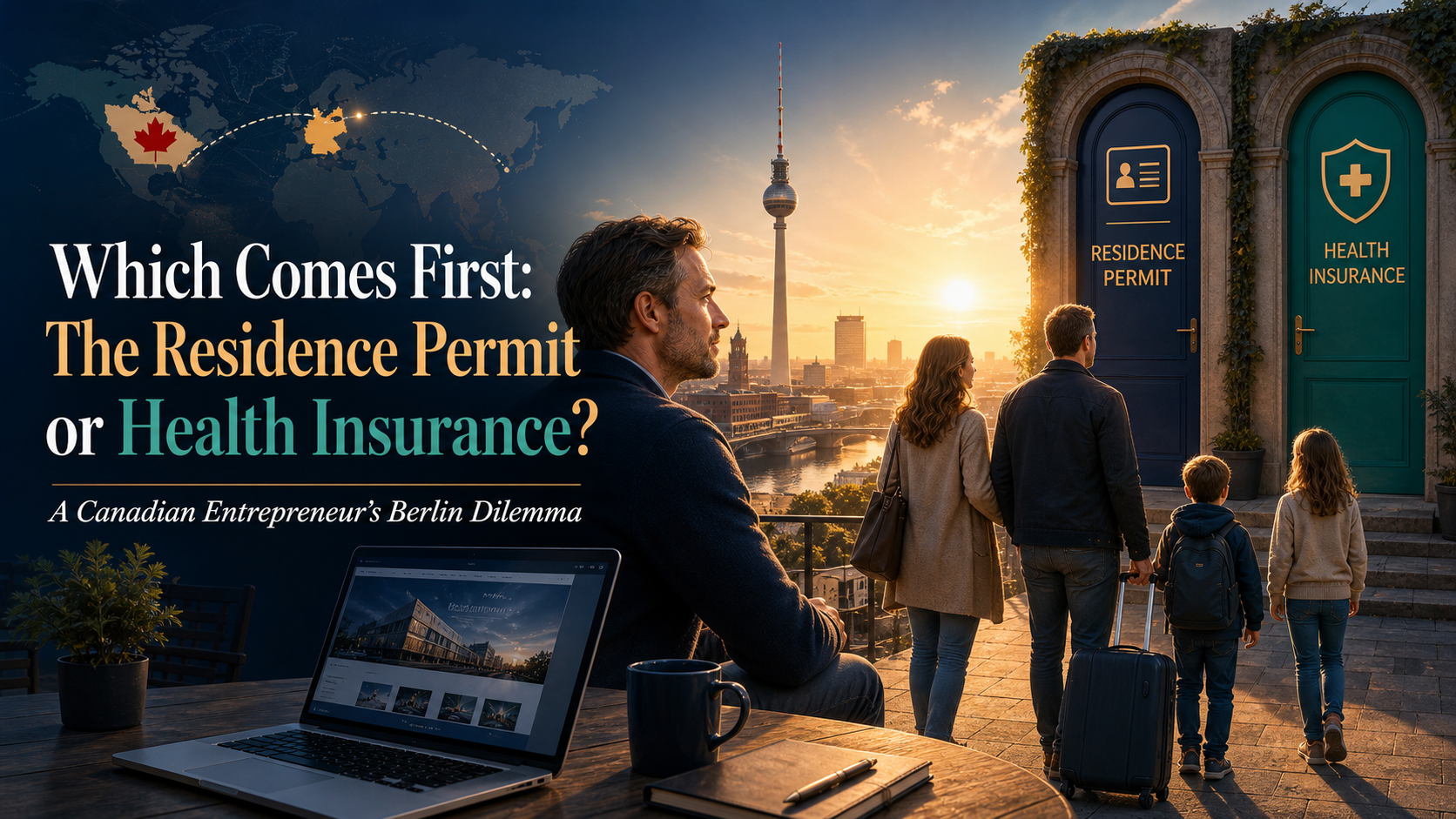
Which had to come first—the residence permit or the insurance?
Daniel and his family had entered an administrative “chicken-and-egg” situation familiar to many internationally mobile entrepreneurs.

Canadian visa-free privileges did not resolve the problem
Canadian citizens are among the nationalities that can generally enter Germany without first obtaining a visa and apply for an appropriate long-term residence permit from within the country. This privilege is established under Section 41 of the German Residence Ordinance.
However, Daniel had not entered Germany merely as a visa-free visitor. He already held a six-month visa permitting self-employed activity.
The relevant issue was therefore not whether he had been allowed to enter Germany. Nor was he attempting to operate a business without authorisation.
He was trying to move from a lawful but temporary business visa to a longer-term residence permit. The insurer’s assessment did not fully account for this transitional stage.
Time was running out
Daniel had entered Germany in January, and his visa was due to expire around June.
Before the deadline, he needed to coordinate several matters:
The application for an extended or subsequent residence permit
Evidence that his business was viable
Proof of adequate financing
Documentation of his Canadian business history
Evidence that he could support his family
Residence arrangements for his wife and children
Comprehensive health insurance for all four family members
Mandatory private long-term care insurance
A written insurance confirmation acceptable to the immigration authority
For an entrepreneur, the first months of a new company are particularly important. Daniel should have been developing products, acquiring European clients and establishing business relationships.
Instead, he was spending a considerable amount of time trying to connect two systems that appeared to demand incompatible documents.

The business plan becomes a source of hope
Daniel was not an inexperienced founder with nothing more than an idea.
He had successfully operated a business in Canada. He had existing customers, regular projects, professional expertise and sufficient assets to finance the early stages of his German company.
He began reorganising his documents so that German authorities could understand the commercial substance of his business.
His application included:
Canadian business and tax records
Contracts with existing Canadian clients
Evidence that these contracts would continue after the move
Bank statements and proof of available capital
Revenue and expense forecasts
A three-year financial plan
A strategy for attracting German and European clients
A portfolio of websites and software projects
Plans for potential recruitment in Germany
Evidence that he could cover the family’s living and insurance costs
Residence permits for self-employment are generally assessed under Section 21 of the German Residence Act.
Factors can include the viability of the business idea, the applicant’s entrepreneurial experience, financing, potential economic benefits, employment effects and innovation. The immigration authority may also obtain opinions from competent professional or business organisations.
A positive commercial assessment does not automatically guarantee a residence permit. The final decision remains with the responsible immigration authority. However, Daniel’s existing clients, business experience and capital gave him a credible foundation.
Could conditional insurance approval break the deadlock?
Daniel returned to the private insurer and explained his position in detail.
He already had a valid visa permitting self-employment. He was not asking the insurer to rely on a hypothetical future business. He could provide Canadian contracts, assets and evidence that Northstar Digital GmbH had begun operating.
He proposed that the insurer complete its assessment and issue a binding confirmation stating that the family’s comprehensive coverage would begin as soon as the longer residence permits were granted.
Such a confirmation could effectively connect the two procedures:
The insurer confirms that the family has been accepted subject to the residence permit being issued.
Daniel submits that confirmation to the immigration authority.
Once the authority grants the residence permit, the insurance contract begins on the agreed date.
The health coverage also has to be coordinated with the required private long-term care insurance. The general obligation relating to private long-term care coverage is addressed in Section 23 of Book XI of the German Social Code.
A conditional confirmation is not automatically accepted in every case. Its wording, commencement date and scope of coverage must satisfy the responsible authority.
Nevertheless, it offered the Mercer family a realistic way to break the circular dependency.
Could a different business structure have helped?
If Daniel had received integrated advice before incorporating Northstar Digital GmbH, he could have compared other routes.
For example, he might have retained his Canadian company while establishing a German branch or subsidiary. Depending on the family’s professional background and actual business plans, Daniel or Emma might have taken responsibility for the German operation under a different corporate and immigration structure.
Possible roles could have included company director, branch representative, transferred employee or employee of a German subsidiary.
Different structures can lead to different residence and insurance consequences. If one spouse becomes subject to mandatory German statutory health insurance, for example, the family’s insurance options may change considerably.
However, the correct assessment does not depend solely on the name or legal form of the company. The person’s actual responsibilities, remuneration, authority, ownership, employment relationship and the way the German operation is managed all matter.
A managing director or substantial shareholder may not be treated in the same way as an ordinary employee. Social insurance obligations must therefore be assessed individually.
The point is not that Daniel selected the “wrong” company form. Establishing a German GmbH may have been commercially reasonable.
The problem was that the company structure, immigration route, health insurance and family relocation had not been designed as one coordinated plan.

The missing element: Specialist advice before relocation
Daniel was an experienced developer and entrepreneur. He could not reasonably be expected to understand every interaction between German immigration law, corporate structures and health insurance.
The most important lesson from his case is that he would have benefited from comprehensive advice before establishing the company and relocating the family.
A specialist familiar with both business immigration and international health insurance could have examined:
The most appropriate residence route
Whether to retain the Canadian business
Whether to establish a branch, subsidiary or independent German company
The appropriate roles of Daniel and Emma
The possibility of statutory health insurance
Private insurance underwriting before relocation
Insurance availability for all four family members
Conditional insurance approval before the visa extension
The best time for the family to move
The documents required before the initial visa expired
Good advice would not have been about avoiding German law. It would have been about identifying the most suitable lawful structure before Daniel committed substantial capital and moved his family.
No adviser could have guaranteed the residence permit or forced an insurer to accept the family. Those decisions remain with the relevant authority and insurance company.
But advance planning could have reduced the risk of discovering the residence permit–insurance loop only a few weeks before the visa expired.
Valuable international expertise caught between two systems
Entrepreneurs like Daniel can contribute technical knowledge, capital and international customer relationships to the German economy.
He had not arrived with only a speculative idea. He brought an established business, existing revenue, professional expertise and the intention to develop a German company.
Yet before he could concentrate on growth and innovation, he had to solve the relationship between two administrative systems.
The immigration authority had legitimate reasons for requiring adequate health insurance. The insurer also had reasons for assessing the duration and stability of an applicant’s residence.
Each requirement could be understood separately.
The serious problem emerged when each side required the other side’s decision first. The family was left in the middle, with the visa deadline approaching.
The story is not over
The Mercer family’s situation had not yet been fully resolved.
But there were reasons for hope.
The insurer was considering conditional coverage for all four family members. Daniel had prepared stronger evidence of his Canadian business history, existing customers, financial resources and plans for Germany.
If the insurer issued an acceptable conditional confirmation and the immigration authority was satisfied with the business plan, the residence permit and insurance could potentially take effect in a coordinated way.
Daniel did not simply need goodwill. He needed a viable business plan, sufficient financing, consistent documentation and an insurance confirmation that met the authority’s requirements.
His first chapter in Berlin had been far more difficult than expected, but it was too early to call the move a failure.
Perhaps the most complicated programme Daniel had ever worked on was not one he developed for a client.
It was the programme connecting four very different systems:
His company, his residence status, his family and their health insurance.
That programme was not yet complete.
But, at last, it was beginning to run.
The central lesson for international entrepreneurs
International entrepreneurs planning to establish a business in Germany should obtain integrated advice before incorporating a company or moving their families.
The corporate structure, residence permit, health insurance, long-term care insurance and timing of the family’s relocation should be planned together.
A long insurance contract is not necessarily equivalent to comprehensive coverage recognised for a German residence permit. Likewise, an insurer’s internal admission requirement should not be confused with a general legal rule.
The best solution must be identified within the available legal options and adapted to the applicant’s business, nationality, family circumstances and financial position.
For Daniel, earlier advice from a business immigration specialist with a strong understanding of health insurance could have revealed a more suitable route.
For other international entrepreneurs, his experience offers a clear warning:
Do not wait until the company has been established and the visa is approaching expiry. Design the business, immigration and insurance strategy before the journey begins.
Free Consultation
Have questions about entering the German market? Request a free consultation.
Request Free Consultation