
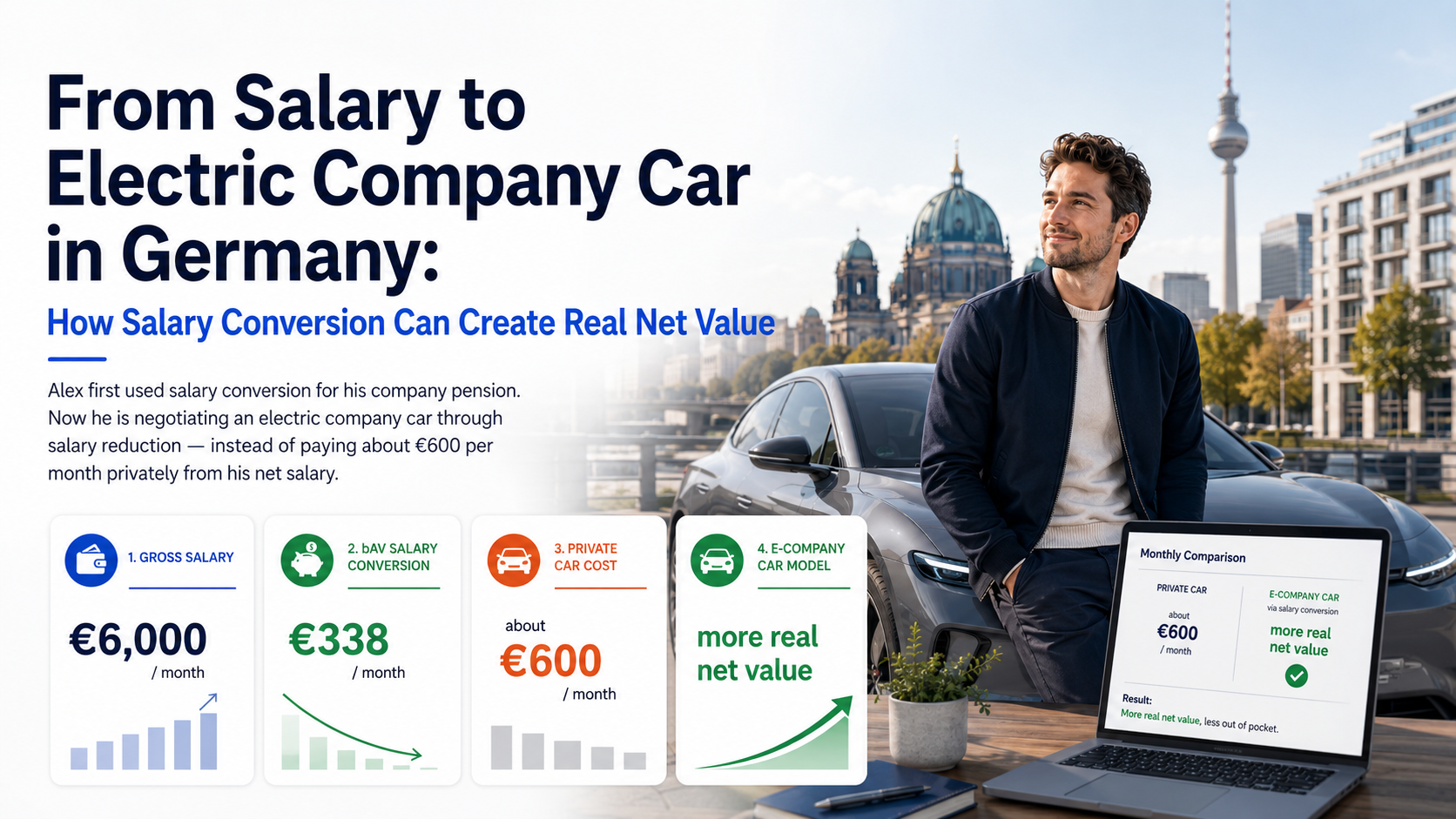
Alex is 30 years old, lives in Berlin, and works as an IT engineer for a German GmbH.
As a regular employee, his salary is subject to normal German payroll tax and social security contributions.
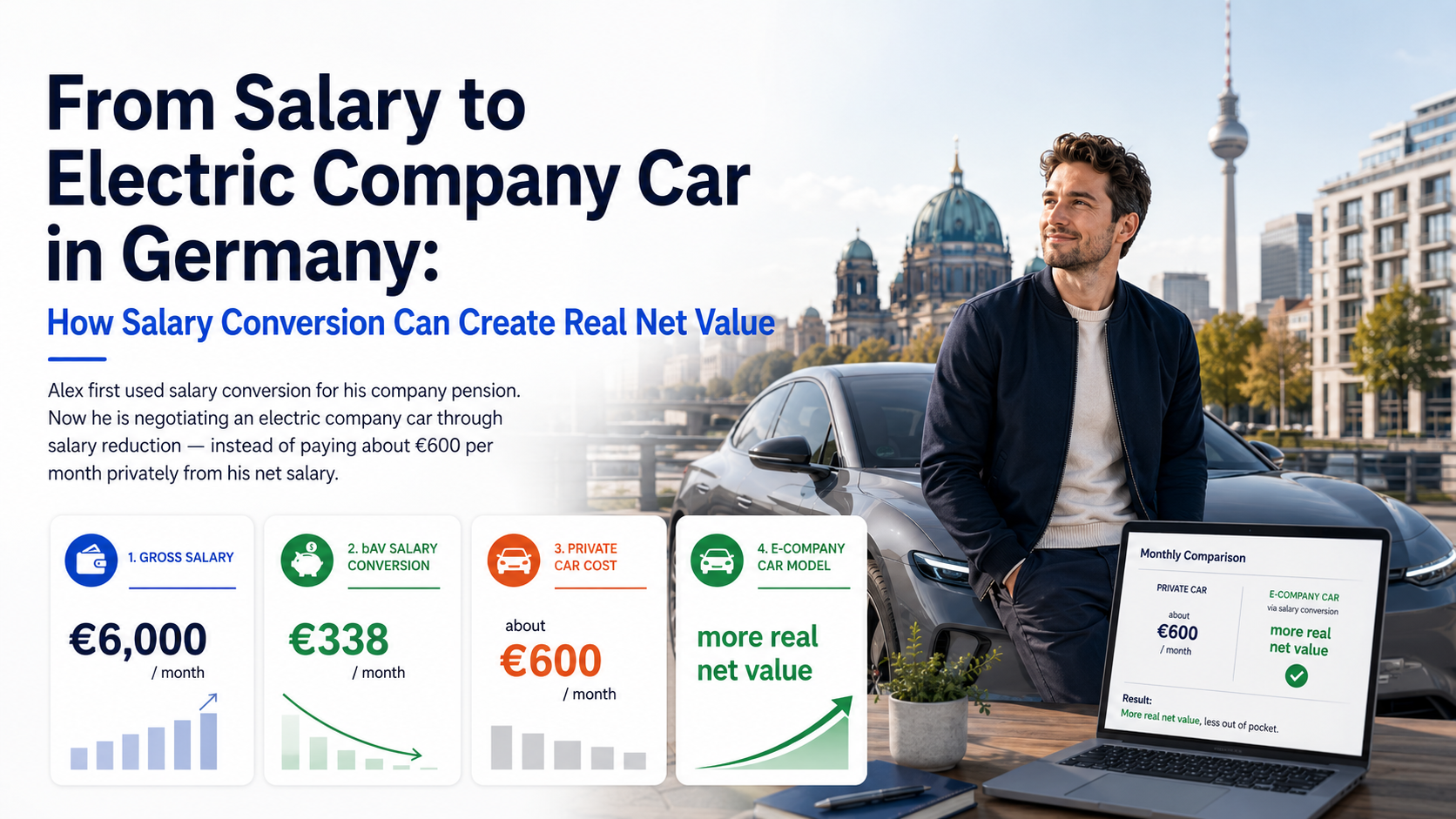
Alex earns a monthly gross salary of €6,000. He is single, has no children, is covered by statutory health insurance, and is in tax class 1.
In the first step, Alex already used a classic form of salary conversion in Germany: he converts €338 per month of his gross salary into a company pension scheme, known as betriebliche Altersvorsorge or bAV.
After this pension salary conversion, his taxable and social-security-relevant income is reduced. His monthly net payout is approximately €3,226.
Now Alex is thinking about the next step.
He is considering an electric company car.
The question is simple:
Should Alex lease the car privately and pay for it from his net salary?
Or should he negotiate with his employer to receive the electric car as a company car in exchange for giving up part of his gross salary?
This is where the second stage of salary optimization begins.
Alex Wants an Electric Company Car
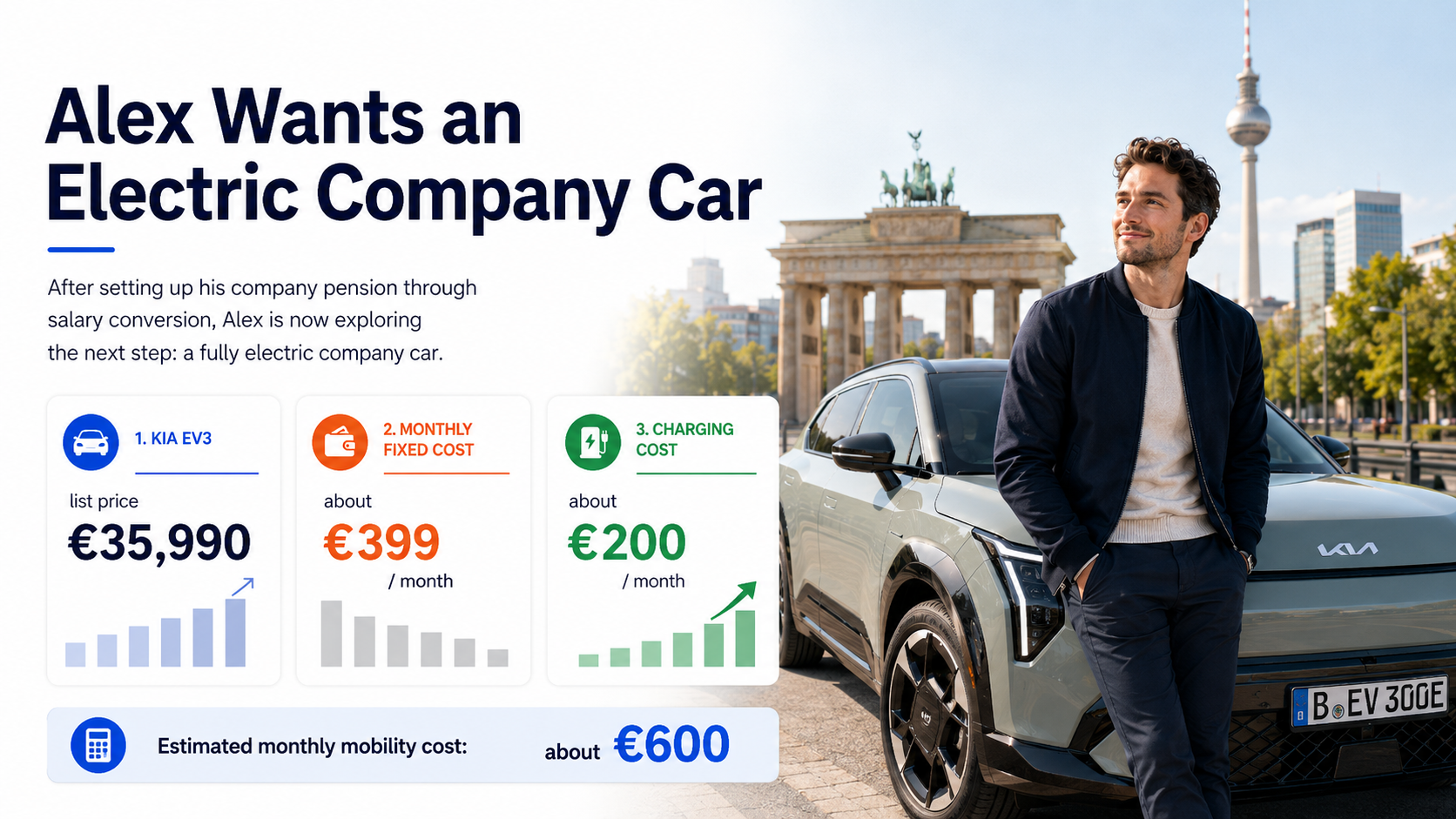
Alex is interested in a fully electric Kia EV3.
The gross list price of the car is approximately:
€35,990
The monthly cost of the car is estimated as follows:
Leasing rate: €299
Insurance, maintenance, and other fixed costs: approx. €100
Charging electricity: approx. €200
Total monthly cost:
around €600
If Alex leased the same car privately, he would have to pay these €600 from his already taxed net income.
This is the key point.
Private leasing means:
Alex first earns his gross salary, then pays income tax and social security contributions, then receives his net salary — and only after that does he pay for the car.
Scenario 1: Alex Leases the Car Privately
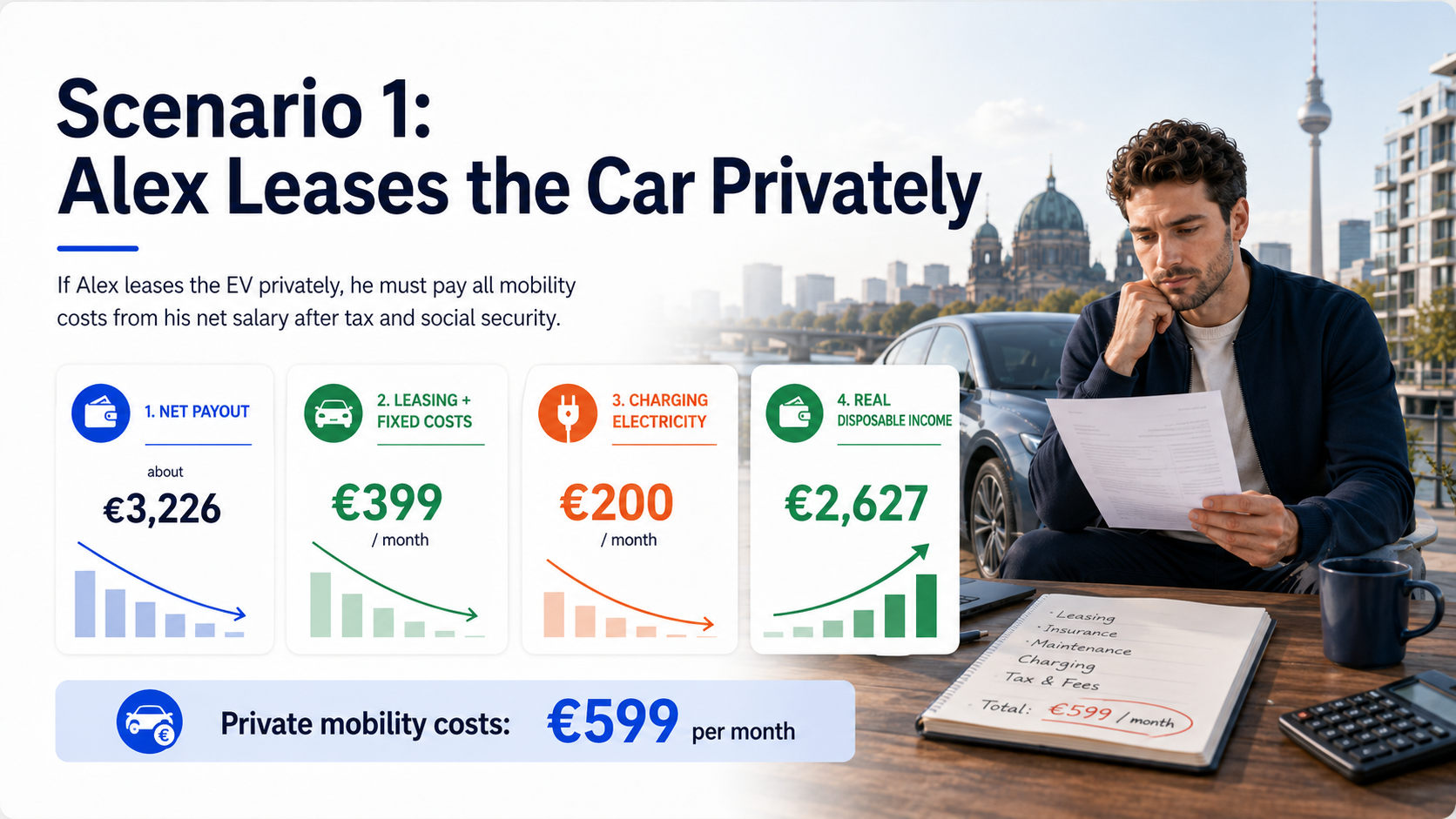
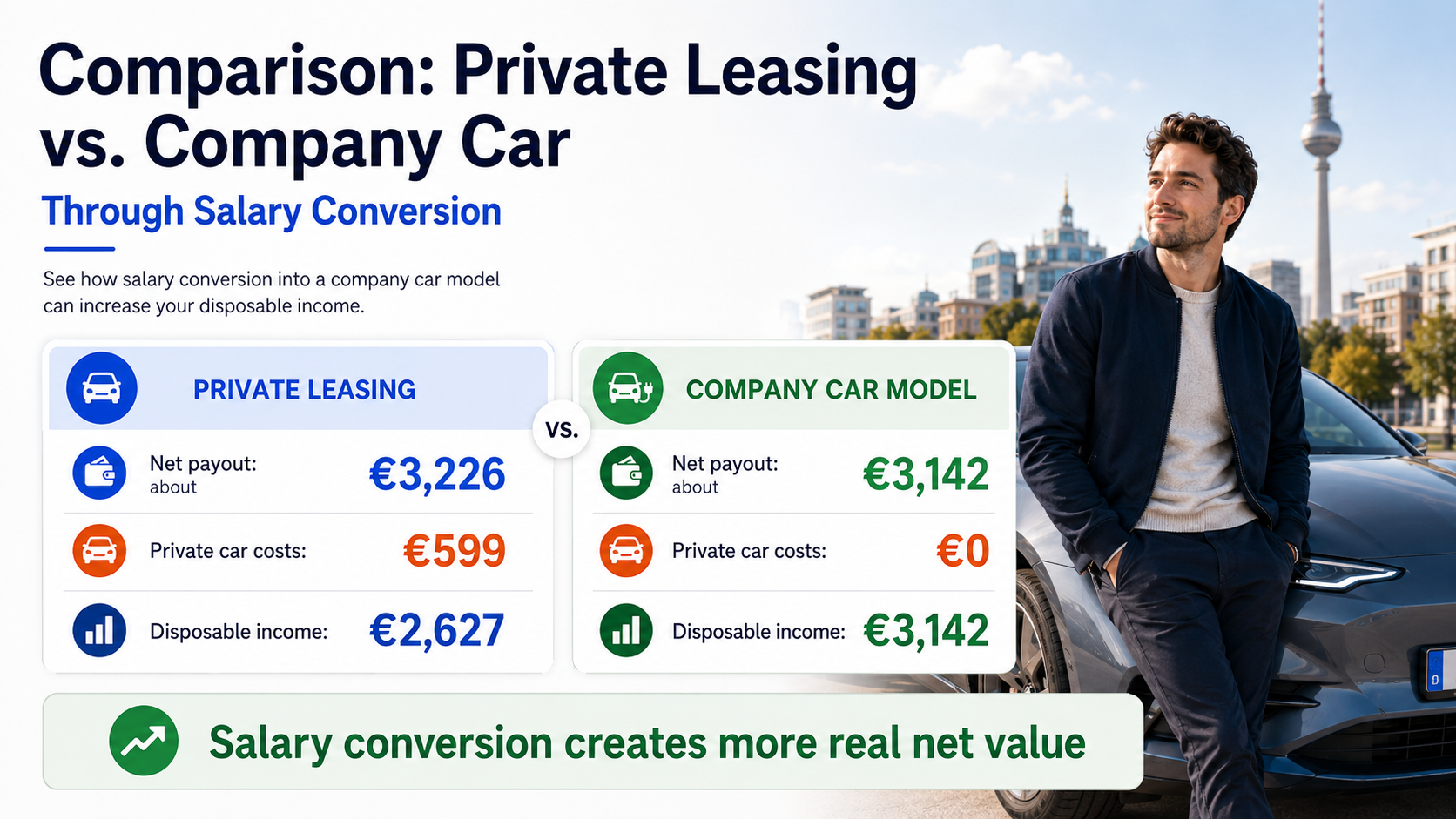
Without a company car, Alex receives approximately:
€3,226 net per month
If he leases a comparable electric car privately, he has to pay approximately:
€399 for leasing, insurance, and fixed vehicle costs
€200 for charging electricity
Total private mobility cost:
€599 per month
His real disposable income after car costs would therefore be:
€3,226 – €599 = €2,627
So even though Alex has a good salary, the private car would reduce his real monthly liquidity by almost €600.
Scenario 2: Alex Negotiates a Company Car in Exchange for Salary Reduction
Alex now proposes a different model to his employer.
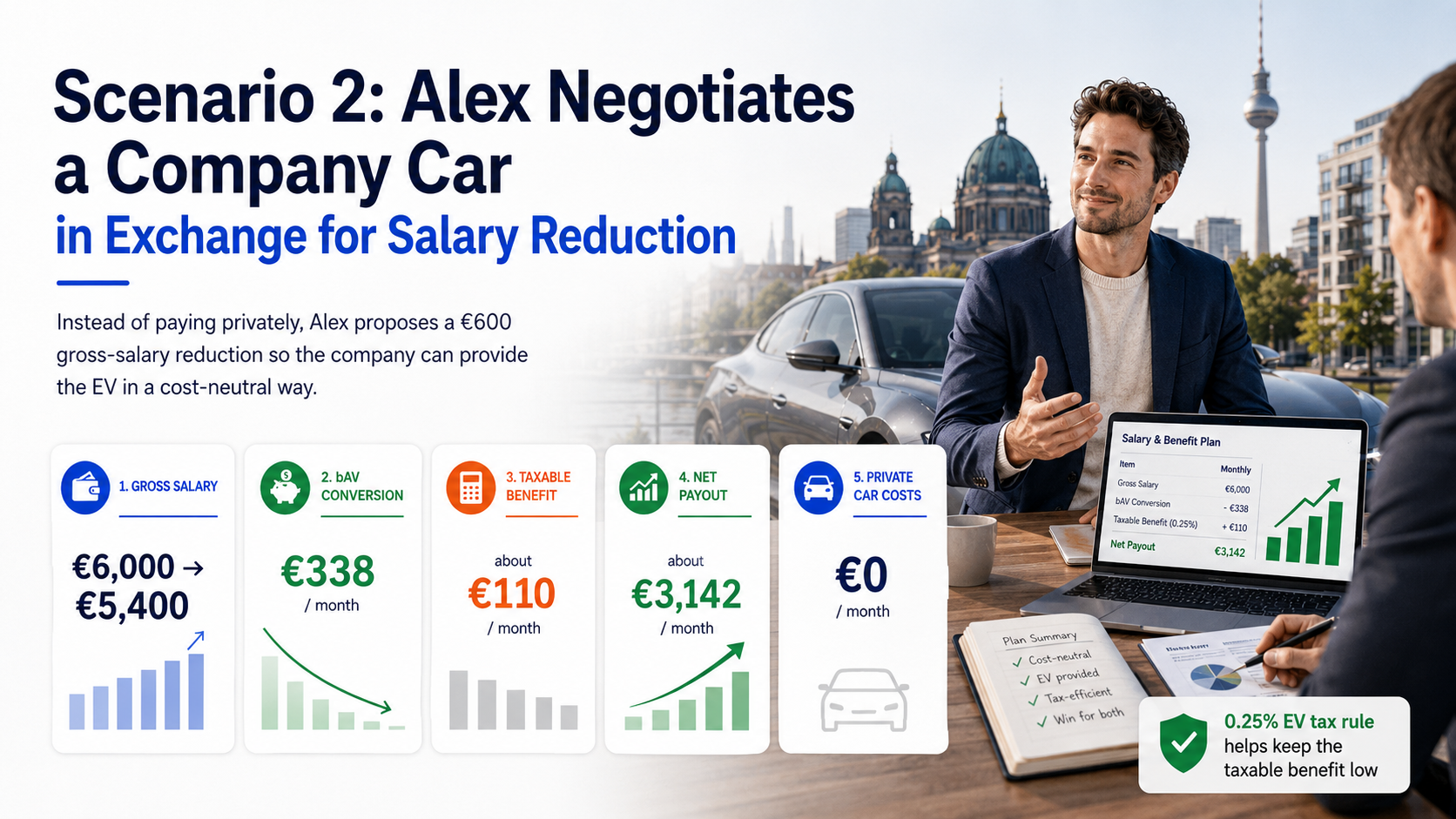
The company provides him with the electric company car. In return, Alex gives up €600 of his monthly gross salary.
His gross salary is reduced from:
€6,000 to €5,400
The company uses this amount to finance the car and the charging costs.
The idea is that the model should remain economically neutral for the employer.
For Alex, the advantage is that he does not have to pay the car from his net income. Instead, part of his gross salary is converted into a concrete benefit: mobility.
This can also be discussed during a salary review.
Instead of asking only for a higher cash salary, Alex could politely ask whether part of a future salary increase could be structured as an electric company car model.
For example:
“Would it be possible to review whether an electric company car through salary conversion could be a useful option for both sides?”
This approach may be attractive for the employer as well, because the company is not simply paying additional cash salary. Instead, both sides are reviewing whether the compensation package can be structured more efficiently.
Why the Electric Company Car Is Especially Attractive
With a normal petrol or diesel company car, private use is often taxed much more heavily.
For a fully electric company car, the tax treatment can be much more favorable if the car qualifies for the preferential electric vehicle rules.
In Alex’s example, the private use of the Kia EV3 is not taxed based on 1% of the gross list price, but only on 0.25% of the gross list price.
With a gross list price of €35,990, this results in a monthly taxable benefit of approximately:
€90
Together with the commuting component or occasional office days, the total taxable benefit in this example is estimated at around:
€110 per month
This means Alex does not have to tax the full economic value of the car.
He only has to tax a relatively small benefit in kind.
The Result
The difference is:
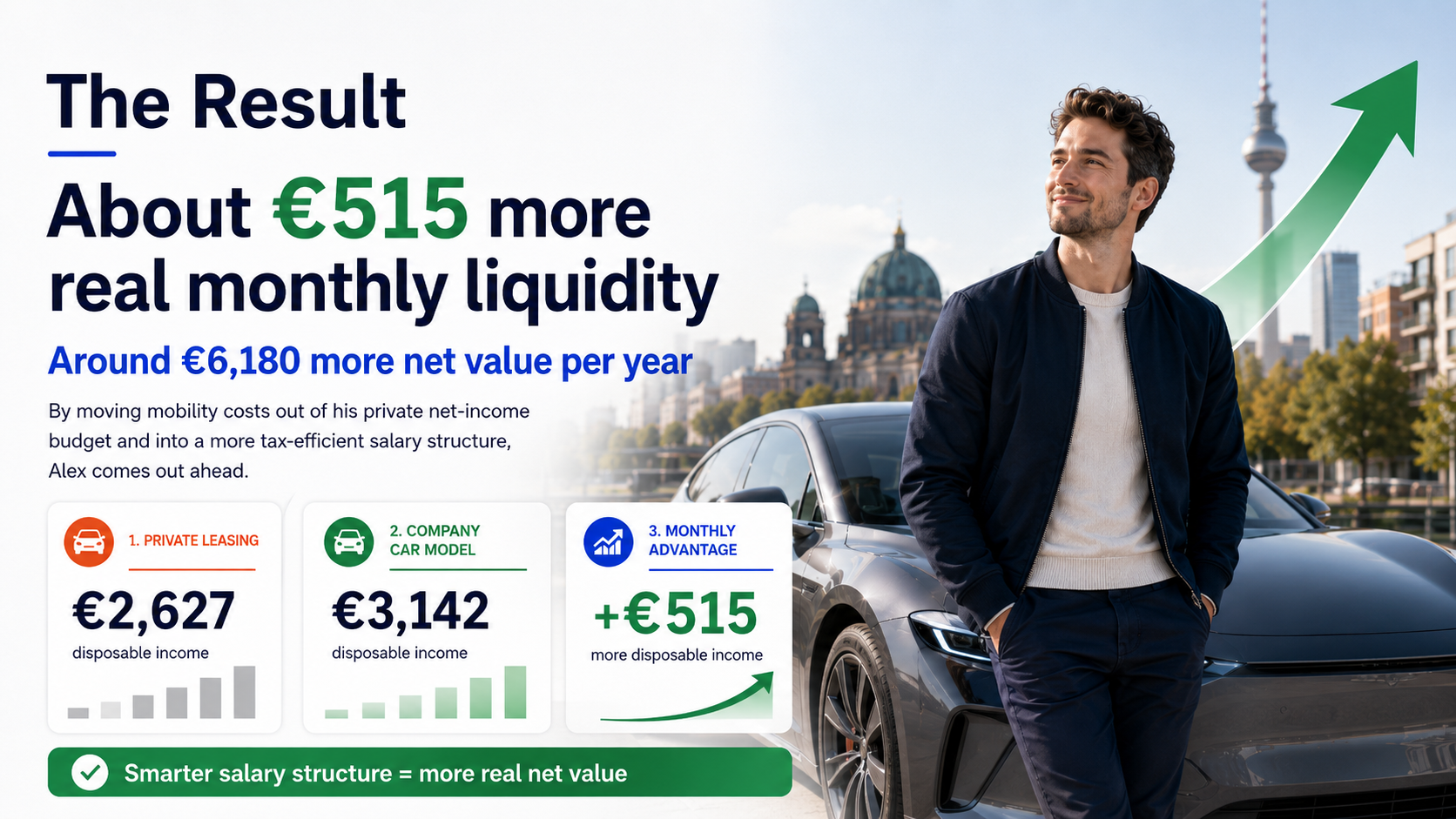
€3,142 – €2,627 = approx. €515 per month
This means that, despite giving up €600 of gross salary, Alex has approximately:
€515 more real monthly liquidity
Over one year, this equals around:
€6,180 of additional net value
This effect does not arise because the company simply gives Alex something for free.
It arises because the structure is more efficient.
Alex does not pay the car from his already taxed net income.
Instead, he converts part of his gross salary into a company car.
The electric company car is taxed at a very low rate.
The documented charging costs can be reimbursed or covered through the company structure.
At the same time, the company can structure the model so that it remains largely cost-neutral.
Why This Makes Sense for Alex
Alex no longer thinks only in terms of:
“How much net salary is paid into my bank account?”
He now asks the more important question:
“How much real value do I have left at the end of the month?”
If Alex leases the car privately, his net salary initially looks higher. But afterwards, he has to pay almost €600 for the car and charging costs.
With the company car model, his net payout is slightly lower than before, but his private mobility costs disappear.
As a result, he has significantly more disposable income at the end of the month.
How Employees Can Raise This Topic with HR
This model does not always have to come from the employer first.
An employee can also raise the topic politely and professionally, especially during:
a salary review,
a promotion discussion,
a planned salary increase,
a review of employee benefits,
or a discussion about mobility and sustainability.
Instead of saying only:
“I would like a higher salary.”
An employee could ask:
“Would it be possible to review whether part of a future salary adjustment could be structured as an electric company car model?”
A possible wording could be:
“I would like to explore whether an electric company car through salary conversion could make sense for both sides. Instead of a purely cash-based salary increase, part of a future salary adjustment could perhaps be used for an electric company car model. It would be important to me that the structure is cost-neutral for the company and handled correctly through payroll. Would it be possible to review this together with HR, payroll, or the company’s tax advisor?”
This sounds professional because the employee is not simply demanding an additional benefit. He is proposing a structured model that may create value for both sides.
Important Practical Points
This model should be documented properly.
The company should review:
the company car agreement,
the salary conversion agreement,
the payroll treatment of the taxable benefit,
the charging cost reimbursement process,
insurance and accident responsibility,
private-use rules,
and the tax treatment with payroll or a tax advisor.
The charging cost treatment is especially important.
If Alex charges the car at home, the company should have a clean process for reimbursement or documentation. Depending on the setup, this may require charging records, invoices, wallbox data, or other evidence.
The structure should not be implemented casually. It should be reviewed before the agreement is signed.
Conclusion
Alex first used the classic salary conversion model through a company pension scheme.
This allowed him to build long-term retirement wealth while reducing tax and social security contributions.
Now he is taking the next step.
He is negotiating an electric company car with his employer in exchange for giving up part of his gross salary.
For Alex, this is especially attractive because he would otherwise have to pay for the car privately from his net income. With monthly mobility costs of around €600, this would be a significant burden.
Through the company car model, these costs are moved out of his private net-income budget and placed into a more tax-efficient salary structure.
The result is clear:
It is not only a higher gross salary that makes Alex financially stronger.
A smarter salary structure can be even more powerful.
That is the real advantage of salary conversion in Germany.
Important note: This article is a simplified educational example and does not replace individual tax, legal, payroll, or financial advice. The exact result depends on salary, tax class, health insurance status, social security contributions, distance to workplace, vehicle list price, charging behavior, company car agreement, payroll setup, and documentation.
Free Consultation
Have questions about entering the German market? Request a free consultation.
Request Free Consultation