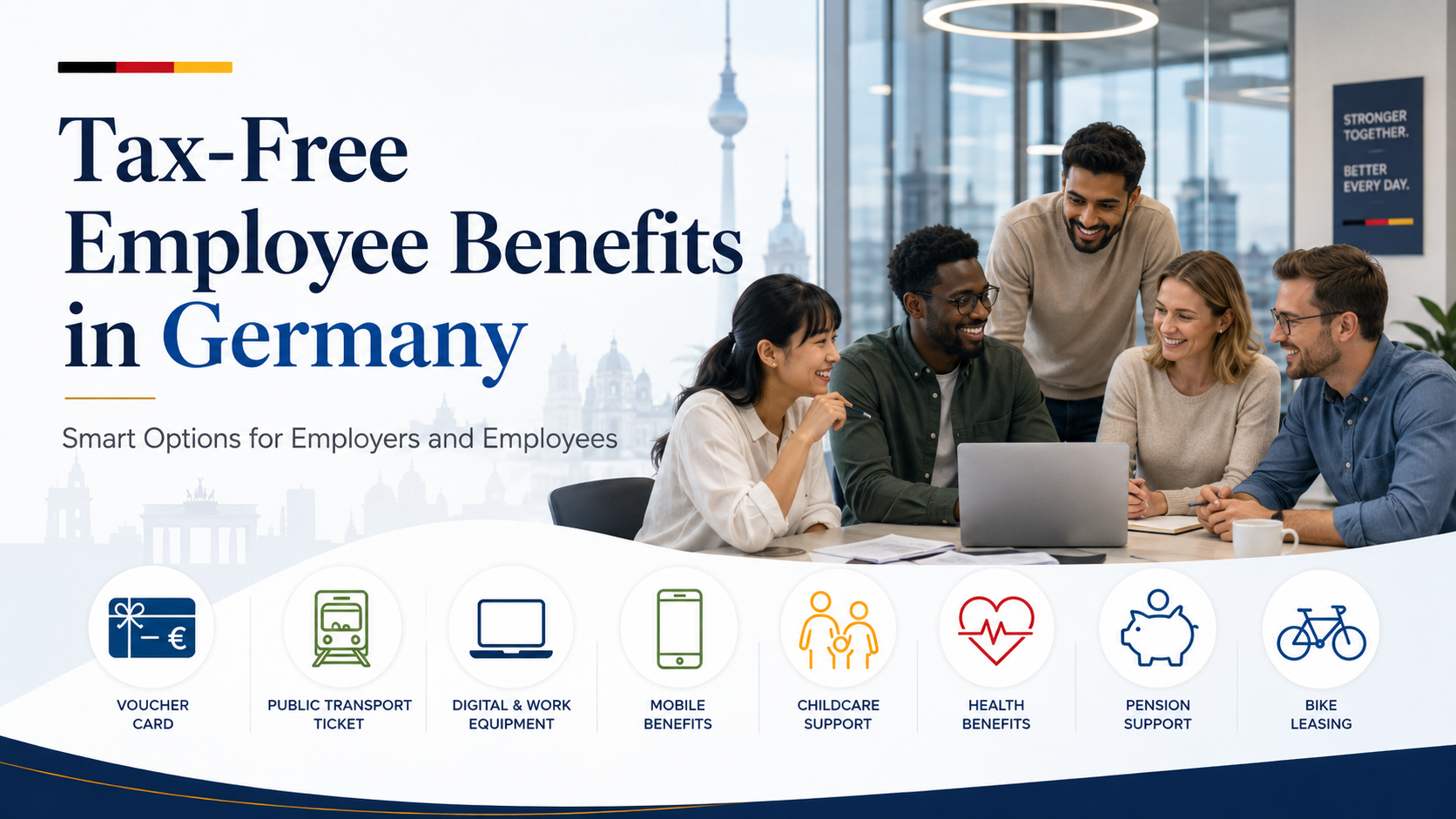
Many companies in Germany want to reward their employees better, but a normal salary increase is often expensive. The employer pays additional payroll costs, while the employee may lose a significant part of the increase through wage tax and social security contributions.
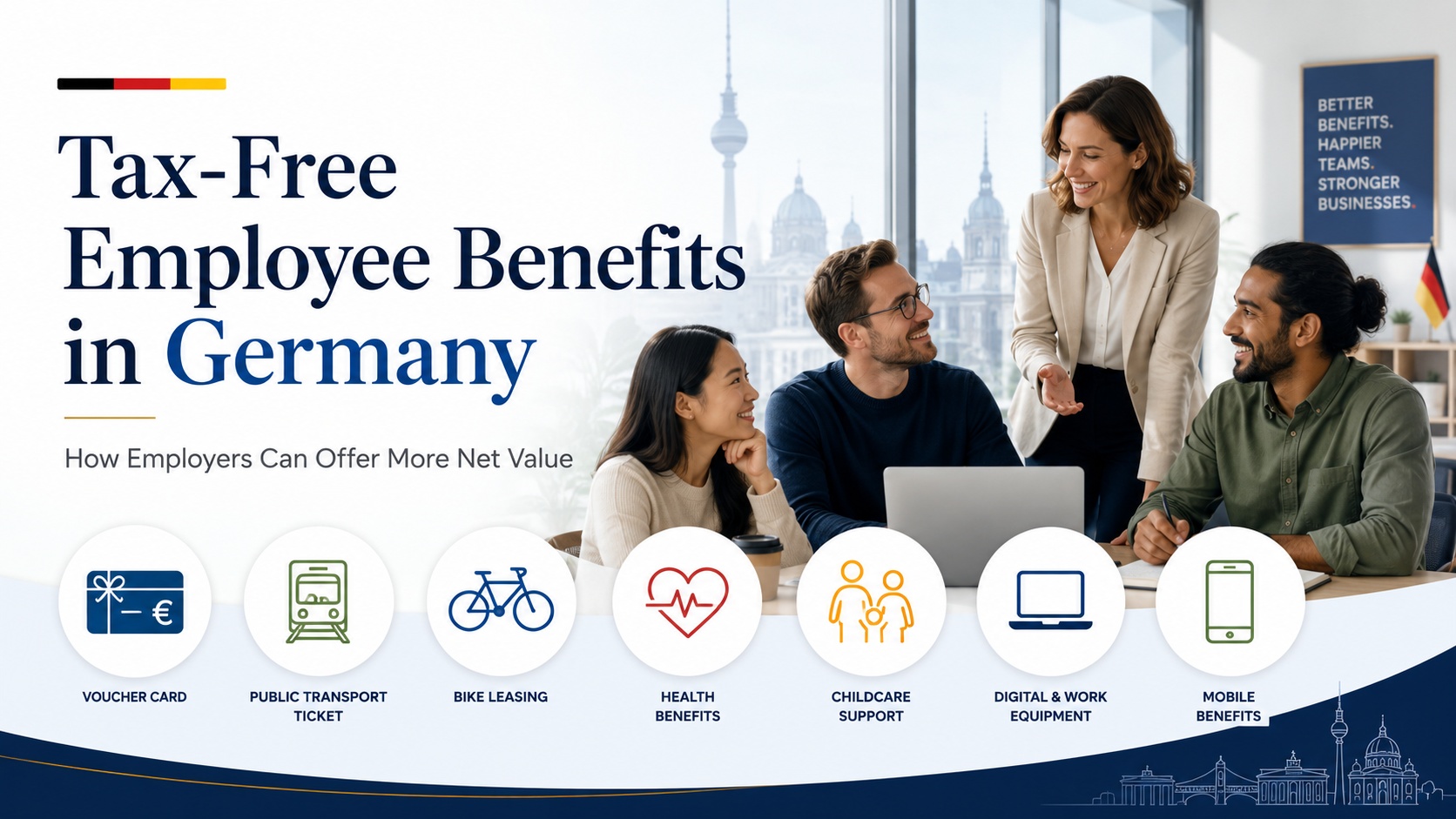
This is why tax-free employee benefits are so interesting in Germany. Used correctly, they allow employers to offer real additional value without simply increasing gross salary.
This is especially relevant for foreign-owned companies in Germany, international employers, startups, restaurants, hotels, care providers, construction companies and service businesses that want to become more attractive employers.
However, one rule is very important: many benefits must be granted in addition to the salary already owed. They usually cannot simply replace existing salary.
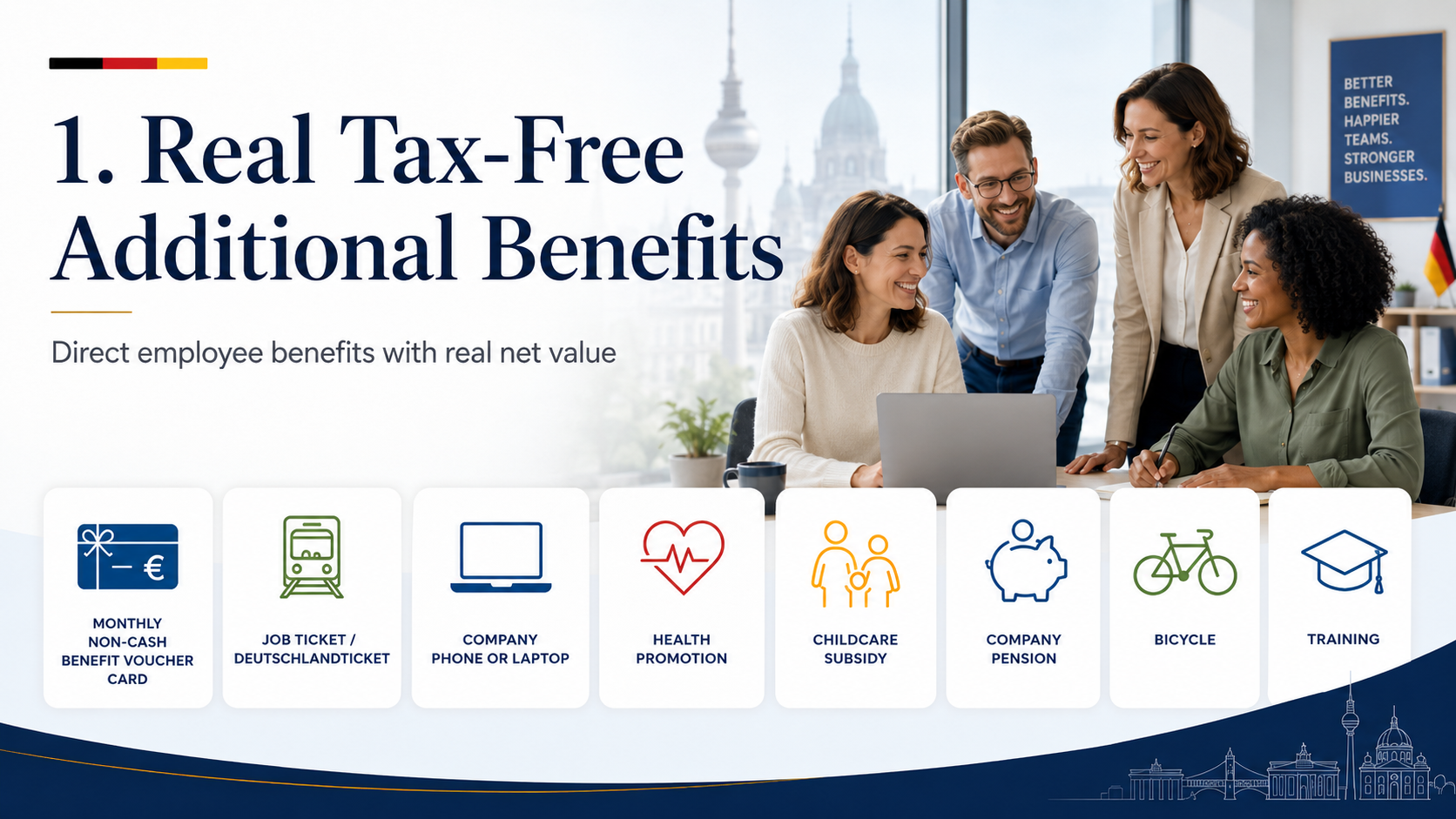
1. Real Tax-Free Additional Benefits
These are the most useful benefits for regular net salary optimization. They can often be used as part of a structured employee benefit package.
Monthly non-cash benefit up to €50
Employers may grant employees a monthly non-cash benefit of up to €50, for example vouchers, benefit cards or fuel cards. This is a monthly exemption limit. If the limit is exceeded, the entire amount can become taxable. The benefit must be a genuine non-cash benefit and not a hidden cash payment.
Job ticket or Deutschlandticket
Employers can support public transport costs, including job tickets or the Deutschlandticket, tax-free if the legal requirements are met. This is especially attractive in cities such as Berlin, Hamburg, Munich, Frankfurt or Cologne. Employer subsidies for public transport are specifically covered by German income tax law when granted in addition to salary.
Company phone, laptop, tablet or computer
If the employer provides work equipment such as a company phone, laptop, tablet or computer, private use by the employee can remain tax-free. This is one of the easiest and most practical benefits, because the equipment often serves both business and private purposes.
Workplace health promotion up to €600 per year
Employers can spend up to €600 per employee per year tax-free on qualified health promotion measures. Examples include certified prevention courses, back training, stress management or health programs. These benefits must meet the relevant health promotion requirements and must generally be provided in addition to salary.
Childcare subsidy
For employees with young children, the employer can pay or reimburse childcare costs tax-free. This applies to non-school-age children, for example daycare, kindergarten or childminders. For families, this can be one of the most valuable benefits because there is no general fixed euro limit, but the subsidy must relate to actual childcare costs and be paid in addition to salary.
Salary Conversion and Company Pension
The German company pension scheme, known as betriebliche Altersvorsorge or bAV, is another important benefit. For 2026, employer contributions are tax-free up to €8,112 per year and social-security-free up to €4,056 per year. Unlike many other benefits, salary conversion can also play a role here, but the rules should be checked carefully.
Company bicycle or e-bike
A company bicycle or e-bike can be an attractive benefit, especially for employees in urban areas. The tax treatment depends on the exact structure, especially whether it is granted additionally or through salary conversion.
Training and further education
If the employer pays for professional training, language courses, seminars or qualifications that are in the company’s business interest, this is usually not treated as taxable salary. This is particularly useful for foreign employees who need German language training, industry qualifications or professional certificates.
Employee capital participation
Employers can also grant certain employee shareholdings or capital participations tax-free up to €2,000 per year, provided the legal requirements are met. This is especially interesting for startups and growth companies that want to retain key employees long term.
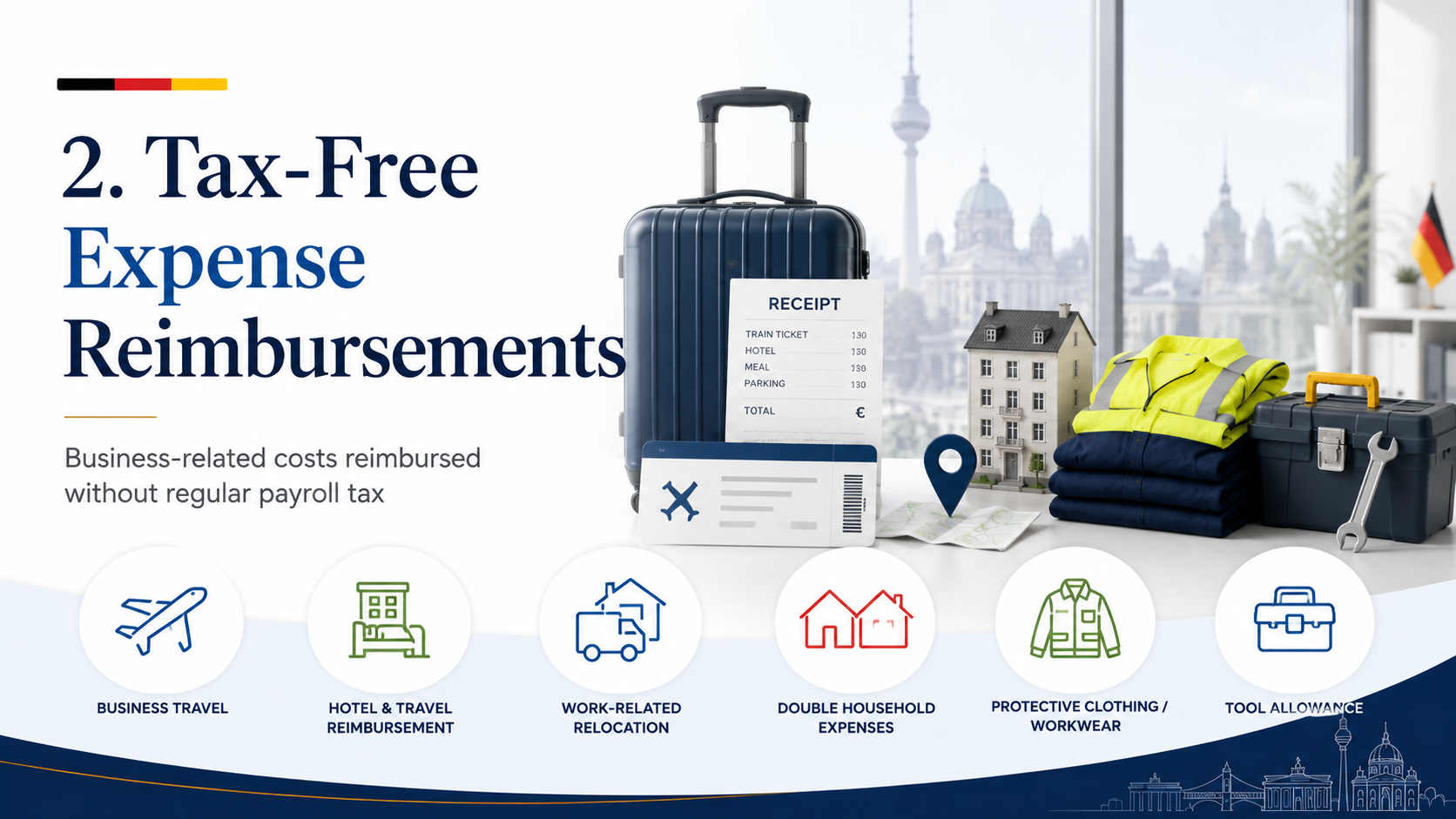
2. Tax-Free Expense Reimbursements
These items are also tax-free, but they are not free bonuses. They require a real business-related expense.
Business travel expenses
Employers can reimburse business travel expenses tax-free within the statutory limits. This includes travel costs, hotel costs, incidental travel expenses and meal allowances.
Work-related relocation costs
If an employee has to move for professional reasons, certain relocation costs can be reimbursed tax-free.
Double household expenses
If an employee maintains a second household for professional reasons, the employer may reimburse certain additional costs tax-free under the German rules for double household maintenance.
Workwear and protective clothing
Typical workwear or protective clothing can be provided or reimbursed tax-free. Examples include safety shoes, uniforms, medical workwear, construction clothing or kitchen clothing.
Tool allowance
If employees use their own tools for work, the employer may reimburse related costs tax-free under certain conditions.
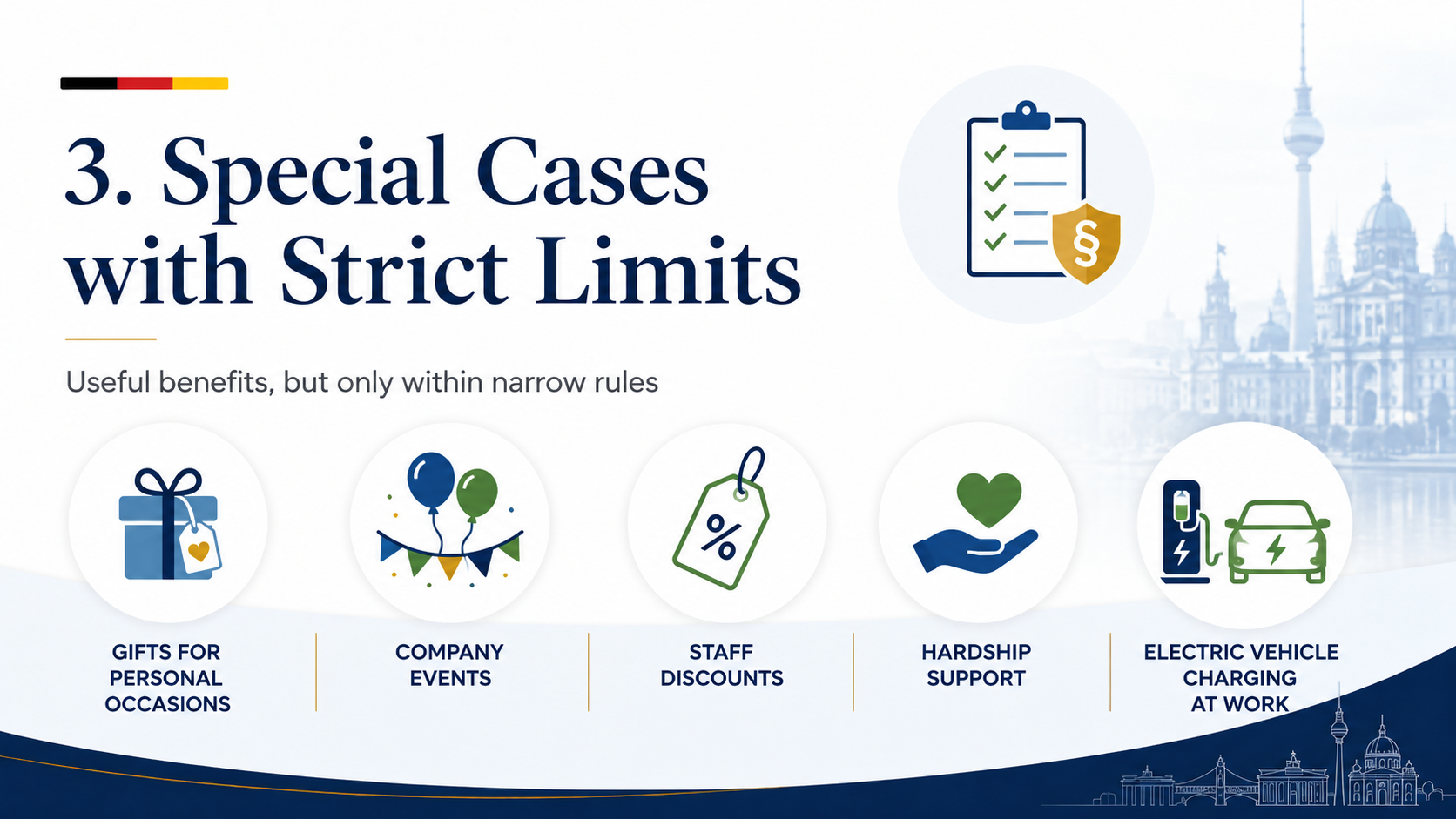
3. Special Cases with Strict Limits
These benefits can be tax-free, but they are not suitable as regular monthly salary replacement.
Gifts for personal occasions up to €60
Employers may give non-cash gifts of up to €60 for personal occasions, such as birthdays, weddings or the birth of a child.
Company events up to €110 per event
Summer parties, Christmas parties or company outings can remain tax-free up to €110 per participating employee per event, generally for up to two events per year.
Staff discounts
If the employer sells its own goods or services, employees may receive staff discounts. These can remain tax-free up to €1,080 per year.
Hardship support
In exceptional personal emergencies, such as illness, accident or special hardship, employers may provide tax-free support. This is not a general bonus, but a special case that should be documented carefully.
Charging electric vehicles at the workplace
Free or discounted charging of electric or hybrid vehicles at the employer’s premises can also be tax-free. This is particularly interesting for employers that already have charging infrastructure.
Not Fully Tax-Free, but Still Attractive
Some benefits are not completely tax-free, but can still be attractive because the employer may use flat-rate taxation. Examples include:
meal subsidies or digital meal vouchers
recreation allowance
commuting subsidies for private car use
These benefits can still improve the employee’s net position, but they must be handled correctly through German payroll accounting.
Practical Recommendation for Net Salary Optimization
For many employers, the best approach is not to use every possible benefit, but to create a simple and clean benefit package.
A strong practical combination would be:
1. €50 monthly non-cash benefit
Simple, regular and useful for almost every employee.
2. Deutschlandticket or job ticket
Very attractive for employees who use public transport.
3. Company phone, laptop or tablet
Easy to justify, practical for work and tax-efficient.
4. Health budget up to €600 per year
Good for employee loyalty, health and employer branding.
5. Childcare subsidy
Extremely valuable for employees with young children.
6. Training and language courses
Especially useful for international teams and foreign employees in Germany.
7. Salary Conversion and Company Pension
A strong long-term benefit with high retention value.
With this combination, employers can offer real additional value without only increasing gross salary. Employees receive more practical net benefit, while the company improves its attractiveness as an employer.
Conclusion
Tax-free employee benefits are a powerful tool for companies in Germany. They help employers attract, motivate and retain staff — especially in competitive sectors such as hospitality, healthcare, construction, logistics, IT and international services.
For foreign employers in Germany, these benefits are also a good way to understand the German payroll system better. A salary package in Germany does not have to consist only of gross salary. With the right structure, employers can offer more value while keeping payroll costs under control.
However, correct implementation is essential. Many benefits require documentation, limits must be observed, and several benefits must be granted in addition to the salary already owed.
Before introducing a benefit system, employers should coordinate with their payroll office or tax adviser.
In practice, the goal is clear: more net value for employees and a stronger employer brand for the company.
Free Consultation
Have questions about entering the German market? Request a free consultation.
Request Free Consultation