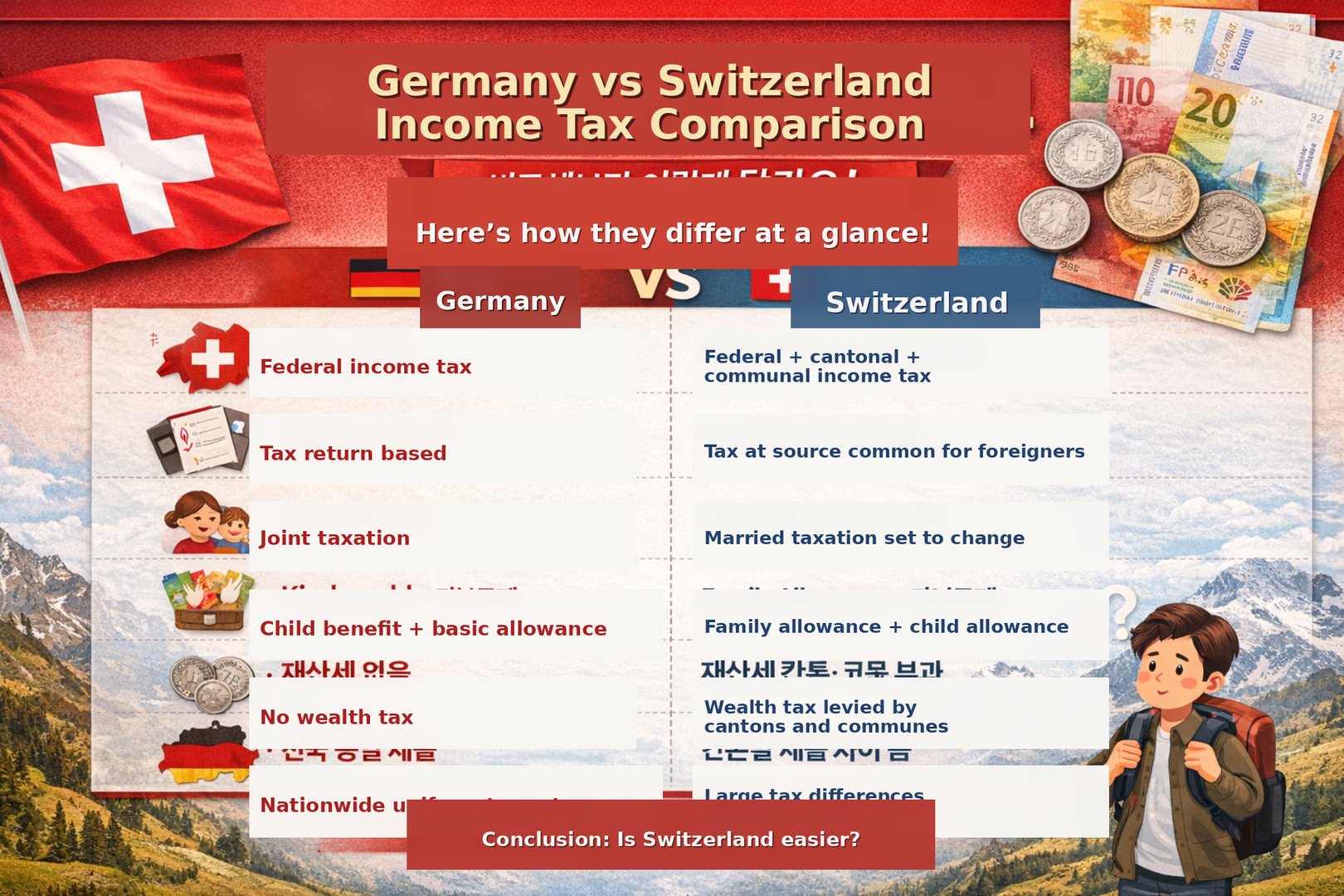
People planning a move to Europe often assume that Swiss taxes must be much simpler than German taxes. At first glance, that idea makes sense. Many foreign employees in Switzerland have tax deducted directly from their salary, which can make the system feel easier than Germany’s from day one. But once you look more closely, the picture changes: Switzerland is not automatically simpler than Germany. In many cases, it is simply complicated in a different way.
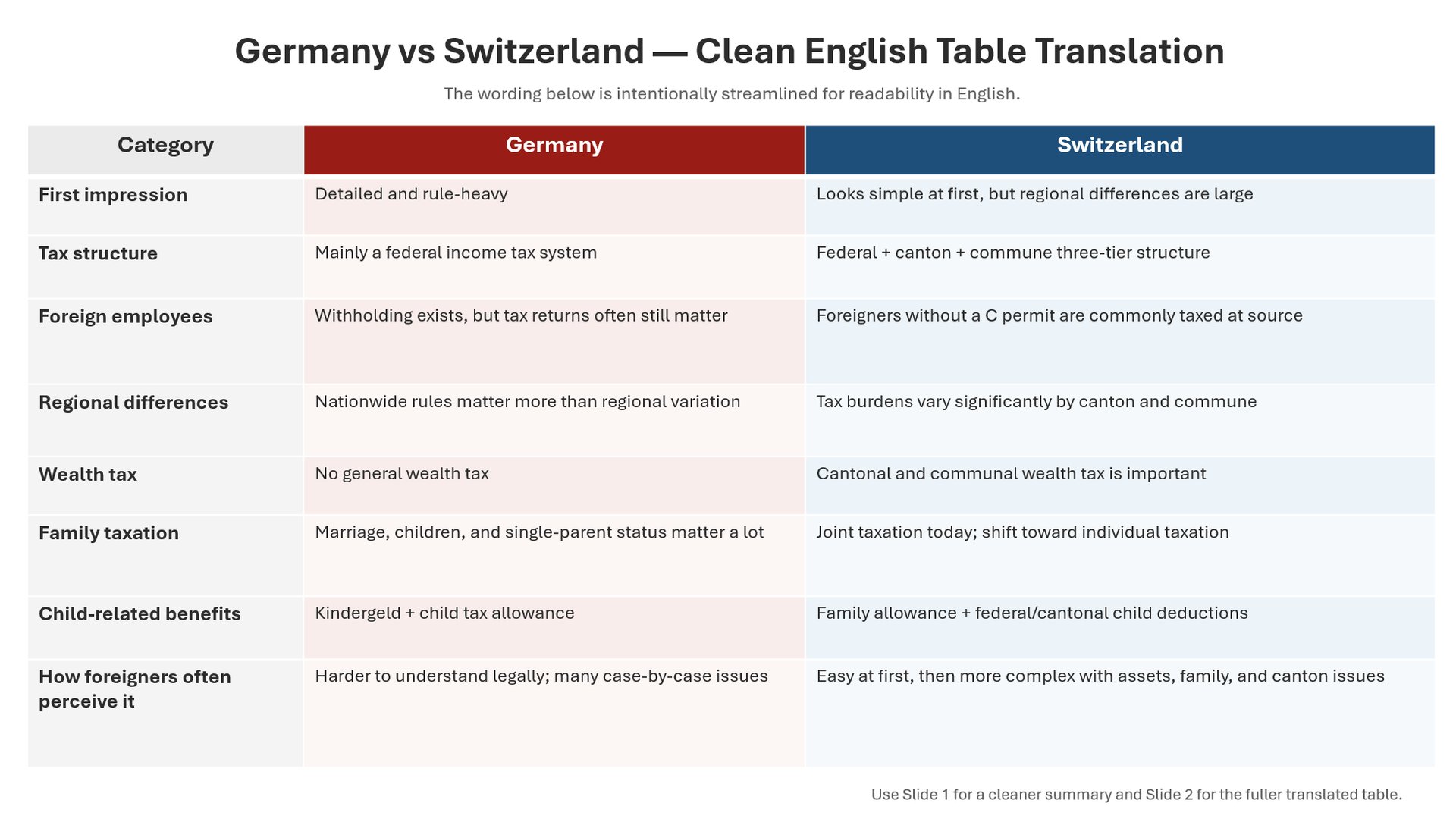
For many foreign employees, Switzerland does feel easier at first. One major reason is tax at source: according to the official Swiss authorities, this mainly applies to foreign residents who do not hold a C permit. In practice, that means tax is often deducted directly from salary, so many newcomers experience a smoother first contact with the system than they might in Germany.
But the broader Swiss tax structure is far from simple. Switzerland levies taxes at three levels — federal, cantonal, and municipal — and official guidance makes clear that your tax burden depends not only on how much you earn, but also on where you live. Similar incomes can therefore lead to different outcomes depending on the canton and commune. That is one of the biggest reasons Switzerland can feel straightforward at first and complicated later.
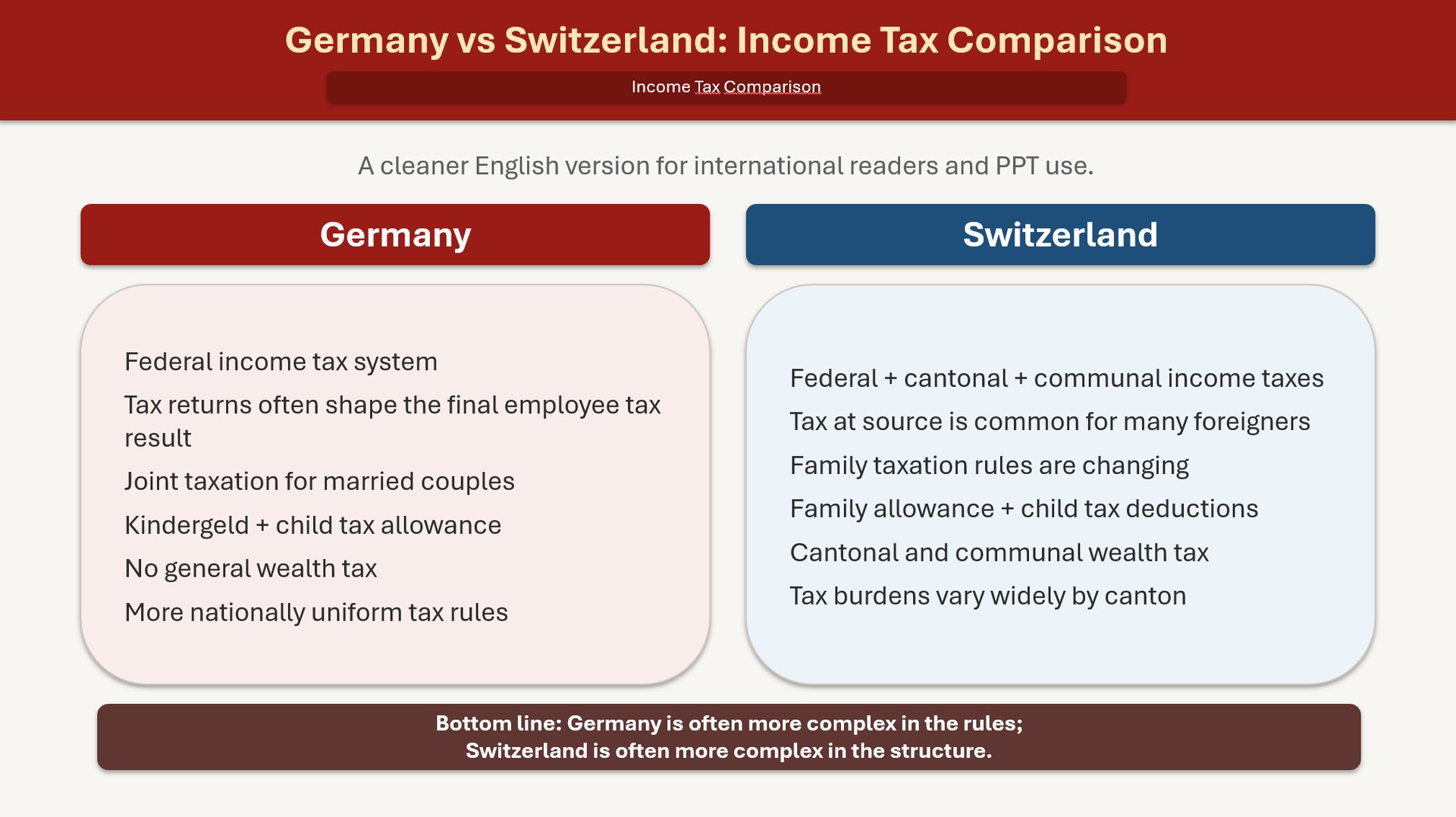
This is where the comparison with Germany becomes useful. Germany is often experienced as difficult because the law itself is detailed, structured, and full of categories, thresholds, and family-status effects. Switzerland, by contrast, often feels difficult because of its layered tax system and strong regional variation. In practical terms, Germany can be harder on the legal side, while Switzerland can be harder on the structural side. That is an interpretation, but it follows directly from how the Swiss authorities describe the system.
Another issue that surprises many internationals is wealth tax. Official Swiss information explains that, for most taxpayers, income tax is the largest item on the bill, but that all cantons and communes also levy a wealth tax. In a Swiss tax return, it may therefore be necessary to declare not just income, but also assets. This can make the system more demanding than expected for households with savings, securities, or property in more than one country.
Family taxation adds another layer. Switzerland has traditionally used joint taxation for married couples, but the Federal Tax Administration states that the federal law on individual taxation was accepted in a referendum on 8 March 2026. At the same time, the authorities also make clear that the cantons will need to adapt their own laws, so the transition will take time. In other words, Switzerland is currently in a period of change rather than a fully settled final model.
This matters because family structure can significantly affect tax outcomes. Whether you are single, married, moving with children, or holding assets abroad may change the practical result. And in Switzerland, those outcomes are shaped not only by your personal facts but also by the canton and municipality in which you live. The existence of the Federal Tax Administration’s comparison calculator reflects exactly that reality.
For self-employed people and founders, the picture becomes more nuanced again. Official Swiss guidance distinguishes between sole proprietorships and partnerships on one side, and corporations or limited liability companies on the other. The tax treatment differs depending on whether profits are taxed at the level of the individual or at the level of the company, which means that legal form matters just as much as income level.
So, is Switzerland simpler than Germany? For many foreign employees, the honest answer is: at the beginning, often yes. Tax at source can make the first experience easier. But if you look beyond the first layer — location, family status, wealth tax, business structure, and long-term residence — Switzerland is not automatically easier to understand or manage.
A practical way to think about the difference is this:
Germany often feels more complicated in the rules.
Switzerland often feels more complicated in the system design.
That is not a legal formula, but it is a useful way for international readers to understand why both countries can be challenging in different ways.
Final takeaway
If you are deciding between Germany and Switzerland, it is safer not to ask, “Which country is easier?” A better question is: Which country is easier for my personal situation? Your answer will depend on whether you are an employee or self-employed, whether you hold a C permit, whether you have children, whether you own assets abroad, and where exactly you plan to live. In Switzerland especially, place matters.
Free Consultation
Have questions about entering the German market? Request a free consultation.
Request Free Consultation