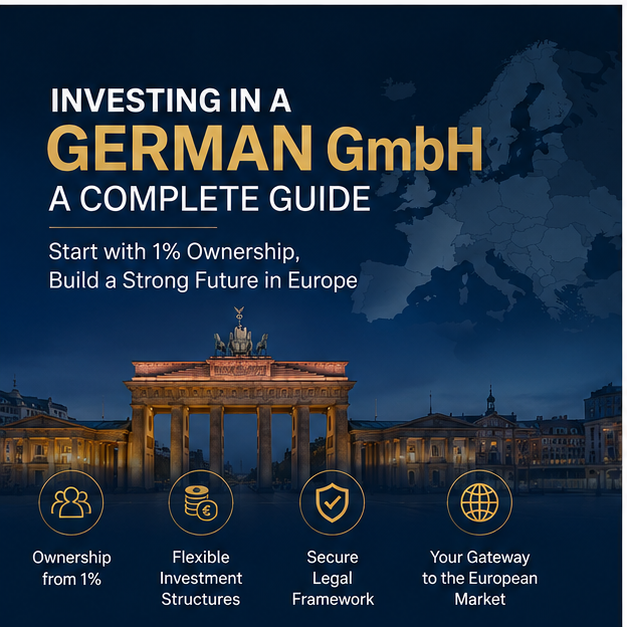
A Practical Guide for International Investors
Germany is one of the most attractive business and investment locations in Europe. International investors are increasingly looking at German companies, especially in sectors such as:
Real estate
Hotels and hospitality
Restaurants and food service
Logistics and trade
IT and startups
Manufacturing
Recruitment and staffing services
Cross-border European business platforms
Germany offers:
a stable legal system,
strong banking infrastructure,
high business credibility,
and direct access to the European Union market.
However, investing in a German company — especially a GmbH — differs significantly from investment structures commonly used in other countries. Understanding these differences is essential before entering the German market.
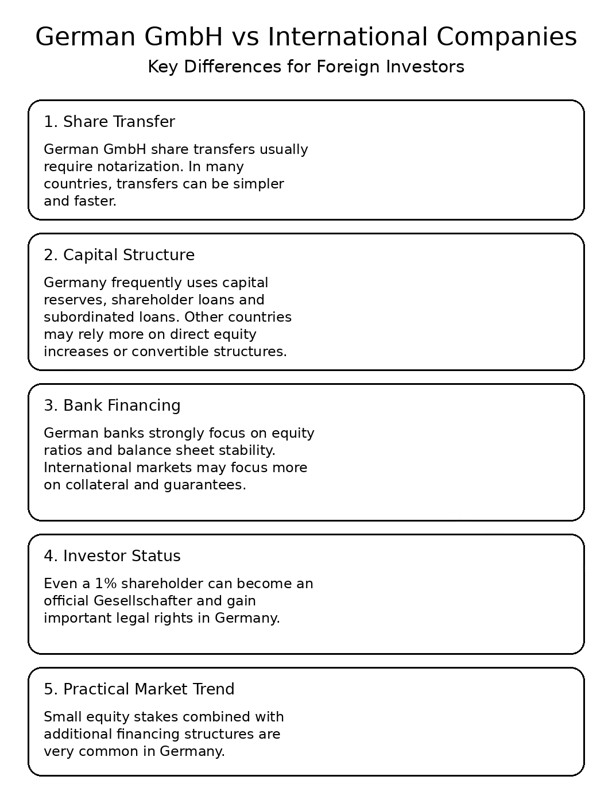
What Is a German GmbH?
A GmbH stands for: Gesellschaft mit beschränkter Haftung
which translates to: limited liability company.
It is one of the most common legal entities in Germany and can be compared to a private limited company or LLC structure in many international jurisdictions.
However, Germany has its own unique legal and financial culture, especially regarding:
notarization,
shareholder structures,
banking requirements,
equity treatment,
and corporate governance.
Key Characteristics of the German Investment Environment
Germany is known for:
long-term business relationships,
conservative financing structures,
strong creditor protection,
and detailed legal documentation.
German banks and business partners usually place significant importance on:
balance sheet quality,
equity ratios,
financial stability,
and transparent ownership structures.
This often differs from faster-moving or more aggressive investment cultures found in some international markets.
Why Many International Investors Start With 1% Ownership
In practice, many foreign investors do not initially acquire large ownership stakes in a German GmbH.
Instead, a common structure is:
acquiring a small ownership interest (for example 1%),
while providing additional financing separately.
This approach offers flexibility and reduces risk during market entry.
The Importance of 1% Ownership
Even a small ownership stake in a GmbH provides the investor with official shareholder status.
This may include:
access to company information,
participation rights,
dividend rights,
voting rights (depending on agreements),
and the ability to participate in future capital increases.
It also creates a stronger legal position compared to being only an outside lender.
For international investors, this structure can be an effective way to:
enter the German market cautiously,
evaluate local partners,
and expand later if the business develops successfully.
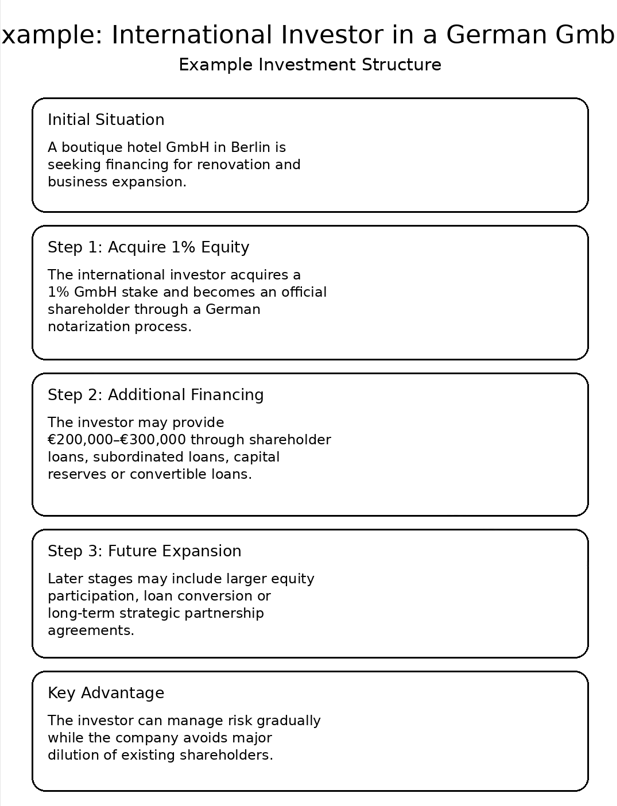
Example: Investing in a German Boutique Hotel GmbH
Assume a boutique hotel company in Berlin is seeking additional capital for:
renovations,
operational liquidity,
marketing,
and business expansion.
An international investor is interested in entering the German market but prefers a controlled and gradual investment approach.
A practical structure could look like this:
Step 1: Acquisition of 1% GmbH Shares
The investor acquires 1% of the GmbH shares.
Example:
Item: Purchase of 1% shares
Amount: €5,000
At this stage, the investor becomes an official shareholder of the GmbH.
Important:
In Germany, the transfer of GmbH shares must be notarized by a German notary public.
Step 2: Additional Financing
After becoming a shareholder, the investor may provide additional capital through various financing structures.
Germany offers several practical options.
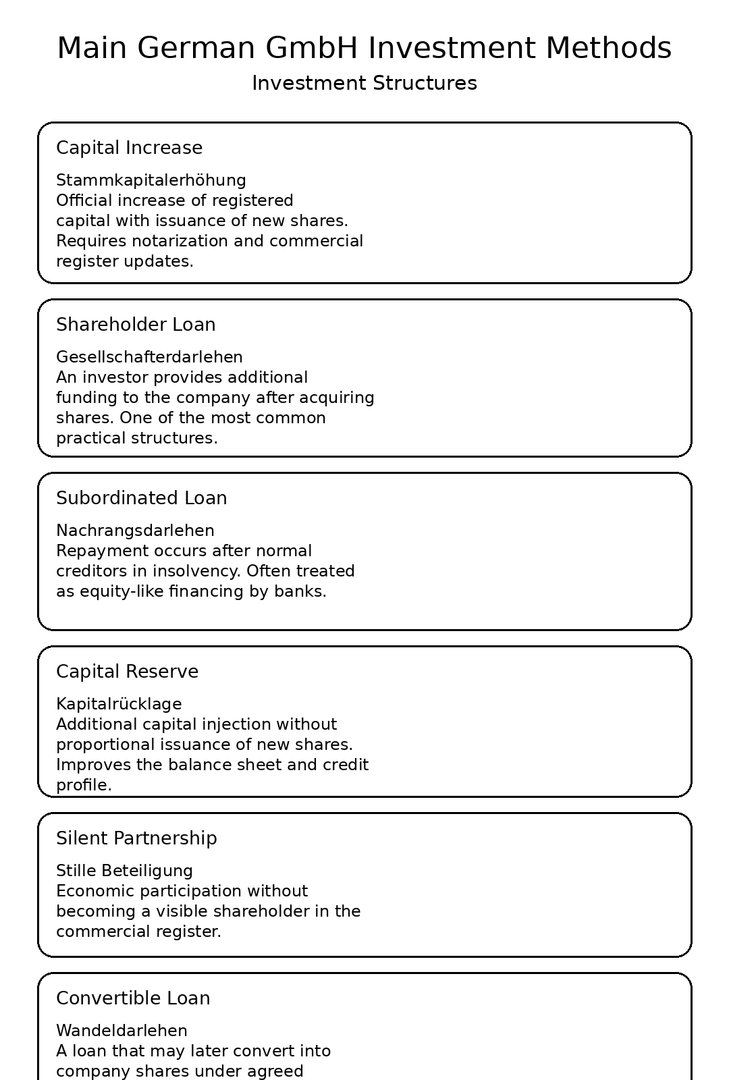
Investment Method 1: Capital Increase (Stammkapitalerhöhung)
The traditional approach is increasing the official registered share capital of the GmbH.
The company issues new shares, and the investor receives additional ownership.
However, in practice this method is not always preferred because it may involve:
notarization,
commercial register changes,
shareholder dilution,
and more complex procedures.
As a result, German companies frequently use alternative financing structures.
Investment Method 2: Shareholder Loan (Gesellschafterdarlehen)
One of the most common structures in Germany.
The investor:
acquires a small ownership stake,
and additionally provides a loan to the company.
Example:
Item: 1% share acquisition
Amount: €5,000 (e.g.)
Shareholder loan: €200,000
Advantages
For the investor
interest income,
repayment claims,
shareholder status,
flexibility for future expansion.
For the company
reduced dilution,
fast access to capital,
flexible financing structure.
This model is extremely common among German SMEs (“Mittelstand”), hospitality businesses, and real estate projects.
Investment Method 3: Subordinated Loan
(Nachrangsdarlehen)
A subordinated loan is repaid after ordinary creditors in insolvency scenarios.
This increases investor risk but may improve the company’s balance sheet position.
German banks sometimes treat subordinated loans as quasi-equity, especially in:
hotel projects,
real estate developments,
and expansion financing.
This makes subordinated loans particularly important in German financing structures.
Investment Method 4: Capital Reserve Contribution (Kapitalrücklage)
This is a very important concept in Germany.
The investor contributes additional capital to the company without necessarily receiving proportional additional shares.
Example:
Item: 1% shares
Amount: €5,000 (e.g.)
Capital reserve contribution: €300,000 (e.g.)
Advantages
strengthens the company’s equity position,
improves financial statements,
increases bank credibility,
supports long-term stability.
German banks often place significant value on strong equity structures and clean balance sheets.
Investment Method 5: Silent Partnership
(Stille Beteiligung)
A silent partnership allows an investor to participate economically without appearing as a formal shareholder in the company structure.
This may resemble:
profit participation structures,
silent equity,
or certain private investment arrangements.
Characteristics
reduced public visibility,
economic participation,
limited or no voting rights,
flexible contractual arrangements.
This structure may be attractive for:
private investors,
strategic partnerships,
family office investments,
or confidential investments.
Investment Method 6: Convertible Loan
(Wandeldarlehen)
A convertible loan starts as debt financing but may later convert into equity under agreed conditions.
This structure is commonly used for:
startups,
growth companies,
international joint ventures,
and phased investment strategies.
Advantages
reduced initial valuation pressure,
gradual investment process,
future ownership expansion possibilities.
Common Combined Structures in Germany
In practice, German investment structures often combine multiple elements.
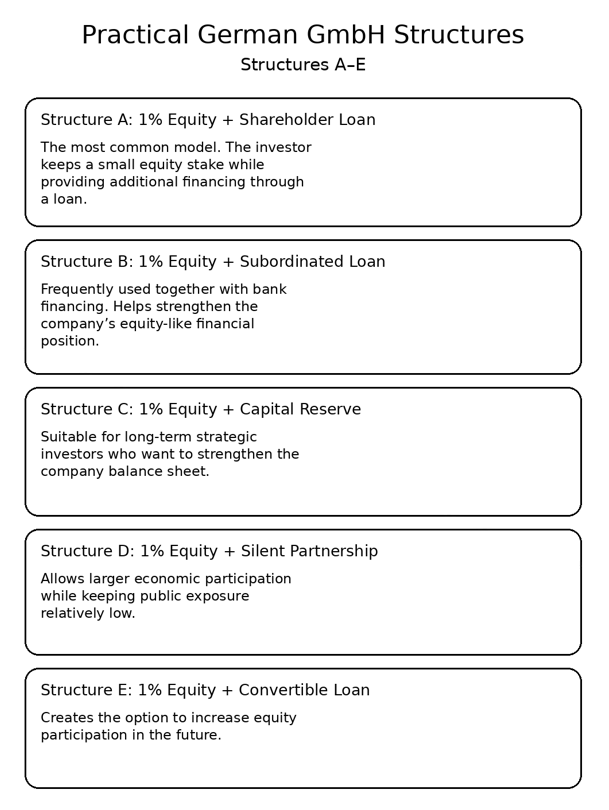
Structure A - 1% Ownership + Shareholder Loan
The most common practical structure.
Structure B - 1% Ownership + Subordinated Loan
Frequently used together with bank financing.
Structure C - 1% Ownership + Capital Reserve
Suitable for long-term strategic investors.
Structure D - 1% Ownership + Silent Partnership
Allows broader economic participation while limiting public exposure.
Structure E - 1% Ownership + Convertible Loan
Creates flexibility for future ownership expansion.
Important Considerations for International Investors
1. Source of Funds Documentation
German banks apply strict anti-money-laundering and compliance procedures.
Clear documentation of investment funds is essential.
2. Notarization Requirements
GmbH share transfers require German notarization.
This is mandatory under German corporate law.
3. Tax Planning
International investors should carefully review:
dividend taxation,
withholding taxes,
double taxation treaties,
corporate tax implications,
and interest deductibility.
4. Shareholders’ Agreement
Especially for minority investors, a detailed shareholders’ agreement is highly recommended.
This may regulate:
information rights,
exit rights,
future investments,
anti-dilution protection,
voting rights,
dispute resolution,
and transfer restrictions.
Conclusion
Investing in a German GmbH can be an excellent gateway into the European market for international investors.
In Germany, investments are often structured not only through direct equity participation but also through:
shareholder loans,
subordinated loans,
capital reserve contributions,
silent partnerships,
and convertible loans.
A common and practical strategy is to:
begin with a small ownership stake,
build market experience,
and gradually expand the investment over time.
Germany values:
long-term stability,
transparency,
financial discipline,
and reliable partnerships.
For international investors, careful structuring of legal, tax, financing, and shareholder arrangements is essential for a successful investment in the German market.
Free Consultation
Have questions about entering the German market? Request a free consultation.
Request Free Consultation