The right business structure for foreign founders
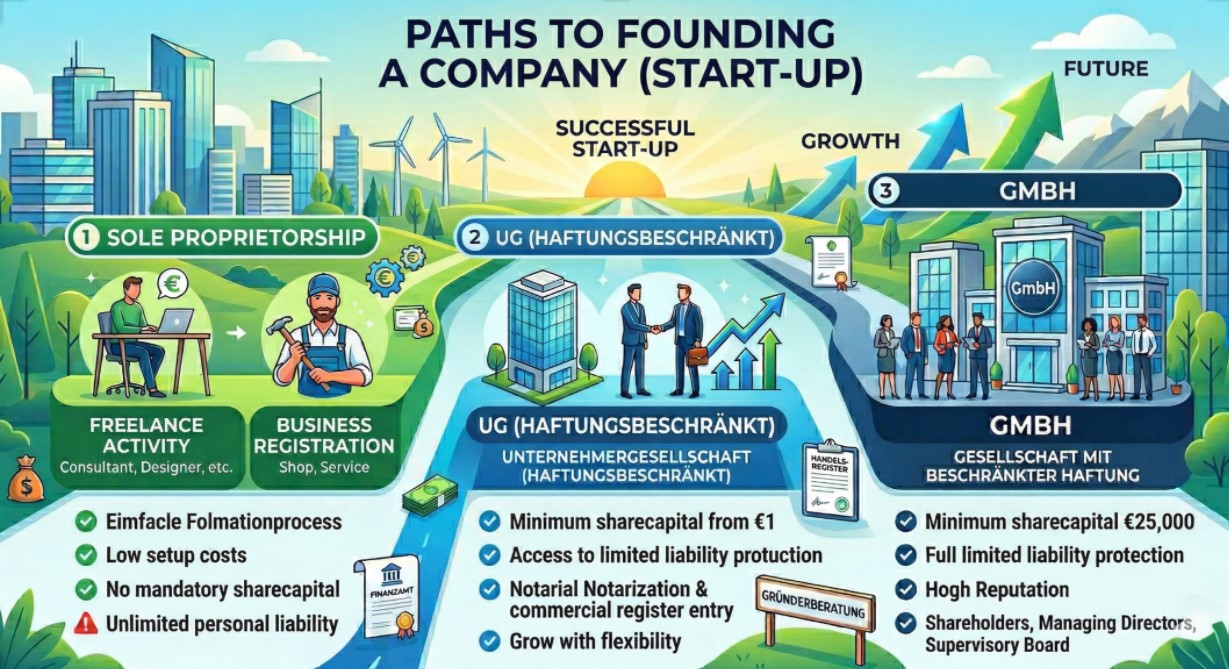
Starting a business in Germany is an exciting step — but one of the first important decisions is choosing the right legal structure. For most foreign founders, the two most common options are a sole proprietorship or a company, usually a UG (limited liability entrepreneurial company) or a GmbH (limited liability company).
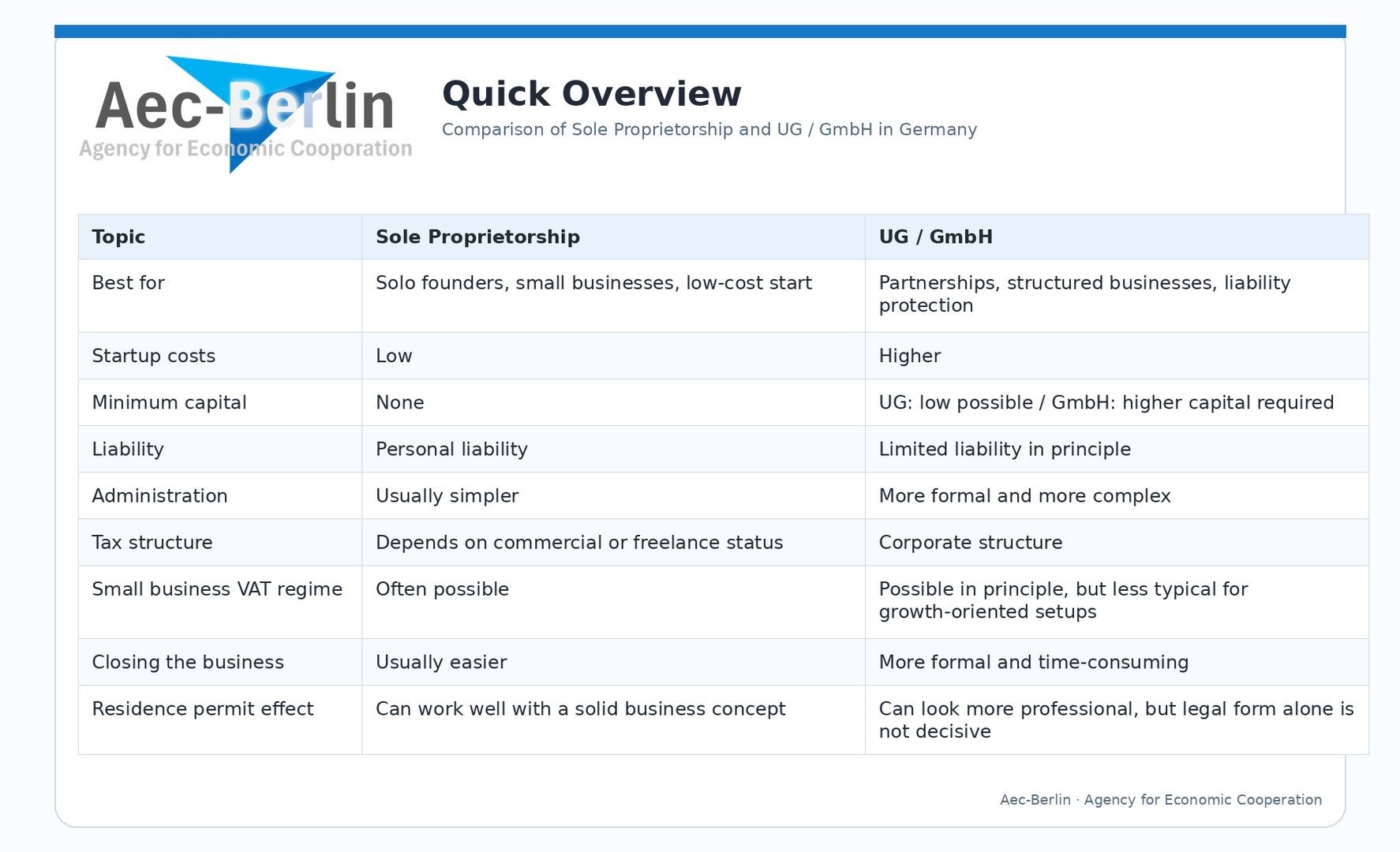
Both options can work well, but they are designed for different situations. A sole proprietorship is often the easiest and most affordable way to get started. A UG or GmbH, on the other hand, can be the better choice if you want limited liability, plan to start with partners, or need a more formal company structure.
The right decision depends on your budget, your business model, your long-term plans, and in some cases also your residence permit situation.
Sole Proprietorship: Simple, flexible, and cost-efficient
A sole proprietorship is often the best choice for founders who want to start quickly and keep costs low. There is no required minimum capital, the structure is straightforward, and administration is usually easier than with a corporation.
This option is especially attractive for people who want to test a business idea, open a small restaurant or shop, offer services independently, or start as a one-person business.
Within a sole proprietorship, it is important to distinguish between two categories:
Commercial business
A commercial business usually applies to activities such as gastronomy, retail, trade, and many service-based businesses. In these cases, registration with the local trade office is generally required.
Why many founders choose this option:
It is practical, fast to set up, and often ideal for smaller businesses with a manageable level of risk.
Things to keep in mind:
The owner is personally liable. This means business risks are not limited to the company itself — private assets may also be affected.
Freelance activity
Some founders do not register a trade because their work qualifies as a freelance profession. This often applies to certain advisory, artistic, academic, educational, or similar professional activities.
For freelancers, the process is often even simpler because there is usually no trade registration and no trade tax.
Why this can be attractive:
Freelance activity is often one of the leanest and most efficient ways to become self-employed in Germany.
Important:
Not every service-based activity is automatically considered freelance. The actual classification depends on the nature of the work.
Small business VAT regime: A useful option for small starters
Many sole proprietors — whether commercial or freelance — may be able to use the small business VAT regime.
This means you usually do not charge VAT on your invoices, which can make your pricing simpler and more attractive, especially when working with private clients. At the same time, however, you also cannot deduct input VAT from your own business expenses.
This model can be very helpful for founders who want to start small, keep administration simple, and avoid unnecessary complexity in the early phase of the business.
UG or GmbH: Stronger structure, limited liability
If you want to build a business with a stronger legal structure, a UG or GmbH may be the better option.
These company forms are especially popular when:
more than one founder is involved
liability protection is important
investors or partners may join later
a more formal and professional structure is needed
A GmbH requires higher starting capital, while a UG is often used as a more affordable entry into the corporate structure.
Why founders choose a UG or GmbH
The biggest advantage is limited liability. In principle, the company is responsible with its own business assets, which offers more protection than a sole proprietorship.
A UG or GmbH can also create a more professional appearance in the market. This can be helpful when dealing with landlords, business partners, clients, or institutions.
For growing businesses, these structures often offer a better framework for long-term planning, ownership distribution, and structured expansion.
What to consider before choosing a company
A UG or GmbH also comes with more formal obligations. Setup is more complex, accounting is usually more demanding, and closing the company later is much more complicated than simply ending a sole proprietorship.
That is why many founders choose a corporation only when they truly need the added structure and liability protection.
What matters for a residence permit
Many foreign founders believe that choosing a GmbH automatically creates a better impression in immigration matters. In practice, this is only partly true.
What matters most is not just the legal form, but the overall quality of the business project:
Is the business plan convincing?
Is the financing secured?
Does the project appear realistic and economically sound?
A GmbH may look more established, and a stronger capital base can certainly help. But in most cases, immigration authorities focus much more on the credibility and viability of the business than on the company type alone.
Which option is right for you?
A sole proprietorship is often the right choice if you:
want to start alone
want to keep setup and administration simple
are working with a limited budget
prefer flexibility in the early stage
A UG or GmbH is often the better choice if you:
are starting with one or more partners
want limited liability
need a stronger legal structure
plan to build a scalable or investment-ready business
Our recommendation
There is no one-size-fits-all solution. The best legal form depends on your personal situation, your financial resources, and your business goals.
If you are planning to start a business in Germany as a foreign founder, it is worth comparing the options carefully before making a decision. A good structure from the beginning can save time, money, and legal complications later
Free Consultation
Have questions about entering the German market? Request a free consultation.
Request Free Consultation