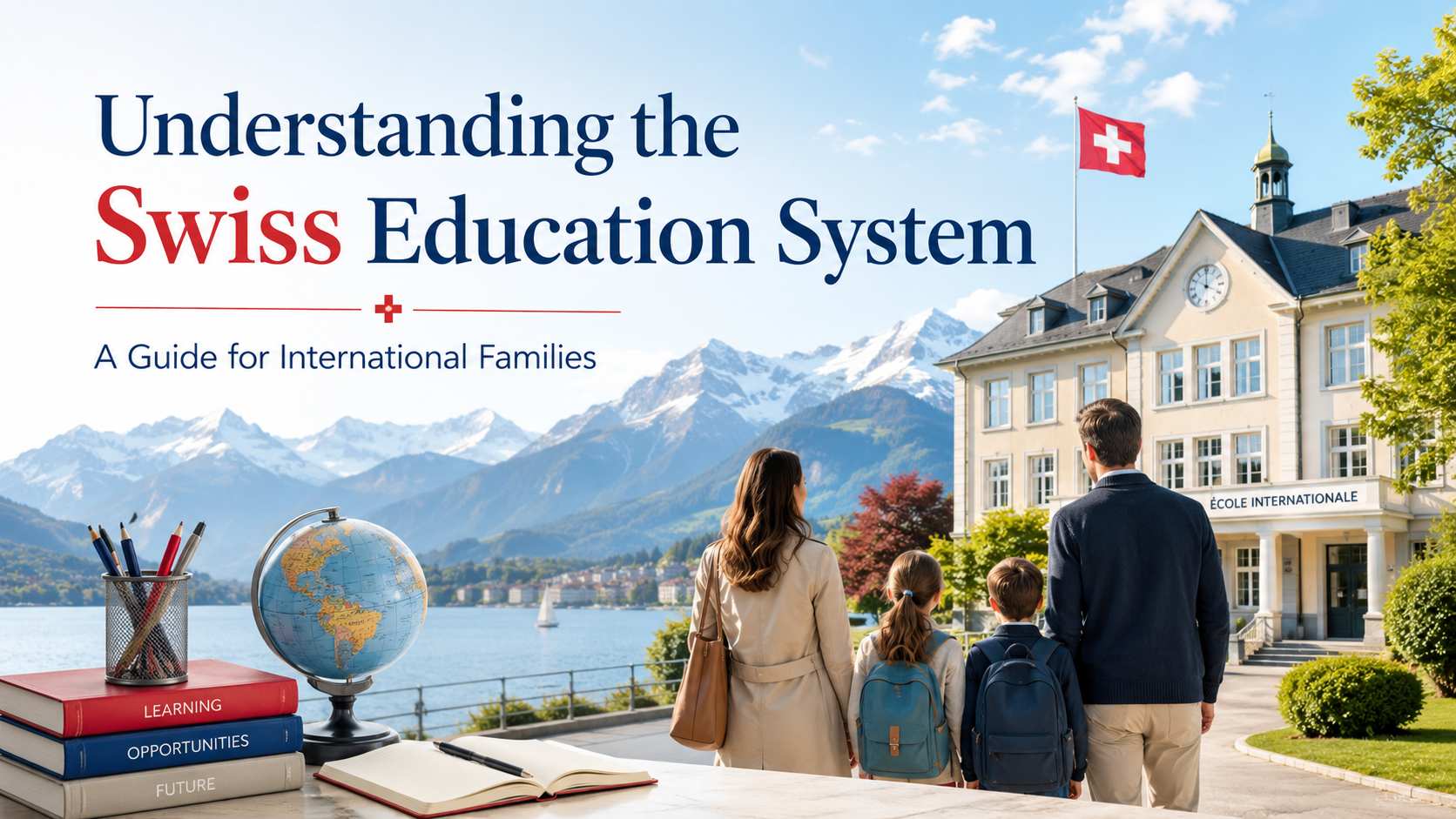
Switzerland is widely known for its high standard of education, stable society, multilingual culture, and strong public institutions. For many international families, it can be an attractive place to raise children and plan their educational future.
However, the Swiss education system is not a single, uniform national system. It is highly regional. Education is mainly organized by the individual cantons, which means that schooling can differ depending on whether a family lives in Zurich, Geneva, Basel, Lausanne, Bern, or Lugano.
For international families, this is one of the most important points to understand:
In Switzerland, choosing a place to live also means choosing a language region, a canton, and a specific school structure.
Key Features of Swiss Education
Switzerland has a strong public education system, but it also has many private and international schools, especially in areas with many expatriate families, multinational companies, international organizations, and diplomatic institutions.
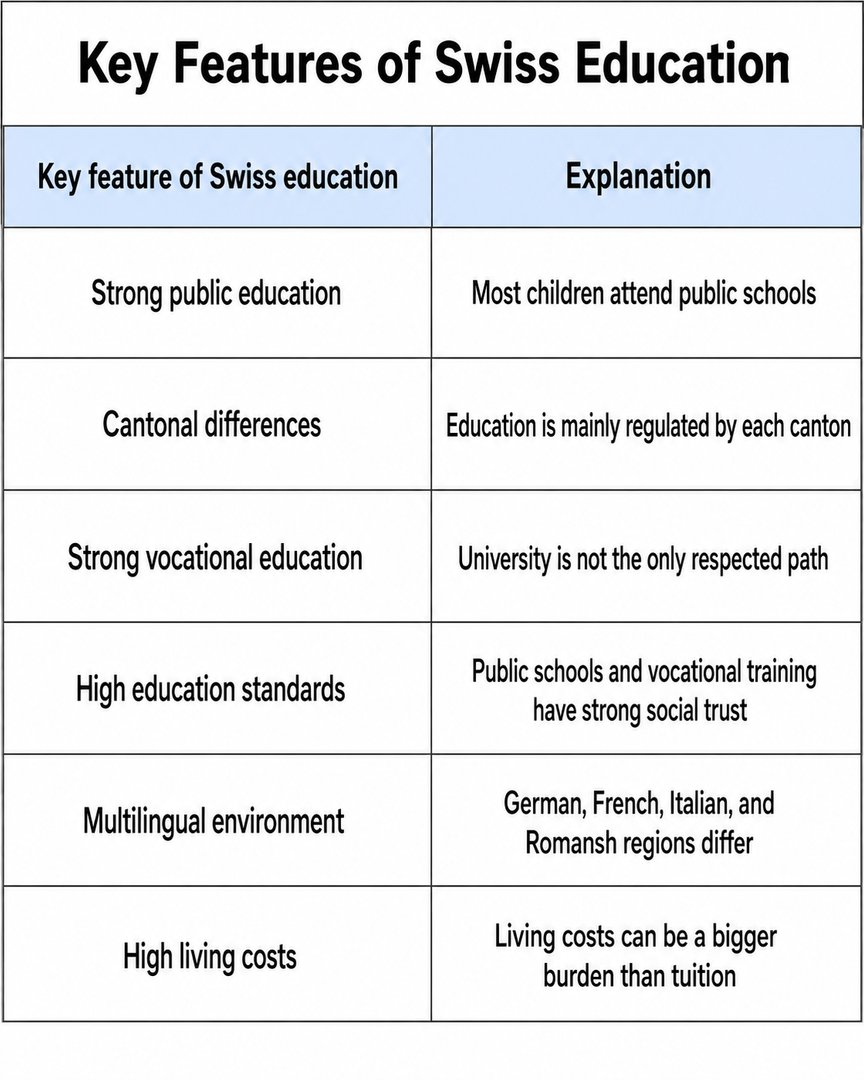
This makes Switzerland very different from countries with a centralized national curriculum. A family cannot fully understand Swiss education by looking only at “Switzerland” as a whole. It is necessary to look at the specific canton and language region.
Basic Structure of the Swiss Education System
The Swiss education system can be broadly divided into compulsory education, upper secondary education, and tertiary education.
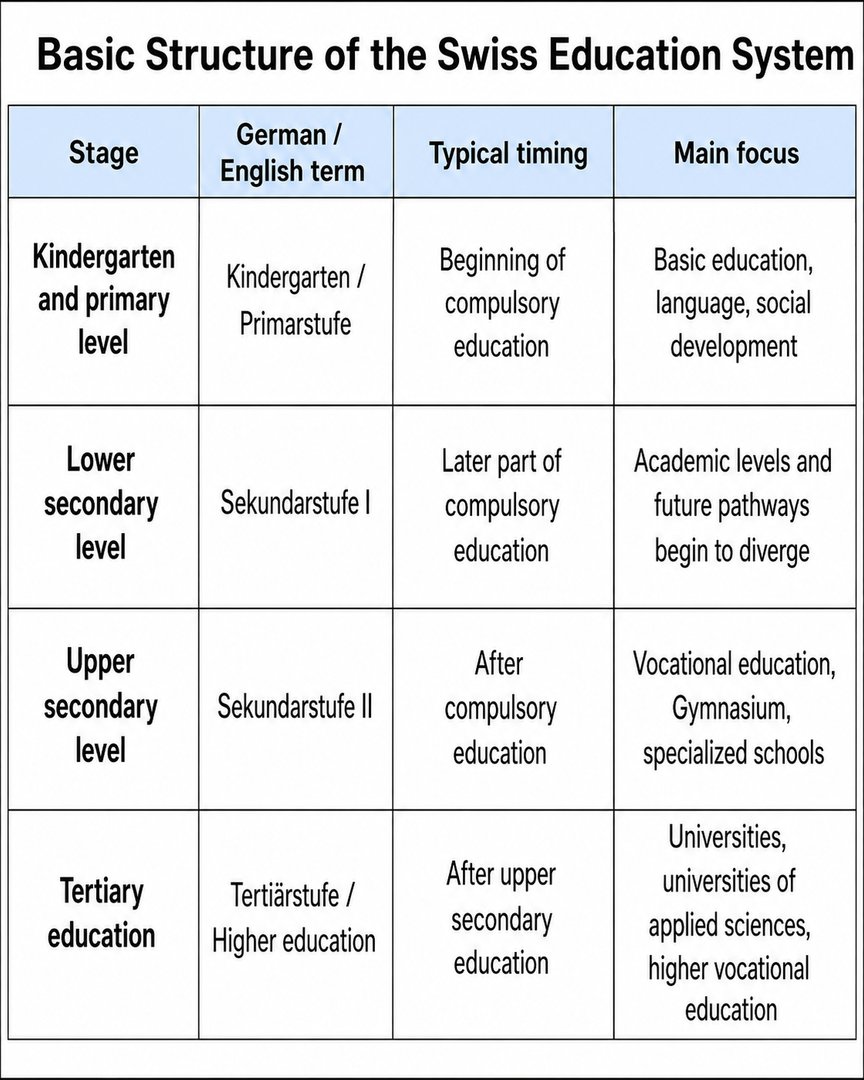
Compulsory education usually lasts around 11 years, but the details can vary by canton. This is why families should always check the local school system before choosing where to live.
Switzerland Is a Cantonal Education System
The word canton is essential for understanding Swiss education. A canton is somewhat similar to a state or province, but in Switzerland the cantons have especially strong authority in education.
This means that school structure, school calendar, language of instruction, transition points, and educational expectations can differ from one canton to another.
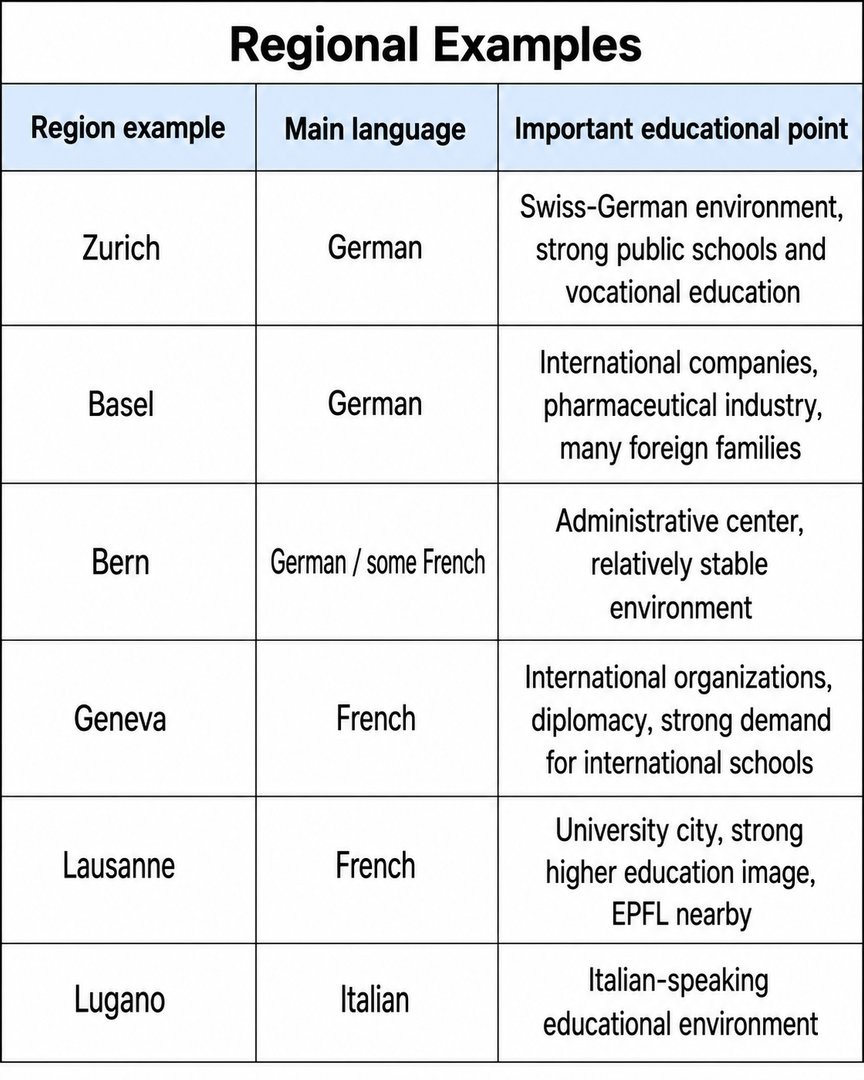
For international families, the first question should not only be “Which Swiss city is good?” but also:
Which language region is suitable for our child?
A child in Zurich will grow up in a German-speaking and Swiss-German environment. A child in Geneva will be in a French-speaking environment. A child in Lugano will be in an Italian-speaking environment. These differences matter greatly for school integration.
Public Schools in Switzerland
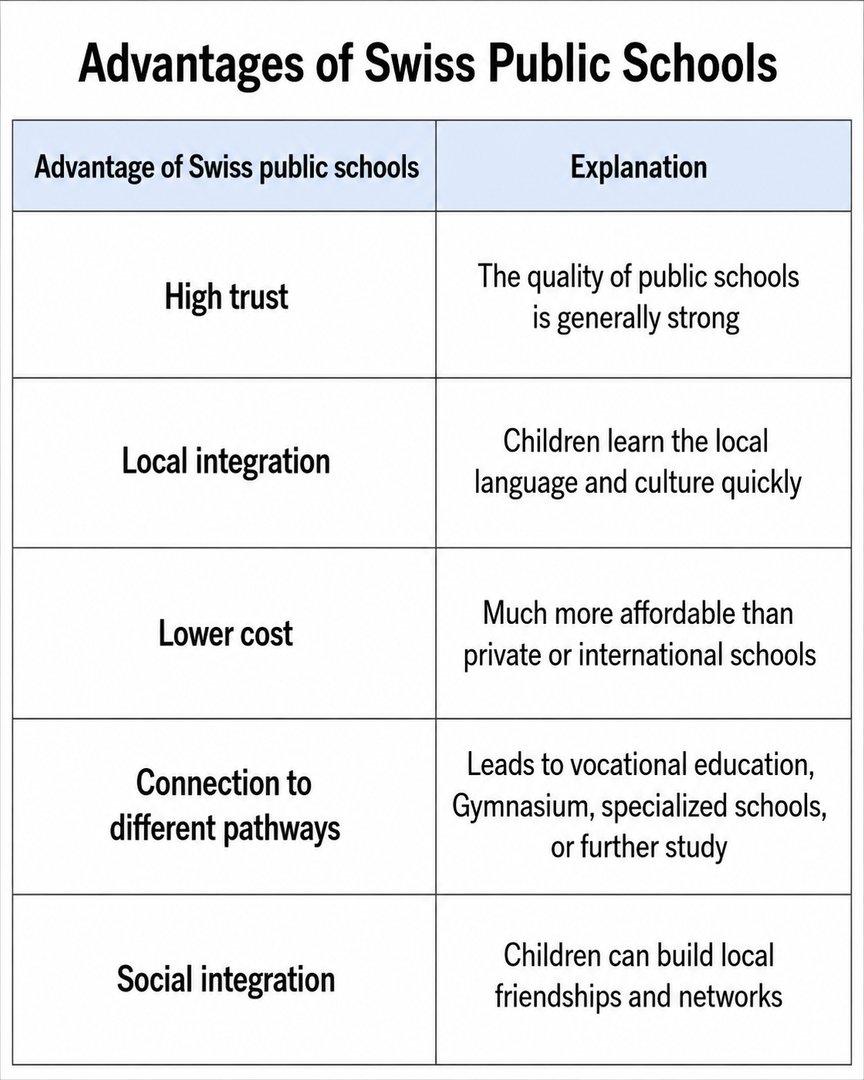
Swiss public schools generally have a strong reputation. Most local families send their children to public schools, and public education is considered reliable and socially respected.
For international families planning long-term residence, public school can be a very good option because it helps children enter the local language, culture, and community.
However, public school is not always easy for foreign children. Language adaptation can be a major challenge. In German-speaking Switzerland, children may need to deal not only with standard German but also with Swiss German in daily life. In French- or Italian-speaking regions, they must adapt to those languages instead.
For young children, this adaptation can often happen quickly. For older children, especially those entering secondary school, the transition can be more demanding.
International Schools and Private Schools
Switzerland has many well-known international schools, especially in Geneva, Zurich, Basel, Lausanne, and other globally connected regions. These schools often offer English-language instruction, IB programs, international curricula, and strong university guidance.
International schools can be excellent for families who move frequently or plan to send their children to universities in the United States, the United Kingdom, Canada, or other international destinations.
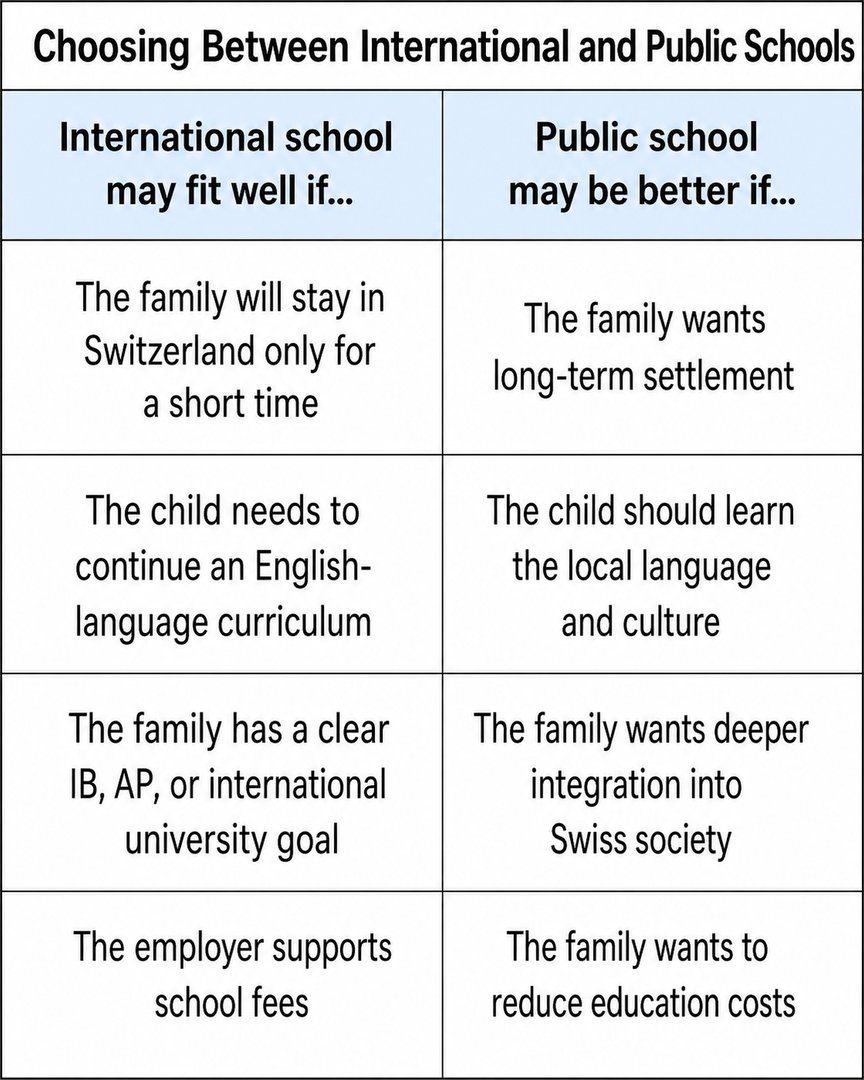
The main challenge is cost. Swiss international schools can be very expensive. Therefore, choosing an international school should not be based only on prestige. Families should consider expected length of stay, budget, language goals, university plans, and the child’s personality.
The Most Important Feature: Vocational Education Is Highly Respected
One of the biggest differences between Switzerland and many other countries is the strength of vocational education.
In some countries, university is seen as the main or even the only prestigious route. In Switzerland, this is different. Vocational education and training, often called VET, is a central part of the education system and is socially respected.
Many students choose a vocational route after compulsory education. This does not mean that they are taking a “lower” path. In Switzerland, vocational training can lead to stable employment, strong professional skills, further education, and even later access to higher education.
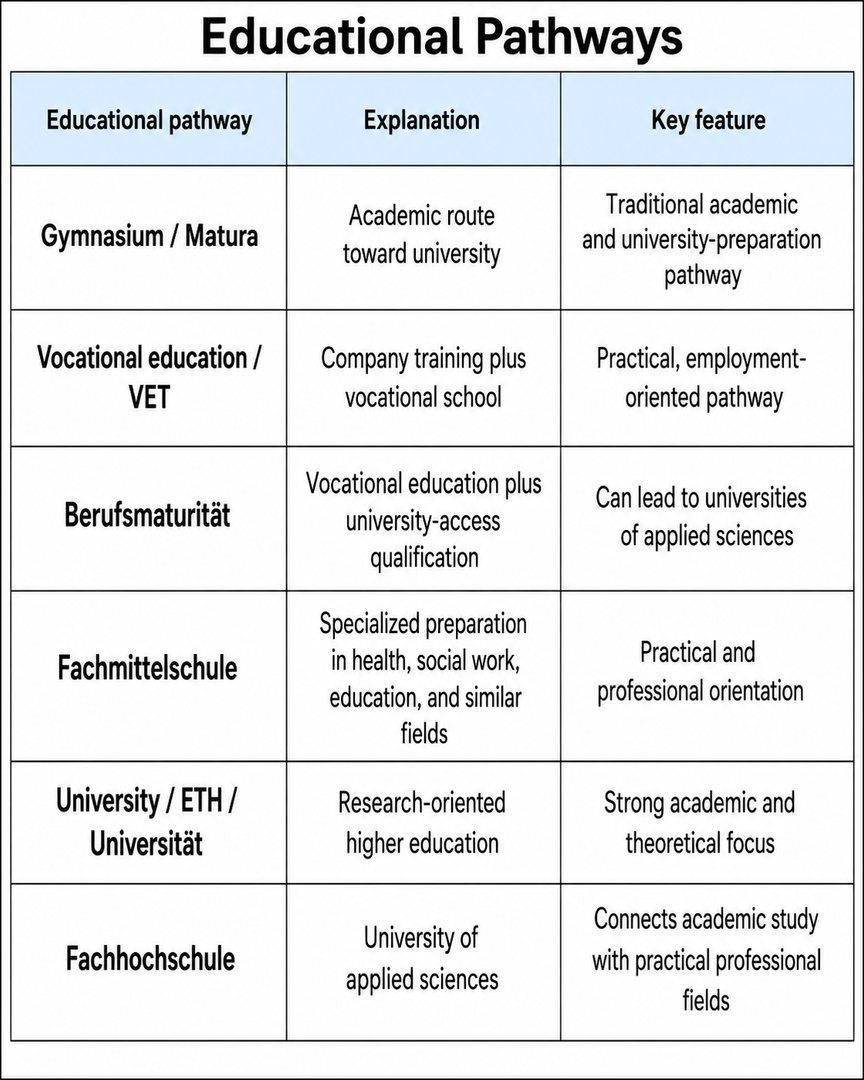
This is extremely important for international families to understand. In Switzerland, the education system is not built around sending everyone to university. It is built around finding suitable pathways for different talents.
A Common Misunderstanding
International families may initially wonder why Swiss students choose vocational education relatively early. Parents from strongly university-oriented cultures may worry that vocational education closes doors.
But in Switzerland, vocational education can open doors.
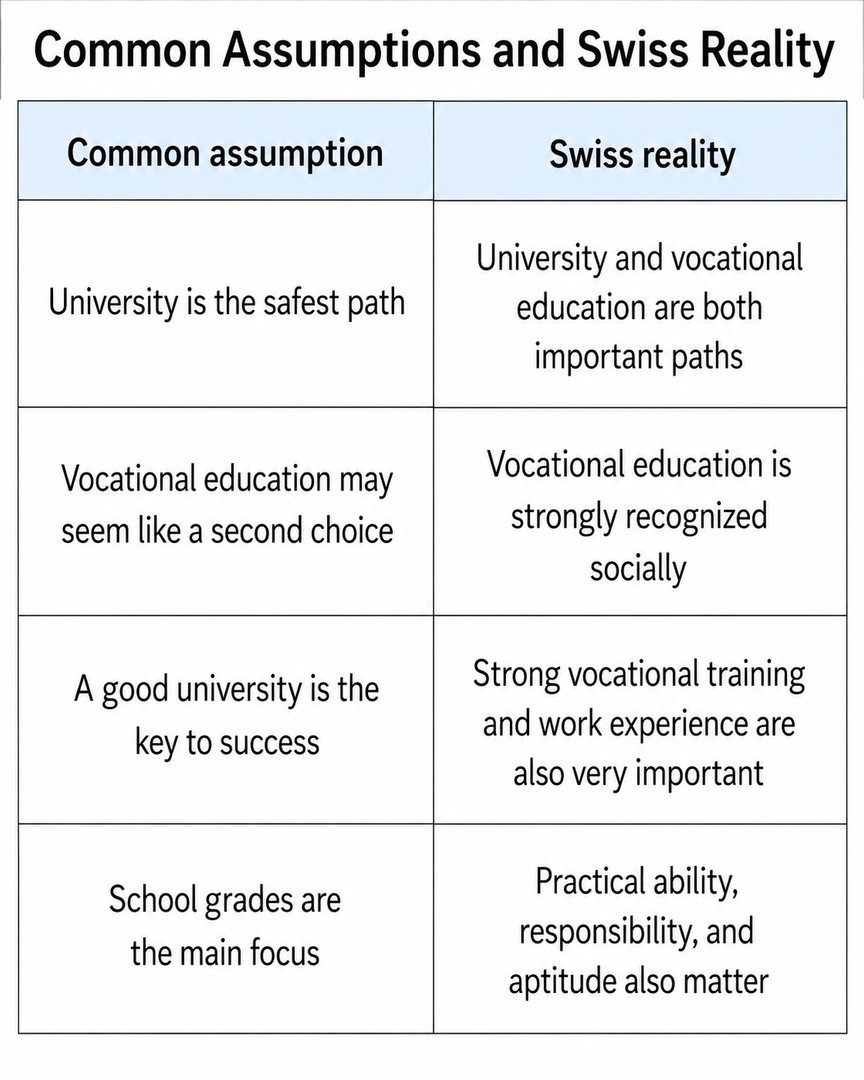
This is one of the strongest features of the Swiss system. It values academic ability, but it also values professional competence, reliability, and practical skill.
Swiss Universities
Switzerland has internationally respected universities, including ETH Zurich, EPFL, the University of Zurich, the University of Geneva, the University of Lausanne, and others.
Compared with universities in the United States or the United Kingdom, tuition at Swiss public universities can be relatively low. However, this does not mean that studying in Switzerland is cheap overall.
The biggest cost factor is often not tuition, but living expenses.
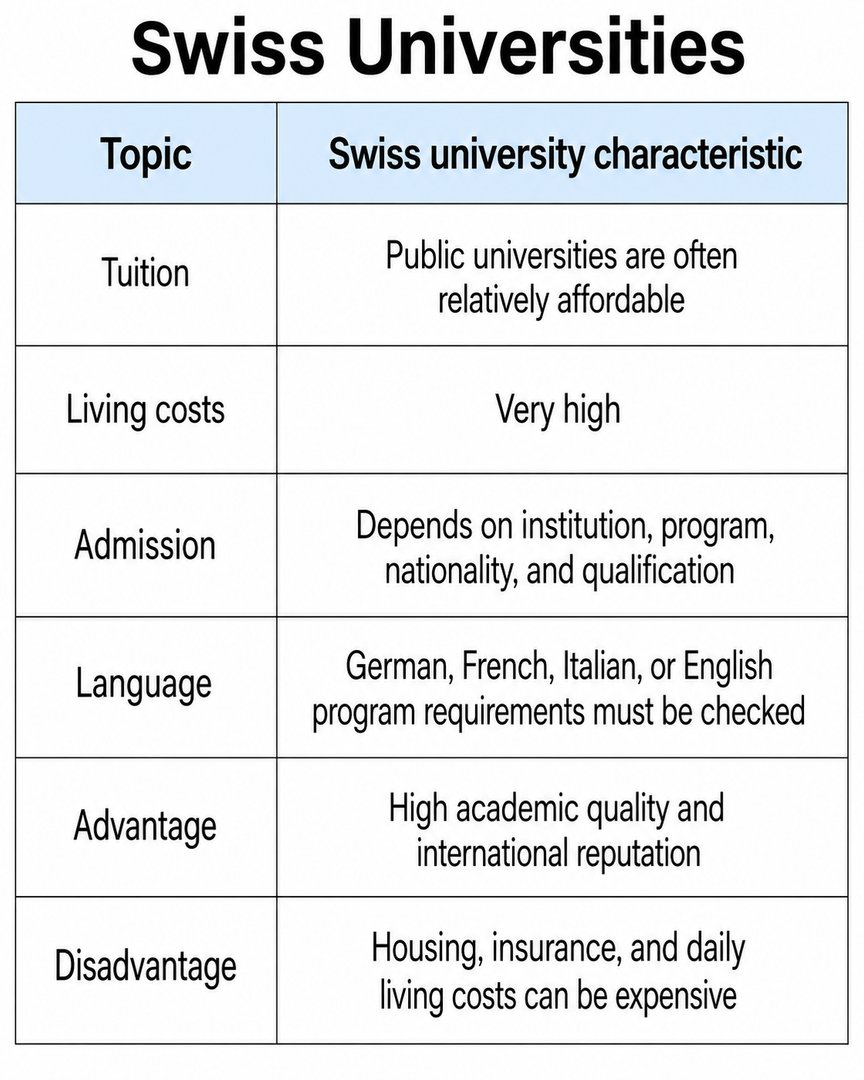
A more accurate explanation would be:
Swiss university tuition may be moderate, but the total cost of studying in Switzerland can still be high because of living costs.
For families planning long-term education, this distinction is very important.
Swiss Education Compared with More Exam-Oriented Systems
In many countries, education is strongly focused on exams, rankings, university entrance, and academic competition. Switzerland is different. It places strong emphasis on aptitude, practical ability, professional pathways, and connection to the labor market.
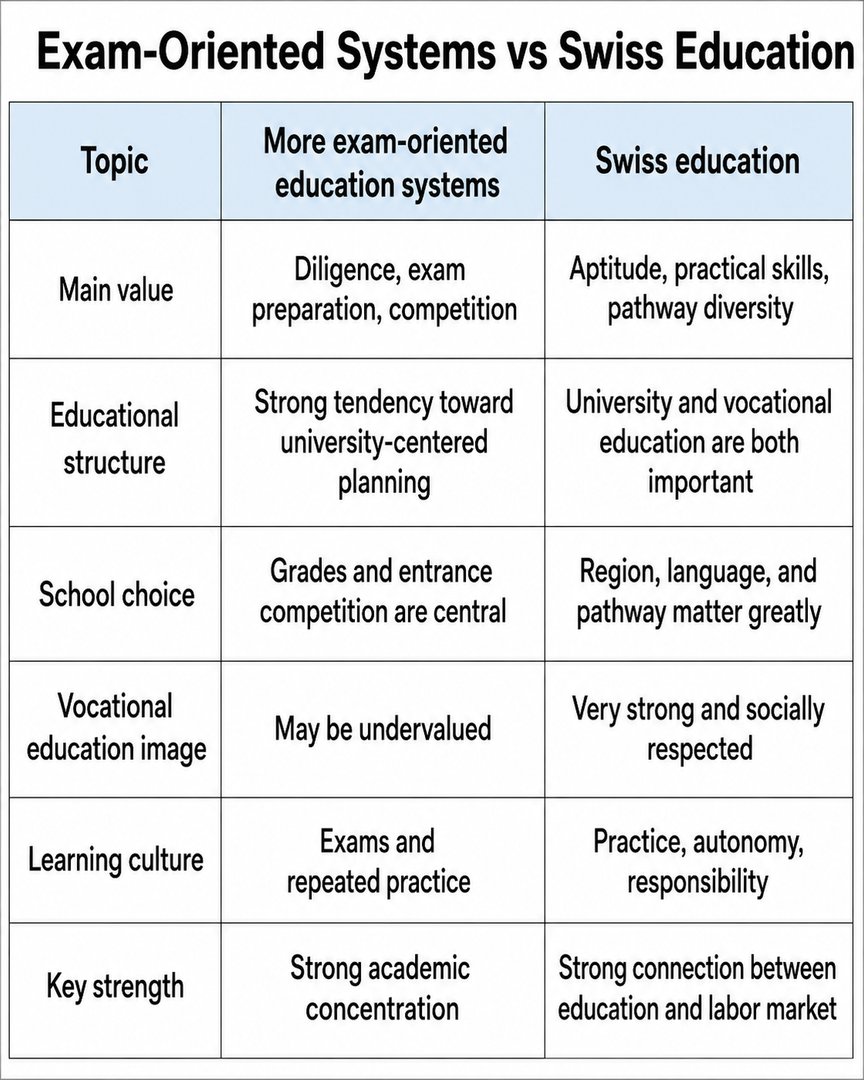
This does not mean that Swiss education is easy or less demanding. It means that the demands are different.
Students need to develop responsibility, independence, language ability, practical judgment, and social maturity.
Which Students Fit the Swiss System Well?
Switzerland can be an excellent educational environment, but it may not fit every child equally. The child’s language ability, adaptability, personality, and long-term goals matter greatly.
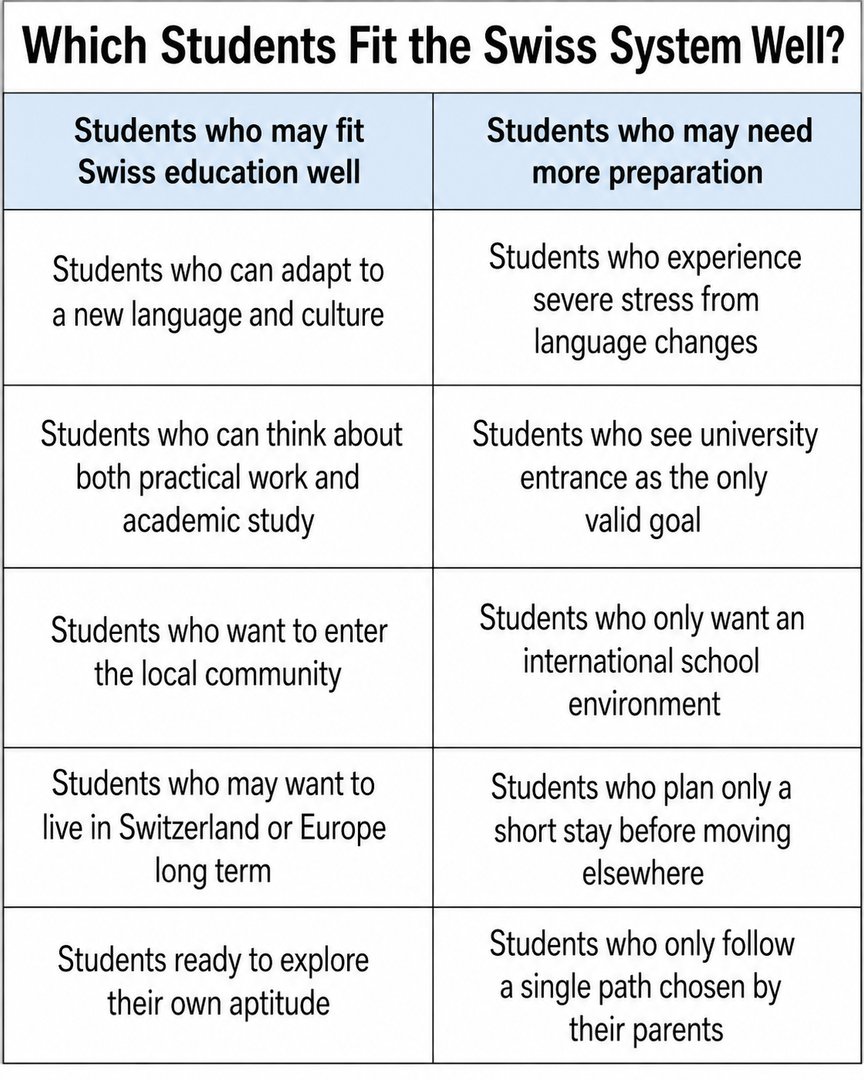
Swiss education can be especially strong for students who are open, adaptable, practical, and willing to explore multiple pathways.
Important Questions for International Families
Before moving to Switzerland or choosing a school, families should ask several key questions.
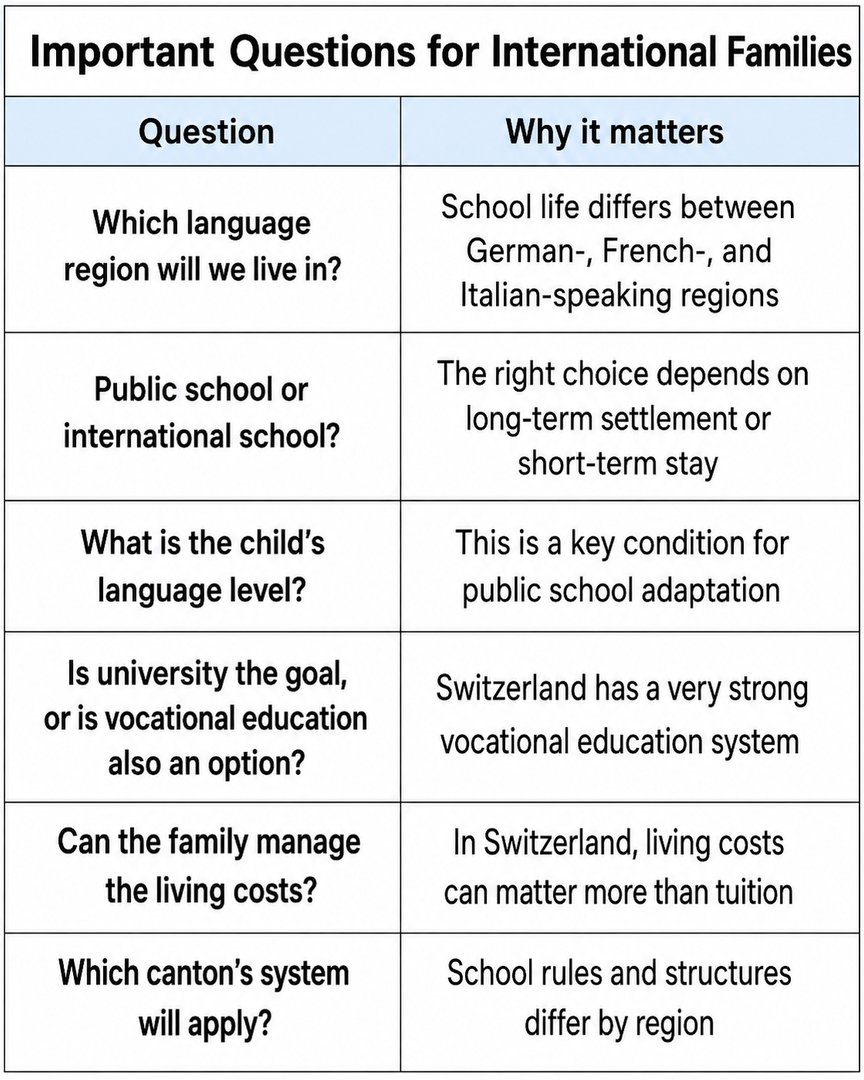
These questions should be answered before choosing a city or school. In Switzerland, school planning and residence planning are closely connected.
Conclusion: Switzerland Offers More Than Prestigious Schools
Switzerland is often associated with high quality, stability, safety, and international prestige. These are real advantages. But Swiss education should not be understood only as “high-quality education in an expensive country.”
Its real strengths are more specific:
It has strong public schools.
It respects vocational education.
It connects education with the labor market.
It offers multiple pathways.
It operates in several language regions.
It requires careful regional and linguistic planning.
For international families, Switzerland can be an excellent educational choice, especially if they understand that success does not always mean following one single academic route.
Swiss education does not force every child into the same path. It offers different routes according to ability, interest, language, region, and long-term goals.
Choosing education in Switzerland is not only about finding a good school. It is about choosing the right canton, the right language environment, the right pathway, and the right long-term plan for the child. If families understand these differences and prepare carefully, , Switzerland can be a highly attractive education destination for international families.
Free Consultation
Have questions about entering the German market? Request a free consultation.
Request Free Consultation