
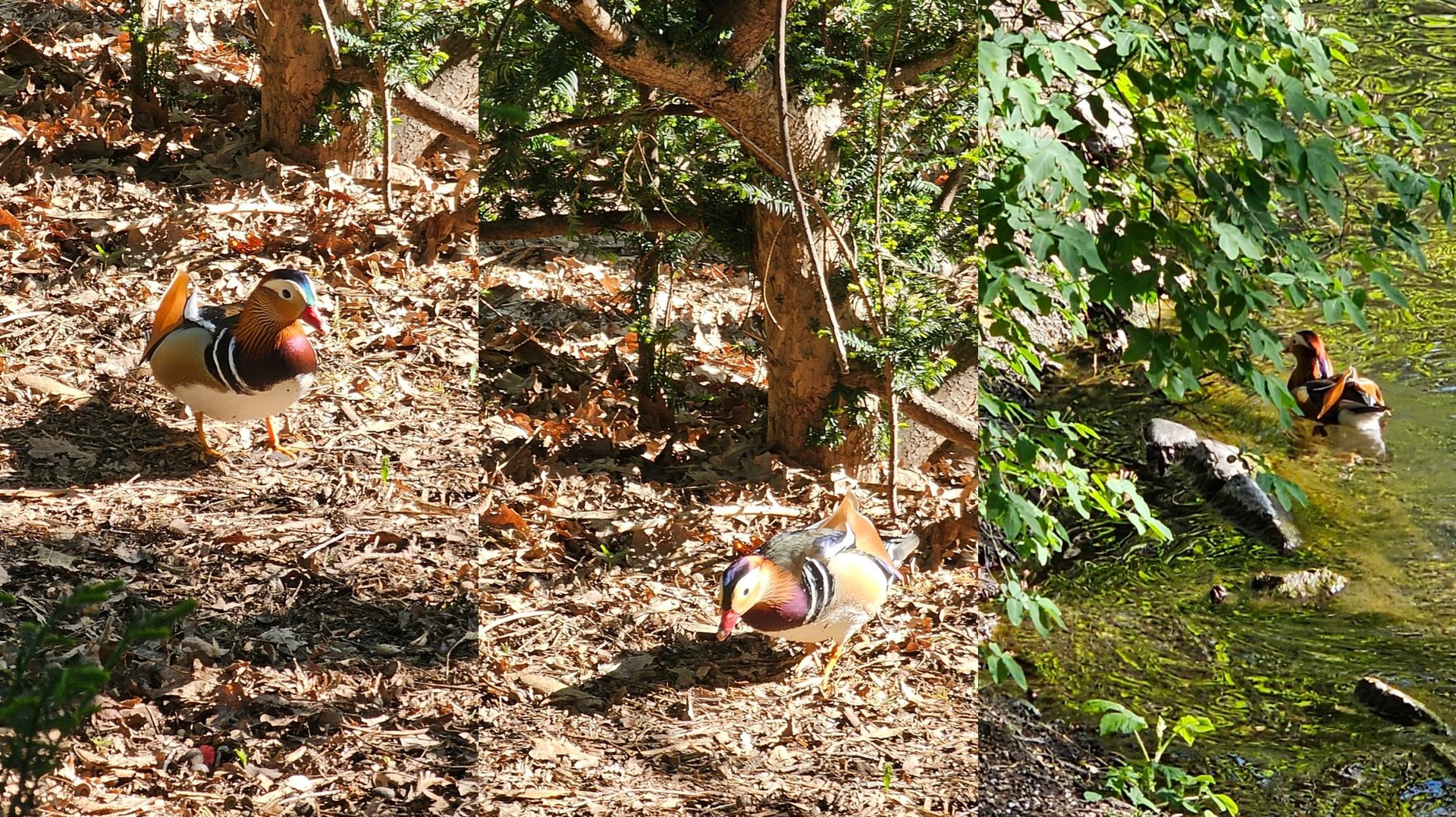
Berlin’s Quiet Answer to New York’s “Hot Duck”
On May 1st, Berlin’s spring already felt like summer.
The sky was clear, the trees of the Tiergarten were full of fresh green leaves, and people seemed to be drawn outdoors as if they had been waiting for this light for months. Parks, lakes and cafés were suddenly full of life.
That day, following the recommendation of a German friend who was visiting Berlin, I went together with that friend to Café am Neuen See, near the Spanish Embassy in the Tiergarten. The café is located by Neuer See, a small lake whose name simply means “New Lake.” Although it is called a café, international readers may understand it better as a kind of Berlin freestyle beer garden.
But it is quite different from the image many foreigners have when they think of a German beer garden. For many international visitors, “beer garden” immediately brings Munich to mind: large beer tents, festival crowds, big beer glasses, loud music and a strong sense of commercial celebration. That, of course, is also part of German culture. But this place in Berlin is softer, quieter and much more natural. It feels less like a staged tourist attraction and more like a relaxed Berlin living space where forest, lake and people blend naturally together.
Even though it lies in the middle of the city, the noise of Berlin suddenly feels far away. Old trees, paths along the water, sunlight on the lake and tables placed naturally under the shade create an atmosphere that feels almost rural. The beer garden does not push nature aside. It seems to have quietly entered into nature.
And there, I saw something unexpected.
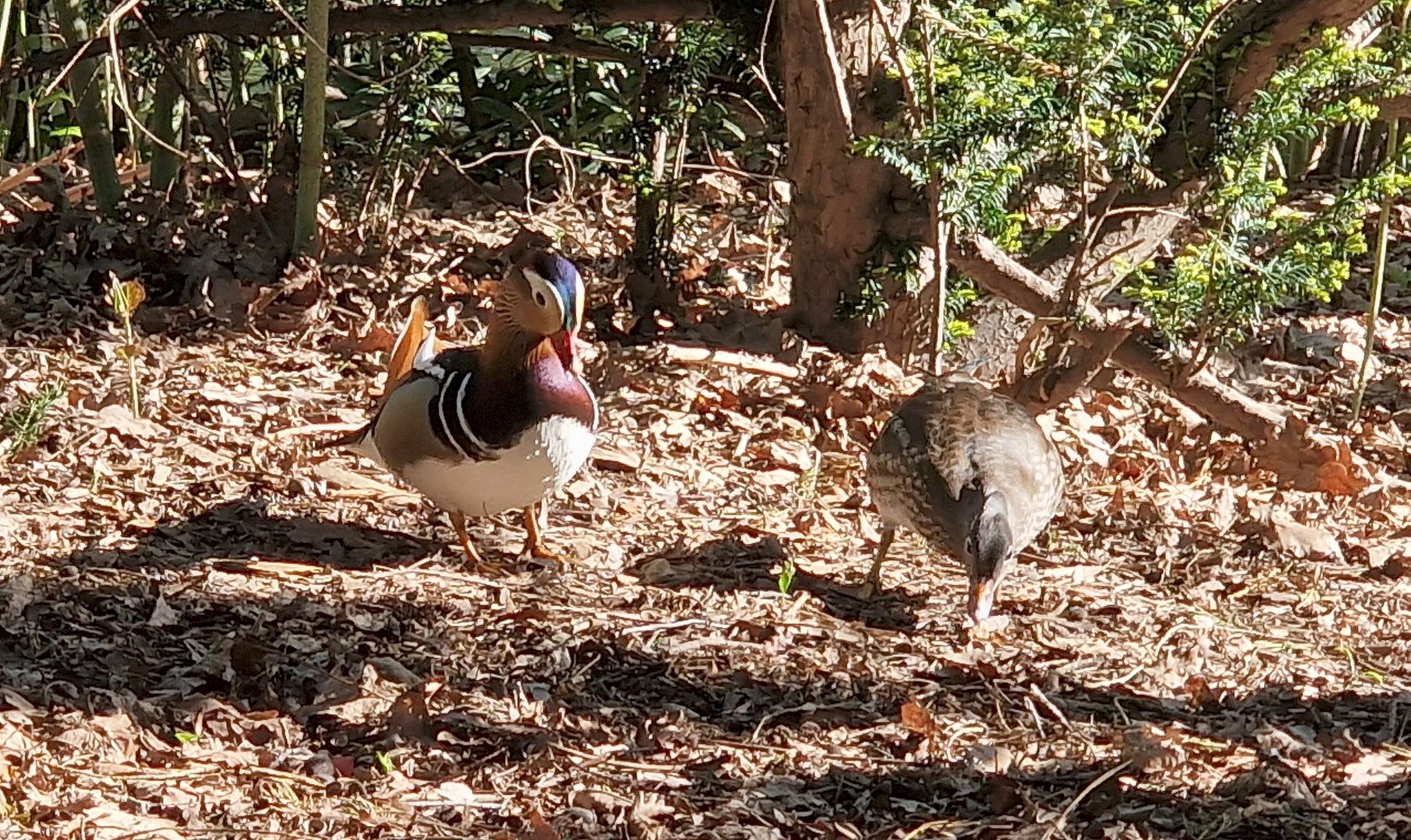
A Mandarin duck.
For many visitors, it may simply look like a beautiful and unusually colorful bird. But for people from East Asia, especially from Korea, Japan and China, the Mandarin duck carries a deeper meaning. In Korea, the bird is known as wonang and has long been associated with harmony, love, marriage and good fortune. Traditional Korean wedding objects often include Mandarin duck figures, symbolizing a wish for a peaceful and faithful life together.
So to see this bird not in Seoul, not in a Korean mountain valley, not in a Japanese garden or a Chinese painting, but at the edge of a small lake in Berlin’s Tiergarten, felt strangely moving.
The male Mandarin duck was impossible to overlook.
Its orange feathers, red beak, white markings and elegant patterns looked almost unreal. It seemed like a detail from an East Asian painting that had suddenly stepped into a Berlin spring afternoon. In the sunlight, this small bird felt both foreign and strangely familiar.
The Mandarin duck is originally native to East Asia. It has long been known in Korea, China and Japan, and in Korea in particular it has strong cultural symbolism. Yet in Europe, too, the bird is not completely unknown. Mandarin ducks were once kept as ornamental birds, and some escaped or were released into the wild. Over time, small populations settled in parks and lakes in several European cities. Berlin and the surrounding Potsdam region are among the places where they can still be seen.
Still, it seems that in Berlin this beautiful bird has never really become a public sensation.
A few years ago, when a Mandarin duck appeared in New York’s Central Park, the reaction was completely different. People came to see it, photographers followed it, the media wrote about it, and the bird became known as New York’s “Hot Duck.” In a city that loves spectacle, the duck became a small urban star.
Berlin, by contrast, lets it live quietly.
Perhaps that is very Berlin.
This city often contains remarkable things without turning them into events. A rare bird, a hidden courtyard, an unexpected concert, a small lake in the middle of the city — Berlin does not always announce its beauty loudly. Sometimes it simply leaves it there, waiting for those who notice.
But the Mandarin duck was only one part of the scene that day.
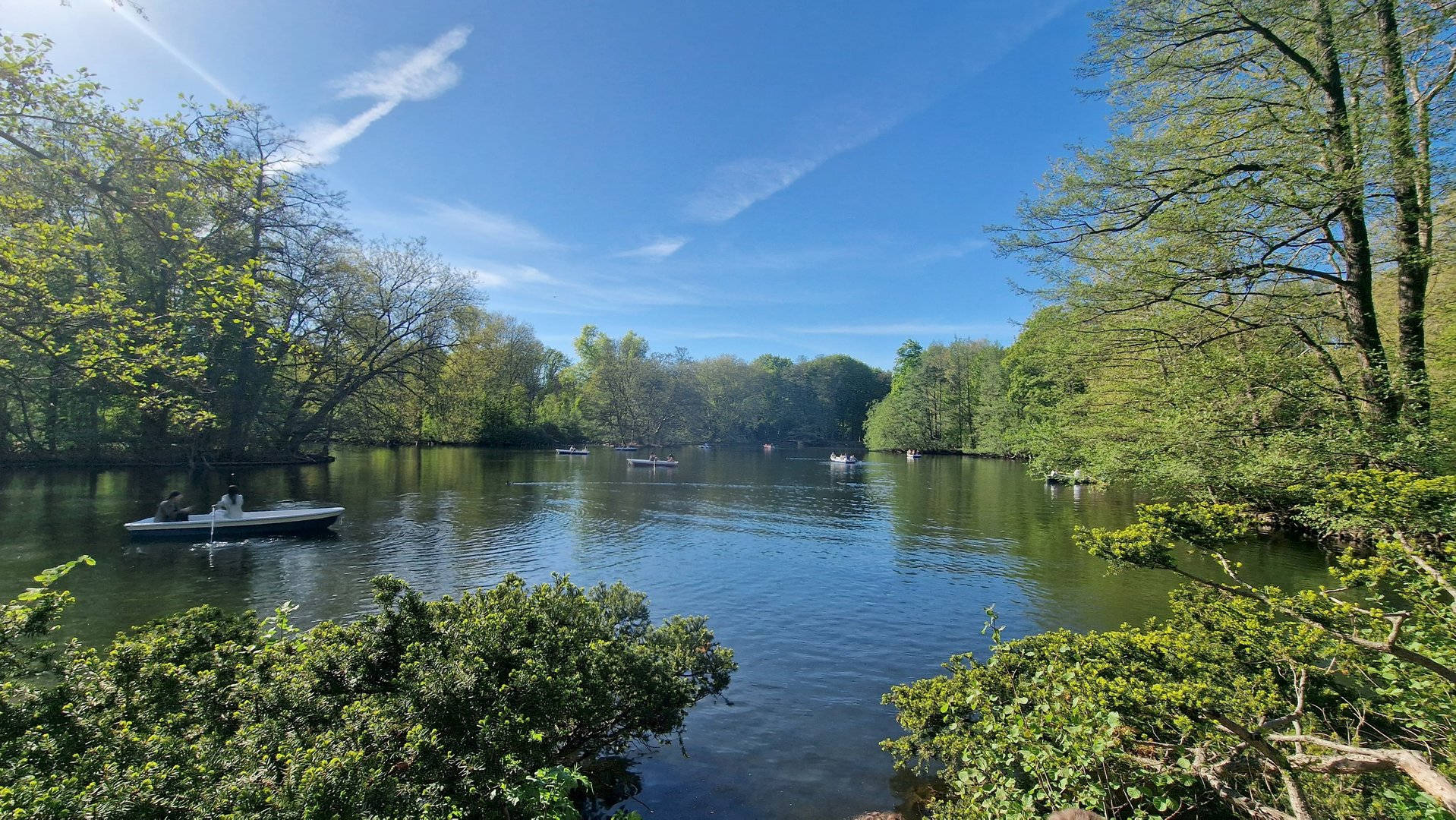
The atmosphere around Neuer See was just as memorable. At Café am Neuen See, the tables stood beneath old trees. People were drinking beer, coffee and soft drinks in the sunshine. The ground was not a polished tourist surface, but earth, leaves and shade. Although we were in the middle of Berlin, the place felt like a quiet lakeside retreat.
From the café, visitors can rent boats and go directly onto the water. Couples row slowly across the lake. Children laugh and lean over the sides of the boats. Families spend time together in the sunlight, while walkers sit a little farther away by the water and enjoy the afternoon in silence.
One scene stayed with me.
A father was sitting in a small boat with several children. He had a glass of beer in his hand, placed it carefully on the floor of the boat, and then took the oars again. The children sat close to him, full of life and light. The sun reflected on the water. The whole image looked almost like a painting.
If that painting had a title, I would call it:
“Complete Earthly Happiness in Berlin.”
A little farther from the beer garden, the noise became softer. People sat by the water, some reading, some talking quietly, others simply looking at the lake. Nearby, young women were dancing to Kurdish traditional music. Their movements were free and joyful. The people around them accepted the moment naturally.
No one stared in judgment.
No one interrupted.
They were simply there, living their freedom for a few minutes under the open sky.
And I thought: this is Berlin.
Berlin is not always beautiful in a polished way. It can be rough, unfinished, loud, cold and chaotic. But it has a rare quality: it allows many different lives to exist side by side. A family in a rowing boat, young women dancing to Kurdish music, walkers resting by the water, people drinking beer under trees, and an East Asian Mandarin duck standing quietly at the lake’s edge.
All of them belonged to the same scene.
For Korean visitors, the Mandarin duck adds a special layer of meaning to this place. It is not only a rare or exotic bird. It becomes a small bridge between cultures: between Korea and Berlin, between wedding symbolism and everyday city life, between East Asian tradition and European spring.
Many Berliners may pass by and simply think, “What a beautiful duck.”
But for someone who knows its meaning, the bird says something more.
It says that happiness does not always have to be far away.
That good fortune sometimes appears quietly.
And that a free city is a place where even the unfamiliar can find its own way to belong.
Neuer See in the Tiergarten.
Near the Spanish Embassy.
Café am Neuen See under the trees.
Sunlight, water, boats, children’s laughter, shade, Kurdish music — and one Mandarin duck.
That day, I saw a symbol from Korea in the middle of Berlin.
And at the same time, I saw something essential about Berlin itself.
Freedom. Nature. Family.
And the ability to live together with what is unfamiliar.
For anyone living in Berlin or visiting the city, Neuer See is worth a walk on a sunny day. There is no need to imagine every German beer garden as a Munich-style beer festival. Berlin has its own version: quieter, greener, more improvised, more integrated into everyday life.
And perhaps, with a little luck, you may meet a Mandarin duck by the water.
In that moment, you may feel that Berlin sometimes shows its quiet happiness through the smallest things —
even through one colorful bird standing calmly at the edge of a lake.
Aec-Berlin
Free Consultation
Have questions about entering the German market? Request a free consultation.
Request Free Consultation