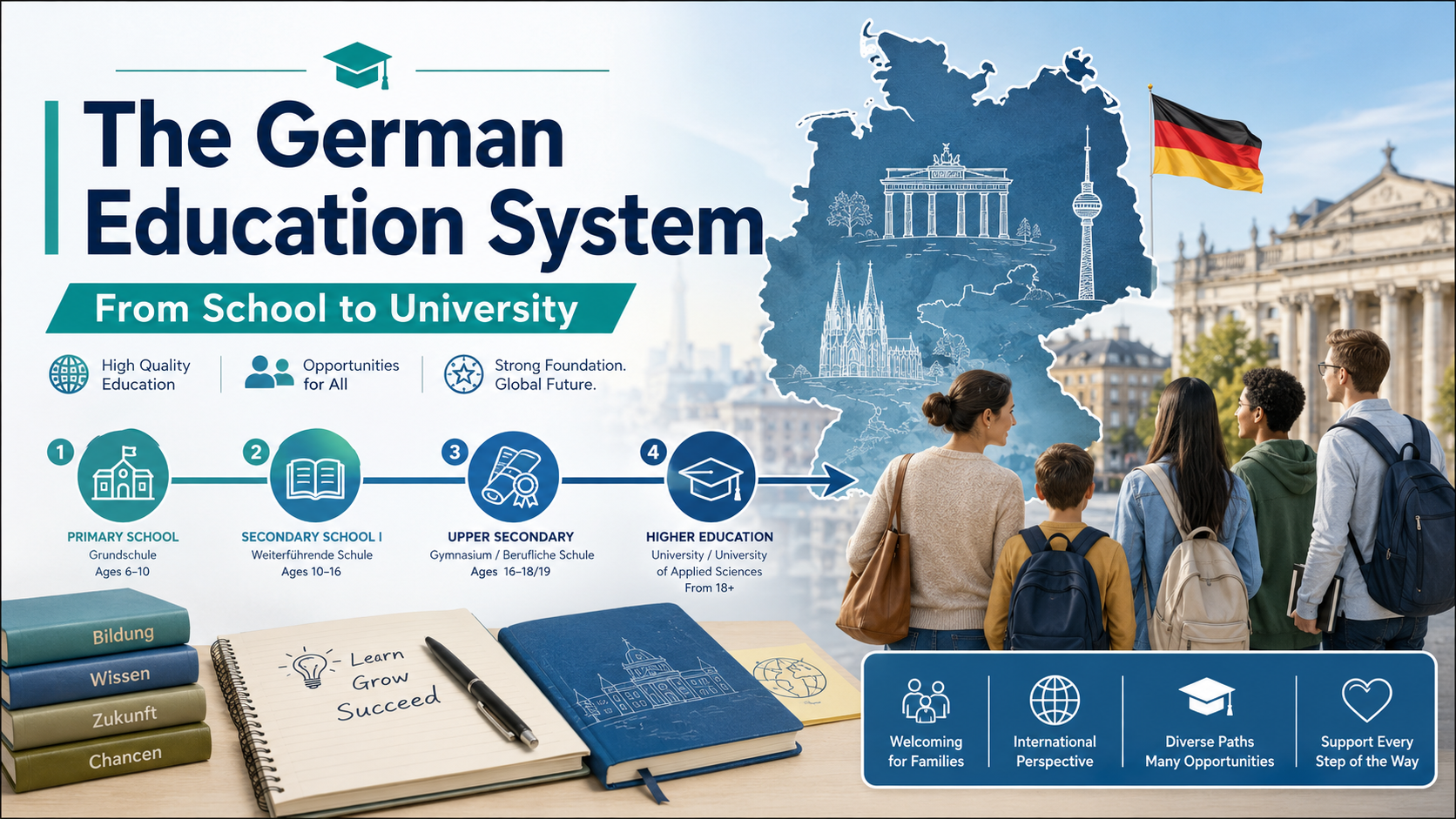
For many international families, Germany is attractive because education is often much more affordable than in countries such as the United States, the United Kingdom, or many parts of Asia. Public schools are generally free, and public universities usually charge only modest semester fees instead of high tuition.
But Germany should not be understood simply as a “low-cost education country.”
The German education system is different in its structure, culture, and expectations.
It gives students more freedom — but also expects more independence.
1. The Basic Structure of German Education
The German education system is not completely uniform across the country. Education is mainly regulated by the individual federal states, called Bundesländer. This means that Berlin, Bavaria, Hesse, Hamburg, and other states may have different school structures.
Still, the basic path is similar across Germany.
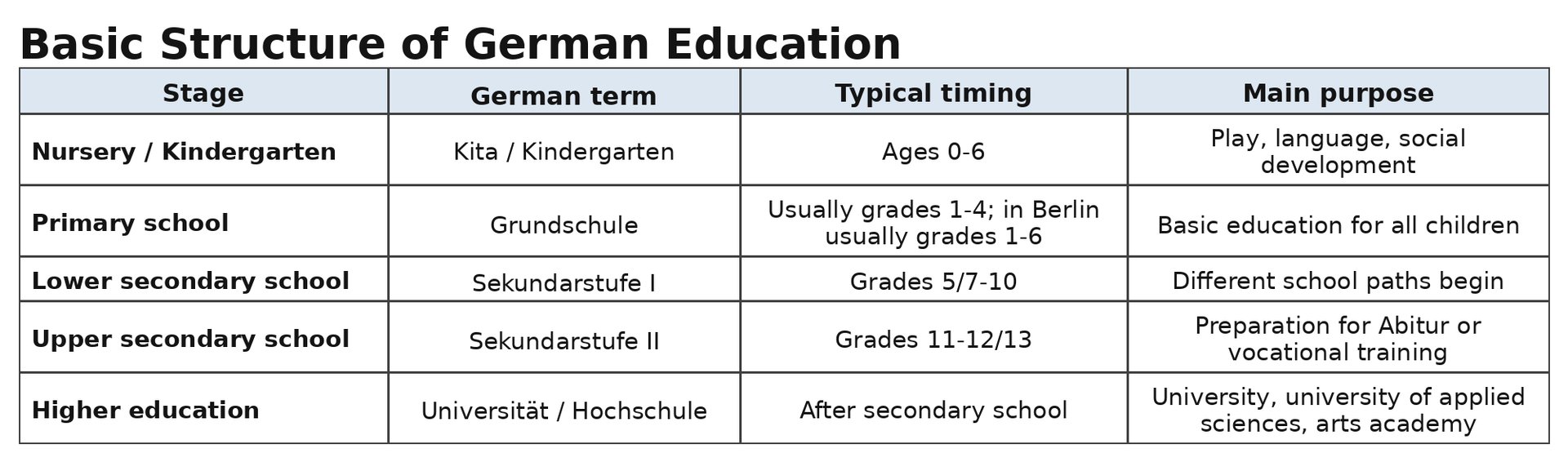
The most important point for international families is this:
Germany does not have only one educational path. There are several routes toward university, vocational training, or professional careers.
2. Germany Offers More Than One Path
In some countries, the education system is strongly focused on one clear route: good school, good exam results, good university. Germany is more flexible, but also more complicated.
Students may follow an academic route, a vocational route, or a mixed route such as dual study, which combines university study with practical company training.
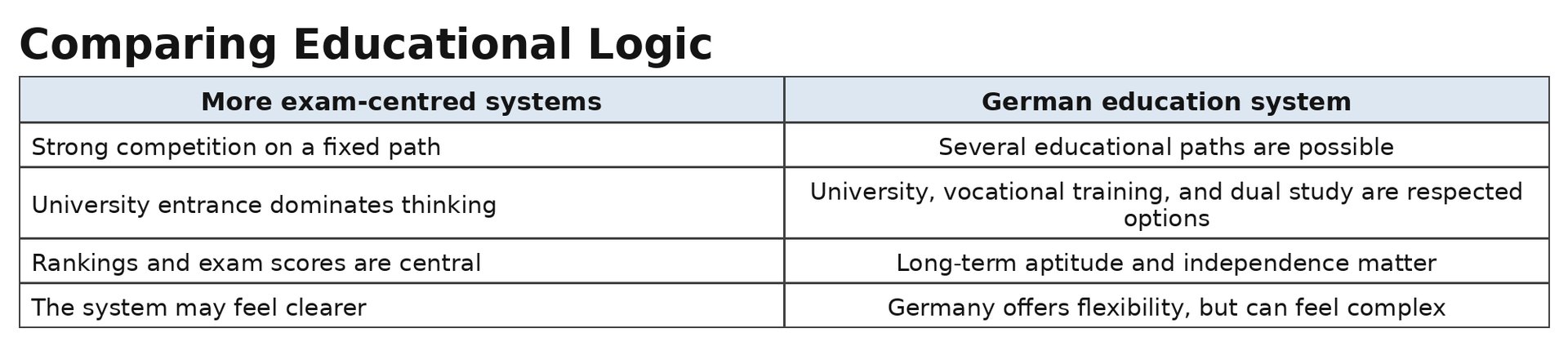
This flexibility is one of Germany’s strengths.
A child does not necessarily lose all future opportunities because of one early decision.
3. Main School Types in Germany
After primary school, children move into different types of secondary schools. The exact names and structures vary by federal state, but the following school types are especially important.
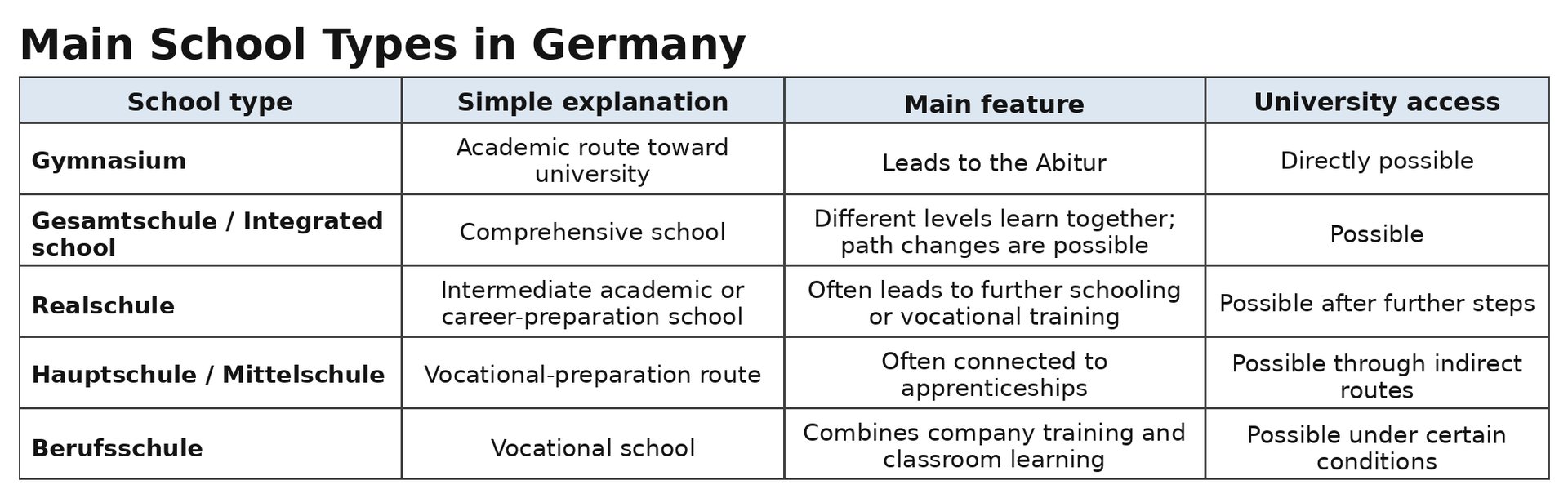
The Abitur is the most important school qualification for university entrance in Germany.
However, it is not the only way to build a successful career.
4. Differences Between Federal States
Because education is regulated by the federal states, families should always check the local system before choosing a city.
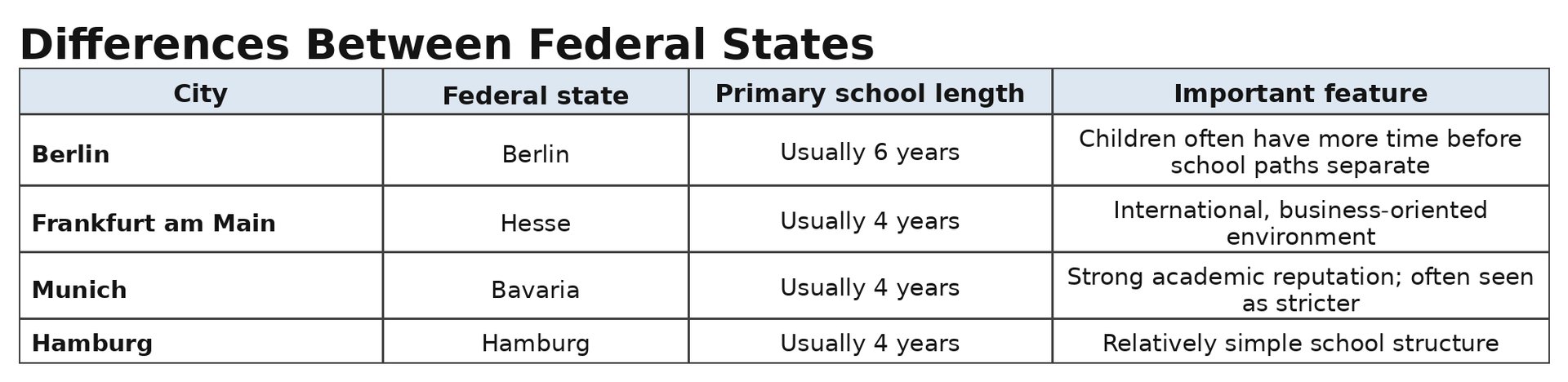
Berlin can be attractive for international families because children usually stay in primary school until grade 6. This gives foreign children more time to adapt linguistically and socially.
Munich and Bavaria are often seen as academically strong, but the system may feel more selective and demanding, especially for children who are still learning German.
5. What Makes German Education Different?
German education often feels less controlled than education systems in many other countries. There may be fewer daily tests, less direct supervision, and more room for individual development.
But this does not mean that German education is easy.
German schools and universities expect students to become independent learners. They must ask questions, express opinions, manage their own time, and take responsibility for their progress.
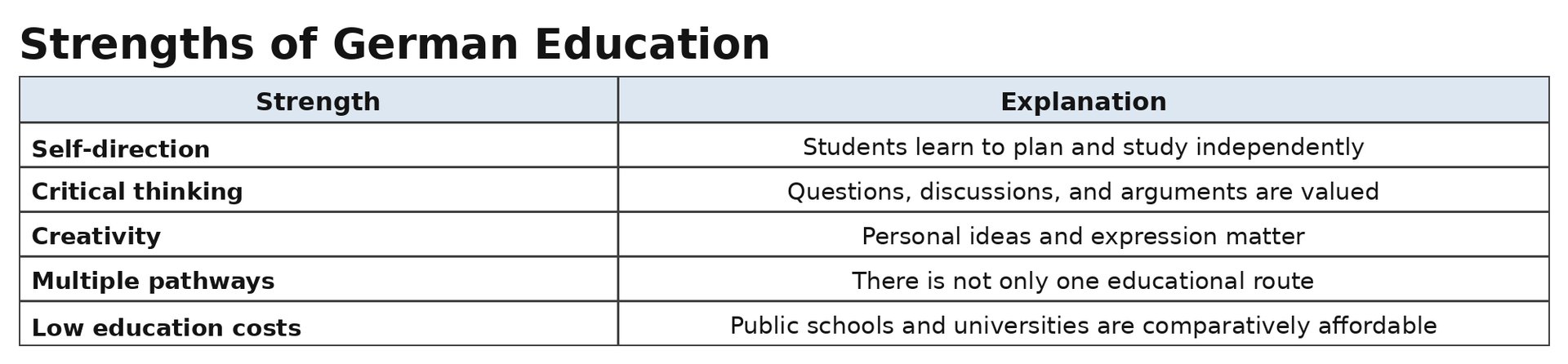
The German system is therefore especially suitable for students who can handle freedom well.
6. The Challenges of German Education
The same freedom can also become a problem.
Students who are used to very structured learning environments may find the German system confusing.
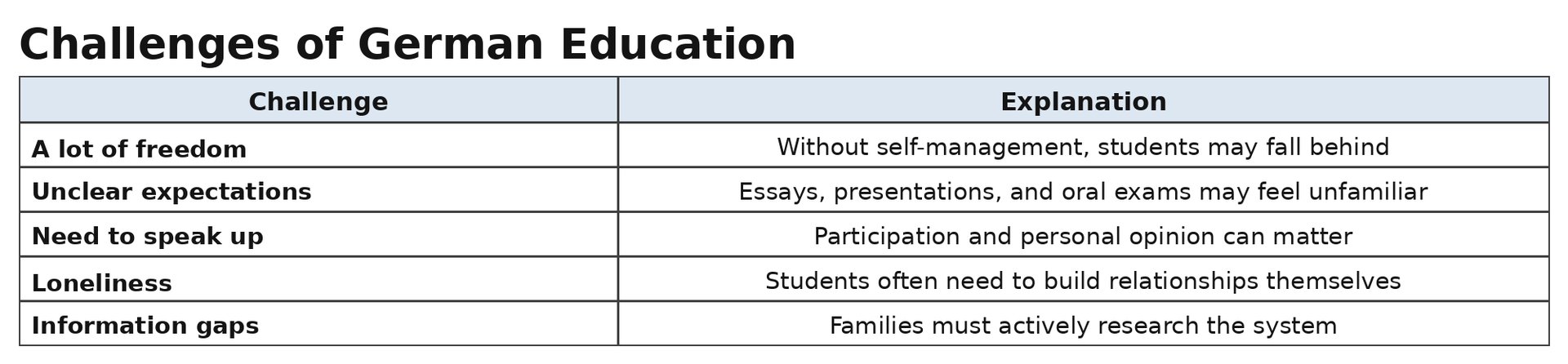
For international students, the biggest challenge is often not academic ability.
It is the combination of language, loneliness, self-organization, and uncertainty.
7. German Universities: Affordable, Flexible, but Not Easy
Germany’s public universities are financially attractive. In many cases, students do not pay high tuition fees. Instead, they usually pay a semester contribution, which is much lower than tuition in many other countries.
But university life in Germany can be demanding in a different way.
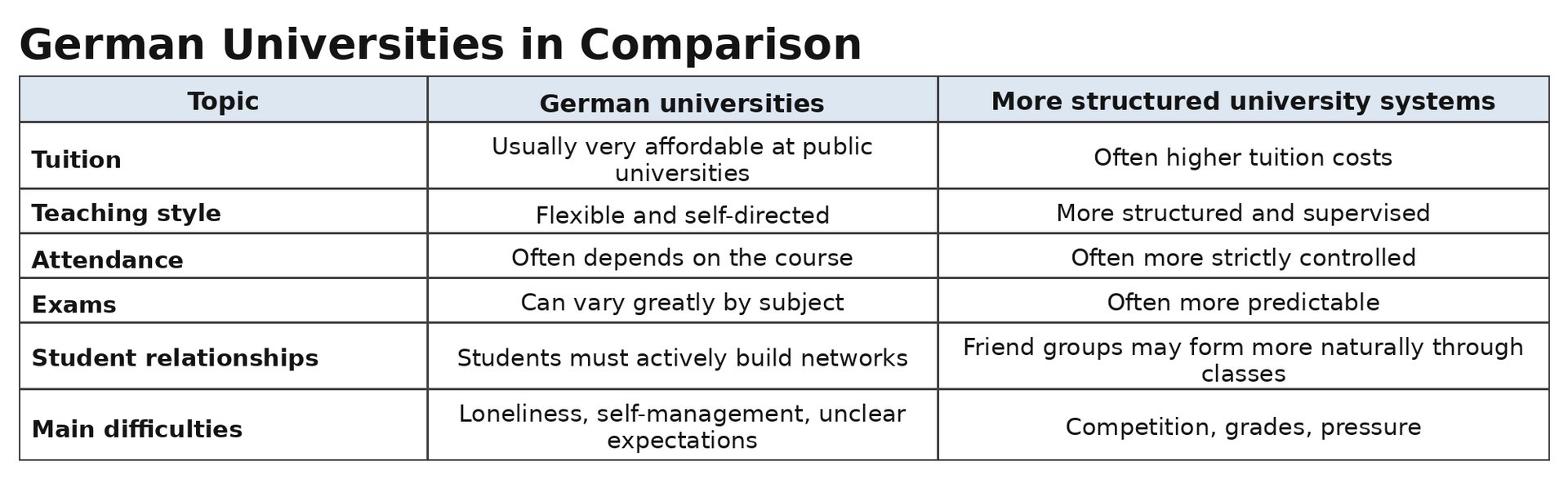
At German universities, nobody may check every week whether a student is keeping up. A student may attend lectures freely, organize their own schedule, and prepare independently for exams.
This is attractive for mature and independent students.
But for others, it can become overwhelming.
8. Social Adjustment Is Very Important
Many international students underestimate how lonely studying in Germany can be.
In some countries, university life is strongly organized around departments, class groups, clubs, or year groups. In Germany, student life can be more individual. Students choose courses independently, commute from different places, work part-time, and may already have their own social circles.
German students are not necessarily unfriendly. But they may not automatically approach international students or take responsibility for integrating them.
That means international students often need to act first.
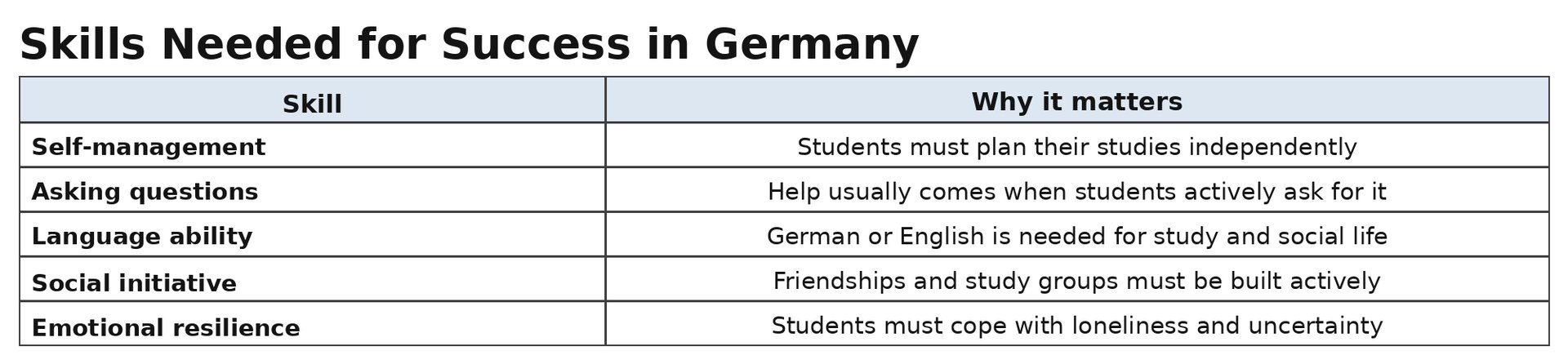
This point is extremely important for families.
Success in Germany is not only about grades. It is also about emotional stability, communication, and initiative.
9. Which Students Fit the German System Well?
Germany can be an excellent choice — but not for every student in the same way.
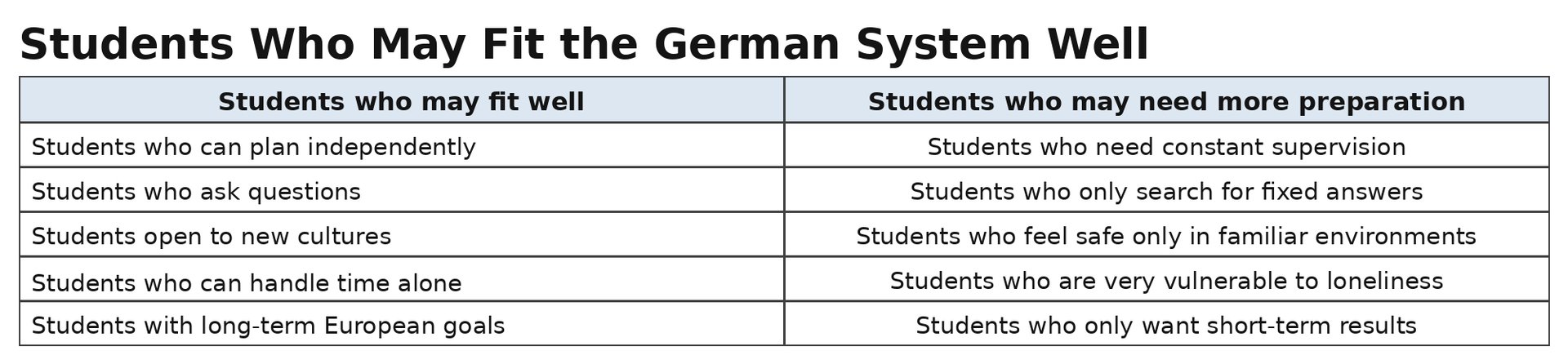
The German system rewards independence.
Students who wait passively for guidance may struggle.
10. Conclusion: Germany Is Affordable, but Not Simple
Germany offers many advantages for international families: low public education costs, respected universities, multiple educational pathways, and strong long-term career opportunities.
But the German system is not simply an easier or cheaper version of other systems. It is culturally different.
It gives students freedom, but expects responsibility.
It offers many paths, but requires families to understand them.
It values independence, but this can also create loneliness.
A good summary would be:
German education is not just low-cost education. It is education built around freedom, responsibility, and self-direction.
For international families, Germany can be an excellent opportunity — especially if students are prepared not only academically, but also socially and emotionally.
Free Consultation
Have questions about entering the German market? Request a free consultation.
Request Free Consultation